Annuity exchange technology is the software a broker-dealer or insurer uses to review a recommended annuity exchange before it goes through: gathering the application packet, setting the old contract beside the new one, checking the customer's earlier exchanges, watching each representative's exchange rate, and documenting the principal's decision. The test of any such tool is the rule it serves. For a deferred variable annuity, FINRA Rule 2330 gives a registered principal no more than seven business days after a complete application reaches the supervising office to decide, and requires that decision to be "documented and signed". For fixed and indexed annuities, state replacement and best-interest rules put a similar review on the insurer. The work is hard because the facts sit in two contracts, a statement and several forms, and because examiners keep finding comparisons that leave out what the customer gives up. Botminds' Annuity & Life Replacement Analysis divides that review: six agents read, price and draft; the principal decides and signs.
The worked examples come from a fictional sample carrier, Larkspur Life & Annuity, running its replacement files through the solution. Rules and findings are quoted from FINRA, the SEC and the NAIC and linked where they appear.
Exchange review, task by task: what the rule asks, and who does it
| Task | What the rule asks | Source | Agent or person |
|---|---|---|---|
| Gather the packet and start the clock | Representative sends a “complete and correct application package” to the supervising office; principal decides within seven business days of receiving it | FINRA 2330(b)(3), (c) | Packet reader checks completeness and starts the clock; a person accepts the package |
| Read both contracts | Consider surrender charges, a new surrender period, lost death or living benefits, higher fees | FINRA 2330(b)(1)(B)(i); NAIC #275 | Contract reader extracts each term, cited to its page |
| Weigh the benefit of the switch | Whether the customer “would benefit from product enhancements and improvements” | FINRA 2330(b)(1)(B)(ii) | Benefit pricer prices gains and losses; the principal judges |
| Check earlier exchanges | Another deferred variable annuity exchange “within the preceding 36 months”; 60 months under the NAIC best-interest model | FINRA 2330(b)(1)(B)(iii), .05; NAIC #275 §6 | Exchange history agent searches the register; the representative documents the customer inquiry |
| Notify the existing insurer | Within five business days of a completed application indicating replacement | NAIC #613 §5A(2) | Letter writer drafts; a person sends |
| Approve or reject | Approve “only if” there is a reasonable basis to believe the transaction suitable; documented and signed | FINRA 2330(c); Reg BI care obligation | Principal only |
| Watch exchange rates | Surveillance of representatives whose exchange rates raise review; corrective measures | FINRA 2330(d) | Exchange history agent flags; compliance decides |
What does a principal review under FINRA 2330?
The principal reviews whether the recommended purchase or exchange is suitable on the factors the rule lists, and may approve only on a reasonable basis. Rule 2330(c) says a registered principal "shall approve the recommended transaction only if he or she has determined that there is a reasonable basis to believe that the transaction would be suitable based on the factors delineated in paragraph (b) of this Rule." Those factors include whether the customer has been informed of the surrender period and charge, the tax penalty before age 59½, mortality and expense fees, rider charges and market risk, and, for an exchange, whether "the transaction as a whole also is suitable".
On an exchange, paragraph (b)(1)(B) adds three questions: whether the customer "would incur a surrender charge, be subject to the commencement of a new surrender period, lose existing benefits (such as death, living, or other contractual benefits), or be subject to increased fees or charges"; whether the customer would benefit from product enhancements; and whether there was another exchange in 36 months. The representative's determination must be "documented and signed by the associated person recommending the transaction", and the principal's by "the registered principal who reviewed and then approved or rejected the transaction."
For broker-dealers, the SEC's Regulation Best Interest sits on top. Its care obligation requires the firm to "Understand the potential risks, rewards, and costs associated with the recommendation" (17 CFR 240.15l-1). FINRA's 2026 oversight report is explicit that Rule 2330 still governs recommended purchases and exchanges of deferred variable annuities alongside Reg BI (FINRA, 2026 Annual Regulatory Oversight Report: Annuities).
How long does a principal have to approve a VA exchange?
Seven business days from the moment the supervising office has a complete and correct application package, and in any case before the application goes to the insurer. Rule 2330(c) puts it in that order: the registered principal reviews and decides before the firm transmits the application to the insurer for processing, and no later than seven business days after the office of supervisory jurisdiction receives a complete and correct application package. The clock does not start on an incomplete package, which is why packet completeness is the first thing technology should check.
The seven days apply to deferred variable annuities sold through FINRA members. A fixed or fixed indexed annuity is not covered by Rule 2330, and the insurer's own review window is set by state rules and its procedures. The sample carrier runs a seven-business-day review on its fixed indexed files too, but that is its own setting, not a FINRA deadline. Funds may move before approval only under conditions: the rule's supplementary material lets a member forward a check to the insurer if the insurer agrees in writing to hold the money in a segregated account and "not issue the variable annuity contract prior to the member's principal approval".
What is the 36-month rule for annuity exchanges?
It requires the representative to consider whether the customer "has had another deferred variable annuity exchange within the preceding 36 months." It is a factor, not a ban: a second exchange inside 36 months can still be suitable, but it must be weighed and the weighing documented. Supplementary Material .05 sets the evidence standard. The firm "must determine whether the customer has had such an exchange at the member and must make reasonable efforts to ascertain whether the customer has had an exchange at any other broker-dealer within the preceding 36 months", and an inquiry to the customer counts as a reasonable effort if both "the nature of the inquiry and the response from the customer" are written down.
Insurers reviewing annuity replacements under the NAIC best-interest model look further back: the 2020 revision of Model #275 asks whether the consumer has had another annuity exchange or replacement, in particular within the preceding 60 months (NAIC Model #275, §6). A tool that serves both reviews needs both windows. In the solution, the exchange history agent searches 60 months for annuities and 36 for deferred variable annuities, and on the sample file it found a December 2024 exchange, 22 months earlier, through the same producer.
Where a replacement file's hours go, by hand and with agents
Most of a manual review is reading and arithmetic, not judgment. Our estimate for one annuity replacement file is about 165 minutes by hand, close to three hours: 25 to sort the packet and check forms, 50 to read both contracts and the statement, 30 to price what is given up and gained, 30 for the exchange history and the buyer's profile, 15 to draft the notice and letters, and 15 for the principal's own review. With the agents doing the first five, the same file takes about 25 minutes, and the principal's 15 do not shrink.
With agents, the principal's own review becomes most of the file's time
By hand · ≈165 min
- Sort packet · 15%
- Read both contracts · 30%
- Price given up · 18%
- History and profile · 18%
- Draft letters · 10%
- Principal · 9%
With agents · ≈25 min
- Agents read, price, draft · 41%
- Principal reviews and signs · 59%
The arithmetic matters for staffing, but more for the window. A principal who signs 25 to 40 files a week from the producer's own summary, as the sample principal did before, has no time to read the 2001 contract behind each one. Seven business days is enough for a decision. It is not enough to build a comparison from scratch on every file in the queue.
What FINRA examiners and enforcement found in 2026
The findings are about missing comparisons, missing data and missing surveillance. The 2026 oversight report lists exchanges that "resulted in, among other consequences" higher fees, "the imposition of surrender fees for early liquidation of the customer's existing product" and "the loss of material benefits". It names data failures as a finding of their own: firms that did not collect and keep data on annuity transactions, above all on replacements and exchanges. And it lists paperwork that understated what the customer gave up, surrender charges among them.
What weak exchange supervision cost in two 2026 FINRA cases
22
inappropriate exchanges one firm failed to detect, with no system that surveilled exchange rates
$129,939
in unnecessary surrender fees paid by 14 customers in that case
114
customers sold exchanges into living-benefit riders they were about to start drawing on
$8,719
average incremental cost of those exchanges per customer
The first case is a surveillance failure in its purest form. FINRA found the firm "had no report, alert, or other system or review that surveilled for its registered representatives' deferred variable annuity exchange rates", which is the duty in Rule 2330(d). The second is a comparison failure: the firm did not give principals enough guidance on whether customers "would benefit sufficiently from the rider's growth credit feature before commencing withdrawals to justify higher fees". An individual case from the April 2026 report makes the same point at the level of one representative, who "failed to conduct a reasonable comparative analysis of the customers' existing and prospective living benefit riders" for six senior customers (FINRA disciplinary actions, April 2026). What bad replacements have cost under state law sets these beside New York's insurance cases.
Can annuity exchange review be automated?
The preparation can; the determination cannot. Rule 2330 lets documents be "created, stored, and transmitted in electronic or paper form", and FINRA's own list of effective practices includes automated tools, exception reports and surveillance for exchange review, some built around the cumulative surrender charges a representative's customers pay or around exchanges made late in a surrender schedule. The NAIC best-interest model likewise allows an insurer's pre-issue review to use a screening system, electronically or by physical review. None of these moves the approval: the principal signs, and an insurer stays responsible for corrective action even when it contracts out the work.
FINRA's effective practices also describe the line technology should help a principal hold. Firms check that each written rationale fits the customer it is written for rather than a template, and require principals "to verify the information in these rationales that registered representatives provide, including product fees, costs, rider benefits and existing product values." Verification is where agents earn their keep: a contract reader that cites the old contract's page for every value lets the principal check the representative's numbers instead of retyping them.
Four seats on an exchange review, and what moves to agents
Today
Signs 25–40 replacement files a week from the representative’s or producer’s summary.
With agents
Opens each file on a priced comparison with every term cited to its page, and the reasons drafted for and against.
Still theirs: The approval or rejection and the signed determination.
Today
Chases missing forms and statements before the clock can start.
With agents
Receives a sorted packet with forms checked and the clock started; sends the existing-insurer notice on day 1.
Still theirs: Sending notices and fixing incomplete packets with the producer.
Today
Finds a representative’s exchange pattern at year end.
With agents
Gets a referral while files are open, with each producer’s 12-month replacement share and the value priced as given up.
Still theirs: The investigation and any corrective measure.
Today
Fills in an exchange disclosure form by hand.
With agents
Gets a return letter with the priced comparison and exactly what would be needed to proceed.
Still theirs: The recommendation and its written rationale.
What is an exchange disclosure form, and what should it show?
It is the document that gives the customer a side-by-side view of the existing and proposed contracts before the exchange. No federal rule prescribes one form, but FINRA lists its use as an effective practice: "Using exchange disclosure forms to provide the customer with meaningful information about the advantages and disadvantages of the recommended exchange", including "a comparison of the fees ... and surrender periods of the existing and new products" and "disclosure of the loss of any benefits with the existing product (including a benefit base that exceeds the contract value)."
That last phrase is where most forms fall short. A guaranteed lifetime withdrawal benefit's base can sit well above the account value after a market fall, and a form that lists only account values shows the customer nothing lost. The same applies to fixed annuities: an old contract's guaranteed minimum rate is a bullet point on most forms and a dollar figure on none. How to price a guaranteed rate the customer gives up works through one such contract.
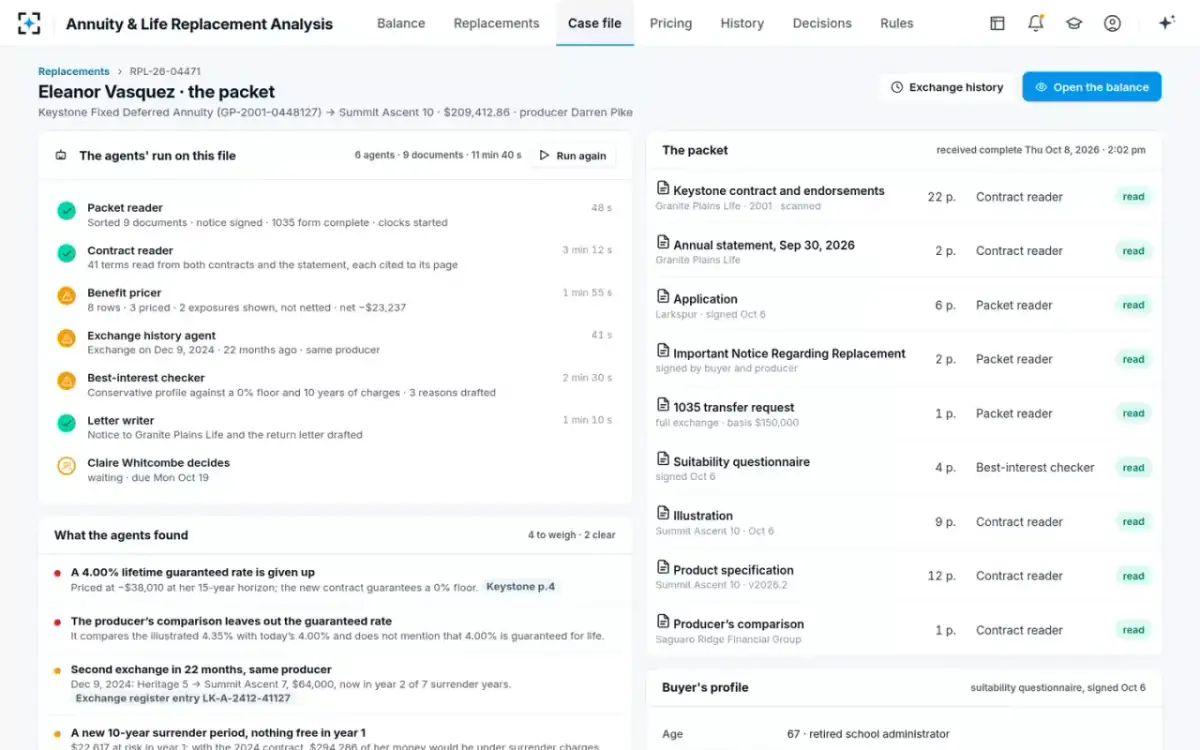
One file, six agents, and the findings the principal reads first
How to choose annuity exchange technology: the questions to ask
Ask how it handles the cases that cause findings, not the clean ones. A demonstration on a matching variable-to-variable exchange proves little; the hard files are a 2001 fixed annuity with a lifetime guaranteed rate, a living-benefit rider whose base exceeds the contract value, and a customer whose earlier exchange went through another firm.
Questions for any annuity exchange review tool
- Does it read the old contract, or only the new product’s data feed?
Given-up guarantees live in old contracts and endorsements, often scanned. A tool that only knows the proposed product cannot price what is lost.
- Can every value on the comparison be traced to a page?
FINRA expects principals to verify fees, rider benefits and existing values. A value without a source cannot be verified.
- Does it net illustrated values with guaranteed ones?
It should not. An illustration is a projection; a guarantee is a promise. Netting them is how a loss looks like a gain.
- Which look-back windows does it run, and on which data?
36 months for deferred variable annuities, 60 under the NAIC best-interest model, plus the customer inquiry Rule 2330 requires for other firms.
- Does it surveil representatives’ exchange rates and act on them?
Rule 2330(d) requires surveillance and corrective measures; a 2026 case found a firm with neither.
- Who signs, and can the tool send anything by itself?
Approvals, returns and notices should carry a named person’s signature. Agents should draft, not send.
- Can you replay last month’s files after a rule change?
A threshold or method change should be tested on decided files before it goes live.
Where Annuity & Life Replacement Analysis fits, and where it does not
The solution sits between the complete packet and the principal's signature. Its packet reader sorts the documents and starts the clocks; the contract reader extracts every guarantee, surrender term, death benefit and fee from both contracts and the statement, each cited to its page; the benefit pricer prices each row by a named method and nets only guaranteed values; the exchange history agent runs the look-backs and the producer's 12-month pattern; the best-interest checker drafts reasons for and against against the buyer's profile; and the letter writer drafts the notice to the existing insurer, the return letter and the decision file. None of the agents approves, declines or contacts the buyer or the producer.
The principal decides: three drafted reasons, one signature
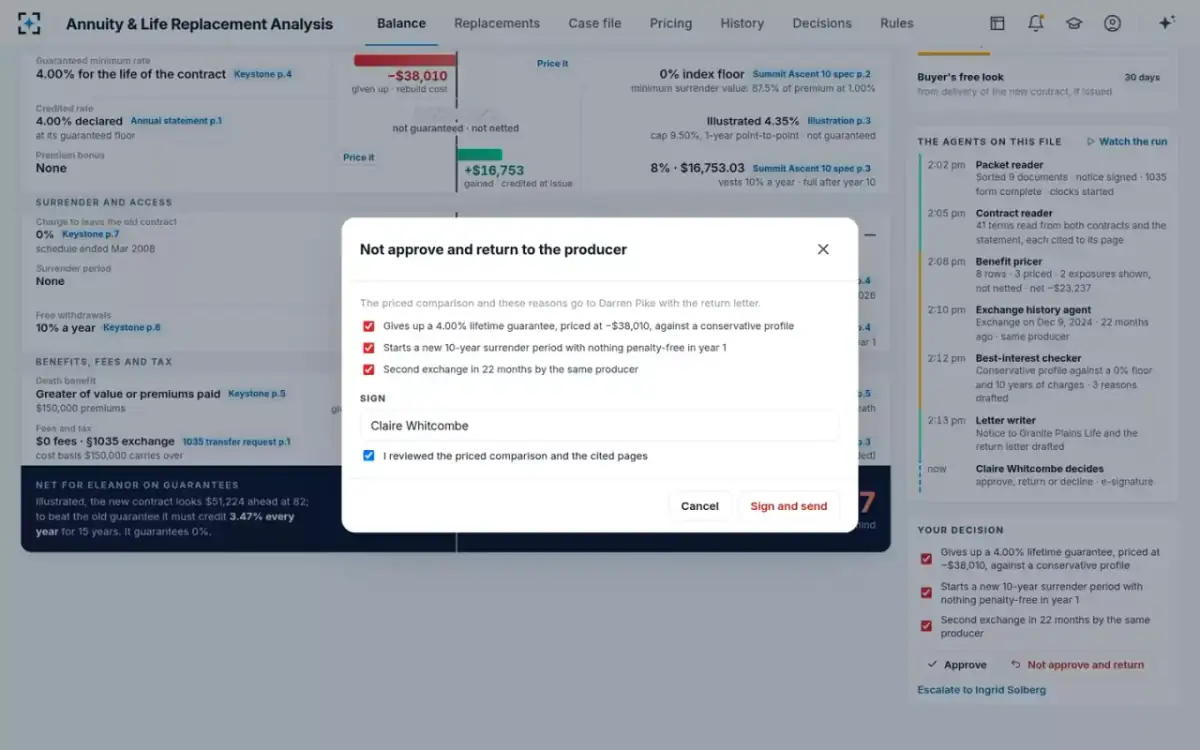
It is not an order-entry platform or a data feed, and it does not replace a firm's existing surveillance reports; it reads the documents those systems do not. It works on what a carrier or firm already has: contracts and statements, the proposed product's specification and illustration, the replacement and transfer forms, the suitability questionnaire and an exchange register. Rule sets, thresholds and approvers are settings, each versioned with an owner. Its two headline numbers are design targets, not measured results: 12 minutes from a complete packet to a priced comparison, and every benefit given up priced in dollars before the decision. Testing a comparison tool on files you have already signed is the fastest honest way to check both. To see the full review on one file, start from Annuity & Life Replacement Analysis.
Questions people ask
How do firms review variable annuity exchanges?
The representative documents and signs the suitability determination, sends a complete application package to an office of supervisory jurisdiction, and a registered principal reviews it within seven business days, approving only on a reasonable basis. Firms must also have written procedures and surveillance for representatives whose exchange rates raise questions, under Rule 2330(d).
Does FINRA Rule 2330 apply to fixed indexed annuities?
No. Rule 2330 covers deferred variable annuities. Fixed and fixed indexed annuities that are not securities fall under state insurance rules, including replacement rules based on NAIC Model #613 and best-interest rules based on Model #275. FINRA does list applying Rule 2330's heightened procedures to registered index-linked annuities as an effective practice.
Who can be the registered principal for a variable annuity exchange?
Rule 2330 defines the registered principal as a person registered as a General Securities Sales Supervisor (Series 9/10), a General Securities Principal (Series 24) or an Investment Company Products/Variable Contracts Principal (Series 26), as applicable.
How are 1035 exchanges processed?
The owner signs the new application, the replacement notice and a transfer request, and the existing insurer sends the old contract's value directly to the new insurer. The direct transfer keeps the exchange tax-free under section 1035; a check paid to the owner and endorsed over does not. The 1035 exchange form, field by field covers the details.
What data does an exchange review need?
FINRA lists data points to consider in its 2026 report, including "whether the customer has had another exchange within the preceding 36 months" and the "living benefit value, death benefit value or both, that was forfeited". It also lists engaging with carriers and third-party providers to confirm data integrity as an effective practice.