New York Reg 60, formally Insurance Regulation 60 at 11 NYCRR Part 51, governs every internal and external replacement of a life insurance policy or annuity contract delivered in New York. It is the state's own rule, not an adoption of the NAIC's replacement model, and it differs in ways that change a carrier's procedures: it defines replacement more broadly, including loans and premium stoppages; it requires a "Definition of Replacement" questionnaire on every application; it requires a signed Disclosure Statement that compares the new and existing contracts on guaranteed and non-guaranteed values; it gives the existing insurer 20 days to supply its figures; and it gives the owner 60 days to return the new contract, with the old one reinstated. The NAIC's own state page lists New York separately, under "Regulation 60". Botminds' Annuity & Life Replacement Analysis runs New York business under its own versioned rule set, so a New York file is checked against New York's forms and clocks rather than the model's.
The rule text is quoted from 11 NYCRR Part 51 as amended effective 21 April 2015, from the Department of Financial Services' prescribed forms and its guidance, and linked where it appears. Screens come from a fictional sample carrier, Larkspur Life & Annuity.
NAIC Model #613 and New York's Regulation 60, side by side
NAIC Model #613 (most states): Lapse, surrender, assignment, conversion to reduced paid-up or extended term, reduced benefits, reissue with less cash value, financed purchase.
New York Regulation 60 (11 NYCRR 51): The same, plus assigning as collateral or borrowing or withdrawing any loan value, using dividends or paid-up additions, and stopping or reducing premiums.
NAIC Model #613 (most states): Exempt when bought with proceeds of an existing annuity.
New York Regulation 60 (11 NYCRR 51): Not exempt; deferred-to-immediate replacements drew industry-wide enforcement.
NAIC Model #613 (most states): Signed statement on existing coverage; notice read aloud and signed if yes.
New York Regulation 60 (11 NYCRR 51): Signed “Definition of Replacement” on every application; the Important Notice, acknowledged, if a replacement is likely.
NAIC Model #613 (most states): Owner may request an in force illustration or policy summary from the existing insurer.
New York Regulation 60 (11 NYCRR 51): Agent signs a Disclosure Statement comparing both contracts, guaranteed and non-guaranteed, delivered no later than the new contract.
NAIC Model #613 (most states): Letter to the owner; information within 5 business days of the owner’s request.
New York Regulation 60 (11 NYCRR 51): Disclosure information within 20 days of a licensee’s request; non-responders reported to the superintendent each year.
NAIC Model #613 (most states): Notifies the existing insurer within 5 business days of a completed application.
New York Regulation 60 (11 NYCRR 51): Sends the completed Disclosure Statement and a list of sales material to the existing insurer within 10 days of delivery.
NAIC Model #613 (most states): 30 days from delivery; refund of premiums and fees.
New York Regulation 60 (11 NYCRR 51): 60 days from delivery; refund within 10 days; old contract reinstated without underwriting.
What is New York Regulation 60?
It is the Department of Financial Services' regulation on "the internal and external replacement of life insurance policies and annuity contracts". Its stated purposes include "making available full and clear information on which an applicant for life insurance or annuities can make a decision in his or her own best interest" and "reducing the opportunity for misrepresentation and incomplete comparison in replacement situations (commonly referred to as twisting)" (11 NYCRR 51.1). It binds insurers, agents, brokers "and other licensees of the department".
The NAIC's state page for its replacement model lists New York's citation as "N.Y. COMP. CODES R. & REGS. tit. 11, §§ 51.1 to 51.8; Apps. 10A, 10B, 10C and 11 (Regulation 60)", with history from 1998 to 2015 (NAIC state page for Model #613). The four appendices are the forms, and they carry most of the regulation's weight: the regulation itself requires them "in at least 12-point type" and allows substitutes only if the superintendent finds them "substantially equivalent" (11 NYCRR 51.8).
What is a replacement in New York?
More than in most states. A replacement occurs when new life insurance or annuities are bought for delivery in New York and "it is known to the department licensee that, as part of the transaction, existing life insurance policies or annuity contracts have been or are likely to be" lapsed or surrendered, converted to paid-up or extended term insurance, reduced in amount or duration, or reissued with cash values released. New York adds two cases the model does not spell out: existing coverage "assigned as collateral for a loan or made subject to borrowing or withdrawal of any portion of the loan value", including dividend accumulations or paid-up additions, and coverage "continued with a stoppage of premium payments or reduction in the amount of premium paid" (11 NYCRR 51.2).
The test is put to every applicant in writing. Appendix 11, the "Definition of Replacement", asks the six questions behind that definition, each with a yes or no, and ends: "IF YOU HAVE ANSWERED YES TO ANY OF THE ABOVE QUESTIONS, A REPLACEMENT AS DEFINED BY NEW YORK INSURANCE REGULATION 60 HAS OCCURRED OR IS LIKELY TO OCCUR". The agent or broker then signs a separate line: "TO THE BEST OF MY KNOWLEDGE, A REPLACEMENT IS INVOLVED IN THIS TRANSACTION" (NY DFS Appendix 11).
Exemptions are narrower too. Regulation 60 does not apply to a new contract from the same insurer or its holding company system issued under a contractual conversion privilege or an approved plan, to policy changes "customarily granted by the insurer" with "no additional surrender or expense charge or suicide or contestable restrictions" and approved by the superintendent, to certain group and employer-paid coverage, or to nonrenewable, nonconvertible term with five years or less to run (11 NYCRR 51.3).
The four Regulation 60 forms: what each does and who signs
| Form | What it is | Who signs | When |
|---|---|---|---|
| Appendix 11 · Definition of Replacement | Six yes/no questions that decide whether a replacement is occurring | Applicant and agent or broker; the agent also signs whether a replacement is involved | With or as part of every application |
| Appendix 10C · Important Notice Regarding Replacement or Change | The buyer’s notice: reasons replacement may be disadvantageous; 60-day return and reinstatement right | Applicant acknowledges receipt | Presented no later than when the applicant signs the application |
| Appendix 10A · Disclosure Statement | Life insurance (or mixed) comparison: premiums, surrender values, death benefits and dividends, guaranteed and non-guaranteed, now and at 5 and 10 years | Agent or broker; applicant acknowledgement at the insurer’s option | Submitted before delivery; delivered no later than the policy |
| Appendix 10B · Disclosure Statement (annuity to annuity) | Account value, surrender charge, MVA and surrender value; surrender values and death benefits at guaranteed and current rates, 5 and 10 years | Agent or broker; applicant acknowledgement at the insurer’s option | Submitted before delivery; delivered no later than the contract |
What is a Reg 60 disclosure statement, and who must sign it?
It is the comparison of the new and existing contracts that New York requires on every replacement, signed by the agent or broker. The regulation requires "an accurate and complete "Disclosure Statement" signed by the agent or broker in the appropriate form prescribed in Appendices 10A or 10B", which "shall specify the primary reasons for recommending the new life insurance policy or annuity contract and why the existing life insurance policy or annuity contract cannot meet the applicant's objectives" (11 NYCRR 51.5(c)(7)). The form adds a third question for the agent: "The advantages of continuing the existing annuity contract without changes are".
Its summary table is what sets New York apart. For life insurance, Appendix 10A compares annual premium, surrender value, death benefit and dividends, each "Guaranteed" and "Non-Guaranteed", now, five years hence and ten years hence, for the new coverage and for the existing coverage left unchanged. It also asks for each contract's guaranteed interest rate, loan interest rate and the expiry dates of the contestable and suicide periods. For annuity-to-annuity replacements, Appendix 10B shows surrender values and death benefits at guaranteed and current rates, with 0%, 6% and 12% hypothetical returns for variable contracts. The agent certifies: "I have personally completed this form and certify that it is correct to the best of my knowledge and ability." The applicant's acknowledgement "may be included or omitted at insurer's option".
One box on the form is easy to overlook and says a lot: the existing-coverage figures came from "the replaced company" or from "approximations if replaced company failed to provide information in the prescribed time". The regulation allows "good faith approximations" when the existing insurer misses its 20 days, and requires the replacing insurer to "review and may accept" them. Why the guaranteed column matters is worked through on a sample file.
New York replacement procedures: the insurer's duties and clocks
The replacing insurer's duties run from training to filing. Under 11 NYCRR 51.6 it must train its agents and the brokers who place business with it; require the Definition of Replacement and the agent's replacement statement with every application; collect the list of contracts replaced, the sales material and proof the applicant received the Important Notice; "examine the sales material, including any proposal ... and the "Disclosure Statement", and ascertain that they are accurate"; deliver the Disclosure Statement no later than the contract; and send a revised one if the contract is issued other than as applied for.
New York's replacement clocks, from the existing insurer's request to the end of the refund window
- Existing insurer answers20 days
- Right to return, from delivery60 days
- Refund10 days
- To existing insurer10 days
Several duties have no equivalent in the model. Within ten days of delivery the replacing insurer must furnish the existing insurer with "the completed "Disclosure Statement" and a list of the sales material", offering copies within ten days of a request. It must "submit annual electronic reports by February 1 of each year to the superintendent, indicating which insurers, if any, have failed to provide the information" required of them. Both insurers must date all material "upon receipt" and "designate a principal officer specifically responsible for the monitoring and enforcement of these procedures", notifying the superintendent of any change within 30 days. And the replacement must be treated "in all respects as if it were a new issuance", with no differences in underwriting, interest rate credits, compensation or "incentives such as bonuses or other inducements to agents or brokers", although lower compensation is allowed (11 NYCRR 51.6).
Does Reg 60 apply to annuities, including immediate annuities?
Yes, and New York has enforced it hardest there. The Department's 2016 circular letter on deferred-to-immediate replacements states that Regulation 60 "requires specific disclosures when a consumer is advised to lapse, surrender, replace or make any other change to an existing life insurance policy or annuity contract in conjunction with the purchase of a new life insurance policy or annuity contract." It explained the stakes: "Given the significantly more favorable minimum interest rates and annuity mortality rates on many previously issued contracts, consumers are receiving thousands of dollars less in lifetime retirement income by replacing such contracts." (NY DFS Insurance Circular Letter No. 7 (2016)).
The circular told insurers what a compliant file must show: the income options available under the existing deferred annuity and the proposed income annuity, and the monthly income under the selected option from both. It was direct about delivery: "An insurer should not deliver an annuity contract as a result of a replacement unless the appropriate income comparison information has been provided and the insurer has ascertained that it is accurate". An existing insurer that refuses to supply the information "would be undermining Regulation 60's intended purpose".
What New York's replacement rules have cost insurers that did not follow them
13
life insurers settled the deferred-to-immediate replacement inquiry by May 2022
$29M
about that much in restitution and penalties across those settlements
60
days for an owner to return a replacement and have the old contract reinstated
20
days for the existing insurer to supply disclosure information
The settlements' corrective actions mirror the circular: insurers agreed to revise their disclosure statements "to include side-by-side monthly income comparison information" and their disclosure, suitability and training procedures. The full run of New York's replacement cases sets their sums beside FINRA's.
The 60-day refund and the right to reinstate
New York's return period is twice the model's, and it reaches the old contract. The replacing insurer must refund premiums, or for variable and market value adjusted contracts the cash surrender benefits plus fees, within ten days of receiving the returned contract, and during the 60 days the existing insurer must put the old policy or contract back as of the replacement date, with no new underwriting and no new contestable or suicide period (the free look after a replacement), once it receives proof of cancellation, any funds it released and any premium due. The Important Notice warns owners that this is not a perfect undo: lost interest or investment performance and tax consequences can remain. How the free look works after a replacement elsewhere shows the gap New York closes.
Regulation 60 and Regulation 187: disclosure and best interest together
Regulation 60 governs disclosure in a replacement; New York's Regulation 187 governs whether the recommendation is in the consumer's best interest, and both apply to the same transaction. The amended Regulation 187 took effect for annuities on 1 August 2019 and for life insurance on 1 February 2020, and reaches in-force transactions as well as sales. After the Appellate Division struck the amendment down in 2021, the Court of Appeals reversed in October 2022 and reinstated it (NY Court of Appeals, 2022). In practice a New York replacement file needs both: the Regulation 60 forms, and the best-interest analysis and documentation Regulation 187 requires.
New York business gets its own rule set, beside the model's
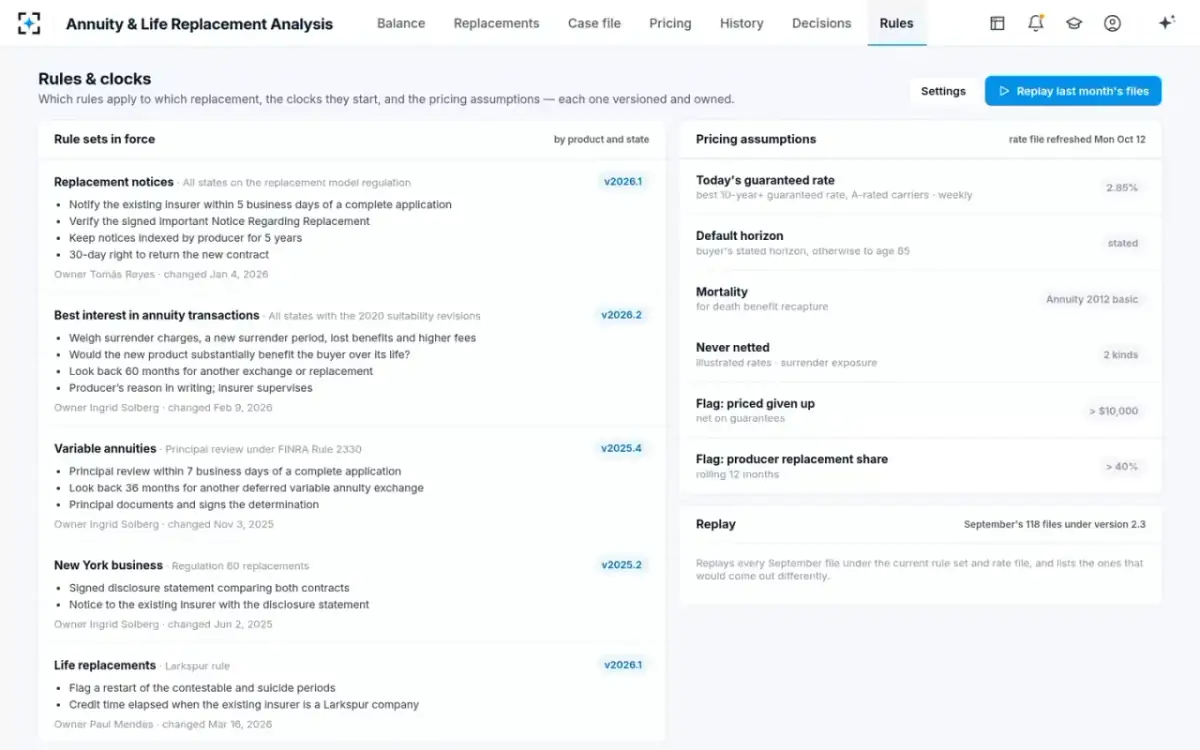
How Annuity & Life Replacement Analysis handles a New York file
A New York application is checked against New York's forms: the packet reader looks for the signed Definition of Replacement, the agent's replacement statement, the acknowledged Important Notice and the Disclosure Statement, and starts New York's clocks rather than the model's. The contract reader extracts the guaranteed and current values both Disclosure Statements ask for, cited to their pages, so the replacing insurer can "ascertain that they are accurate" against the contracts rather than the producer's figures. The letter writer drafts the documents the carrier sends; people sign and send them. The sample carrier's New York rule set is versioned and owned by its sales-practice compliance officer.
What the solution does not do is replace New York's judgment calls: whether a replacement is in the consumer's best interest under Regulation 187, whether an approximation is good faith, or whether a disclosure is adequate stay with the principal and compliance. Its job is to put the numbers the forms require in front of them, accurately and early. To see a New York file run through its own rule set, start from Annuity & Life Replacement Analysis; the model-state notice and its clocks covers business outside New York.
Questions people ask
Does Regulation 60 apply to internal replacements?
Yes. It covers "internal and external" replacements, so a new contract from the same insurer is a replacement unless an exemption in 11 NYCRR 51.3 applies, such as a contractual conversion privilege or a customary policy change with no new charges or contestable restrictions approved by the superintendent.
What happens if the existing insurer does not answer within 20 days?
The replacing agent or broker may use "good faith approximations based on the information available", which the replacing insurer must review and may accept, and the Disclosure Statement marks that approximations were used. The replacing insurer reports insurers that failed to provide information to the superintendent each year by 1 February.
Is the Reg 60 disclosure statement required for a term conversion?
Generally not, if the new policy comes from the same insurer or its holding company system under a contractual conversion privilege in the existing policy; 11 NYCRR 51.3(a) exempts it. A conversion to a different insurer, or one outside the policy's privilege, is a replacement.
Does Regulation 60 apply to group insurance?
Not usually. It exempts new coverage under group policies unless an agent, broker or insurer directly solicits the certificateholder and the certificateholder pays part of the premium, and it exempts individual coverage paid wholly by an employer or association.
How long must Regulation 60 documents be kept?
The insurer keeps the Definition of Replacement, the sales material, proof the Important Notice was received, the signed Disclosure Statement and the notification to the existing insurer, indexed by agent and broker, under New York's record retention regulation, Part 243 (Regulation 152), which 11 NYCRR 51.6 cites for each.
Does a New York replacement need a FINRA review as well?
If the contract is a deferred variable annuity sold through a broker-dealer, yes: FINRA Rule 2330's principal review within seven business days applies alongside Regulation 60 and Regulation 187.