Annuity bonus recapture is the contract term that lets an insurer take back all or part of a premium bonus if the owner surrenders, withdraws more than the free amount, or in some contracts dies, before the bonus has vested. For the carrier or broker-dealer reviewing a replacement, recapture is the difference between the bonus the illustration shows on day one and the money the buyer can actually keep in the years she may need it. That matters because the bonus is usually the selling point of a bonus exchange, and the rules a principal reviews against, NAIC Model #275 for insurers and FINRA Rule 2330 for deferred variable annuities, ask for the whole transaction to be weighed: the new surrender period, the benefits given up, the fees, and whether the buyer gains on balance. Botminds' Annuity & Life Replacement Analysis reads both contracts, prices the bonus by its vesting schedule and nets it only against guaranteed values, so the principal sees in dollars whether the bonus pays for what the exchange gives up.
The priced example on this page is one fictional sample file in the solution: a buyer of 67 at a sample carrier, offered a fixed indexed annuity with an 8% bonus in exchange for a 2001 contract guaranteeing 4.00% for life. Regulators' rules and statements are quoted and linked where they appear.
On guarantees, the bonus covers less than a third of what the exchange gives up
Sample file · $56,743 changing hands
- Bonus gained +$16,753 · 29.5%
- Guarantee and death benefit given up −$39,990 · 70.5%
The same bonus after year 5
- Vested $8,377 · 50%
- Unvested, recaptured on death $8,377 · 50%
What is annuity bonus recapture, and when does it apply?
Bonus recapture applies when a contract event happens before the bonus has vested, and the contract, not the regulator, names the events. The usual ones are a full surrender during the vesting period, a withdrawal above the penalty-free amount, and on some contracts death or annuitization within a set number of years. A bonus that vests 10% a year, as the sample's does, is 30% the owner's after three years and wholly the owner's after ten; until then, the unvested part sits in the account value on the statement but is not the owner's to take.
The bonus itself is a credit at issue, usually a percentage of the first premium or of premiums paid in the first contract year. The SEC's investor guidance describes variable annuity bonuses as adding "extra money to your contract value based on a specified percentage (typically ranging from 1% to 5%) of purchase payments", and notes that "A bonus may only apply to your initial purchase payment, or to purchase payments you make within the first year" (SEC, Investor.gov: Variable Annuities). Fixed and fixed indexed contracts carry bonuses too, often larger; the sample's 8% is one.
The NAIC's disclosure model treats the conditions as material. Its rules require that "Any conditions on the payment of bonuses shall be explained", and an illustration must show the amount available on surrender "after deduction of surrender charges, bonus forfeitures, contract loans" and any market value adjustment (NAIC Model #245). For a reviewer that settles the first question on any bonus file: the comparison the buyer saw should show the bonus net of what could be forfeited, year by year, and if it shows the full credit as a day-one gain, it is not showing what she could take out.
Why bonus exchanges get a regulator's second look
Regulators single out bonus exchanges because the cost of a bonus is recovered in places a buyer sees less clearly than the bonus itself. The SEC's Director of Investment Management put it to the industry in 2000: "bonus credits are often coupled with higher surrender charges, longer surrender charge periods, and higher asset-based charges -- all of which can make a bonus more apparent than real" (Paul F. Roye, SEC, 5 June 2000). The concern was sharpest for a 1035 exchange "where an investor at or near the end of a surrender charge period takes on a new surrender charge period as a result of the exchange."
The same speech said what the SEC expected of firms, and it still reads as a supervisory brief: "We expect that any firm engaged in the distribution of bonus products will pay particularly close attention to sales of these products, ensuring that adequate safeguards exist to prevent unsuitable sales, and flagging for compliance review any individual sales that appear to be unsuitable." It also asked whether a contract stays meaningfully redeemable if an investor leaving it pays a sales load "along with the recapture of the bonus".
The securities side had already written procedures down. NASD Notice to Members 99-35 suggested an exchange or replacement analysis document for every variable annuity replacement, and compliance systems "that can monitor and identify those registered representatives whose clients have a particularly high rate of variable annuity replacements or rollovers" (NASD Notice to Members 99-35). New York went further on the insurer's own incentives: a replacing insurer must treat the new contract as a new issue with no difference in "premium discount, interest rate credit, insurance agent or broker compensation or expenses, or incentives such as bonuses or other inducements to agents or brokers" (11 NYCRR 51.6(b)(9)). How the New York rule differs in its forms and clocks is set out in New York Reg 60.
What does a principal have to weigh on a bonus replacement?
A principal has to weigh the whole transaction, not the bonus: the surrender charge to leave, the new surrender period, the benefits lost, any increase in fees, whether the buyer gains on balance, and her exchange history. That list is nearly word for word the same in the insurance and securities rules. Model #275 tells the producer, and through the supervision system the insurer, to consider whether "The consumer will incur a surrender charge, be subject to the commencement of a new surrender period, lose existing benefits, such as death, living or other contractual benefits, or be subject to increased fees", whether "The replacing product would substantially benefit the consumer in comparison to the replaced product over the life of the product", and whether there was another exchange within the preceding 60 months (Model #275 §6.A(1)(j)).
FINRA Rule 2330 asks the same of a deferred variable annuity exchange, with a 36-month look-back and one telling difference in wording: whether "the customer would benefit from product enhancements and improvements" (FINRA Rule 2330(b)(1)(B)). A registered principal must decide within seven business days of a complete and correct application package, and document and sign the determination. A bonus is the most visible enhancement there is; the rule's question is whether it is a benefit once its conditions are counted.
The replacement rules, read for a bonus file: what each item asks the reviewer to show
| What the rule asks | Where it is written | What a bonus file must show |
|---|---|---|
| A surrender charge to leave the old contract | #275 §6.A(1)(j)(i); Rule 2330(b)(1)(B)(i) | The charge today, in dollars, from the old contract and statement |
| A new surrender period starting | #275 §6.A(1)(j)(i); Rule 2330(b)(1)(B)(i) | The new schedule year by year, beside the bonus vesting schedule |
| Benefits lost: death, living, other | #275 §6.A(1)(j)(i); Rule 2330(b)(1)(B)(i) | Each guarantee given up, priced, including a death benefit reduced by recapture |
| Increased fees or rider charges | #275 §6.A(1)(j)(i); Rule 2330(b)(1)(B)(i) | Fees and crediting terms of the bonus product against its no-bonus version, where one exists |
| A substantial benefit, or product enhancements | #275 §6.A(1)(j)(ii); Rule 2330(b)(1)(B)(ii) | The bonus counted as it vests, netted against guaranteed values, never against an illustration |
| Another exchange in the look-back | #275: 60 months; Rule 2330: 36 months | Every earlier exchange, with whose surrender period it started |
How to price a bonus that vests over ten years
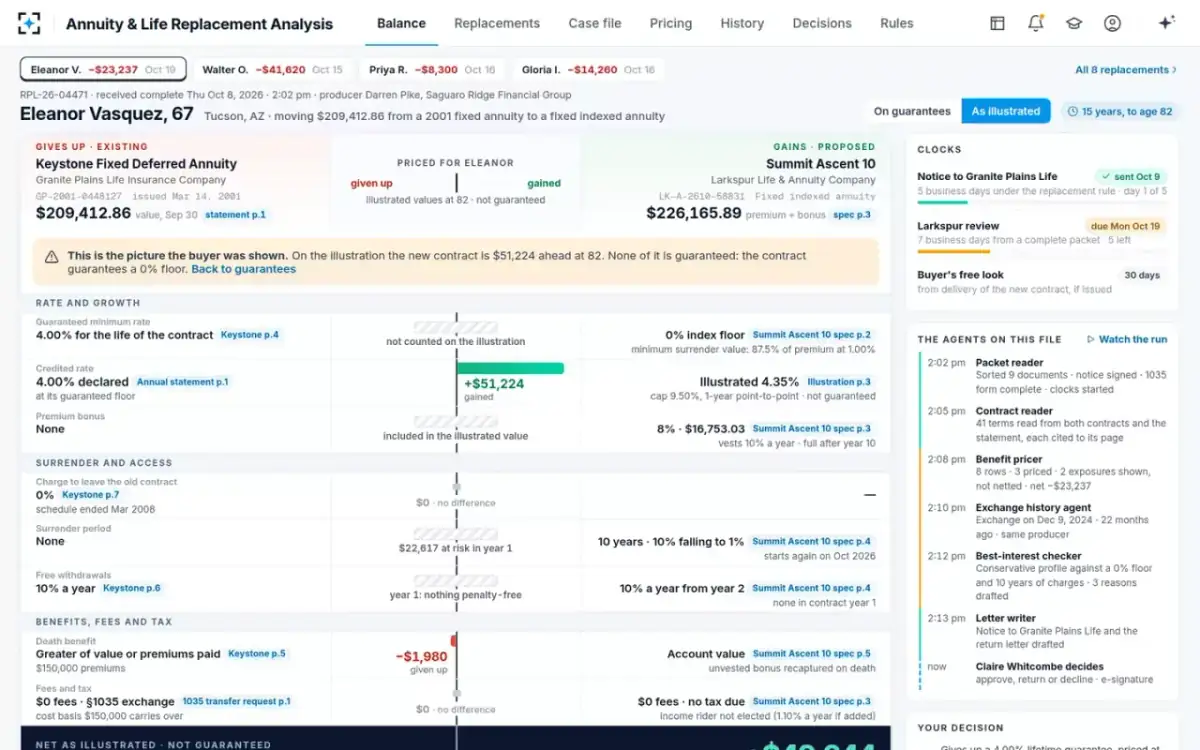
Price the bonus as the amount that has vested by each year the buyer might need money, not as the credit at issue. On the sample contract the 8% bonus is $16,753.03, it vests 10% a year, and the unvested part is recaptured if the owner dies. A full surrender in the meantime pays the year's surrender charge on the whole value. Set side by side, the two schedules show when the bonus is really the buyer's and what leaving would cost on the same date.
The sample bonus year by year: vested, still at risk, and the charge to leave
| Contract year | Bonus vested by year end | Unvested at year end | Surrender charge in the year | Full surrender in the year, at the 0% floor |
|---|---|---|---|---|
| Year 1 | $1,675 | $15,078 | 10% | $22,617 |
| Year 2 | $3,351 | $13,402 | 9% | $20,355 |
| Year 3 | $5,026 | $11,727 | 8% | $18,093 |
| Year 5 | $8,377 | $8,377 | 6% | $13,570 |
| Year 8 | $13,402 | $3,351 | 3% | $6,785 |
| Year 10 | $16,753 | $0 | 1% | $2,262 |
Two things follow for the reviewer. First, the bonus and the surrender charge move in opposite directions, so in the early years the cost of leaving is larger than the whole bonus: in year one, $22,617 against $16,753. A buyer who might need the money early is not being paid by the bonus to take that risk. Second, the death benefit changes too. The old contract paid the greater of value or premiums paid; the new one pays account value with the unvested bonus taken back. The solution prices that difference by mortality-weighted recapture, the chance of death in each year times the bonus that would be lost, and on the sample file it comes to −$1,980.
The solution leaves the surrender schedule out of the net. A surrender charge is a cost only if the money is needed, so it is shown year by year beside the bonus and set against the buyer's stated liquidity needs, rather than added to a total that would then assume she will surrender.
The bonus against the guarantee it buys out
On most bonus replacements the largest cost is not the new product's charges but what the old contract guaranteed. The sample file shows the scale. The old contract guarantees 4.00% for life. Priced by rebuild cost, what it would take today to buy the same guaranteed value at the buyer's 15-year horizon at the best guaranteed rate in the sample rate file, 2.85%, the guarantee is worth $38,010. Against it the bonus brings $16,753. On guarantees the exchange leaves the buyer $23,237 behind, and the new contract would have to credit 3.47% a year for 15 years, counting the bonus, just to break even. It guarantees 0%.
The bonus is fixed; the guarantee it replaces is worth more the longer the horizon
The producer's comparison told the opposite story. It set the new contract's illustrated 4.35% against the old 4.00% and did not say the 4.00% was guaranteed for life; on that basis the new contract looked $51,224 ahead at 82. Both pictures can be shown to a principal. Only the guaranteed one can be netted. How an old guaranteed rate is priced sets out the rebuild-cost method and its inputs.
The picture the buyer was shown, labelled for what it is
Where the cost of a bonus usually sits
The cost of a bonus usually sits in some mix of a longer or steeper surrender schedule, higher charges, and lower crediting: lower caps, participation rates or declared rates than the same insurer pays without a bonus. The SEC's investor page is blunt: "Variable annuities with bonus credits may impose higher fees and expenses than variable annuities that do not offer bonus credits." Where an insurer sells a product in a bonus and a no-bonus version, setting the two side by side is the most direct way for a reviewer to see what the bonus is paid for with.
Bonus version against no-bonus version: what a reviewer compares
With a bonus: Premium plus the bonus, part of it unvested
Without a bonus: The premium
With a bonus: Often longer or higher, so an early exit repays the bonus
Without a bonus: Can be shorter or lower for the same design
With a bonus: Higher fees, or lower caps and rates, may offset the gain
Without a bonus: No bonus cost to recover
With a bonus: Vesting; recapture on surrender, excess withdrawal or death
Without a bonus: Nothing to forfeit
With a bonus: May exclude the unvested bonus
Without a bonus: Account value or the contract’s stated benefit
With a bonus: The bonus is weighed against guarantees given up and a new schedule
Without a bonus: The same weighing, without one large number to anchor it
Compensation is the other half of the picture. Insurers typically pay brokers a commission on variable annuities that "ranges from 0% to over 10% of investors’ premium payments", and a study of those sales found them "roughly four times as sensitive to brokers’ financial interests as to investors’" (Egan, Ge and Tang, NBER Working Paper 27577). Model #275 makes the insurer identify and eliminate sales contests, quotas, bonuses and non-cash compensation based on sales of specific annuities within a limited period. Compensation on a bonus product is not wrong in itself; it is a reason to read the producer's rationale closely.
Do bonus products change how producers are supervised?
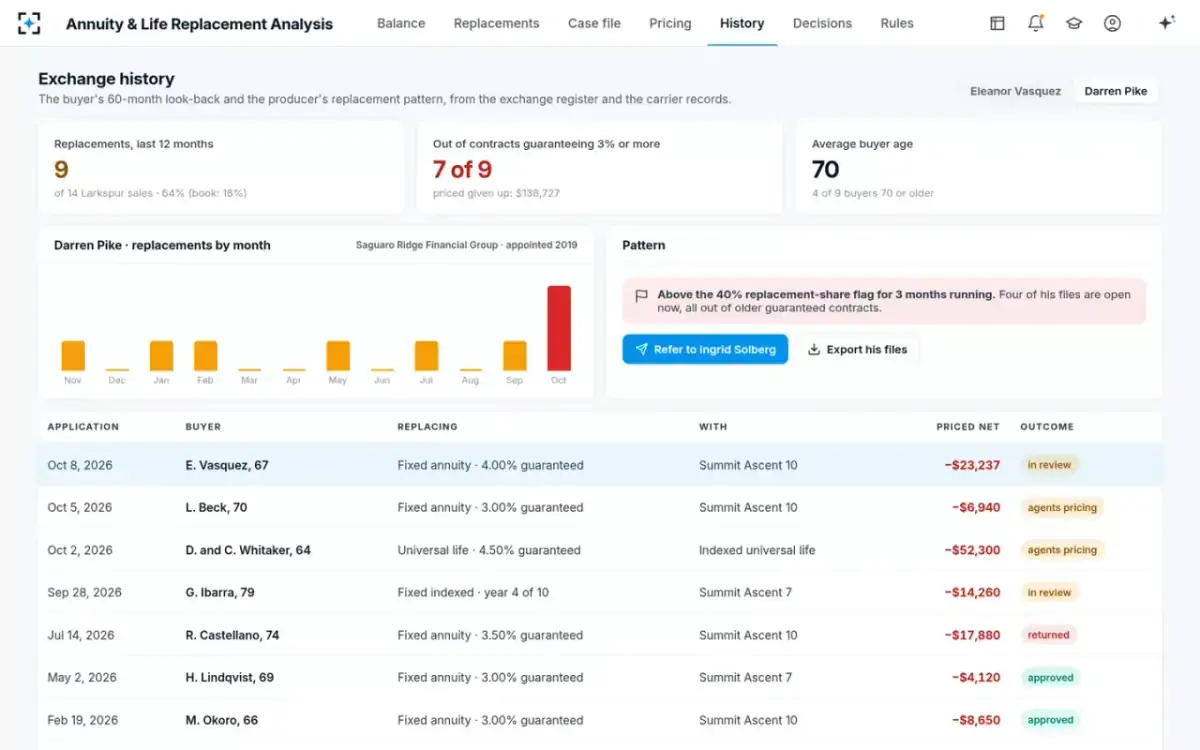
They raise the stakes of the surveillance both rule sets already require. The NAIC replacement model makes each insurer able to produce, for every producer, "Annuity contract replacements as a percentage of the producer’s total annual annuity contract sales" and replacements "indexed by replacing producer and existing insurer" (Model #613 §4.B). FINRA Rule 2330 requires surveillance of each associated person's rate of variable annuity exchanges, and corrective measures where the rate evidences inappropriate exchanges.
FINRA's 2026 oversight report shows where supervision is still failing and what better firms do. Its findings include paperwork "understating surrender charges" and "not indicating when customers had surrendered or exchanged a variable annuity in the past 36 months". Among effective practices it lists automated surveillance that takes into account the "cumulative surrender charges" incurred by a representative's customers, and "excessive rates of exchanges within the last one to two years of the surrender schedule" (FINRA, 2026 Annual Regulatory Oversight Report: Annuities). A bonus product is exactly what makes an exchange late in a schedule attractive to sell, which is why the pattern belongs in front of a supervisor while files are still open. How regulators have priced bad switches is in twisting and churning penalties.
One producer's replacements, priced, before year end
A bonus-replacement checklist for the principal
The checks below turn the rules into questions a principal can answer from the file before signing. Each should be answerable in dollars or dates; a file that cannot answer one goes back to the producer.
Before a bonus decides a replacement: what the principal confirms
- What guarantees and benefits does the buyer give up to get the bonus?
Price each on the same basis as the bonus. A lifetime guaranteed rate is a dollar figure once priced.
- How does the bonus vest, and what triggers recapture?
Surrender, excess withdrawal, death, annuitization. Show the vested amount by year beside the surrender charge.
- Is the old contract near or past the end of its own schedule?
The SEC’s 2000 concern: a buyer near the end of one surrender period taking on a new one.
- What does the no-bonus version of the product offer?
If the insurer sells one, its caps, rates and fees show what the bonus costs.
- Does the comparison net the bonus against guarantees only?
Netting it against an illustrated return makes the bonus look like the whole story.
- Has the buyer exchanged before?
Within 60 months under Model #275; 36 months for variable annuities under Rule 2330.
- Does the producer’s rationale address this buyer?
FINRA’s effective practices: a rationale specific to the customer, with fees, rider benefits and existing values verified by the principal.
- Is the producer’s replacement share or pattern above your threshold?
Model #613 §4.B and Rule 2330(d) expect the firm to be able to see it.
Where Annuity & Life Replacement Analysis puts the bonus, and where it stops
The bonus gets its own row on the balance, priced by the "credited at issue" method: the dollar amount with its vesting schedule, counted only as it vests within the buyer's horizon, with a chip to the page of the product specification that states the terms. The guaranteed rate, death benefit and fees given up get rows of their own, by rebuild cost, mortality-weighted recapture and present value. The new surrender period is shown year by year and never netted. The exchange history agent searches the buyer's last 60 months, 36 for variable annuities, and the producer's last 12. The best-interest checker sets the result against the buyer's profile and drafts reasons for and against.
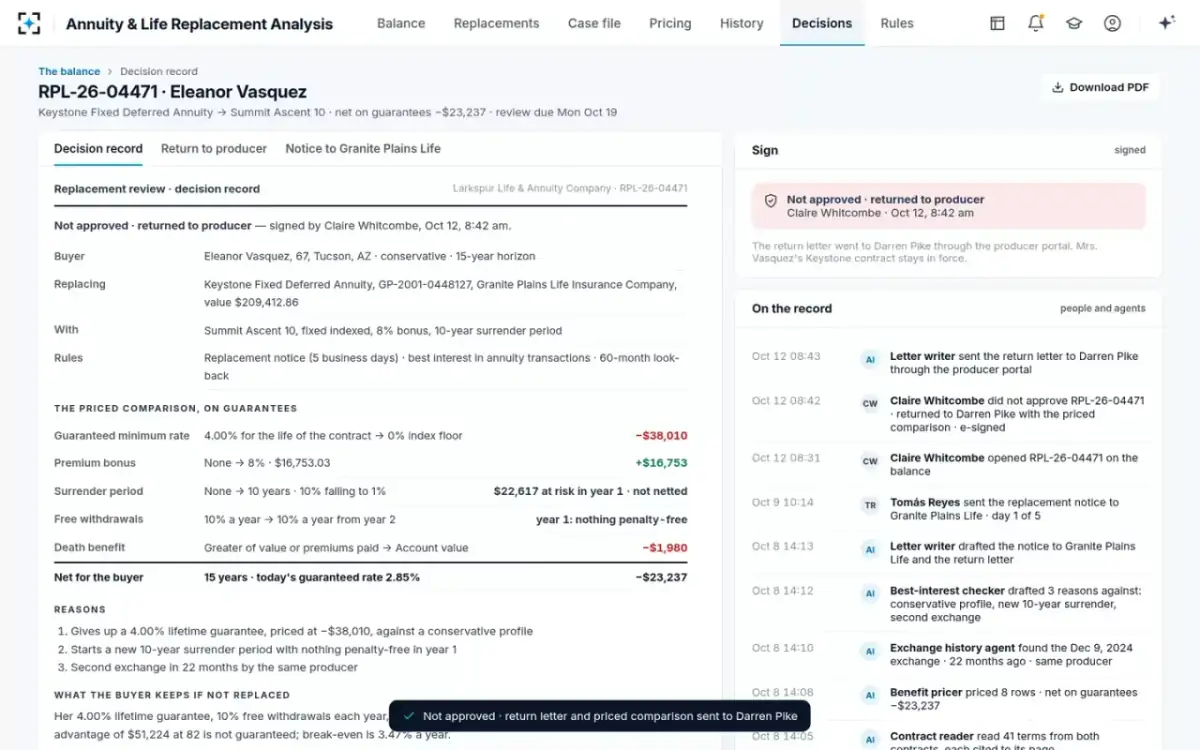
The principal decides. On the sample file she returned the switch with three reasons, the first being the 4.00% guarantee given up, and approving a switch priced as a loss would have needed a written reason and a second approver from sales-practice compliance. The agents do not approve or decline, contact the buyer or the producer, or net an illustrated value. They also do not judge whether an index strategy suits the buyer or replace the insurer's illustration system; they read what the contracts say and price what the rules ask a reviewer to weigh. The routing of each file to the principal inside the seven-day window is covered in annuity exchange technology.
The signed decision: what the buyer keeps if the switch is not made
To net bonuses against guarantees on your own past replacement files, start from Annuity & Life Replacement Analysis.
Questions people ask
What is a premium bonus recapture?
It is the insurer taking back some or all of a premium bonus because a contract event, such as a surrender, an excess withdrawal or in some contracts death, came before the bonus vested. The contract sets the vesting schedule and the triggers, and NAIC Model #245 requires that any conditions on the payment of bonuses be explained.
Do bonus annuities have longer surrender periods?
Often, though not always. The SEC warned in 2000 that bonus credits are often coupled with higher surrender charges and longer surrender charge periods, because the insurer must recover the bonus if the owner leaves early. Comparing a product's bonus and no-bonus versions shows where a given insurer recovers it.
Is a bonus a "product enhancement" under FINRA Rule 2330?
Rule 2330 asks whether the customer would benefit from product enhancements and improvements, alongside the surrender charge, the new surrender period, lost benefits and higher fees. A bonus can be weighed as an enhancement only once its vesting and recapture terms and the cost of the new schedule are counted.
Can a replacing insurer pay a bonus only on replacement business?
Not in New York. 11 NYCRR 51.6(b)(9) requires the replacing insurer to treat a replacement exactly like a new sale, with no difference in interest rate credits, compensation or incentives such as bonuses to agents or brokers. Other states rely on suitability and replacement rules rather than a flat ban.
How long must replacement files be kept?
Under NAIC Model #613 the replacing insurer keeps the replacement notices, indexed by producer, for at least five years or until the next regular examination by its domiciliary state, whichever is later. Model #275 leaves the period for suitability records to each state; its drafting note suggests five years.
Does a 1035 exchange restart the surrender period?
A 1035 exchange moves the money into a new contract, and that contract's own surrender schedule starts at issue. That is why both Model #275 and Rule 2330 list the commencement of a new surrender period among the costs a reviewer must weigh.