Life insurance risk classification is the system by which an insurer sorts the applicants it accepts into rate classes: one or more preferred classes and a residual standard class for each of tobacco and non-tobacco, then table ratings and flat extras for impairments. The insurer writes the criteria for each class, on build, blood pressure, cholesterol, personal and family history, driving, avocations and tobacco, and those criteria decide the mortality each class will produce, the share of applicants who land in it and the premium they pay. It is hard because the criteria live in several places at once, the reinsurer's manual, the company's own guidelines and the memos that amend them, and every underwriter must apply them the same way to every case. Botminds' Life Underwriting Manual Search rates each case from those sources, with the page behind every line, so the classification the company designed is the classification it actually issues.
This guide is written for chief underwriters, underwriting and new business leaders and the pricing and valuation actuaries who own a class structure. Research figures come from the Society of Actuaries, the NAIC and New York's regulator; the case examples use a fictional sample insurer and reinsurer manual as they run through the solution.
How many classes insurers offered non-tobacco applicants
Insurers by number of non-tobacco classes, 2002
- Two classes · 16%
- Three classes · 57%
- Four or more · 26%
What is risk classification in life insurance?
Risk classification in life insurance is the placing of each accepted applicant in a class whose members are expected to have similar mortality, so that each class can be priced and reserved on its own. Above the line sit the standard classes, which a preferred program subdivides; below it sit the substandard classes, Table 1 and upward, for applicants with ratable impairments. The Society of Actuaries' documentation for its preferred-class tool draws the line precisely.
All of the preferred risk classes, whether super preferred, preferred, standard, or whatever other risk class names an insurer uses are standard underwritten risks.
SOA Underwriting Criteria Team, Relative Risk Tool documentation (2016)
Regulators see the ladder through two lenses. For reserving, the NAIC's principle-based reporting asks insurers to report each policy's class, with preferred and standard classes "numbered 1 through 9 with 1 being the best preferred class" (NAIC, 2026 VM-51 Data Dictionary). For valuation tables, the NAIC's model regulation recognises "super preferred nonsmokers, preferred nonsmokers, residual standard nonsmokers, preferred smokers, and residual standard smoker" classes (NAIC Model #815). Everything between those formal rungs, standard plus, select, elite, is each company's own naming.
The names do not travel. The Society of Actuaries' survey of preferred practices found "there is no common definition," and that one company's preferred rates may be lower than another company's super-preferred (SOA, report on 2002 preferred practices). For a company designing or reviewing a structure, the names are marketing; the criteria and the prevalence of each class are the design.
What are the types of risk classification in life insurance?
There are two ways to qualify an applicant for a preferred class, and most programs use one or a blend. A knock-out program sets a limit on each criterion, and an applicant who misses any one drops a class. A debit-credit program scores each criterion and qualifies the applicant on the total, so a strength on one can offset a weakness on another. The Society of Actuaries' relative-risk tool models both, and their combination, because both are in the market (SOA, RR Tool documentation).
Knock-out and debit-credit preferred programs, side by side
Knock-out: Meets every limit for the class: build, blood pressure, cholesterol, history, driving, tobacco.
Debit-credit: Scores under a total; debits for weaker results, credits for stronger ones.
Knock-out: Easy to apply, easy to explain to an agent, easy to audit.
Debit-credit: Finer sorting: a near miss on one criterion need not cost a class.
Knock-out: One reading just over a limit costs a class, so exceptions creep in.
Debit-credit: Credits can carry a weak risk into a class it does not belong in.
Knock-out: A written rule for exceptions, applied the same way.
Debit-credit: Caps on credits and a rule that ratable impairments are excluded before scoring.
Below the preferred ladder, almost every manual is a debit-credit system: each impairment adds debits or earns credits, they are summed, and the total is rounded to a table. The numerical rating system works that arithmetic line by line, and what one table either way costs prices the rounding.
Setting preferred class criteria: where the limits sit
The criteria are a trade between mortality and placement. Tighter limits produce a best class with lower mortality and fewer members; looser ones place more applicants and raise the class's mortality. The Society of Actuaries says it plainly: "Choosing overall program limiting criteria restriction values more liberal than the industry standard values will increase the overall mortality of the program. Stricter restrictions will decrease the overall mortality of the program" (SOA, RR Tool documentation).
What separated the best preferred class from standard, across insurers in 2002
| Criterion | Range across insurers for the best non-tobacco class | What it tells a designer |
|---|---|---|
| Total cholesterol | Maximum from 200 to 274, depending on the number of classes | Limits loosen as classes multiply; nearly half treated readings under treatment differently. |
| Cholesterol to HDL ratio | Maximum from just under 4.0 to 6.5 | More than half did not adjust the ratio for treatment. |
| Blood pressure, male aged 45 | Maximum untreated reading from 120/80 to 150/90 | 42% excluded anyone treated for hypertension from preferred. |
| Medical history | Internal cancer, heart disease, diabetes and melanoma used by at least 98% of insurers | History criteria are near universal; numeric limits are where companies differ. |
| Ratable impairments | One company: "Any ratable impairment precludes preferred plus and preferred class" | The line between the preferred ladder and the table ladder must be written down. |
Market pressure pushes the other way. In a market with many preferred programs, the SOA notes, "the applicant will tend to choose policies from programs more advantageous to their particular situation" (SOA, RR Tool documentation). An applicant whose cholesterol just misses one company's limit will be placed by a company whose limit is looser; a company that loosens one criterion to win that business takes on the mortality that came with it. The design question is not which limit is right in the abstract but which one the company's pricing assumed.
How many applicants each class should take
Every class structure implies a prevalence: the share of applicants expected to qualify for each rung. It is the number pricing relies on, and the number underwriting can most easily drift from without anyone noticing, because a class that takes more applicants than priced is a mortality problem that arrives years later.
At the median insurer with three classes, each class took roughly a third of applicants
The range is the point. A best class that takes 8% of applicants and one that takes 44% are different products under the same name, and the SOA's tool exists partly so a company can estimate the relative mortality of its own classes when it lacks the experience to measure it (SOA, RR Tool documentation). Tracking actual placement by class against the priced prevalence, month by month, is the earliest warning a company gets that its criteria are being applied more loosely than designed.
Exceptions: the preferred rule underwriters bend most
Most companies allow exceptions to their preferred criteria, and most of those exceptions concern two criteria. The 2002 survey found that only 18% of insurers allowed no exceptions, that the two most common were cholesterol and build, each named by more than half, and that 72% let underwriters use judgment in qualifying an applicant for preferred (SOA, report on 2002 preferred practices).
Exceptions to preferred criteria are the norm, and often unwritten
18%
of insurers allowed no exceptions to their preferred criteria
>50%
named cholesterol, and build, among their most common exceptions
72%
let underwriters use judgment in qualifying an applicant for preferred
42%
followed written internal guidelines for when exceptions are made
The last figure is the one a chief underwriter should test against today. An exception made under a written rule is part of the class definition, and can be priced. An exception made on judgment without one is a class definition that varies by underwriter, and it is invisible in the mortality study until the study is broken out by who signed. A written exception rule needs three parts: which criteria may be excepted, by how much, and at whose authority.
Does a class structure earn its mortality?
Only experience by class can say, and many companies cannot yet say it. Among 2002 respondents that tracked mortality by preferred class, 30% reported experience better than expected, 22% in line, 7% worse, and 41% said it was too early to tell or did not know (SOA, report on 2002 preferred practices). Preferred classes are long-dated promises, and the evidence on them accumulates slowly.
How insurers' preferred classes were running against expected mortality
When a study does speak, the response is usually a memo, not a new manual. In the fictional sample, the insurer's 2025 mortality study found diabetic cases with two manual credits running at 118% of expected, and the chief underwriter capped all credits for applicants with diabetes at −25 with immediate effect. That memo is now part of the company's risk classification. Whether it is applied on Monday morning depends on whether every underwriter finds it, which is the subject of how an underwriting manual's combination rules are applied.
What does the law require of a life insurance risk classification?
The law requires that classes be drawn on mortality, applied evenly and explained when they go against an applicant. New York's Insurance Law bars a life insurer from making "any unfair discrimination between individuals of the same class and of equal expectation of life," and from charging a different rate solely because of an impairment or disease "except where the refusal, limitation or rate differential is permitted by law or regulation and is based on sound actuarial principles or is related to actual or reasonably anticipated experience" (NY Ins. Law § 4224).
Two further rules bind the design. Under the NAIC's privacy model, which states adopt in their own versions, an offer of life, health or disability coverage "at higher than standard rates" is an adverse underwriting decision, and the insurer must give the specific reasons in writing or tell the applicant they may request them (NAIC Model #670). And where external data or AI feeds the classification, New York's 2024 circular letter says an insurer should not use them for underwriting or pricing unless it can establish that they are not unfairly discriminatory, and that insurers "retain responsibility for understanding any tools" they use, including a vendor's (NY DFS, Circular Letter No. 7 (2024)).
What the rules ask of a class structure, and the evidence that answers each
| The rule asks | The evidence a company should be able to produce |
|---|---|
| Same class, same expectation of life, same rate (NY Ins. Law § 4224(a)(1)) | Two applicants with the same facts placed in the same class, whoever underwrote them |
| A rating on an impairment rests on actuarial principles or experience (§ 4224(a)(2)) | The manual page, guideline or memo behind each debit, and the study behind each departure |
| Reasons for an offer above standard (NAIC Model #670) | The specific findings that moved the class, as the underwriter recorded them |
| External data and AI not unfairly discriminatory (NY DFS CL 2024-07) | Testing of each data source and model, and an understanding of any vendor tool |
Applying risk classification the same way on every case
A classification is only as consistent as its application, and the commonest inconsistencies are not judgment calls but lookups: the wrong table read, a memo missed, a credit allowed that a newer rule caps. In the fictional sample insurer's consistency test, two of five underwriters rating the same diabetic case with a heavy build read the standard build chart instead of the diabetic one, and their totals came out a table lower. What an underwriting auditor tests walks through that test.
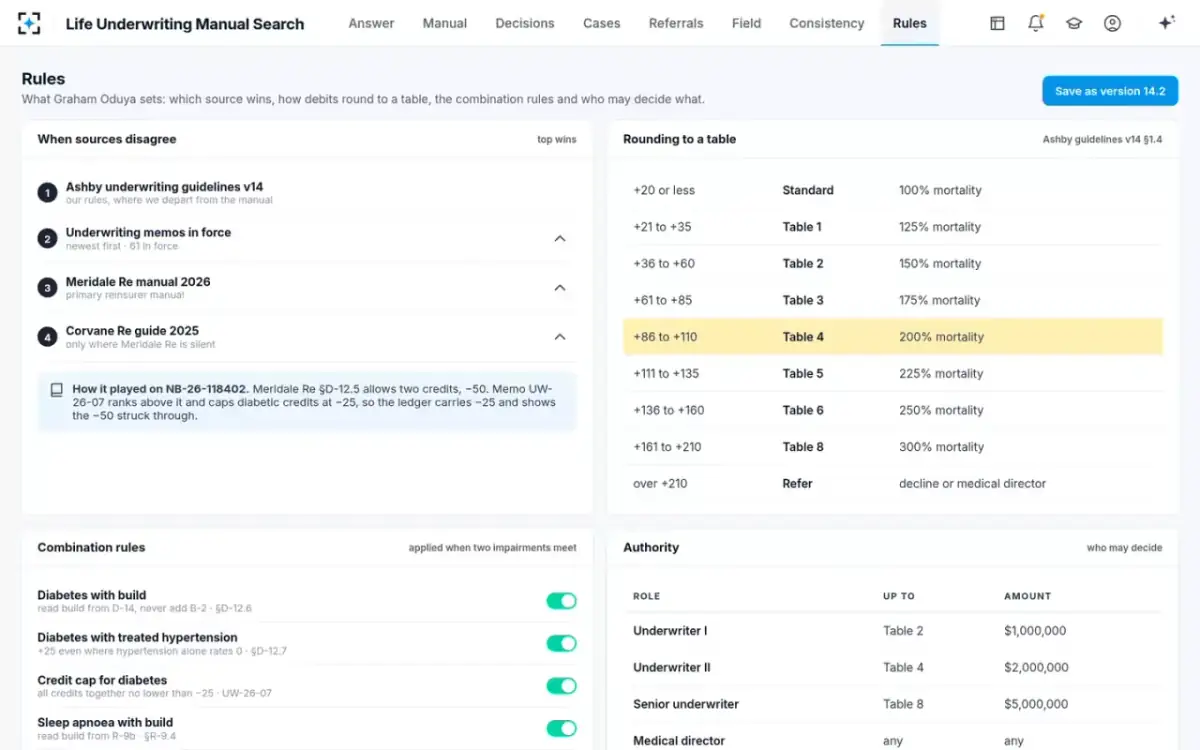
Life Underwriting Manual Search applies the company's classification from its own sources. The chief underwriter sets which source wins when they disagree: in the sample, the company's guidelines first, then memos in force, newest first, then the primary reinsurer manual, then a secondary guide where the primary is silent. The rounding bands that turn a debit total into a class, the combination rules and the authority grid sit in one place, and each change is a new version.
The rules behind every class in Life Underwriting Manual Search
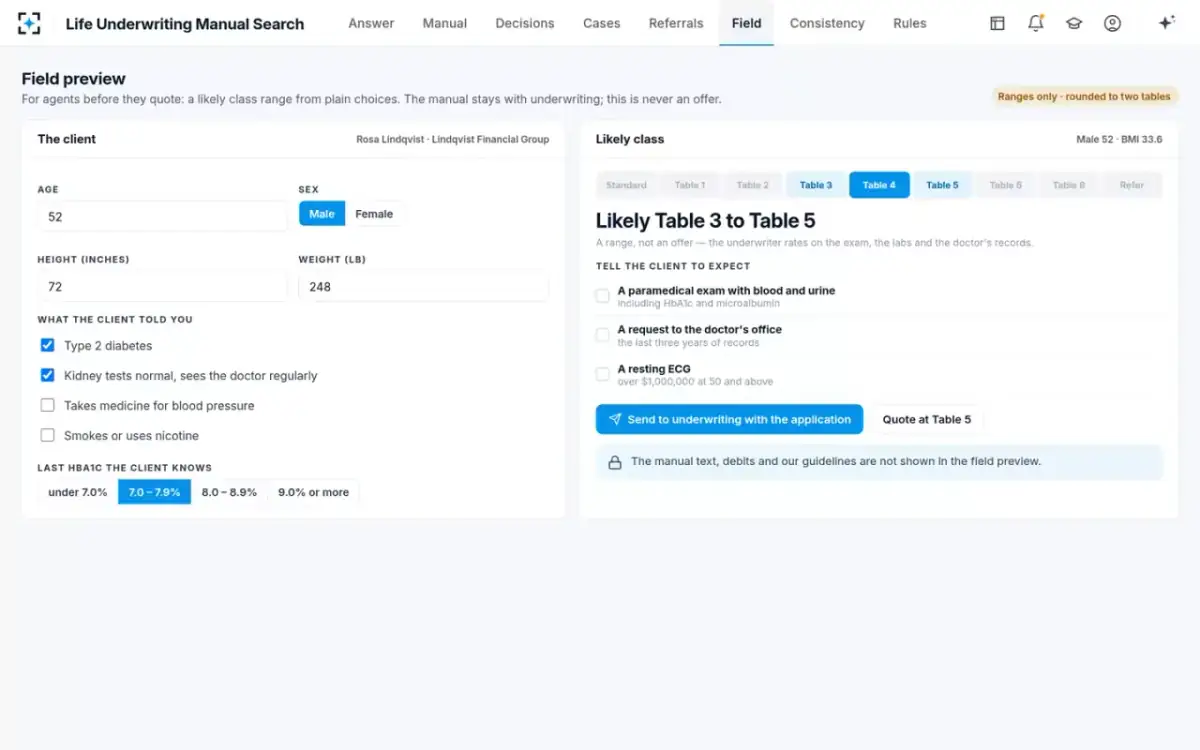
The same rules feed the field. Agents who quote a class the client hopes for and re-quote when the offer comes back rated are working without the classification; the solution's field preview gives them a likely range, rounded to two tables, from the same rules the underwriter uses, and never the manual itself. In the sample, an agent's preview for a 52-year-old with type 2 diabetes and a heavy build reads likely Table 3 to Table 5, and the underwriter's eventual offer, Table 4, sits inside it.
A field preview: a likely class range from the same rules, not the manual
The underwriter decides every class within their authority; above it, or on a line marked refer, the medical director decides. Each question, the pages returned and the decision are logged with who asked and kept seven years, which is the evidence the table above asks for. To see the classification applied to a full case, start from Life Underwriting Manual Search.
Questions people ask
What is the difference between a preferred class and a table rating?
A preferred class is a rung within standard risk: the SOA's tool documentation calls every preferred class, whatever its name, a standard underwritten risk. A table rating is substandard, for an applicant with a ratable impairment, and under the NAIC privacy model an offer above standard rates is an adverse underwriting decision that carries a right to the reasons.
How many preferred classes should an insurer have?
No rule sets a number. In the SOA's 2002 survey, 57% of insurers had three non-tobacco classes and 26% had four or more. More classes sort applicants more finely, but each needs criteria, prevalence assumptions and eventually its own experience to support it.
Can credits move an applicant into a preferred class?
In a debit-credit program, yes, within the program's rules; in a knock-out program, no. Many programs guard against it: one 2002 respondent required applicants to be "a standard risk without use of credits," and another excluded anyone with a single risk item of 25 debits or more from all preferred classes.
Who owns a life insurer's risk classification?
Usually the chief underwriter owns the criteria and their application, and the pricing and valuation actuaries own the assumptions each class carries. The two must agree on prevalence and on every exception rule, because a criterion applied more loosely than priced shows up only in later mortality studies.
Does New York regulate how insurers use external data in risk classification?
Yes. Circular Letter No. 7 of 2024 says insurers should not use external consumer data or AI systems in underwriting or pricing unless they can establish the use is not unfairly discriminatory, and that insurers stay responsible for vendor tools. It also expects reasons for adverse decisions to include the source of the information relied on.
How often should preferred criteria be reviewed?
Whenever experience or the market moves, and the evidence is that they move often: the SOA's 2002 report observed that criteria and qualification requirements appear to change frequently. A review compares actual placement by class with the priced prevalence, and actual mortality by class with expected, before any limit is changed.