A table rating in life insurance is the class an underwriter assigns when an applicant's expected mortality is above the insurer's standard: Table 1 is roughly 125% of standard mortality, Table 2 about 150%, Table 4 about 200%, each table usually adding 25 points. Because the premium follows the table for the life of the policy, a rating one table off is not a rounding detail. One table too low and the insurer collects a premium for 25 points less mortality than it expects; one table too high and the applicant is overcharged, the agent re-quotes, and the case may not be taken at all. Tables are set by each insurer and its reinsurer's manual, not by law, which is why Botminds' Life Underwriting Manual Search answers rating questions with the section and page behind every debit and the guideline that rounds the total.
The examples use a fictional sample case and insurer as they run through the solution; the cost arithmetic is illustrative, with the assumptions stated. The research comes from the Society of Actuaries, the NAIC, NBER and the Journal of Insurance Medicine, linked where it appears.
One table either way on a Table 4 case: who pays for the error
Rated one table too low (Table 3): 175% of standard against 200% expected: the mortality part of the premium covers seven-eighths of the expected cost.
Rated one table too high (Table 5): 225% against 200%: the applicant pays for an eighth more mortality than expected.
Rated one table too low (Table 3): The insurer and its reinsurer, every year the policy stays in force.
Rated one table too high (Table 5): The applicant if they accept; the insurer and agent if they walk away.
Rated one table too low (Table 3): Years later, in claims, and in a reinsurer's audit of the file.
Rated one table too high (Table 5): Within weeks: a re-quote, a reconsideration request, a not-taken case.
Rated one table too low (Table 3): A credit applied that a memo had capped; build read from the wrong chart.
Rated one table too high (Table 5): A combination rule applied twice; a total rounded up at a band edge.
Rated one table too low (Table 3): An adverse underwriting decision notice, since the offer is above standard.
Rated one table too high (Table 5): The same notice, now for a rating the facts do not support.
What is a table rating in life insurance?
A table rating is a substandard class expressed as a multiple of the insurer's standard mortality. It comes from the numerical rating system: the underwriter adds debits for each impairment, subtracts any allowed credits, and rounds the net total to a table. A 2026 article in the Journal of Insurance Medicine equates a mortality ratio of 200% with roughly 100 debits (Iacovino, 2026); with 25 debits to a table, that is Table 4.
Depending on the insurer, tables are numbered or lettered, and the top of the scale differs. Table ratings sit between standard and decline: above them, the case goes to a medical director or is declined. The full arithmetic, from debit to class, is worked in the numerical rating system in life insurance.
What does Table 4 mean in life insurance? And Table 2?
Table 4 means expected mortality about twice the insurer's standard class, a net total of roughly 100 debits. Table 2 means about one and a half times standard, roughly 50 debits. In the fictional sample insurer's guidelines the bands are explicit: +36 to +60 is Table 2, 150% mortality; +86 to +110 is Table 4, 200%.
The sample case shows how an applicant reaches Table 4. A 52-year-old with type 2 diabetes, diagnosed at 45, an HbA1c of 7.6% and metformin only, gets +75 from the manual's diabetes table. His build, read from the diabetic build table that the manual's combination rule requires, adds +50. Credits for normal kidney tests and regular follow-up, capped at −25 by the insurer's memo, bring the total to +100: Table 4.
Where the total lands: the class ladder and the authority line
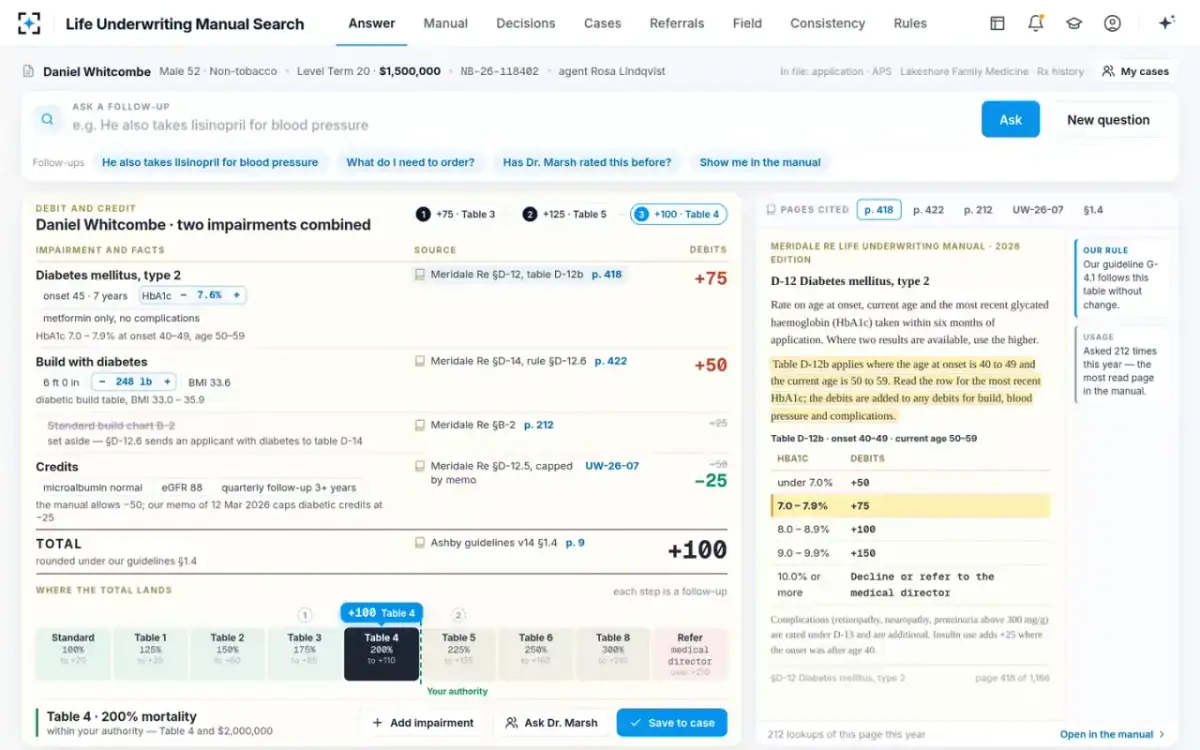
Table rating chart: 25 points a table, and 25% of what?
Most scales add 25 points of mortality per table, but insurers differ on the base the 25% is taken from. When the Society of Actuaries asked insurers in its 2002 preferred underwriting survey how a one-table substandard rating was defined, 60% applied 25% of the residual standard class, 9% 25% of the aggregate standard class and 6% 25% of an intermediate class; the rest described other bases, including "Special table of substandard extra premiums" (SOA Preferred Underwriting Survey Subcommittee, report on 2002 practices).
What 'one table' is 25% of: the answer differs by insurer
The difference is not academic. An insurer with a preferred structure expects higher mortality in its residual standard class, the lives left after the preferred classes are taken out, than in its standard lives as a whole, so 25% of the residual class is more extra mortality, in deaths per thousand, than 25% of the blend. A table rating chart printed without its base cannot be compared between companies, and a rating copied from one insurer's chart to another's is not the same risk.
What one table too low costs the insurer
A rating one table too low on a Table 4 case collects the mortality charge for 175% of standard when the insurer expects 200%: a shortfall of one-eighth of the expected mortality cost, every year the policy stays in force. Take an illustrative standard mortality of 3 deaths per 1,000 lives a year at the applicant's age, an assumption for the arithmetic only. At Table 4 that is 6 per 1,000; on $1,500,000 of cover the expected mortality cost is about $9,000 a year. Table 3 prices $7,875. The gap, about $1,125 a year on one policy, is the insurer's and its reinsurer's.
That is why reinsurers watch for one-table errors in their audits. A company comment in the Society of Actuaries' survey of business decisions put it from the ceding side: "On audit, reinsurers seem concerned about a one-table reduction" (SOA Business Decisions survey, 2007). The same survey found 16 of 58 respondents ran formal table shave programs, which improve some substandard offers by a table or more as a matter of written policy; an accidental one-table error has the same effect without anyone having decided it.
The causes are seldom exotic. On the sample case the two most likely one-table-low errors are an uncapped credit, −50 from the manual instead of −25 under the memo, which gives Table 3, and a stale guideline that predates the memo. Both are visible on a worksheet that names the memo, and invisible on one that shows only a total.
What happens if an underwriter rates one table too high?
A rating one table too high costs less on paper and more in the field. The applicant is offered a premium for an eighth more mortality than the facts support; the agent who quoted a better class has to re-quote; and some applicants walk away, taking the acquisition cost with them. The insurer also owes the applicant an explanation, because the NAIC's privacy model treats any above-standard offer as an adverse decision.
In the case of a life, health or disability insurance coverage, an offer to insure at higher than standard rates.
NAIC Insurance Information and Privacy Protection Model Act (#670), definition of an adverse underwriting decision
Under the model, the insurer must give the specific reasons in writing, or tell the applicant they can ask for them; on a written request made within 90 business days, it must send the reasons and the specific information behind them within 21 business days. A table set one too high must therefore be explained by reasons that do not support it. Life insurance risk classification covers the class ladder and how a field preview sets expectations before the quote, so that an offer at a table is not a surprise.
What table rating is uninsurable?
There is no universal cut-off; each insurer sets where table ratings stop and decline or referral begins. In the fictional sample insurer, totals above +210, beyond Table 8 at 300%, go to the medical director or are declined. Simplified issue products stop much earlier. In a Society of Actuaries survey of simplified issue products, the most common maximum rating that still qualified as standard was Table 4, for 40% of the 42 products that answered; 14% allowed no substandard risk at all (SOA Simplified Issue Survey Subcommittee, 2008).
How simplified issue products handled substandard applicants
Economics explains why a cut-off exists at all. Nathaniel Hendren's study of rejections in long-term care, disability and life insurance found that applicants with conditions that lead to rejection hold enough private information about their own risk to make a market at any price unsustainable: "private information prevents the existence of large segments of these three major insurance markets" (Hendren, NBER Working Paper 18282, published in Econometrica 2013). Beyond a point, a higher table does not buy the insurer a priceable risk.
How is substandard life insurance priced?
Substandard cover can be priced with a table rating, a percentage of standard mortality, or with a flat extra, a fixed charge per $1,000 of cover for as long as the policy states; in the simplified issue survey above they were the first two methods named, with graded death benefits. The two answer different shapes of risk. A table suits an impairment whose extra deaths grow with the applicant's underlying mortality; a flat extra suits a hazard that adds a roughly fixed number of deaths, such as a dangerous hobby. Flat extra premium life insurance vs a table rating works the comparison.
Which applies, and how much, is set by the reinsurer's manual and the insurer's own guidelines, and both change. A memo can cap credits, a guideline can depart from the manual, and the rounding bands belong to the insurer. That layering is the main source of table errors, and the reason to read the manual page, the guideline and the memo together for every rating.
Can a table rating be removed?
Often it can be reconsidered later, on new evidence, under the insurer's own reconsideration rules; there is no general legal right to have it removed. Applicants who think a rating is wrong can ask for the specific reasons under the adverse-decision rules, and the insurer's own procedures govern a review: the Massachusetts examination cited in what an underwriting auditor tests describes one insurer's escalation, in which a challenged rate goes back to the underwriter and a director or executive for reconsideration. New evidence is what moves a rating. In the sample case a reading in a different band of the diabetes table moves the line by 25 points or more, a full table.
How Life Underwriting Manual Search keeps the table on the page
Life Underwriting Manual Search builds every rating as a worksheet in which each debit and credit carries its section and page, the rounding cites the insurer's guideline, and the class sits on a ladder that shows the underwriter's authority. In the sample case the three questions took 14 seconds in all and cited four pages from three sources; the struck-through lines, the standard build chart and the manual's uncapped credit, stay visible with the rule that set them aside.
A provisional table: one fact still open, the total can still move
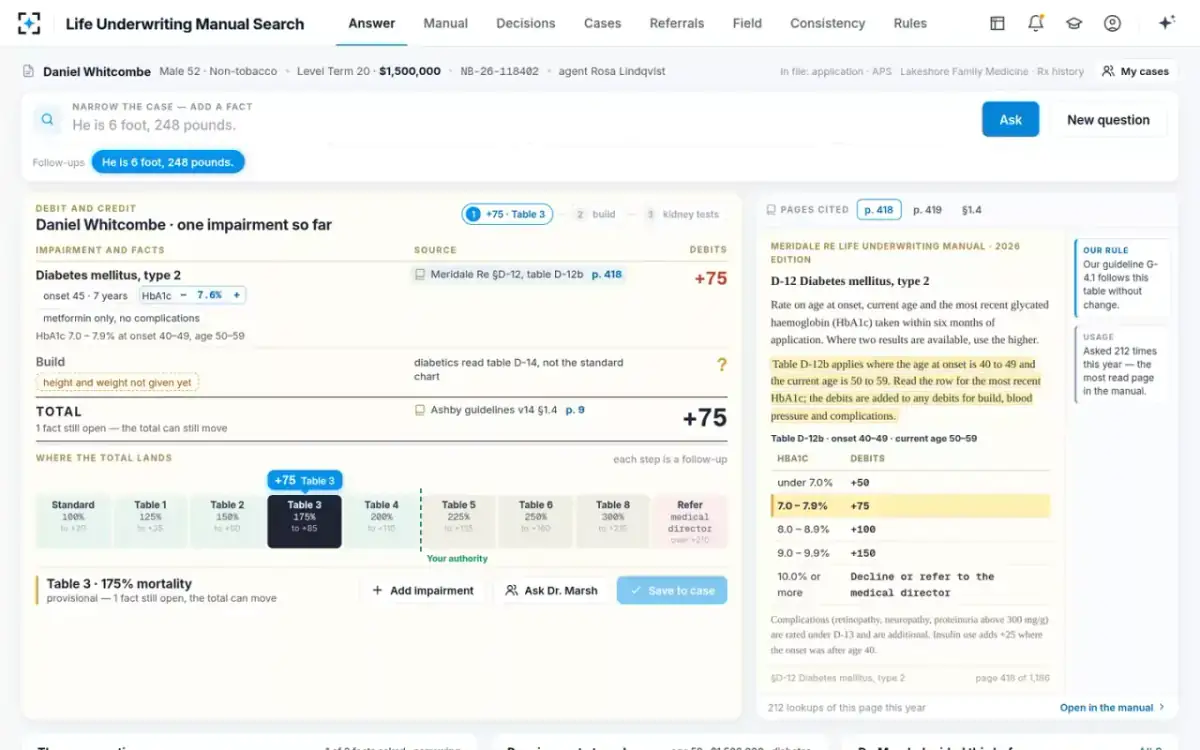
The design answers both errors on this page. The one-table-low error, an uncapped credit, cannot pass silently, because the memo that caps it ranks above the manual in the chief underwriter's order of precedence and is shown beside the line. The one-table-high error, a total near a band edge or a rule applied twice, is visible because every line names the rule that produced it. The underwriter still decides; the table they decide on can be rebuilt by anyone from the file. To see the full sample case, start from Life Underwriting Manual Search.
Questions people ask
Is a table rating the same as a substandard rating?
Yes, in most usage: a table rating is one form of substandard rating, alongside flat extras, graded benefits and exclusion riders where allowed. All of them price or limit a risk the insurer expects to be worse than its standard class.
How much more does a table rating cost?
It raises the mortality part of the premium by roughly 25% of standard per table, but the premium as a whole rises by whatever the insurer has priced for each table, since premiums also carry expenses and other charges. Compare the insurer's actual rates for the standard class and the table offered.
Can a preferred applicant get a table rating?
Not usually for the same impairment: a ratable impairment generally takes an applicant out of the preferred classes. Some insurers do allow a flat extra for a non-medical hazard, such as aviation, on an otherwise preferred applicant.
Who decides a table rating above the underwriter's authority?
A more senior underwriter or the medical director, under the insurer's authority grid. In the fictional sample insurer an Underwriter II may decide up to Table 4 and $2,000,000, a senior underwriter up to Table 8 and $5,000,000, and the medical director any case.
What is a table shave program?
A program under which an insurer improves some substandard offers by one or more tables as a matter of written policy, rather than case by case. In the Society of Actuaries' survey of business decisions, 16 of 58 insurers had a formal program, and none of the six who answered the question would let a table-waived case reach a preferred class.