A material misrepresentation in life insurance is a wrong answer on the application that would have changed the insurer's decision to issue the policy. In New York, the clearest statute, a misstatement is material only if the insurer, knowing the true facts, would have refused to make the contract; other states also count a higher premium, require proof that the insured meant to deceive, or require that the misstated condition contributed to the death. A material misrepresentation found within the contestable period, usually the first two years, lets the insurer rescind the policy and return the premiums. An immaterial one does not, however wrong the answer. Contestable Claim Review, Botminds' software for contestable death claims, tests materiality the way the courts expect: on the insurer's own underwriting manual, the version in force when the policy was issued.
This guide is for examiners and counsel who apply the rule, and for beneficiaries who received a letter citing it. It uses a fictional sample claim from the solution, Martin J. Ressler, who died in month 18 of a $1,500,000 term policy after answering "No" to a question about heart disease 112 days after a cardiologist diagnosed it.
Material misrepresentation, in three questions and two state add-ons
1
Was it a representation?
A statement of past or present fact, made by or for the applicant before the contract, to induce it.
2
Was it false?
Measured against the records, inside the question's own look-back window and wording.
3
Was it material?
Would the truth have changed the decision, on the insurer's own rules at issue, under the state's test?
+
In some states, more
Texas: intent to deceive. Missouri and Kansas: the matter misrepresented contributed to the death.
What is material misrepresentation in insurance?
It is a false statement of fact by the applicant that mattered to the insurer's decision. New York defines the parts precisely. A representation is "a statement as to past or present fact, made to the insurer by, or by the authority of, the applicant for insurance or the prospective insured, at or before the making of the insurance contract as an inducement to the making thereof", and a misrepresentation is a false one (§3105(a)).
Materiality is the filter. "No misrepresentation shall avoid any contract of insurance or defeat recovery thereunder unless such misrepresentation was material. No misrepresentation shall be deemed material unless knowledge by the insurer of the facts misrepresented would have led to a refusal by the insurer to make such contract" (§3105(b)(1)). New York's appellate courts read the test as asking whether the insurer would have issued the same policy, and require the insurer's underwriting documents to show it.
“In determining the question of materiality, evidence of the practice of the insurer which made such contract with respect to the acceptance or rejection of similar risks shall be admissible.”
N.Y. Insurance Law §3105(c)
That sentence is why materiality is tested on the insurer's own rules, not on what a reasonable insurer might do. The question is never whether the fact sounds serious. It is what this insurer's manual did with this fact on the day the policy issued.
What counts as material on a life insurance application?
A fact counts as material when the insurer's underwriting rules would have treated the truth differently enough to meet the state's test: a decline, a postponement or, in states that count it, a higher class or premium. Diagnoses, abnormal tests, treatment, specialist consultations and current medications are the usual candidates; the sample manual reads several of them directly, from heart tests (§4.2) to treated cholesterol (§3.1).
New York closes a gap applicants sometimes rely on. Denying a consultation or treatment is treated as denying the condition behind it: a misrepresentation that the applicant had no previous medical treatment, consultation or observation "shall be deemed, for the purpose of determining its materiality, a misrepresentation that the applicant has not had the disease, ailment or other medical impairment for which such treatment or care was given" (§3105(d)). In the sample, the insured listed only a routine physical when asked about physicians consulted; under §3105(d) that answer is judged as if he had denied the coronary disease the cardiologist was seeing him for.
California frames the same idea from the other side, through concealment. "Neglect to communicate that which a party knows, and ought to communicate, is concealment", and "Concealment, whether intentional or unintentional, entitles the injured party to rescind insurance." Its materiality test looks forward from the application, not back from the death: "Materiality is to be determined not by the event, but solely by the probable and reasonable influence of the facts upon the party to whom the communication is due, in forming his estimate of the disadvantages of the proposed contract, or in making his inquiries" (Cal. Ins. Code §§330, 331, 334).
Five state tests for material misrepresentation in a life application
| State | What makes it material | Intent required? | Must it relate to the death? |
|---|---|---|---|
| New York | The insurer would have refused to make the contract (§3105(b)(1)); courts ask whether it would have issued the same policy | No; even innocent misstatements, if material, suffice | No |
| California | The probable and reasonable influence of the facts on the insurer’s estimate, judged “not by the event” (§334) | No; concealment “whether intentional or unintentional” (§331) | No |
| Texas | Of a material fact and affecting the risks assumed (§705.051) | Yes; the insurer must plead and prove intent to deceive (Arce, 2023) | Alternative route: material to the risk or contributed to the event (§705.004) |
| Florida | Fraudulent, or material to the risk, or the insurer would not have issued it, at the same premium, in that amount, or covering that hazard (§627.409) | No, if material | Only as one of the listed routes |
| Missouri · Kansas | Not material unless the matter misrepresented actually contributed to the event that made the policy payable | No (Missouri’s annotations note it applies whether fraudulent or innocent) | Yes |
Representation, not warranty: why the statutes insist on the word
The statutes call application answers representations so that materiality applies to them. Florida says so in its first sentence: "Any statement or description made by or on behalf of an insured or annuitant in an application for an insurance policy or annuity contract, or in negotiations for a policy or contract, is a representation and not a warranty" (Fla. Stat. §627.409(1)). New York builds its whole rule on the same word, defining a representation and then making only material misrepresentations count (§3105(a)–(b)).
The label is what brings the materiality test into play. Because every application answer is a representation, a wrong answer about an old sprained ankle cannot defeat a policy unless the insurer's rules would have cared about the ankle. For a contestable review the consequence is practical: every flagged answer needs a materiality test, and none can be treated as automatically fatal because the applicant signed a statement that the answers were true.
Is an honest mistake a misrepresentation? Does intent matter?
In most of the states above, an honest mistake can still be a material misrepresentation; intent is not part of the test. New York's Appellate Division has said that even innocent misrepresentations, if material, defeat recovery (Smith v Guardian, 2014), and California's concealment rule applies whether the concealment was intentional or not. Florida lets a misstatement count if it was fraudulent or if it was material, so an innocent but material one is enough.
Texas is the clear exception. Its statute says "A misrepresentation in an application for a life, accident, or health insurance policy does not defeat recovery under the policy unless the misrepresentation: (1) is of a material fact; and (2) affects the risks assumed" (§705.051). The insurer in a 2023 case argued that this replaced the old common-law requirement of intent. The Supreme Court of Texas disagreed: "We hold that section 705.051 does not displace the common-law rule because the statute prescribes necessary, not exclusive or sufficient, conditions for denying recovery under a contestable policy" (Arce). A Texas insurer must therefore prove intent as well as materiality.
The same wrong answer, in New York and in Texas
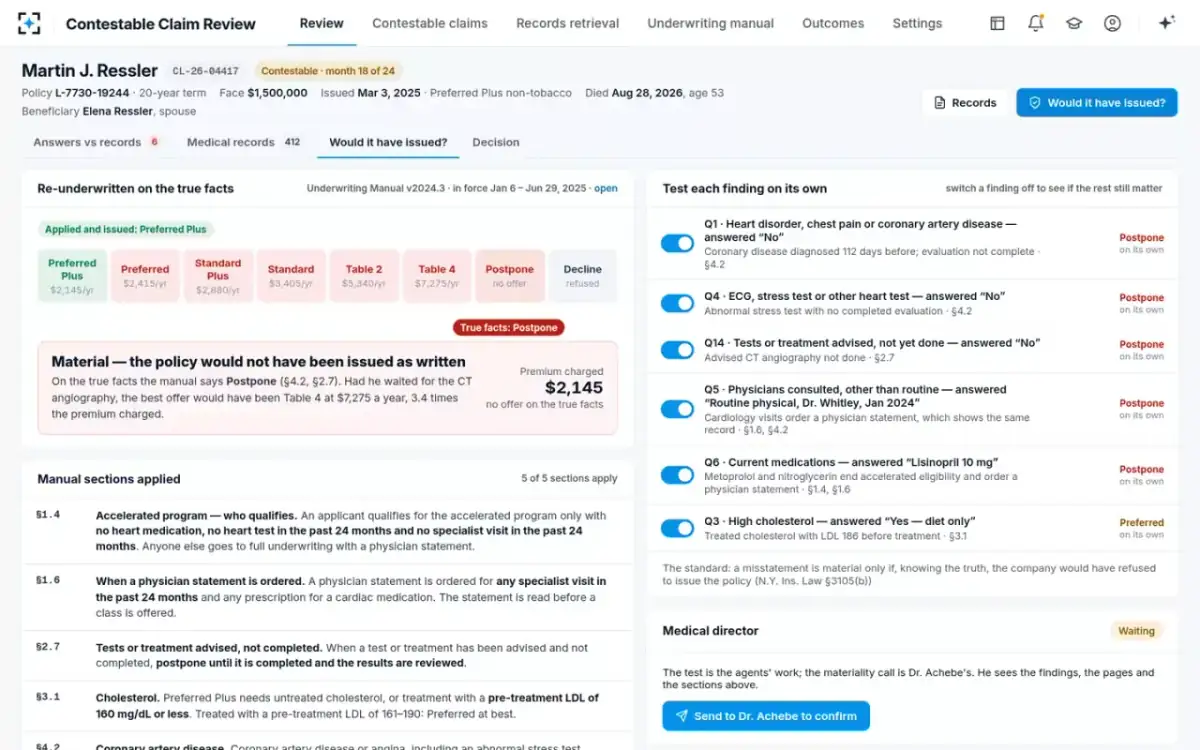
New York: “No” to heart disease, after a diagnosis 112 days earlier.
Texas: The same answer, on a Texas policy.
New York: The answer was false, and the manual at issue shows it would not have issued the same policy.
Texas: The answer was false and material, it affected the risks assumed, and the insured intended to deceive or induce issue.
New York: Still enough, if material.
Texas: Not enough; intent is an element the insurer must prove.
New York: Not in issue.
Texas: The insurer must plead and prove it; §705.004(c) also makes materiality and contribution questions of fact.
Whatever the state, a contestable review should keep intent out of its findings. The answer matcher in Contestable Claim Review marks answers consistent, inaccurate or incomplete with their pages and never calls a misstatement intentional or fraudulent. In New York intent does not matter; in Texas it is for counsel to prove; anywhere, a suspicion of fraud follows its own investigation route.
Who has to prove misrepresentation?
The insurer. In New York's words, "[T]o establish its right to rescind an insurance policy, an insurer must demonstrate that the insured made a material misrepresentation" (Neiditch, 2019, quoting earlier cases). The beneficiary does not have to prove the answers were true.
The usual forum is a jury. The same court explained: "Ordinarily, the question of materiality of misrepresentation is a question of fact for the jury. However, where the evidence concerning the materiality is clear and substantially uncontradicted, the matter is one of law for the court to determine" (Neiditch). That is the practical reason insurers bring their underwriting manuals to court: a manual that plainly maps the true facts to a decline or postponement is what makes the evidence clear enough for a judge to decide. Missouri sends the contribution question to the jury by statute (§376.580), and Texas makes materiality and contribution questions of fact (§705.004(c)).
The sample claim, in the terms the rule uses
112days
between the coronary diagnosis and the “No” on the application
6of 14
answers flagged: 5 inaccurate and 1 incomplete
Postpone
what the issue-date manual says on the true facts (§4.2, §2.7)
$2,415
what the cholesterol answer alone would have changed: Preferred instead of $2,145 Preferred Plus
Can a claim be denied for a minor omission?
Only if the omission was material under the state's test, and "minor" is the insurer's manual's call, not the beneficiary's or the examiner's. In the sample manual, treated cholesterol changes a preferred class (§3.1), which matters in Florida, whose statute names a different premium rate, and may or may not matter in New York, where courts ask whether the insurer would have issued the same policy and want the guidelines to show it.
The sample shows the difference. On the true facts, the heart-disease answer alone would have postponed the policy: material in every state that asks the refusal question. The cholesterol answer alone, "Yes, diet only" when treatment had followed an LDL of 186, moves the insured from Preferred Plus at $2,145 to Preferred at $2,415. A careful decision rests on the findings that stop the policy outright and treats the class change as a question for counsel. How the test separates the two is the subject of before you rescind a life insurance policy.
Re-underwritten on the true facts: where materiality is decided
Life insurance claim denied for misrepresentation: what the letter should show
A beneficiary told that a claim was denied for misrepresentation should be able to find four things in the letter: the question and the answer given, the record that contradicts it, why the truth would have changed the insurer's decision, and how to ask for a review or complain. NAIC's model unfair claims act counts it as unfair to deny a claim without promptly giving a reasonable and accurate explanation of why (Model #900 §4.L); what a denial letter must contain in one large state is set out in insurance claim denial letter requirements in California.
New York's regulator has also faulted an insurer for not giving beneficiaries specific reasons and for not referring in writing to the policy provisions relied on (DFS, 2016). In Contestable Claim Review the letter drafter writes in plain words, cites the page behind each statement, says why the finding matters under the manual in force at issue and explains how to ask for a review; it never sends, and counsel approves every rescission letter. What each state requires of a denial letter differs; California's rules are set out in the guide to insurance claim denial letter requirements in California.
When material misrepresentation stops mattering: after the contestable period
Once the policy has been in force for two years during the insured's lifetime, the statutes in New York, California, Texas and Florida make it incontestable, so a material misrepresentation in the application can no longer defeat it, with narrow exceptions such as nonpayment of premiums. A death inside the two years means the policy never reached that point, which is why contestable review exists at all. The rules and the exceptions, state by state, are in the life insurance contestability period by state.
Questions people ask
What is the definition of material misrepresentation in insurance?
A false statement of fact by the applicant that would have changed the insurer's decision. New York's statute counts it as material only if knowing the truth would have led the insurer to refuse the contract; Florida also counts a different premium or amount.
Does the misrepresentation have to be related to the cause of death?
In most states, no: California's statute says materiality is determined "not by the event". Missouri and Kansas are exceptions, where the matter misrepresented must have actually contributed to the event that made the policy payable.
What happens if I lie on a life insurance application?
If the insured dies within the contestable period and the lie was material, the insurer can seek to rescind the policy and return the premiums instead of paying the death benefit. A deliberate lie can also raise separate fraud questions; after the contestable period, New York, California, Texas and Florida bar contesting the policy over the application.
Can the insurer use records the beneficiary did not provide?
Yes. Insurers can obtain records directly from providers under a signed authorization, and New York's regulator says beneficiaries are not required to produce them. Separately, §3105(d) presumes a proven misrepresentation material where a claimant prevents full disclosure of the impairment.
Is "I forgot" a defence to misrepresentation?
In Texas it can matter, because the insurer must prove intent to deceive. In New York, California and Florida a material misstatement can defeat the policy even if it was an honest mistake.