A prescription history report is a consumer report that tells a life or health insurer which prescription drugs an applicant has filled, with dates, doses, refills, the pharmacy and the prescribing doctor, so an underwriter can see conditions the application may not mention. Insurers buy it from specialty consumer reporting companies, with the applicant's authorization, and in accelerated programs it often stands in for the medical exam. What it shows is what the reporter's sources saw: the Federal Trade Commission described one reporter obtaining histories from pharmacy benefit managers, so a fill paid in cash or with a discount card, outside the drug plan, can be missing. On a contestable death claim that gap matters both ways. Contestable Claim Review, Botminds' software for these claims, sets the pharmacy's own dispensing record against the report run at issue, explains each difference, and never treats a missing fill as proof that the insured was not treated.
This guide is for examiners and for applicants and families who want to know what the report holds. It uses one fictional sample claim from the solution: Martin J. Ressler, whose report at issue showed one blood-pressure drug, and whose pharmacy, asked at claim, showed three more.
The report run at issue and the pharmacy's record at claim, on the same insured
Prescription report, run 11 Feb 2025: A specialty consumer reporting company, compiled from benefit-plan data.
Pharmacy dispensing record, received 24 Sep 2026: Congress Park Pharmacy’s own dispensing log, all payment types.
Prescription report, run 11 Feb 2025: Lisinopril only.
Pharmacy dispensing record, received 24 Sep 2026: Atorvastatin, metoprolol and nitroglycerin, filled from 22 October 2024.
Prescription report, run 11 Feb 2025: Not visible.
Pharmacy dispensing record, received 24 Sep 2026: With a discount card, outside his drug plan.
Prescription report, run 11 Feb 2025: No cardiac drugs.
Pharmacy dispensing record, received 24 Sep 2026: Nine cardiac fills before he signed on 10 February 2025.
Prescription report, run 11 Feb 2025: His answer naming lisinopril as his only medication looked consistent at issue.
Pharmacy dispensing record, received 24 Sep 2026: The medication answer was incomplete; the fills match a cardiologist’s plan dated 21 October 2024.
What is a prescription history report?
It is a profile of an applicant's filled prescriptions sold to insurers for underwriting, and sometimes for claims. The CFPB's list of consumer reporting companies describes one provider as collecting "prescription drug purchase history for quantifying the relative mortality risk of life insurance applicants" and providing "risk scores for underwriting decisions" (CFPB, 2025).
The FTC's 2007 complaint against that provider described what the profile contained: "all prescription drugs, including dosage and number of refills filled by the insurance applicant for the previous five years. It also includes, for each drug, the name and address of the dispensing pharmacy, as well as the name and address of the prescribing doctor, including medical specialty" (FTC complaint). The prescriber's specialty is often the most telling line: a statin from a family doctor and a nitrate from a cardiologist say different things.
"What is Milliman IntelliScript?" is a common search for that reason. The CFPB lists Milliman IntelliScript among medical specialty reporting companies and notes that "IntelliScript is part of Milliman, Inc." (CFPB). It is one provider; the FTC's 2007 cases concerned two.
Do life insurers check prescription history?
Widely, especially in accelerated programs that skip the medical exam. The NAIC describes those programs as using "data from external sources, like prescription drug history and motor vehicle records" in place of the exam (NAIC). In the Society of Actuaries' 2022 survey of 24 direct writers, 88% named prescription histories and MIB data among the tools used to waive fluid tests or the exam (SOA survey).
Prescription history ranks first among data sources for assessing mortality in accelerated programs
The reports are not only an underwriting tool. The FTC's complaint said the provider had contracts with insurers "that use IntelliScript for underwriting or claims review purposes" (FTC complaint). On a contestable claim the report run at issue is evidence of what the insurer knew when it issued the policy, which is half of the materiality question.
How far back does prescription history go?
In the FTC's 2007 description, five years: the provider "obtains an insurance applicant’s five-year prescription drug history from the PBMs and creates a medical profile on the applicant for the insurance company" (FTC complaint). Products and sources may have changed since 2007, so the look-back of any report should be read from the report itself.
The report's window and the application's windows are separate things, and a contestable review needs both. If the application asked about treatment "in the past 10 years" and the report reaches back five, the report cannot confirm a "No" to the older half of the question. In the sample claim the cardiac fills fell in the months just before the application, well inside any window; the problem was not the window but the source.
Is a prescription history report a consumer report?
Yes. The FTC said in 2007 that such profiles "are consumer reports because they include information that bears on an individual’s personal characteristics and are used to determine their eligibility for insurance" (FTC), and federal law names a category of "nationwide specialty consumer reporting agency" for companies that keep files nationwide on, among other things, "medical records or payments" (15 U.S.C. §1681a(x)).
That status carries the Fair Credit Reporting Act's protections. An insurer that takes adverse action based in whole or in part on a consumer report must give the consumer notice and name the reporting agency, with a statement that the agency did not make the decision (§1681m). The consumer may dispute an item, and the agency must reinvestigate free of charge, generally within 30 days (§1681i). For a contestable claim decided after the insured's death, counsel decides how these duties apply to the estate and the beneficiaries; the report's role as evidence should be recorded either way.
Are cash pharmacy fills on the report?
Not reliably. A history compiled from benefit-plan data sees fills the plan adjudicated; a fill paid in cash or with a discount card, without using the plan, may never reach it. Researchers who study claims data describe the same gap: "claims databases do not capture dispensings where the patient fails to use a pharmacy benefit, such as when paying cash" (Cepeda et al., 2017).
A quarter of dispensings were missing from a commercial claims database, in every drug class studied
Diuretics
- Captured · 77%
- Missing · 23%
Opioids
- Captured · 76%
- Missing · 24%
Antiplatelet drugs
- Captured · 72%
- Missing · 28%
Anticoagulants
- Captured · 73%
- Missing · 27%
The study, by authors at Janssen Research and Development and IMS, linked a commercial claims database to one that "captures pharmacy dispensings independently of payment method, including cash transactions", across 1,426,498 adults. A quarter of dispensings were missing from the claims data, and the authors added that "The lack of capture goes beyond cash transactions": 48% of the missing dispensings involved someone with more than one health plan (Cepeda et al.). A report built from one plan's data can miss what another plan paid for.
For an applicant the lesson is plain: the report is not the whole history, and the application asks for the whole history. For an examiner it cuts the other way too: a fill missing from the report is not evidence that a misstatement was intended, and a fill missing from both the report and the pharmacy's record is not evidence that no drug was taken.
“The reconciler never treats an absent fill as proof of no treatment.”
One of the agent's fixed rules in Contestable Claim Review
The report at issue against the pharmacy at claim: the sample claim, step by step
In the sample claim the report run on 11 February 2025, the day after the application was signed, showed lisinopril only. The recorded telephone interview the next day had the insured naming lisinopril as his only medication. Both looked consistent, and the accelerated program issued Preferred Plus without an exam or a physician statement.
At claim, the records retrieval agent requested Congress Park Pharmacy's dispensing record for all payment types. It arrived on 24 September 2026: six pages, nine dated events. Atorvastatin, metoprolol and nitroglycerin had been filled from 22 October 2024, the day after a cardiologist diagnosed coronary artery disease with stable angina and started those drugs, and paid with a discount card rather than the drug plan. The pharmacy and history reconciler set the two against each other and wrote the explanation on the file: nine fills before the application, paid outside the plan, absent from the report.
The pharmacy's own record among the sources, and the cardiology page behind the fills
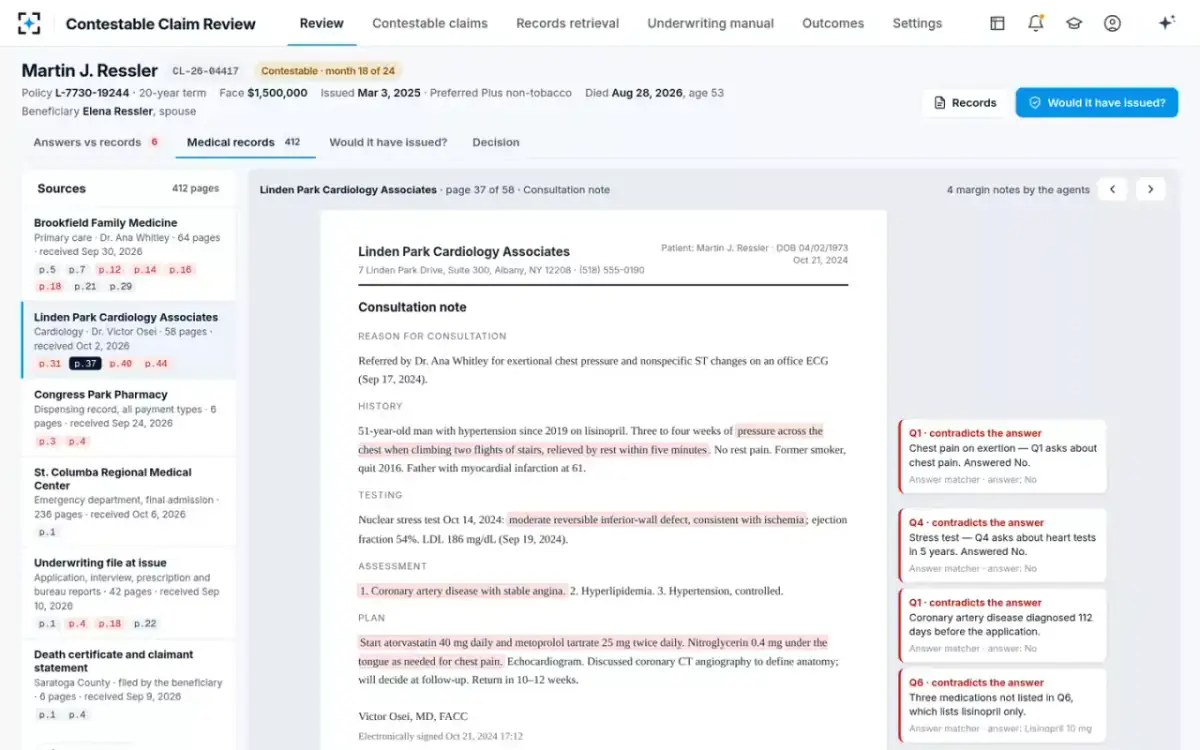
The examiner then had three consistent sources against one: the cardiologist's plan, the pharmacy's log and the stress test that preceded them, all inside the application's windows. The report's silence was explained, not ignored. Whether those facts were material is a separate step, covered in before you rescind a life insurance policy; how a team can test whether a tool catches fills like these is in testing a claim review tool.
Can I get my prescription history report, and can I dispute it?
Yes, if a reporter holds a file on you. The CFPB's list says of Milliman IntelliScript: "The company will provide a free copy of your report if they have one and if you request it", and advises consumers to "Fact-check your medical specialty report before or when applying for private life, health, critical illness, long-term care, or disability income insurance" (CFPB). Federal law gives consumers a free annual disclosure from nationwide specialty consumer reporting agencies, to be provided within 15 days of the request (§1681j).
For applicants and families: getting and checking a prescription history report
- Find out who may hold a file
The CFPB’s list of consumer reporting companies names the medical specialty reporters and how to contact them.
- Ask for your free copy
Specialty reporters must provide a free annual disclosure on request, within 15 days.
- Check each fill, pharmacy and prescriber
Look for drugs you never took, a prescriber you never saw, or someone else’s fills.
- Dispute errors in writing
The reporter must reinvestigate free of charge, generally within 30 days of your dispute.
- If an insurer acted on it, read the notice
It must name the reporter and say the reporter did not make the decision.
- Answer the application from your own history, not the report
A fill missing from the report is still a fill the application asks about.
What the MIB file is, and what it is not
The MIB file is a separate specialty consumer report. The CFPB describes MIB, Inc. as collecting "information about medical conditions and hazardous avocations" that it reports "to life and health insurance companies with your authorization to assess risk and eligibility during the underwriting of individual" policies; if it has a file about you, it "will provide one free report every 12 months if you request it" (CFPB). The CFPB adds that people who have not applied for individual life or health insurance with a company that uses such a service generally will not have a file.
It is not a medical record and not a prescription history. On a contestable claim it is one more source to set against the records, as the bureau codes were in the sample, where the reconciler found no prior codes. A clean bureau file, like a clean prescription report, shows what the source saw, not what happened.
What an examiner should never conclude from a missing fill
Never that the insured was untreated, and never that the insured lied. A fill can be missing because it was paid in cash, filled under another plan, dispensed as a sample, or bought at a pharmacy no one asked. The reverse error is as costly: a report that missed a fill does not prove the insured hid it; the application asks what the applicant was told and took, not what a database recorded.
That is why Contestable Claim Review asks pharmacies for dispensing records covering all payment types, keeps the report run at issue beside them, and writes a one-line explanation of each difference for the examiner. In the sample, the reconciler "found 9 fills made before the application, paid with a discount card and missing from the prescription report run on Feb 11, 2025". On another file the explanation might be a fill under a spouse's plan, or no record at either source. The examiner decides what each means.
Questions people ask
Can a life insurer see my prescriptions without asking me?
Not through a consumer report. A reporting company may furnish a report containing medical information for an insurance transaction only if "the consumer affirmatively consents to the furnishing of the report" (§1681b(g)); the FTC's 2007 complaint described insurers having applicants sign a consent form for exactly this.
Do prescription history reports show prescriptions that were written but never filled?
A purchase history records fills, so a prescription never filled would not appear. A medical record can show what was prescribed or advised; in the sample claim the cardiologist's note showed the plan and the pharmacy's log showed the fills.
Will a discount card keep a prescription off the report?
It can. Histories compiled from benefit-plan data may not include a fill the plan never adjudicated; research on claims data found a quarter of dispensings missing, for cash and other reasons. It does not take the prescription off the application, which asks about treatment, not about databases.
Is the prescription history report the same as an MIB report?
No. The CFPB lists them as separate specialty consumer reports: MIB collects information about medical conditions and hazardous avocations from member insurers' underwriting; prescription histories record drug purchases. Insurers often use both.
Who can see the report after the insured dies?
The insurer that ran it keeps it in the underwriting file, where it becomes evidence at a contestable claim. Whether and how an estate can obtain it is a question for the reporter and the estate's representative under the Fair Credit Reporting Act; the medical records themselves follow HIPAA's rules for personal representatives.