APS retrieval and summary services do two separate jobs for a life insurer: retrieval, which is ordering the attending physician statement, chasing the doctor's office and paying its copy fee, and summary, which is reading the records and writing an abstract for the underwriter. Most carriers buy retrieval because chasing offices is labour with no clinical content. The summary is where the real choice lies, between paying a service per file, staffing underwriting nurses, or having agents read every page the moment it arrives. Botminds' APS Summarization is the third option, and it does only the summary: it starts when the records land and does not order or chase them. This guide sets out what each option costs per file, using federal wage data and a state fee rule, and what each leaves behind for the underwriter.
The examples use the solution's fictional sample: a carrier that decided 412 fully underwritten cases in September and a 312-page sample file. Every cost below is a method with our worked numbers; replace them with yours.
Reading one 300-page APS: wage cost of the people's time, three ways
What do APS retrieval companies do, and what do summary services add?
A retrieval company turns a signed authorization into records in the insurer's hands. The insurer, or its case manager, sends the authorization the applicant signed, which HIPAA requires to name "The name or other specific identification of the person(s), or class of persons, to whom the covered entity may make the requested use or disclosure". The retrieval firm then sends it to each doctor's office, follows up by phone and fax, pays the office's copy fee, and forwards the pages. That is valuable work, and its delay is measured in weeks: on the fictional sample case the APS was ordered on 21 September and arrived on 9 October.
A summary service adds a reader. It returns an abstract of the records, by visit or by impairment, for the underwriter to work from. The quality of that abstract decides what the underwriter still has to do: an abstract that cites its pages can be checked in minutes, one that does not has to be trusted or re-read. Both kinds of firm are commercial, and nothing public measures their turnaround or accuracy, so the questions at the end of this guide are the only benchmark there is.
Who pays for an APS, and how much does the attending physician statement cost?
The insurer pays; the applicant does not. State rules on medical records let the doctor charge the party that asks. Florida's Board of Medicine rule shows how this works: a physician "may condition such release upon payment by the requesting party of the reasonable costs of reproducing the records." It then sets two price lists, one for patients and one for everyone else.
The difference is worth seeing. For patients and governmental entities Florida caps paper copies at $1.00 a page for the first 25 pages and 25 cents a page after that. For other entities, which includes an insurer, the rule says the cost "shall not be more than $1.00 per page." The sample file's 118-page primary care chart would therefore cost a patient at most $48.25 and an insurer at most $118 from a Florida physician. HIPAA's own fee limit does not help the insurer: the "reasonable, cost-based fee" applies when the individual asks for their own records, not when a third party asks under an authorization. Copy fees are state law, they differ by state and by type of provider, and they are only part of what a retrieval firm charges.
Copy fees for one APS chart under Florida's physician rule
| Requester | First 25 pages | Each page after 25 | 118-page primary care chart |
|---|---|---|---|
| Patient or government | $1.00 a page | $0.25 a page | $48.25 at most |
| Other entities, such as a life insurer | $1.00 a page | $1.00 a page | $118.00 at most |
| X-rays and special records | Actual cost | Actual cost | — |
The cost of reading one APS, in four terms
Whatever option you choose, the cost of reading a file is the sum of the same four terms, and the options move cost between them rather than removing it. The reading term is the one most carriers know; the review term is the one most forget. An outsourced abstract that the underwriter does not trust gets re-read, and then the carrier pays for the reading twice.
Cost of the summary on one APS file
Reading
Pages ÷ pages read per hour × the reader’s loaded hourly cost
Our estimate is about 3 hours for 300 pages by hand. With agents it is the per-file price.
Nurse, underwriter, vendor or agents
Review
Underwriter minutes to check the abstract against the pages × loaded rate
Near zero if every statement cites its page; a full re-read if none do.
Underwriter
Waiting
Days the file waits for a reader × the cost you put on a day of delay
A file that lands on Friday evening and waits for Monday is two days older before anyone has read it.
New business
Errors
Rate of missed or wrong findings × the cost of one (a misclassified case, a post-issue audit finding)
Measured only by an audit that re-checks the abstract against the pages.
Underwriting audit
Three options, one month: 412 fully underwritten cases
At the fictional carrier's volume the reading hours decide the staffing. At our estimate of three hours a file, 412 files a month is about 1,236 hours of reading, or between seven and eight full-time readers at 160 hours each. At about 24 minutes of human review a file with agents, it is about 165 hours, roughly one person. At the nurse median wage that is about $58,000 of reading wages a month by hand against about $7,700 of review wages with agents, before the agents' price, benefits and overhead.
Where a month of reading hours goes: by hand vs with APS Summarization
By hand: about 1,236 hours
- Reading every page · 50%
- Collecting lab values · 17%
- Checking the application · 17%
- Ordering and duplicates · 8%
- Notes · 8%
With the agents: about 165 hours
- Reading the pages that matter · 50%
- Checking flags · 25%
- Notes · 25%
Two figures from the sample keep the arithmetic honest. In the carrier's September audit, the median agent read took 4 minutes 50 seconds for a median file of 214 pages, and the median underwriter time in a file, from opening to decision or referral, was 22 minutes. Both are sample data on fictional cases. They are close enough to our estimate of 24 minutes of human time to use it for planning, and different enough that a carrier should measure its own.
Should we outsource APS summaries? What each option leaves behind
Outsource retrieval if you do not want to chase offices; decide the summary on what the underwriter is left holding. The three options differ less in their price than in four things the underwriter inherits: whether every statement can be traced to a page, how long the file waits, whether the application has been checked against the records, and whether anyone can audit the reading later.
APS retrieval and summary services vs in-house nurses vs agents, on what the underwriter inherits
| Question | Retrieval plus an outsourced summary | In-house nurses reading by hand | In-house, with APS Summarization |
|---|---|---|---|
| Who orders and chases the records? | The service | Your case managers or a retrieval firm | Your case managers or a retrieval firm: the solution does not retrieve |
| When is the file read? | When the vendor’s reader reaches it | When a nurse is free | When it lands, night or weekend |
| Can every statement be traced to a page? | Only if the contract requires page citations | Depends on the nurse’s habits | Yes: a sentence without a page is not written, and an unfound citation blocks signing |
| Is the application checked against the records? | If ordered as part of the abstract | Yes, by the nurse | Yes: each Part II answer beside the records, the prescription history and the MIB report |
| What happens when more pages arrive? | Usually a new order | The nurse re-reads | The file is read again and the summary shows what changed |
| Who sets the impairments and ranges? | The vendor’s template | The carrier’s manual, applied by each reader | Carrier settings, saved as versions |
| How is the reading audited? | By your own sample of abstracts | By your own sample of files | Monthly sample, every citation re-checked against its page |
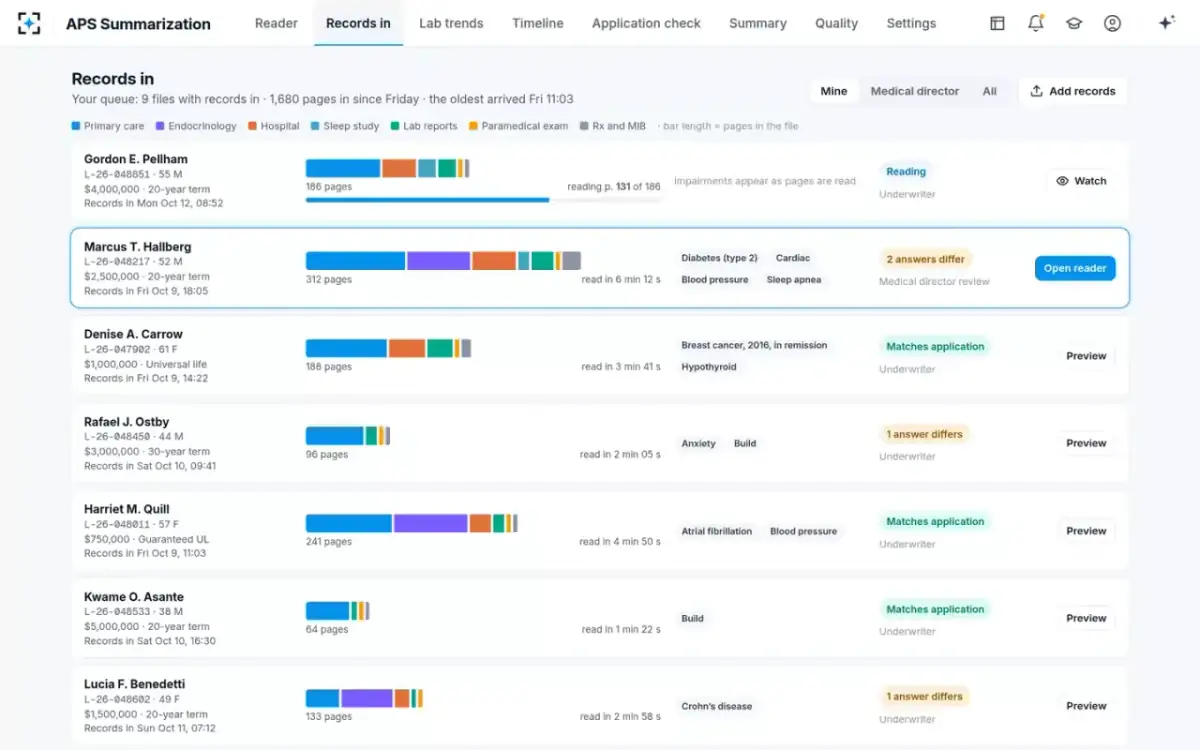
Records in: every APS read as it lands, whoever retrieved it
How long does APS retrieval take, and does faster reading matter?
Retrieval takes weeks and reading takes hours; only the second is yours to remove. The NAIC describes the traditional process, with its exams and records, as taking up to a few months from application to issue, and says accelerated programs that skip the exam can cut the application process "from several weeks to just a few hours". No regulator or independent study measures APS turnaround on its own, so the useful benchmark is your own order-to-arrival dates. On the fictional sample the wait was 18 days.
That makes the reading delay look small, and on one file it is. Across a month it is not. A file that waits two days for a reader, multiplied by every file that lands late in the week, is a standing backlog that grows whenever a nurse is out. Reading on arrival removes the backlog rather than shortening it, because there is no queue for a reader to clear.
The APS is read twice: at issue and in the audit
Reading capacity is needed in two places, and a cost model that counts only new business undercounts it. Accelerated programs issue many policies without records, then check a sample afterwards. In the Society of Actuaries Research Institute's 2022 survey of 24 direct writers, written by authors at Milliman, post-issue audits covered on average 6% of eligible policies, random holdouts 4%, and the primary audit tool was "an attending physician statement (APS) (80% of the respondents)".
Every one of those audit files is an APS that someone must read and compare with what the applicant said at issue, which is the same work as new business with less urgency and more at stake: a finding can end in rescission. A reading capacity sized only for new business will push audits to the back of the queue. The same records can surface a third time at a contestable claim, which the guide to medical records after death follows.
What to ask any APS summary service or tool before you buy
Ask for evidence on your own files, not a demonstration on theirs. A summary is only as good as the underwriter's ability to check it, so the first questions are about citations, and the last are about who is accountable when it is wrong. A pilot design that tests these on decided cases is laid out in APS medical summarization: pilot it on 40 of your closed cases.
Questions for an APS retrieval and summary service, or an in-house tool
- Does every statement cite the page it came from?
And is the citation checked against the page before the summary is delivered?
- What happens to duplicate and unreadable pages?
Deleted pages break citations; unreadable ones should go to a person, not be skipped.
- Are lab values charted over time, with their sources?
A table of latest values hides the trend the underwriter rates.
- Is the application checked against the records, the prescription history and the MIB report?
And are differences written neutrally, without judging intent?
- Whose impairment list and reference ranges apply?
Yours, versioned, or the vendor’s template?
- What is re-read when more records arrive?
A new order and a new fee, or the file read again with the changes shown?
- Who measured the accuracy, and on whose files?
Ask for a re-check of citations on a sample of your decided cases.
Where APS Summarization fits, and where it does not
It fits where the reading is the bottleneck and the underwriter must be able to check every line. It reads files of any length as they arrive, indexes every impairment mention, charts lab values with their pages, checks the application against the records, prescription history and MIB report, and writes a two-page summary in which every sentence carries its page. It never states a rating or class, orders a requirement or contacts anyone.
What the underwriter inherits when the reading is done in-house with agents
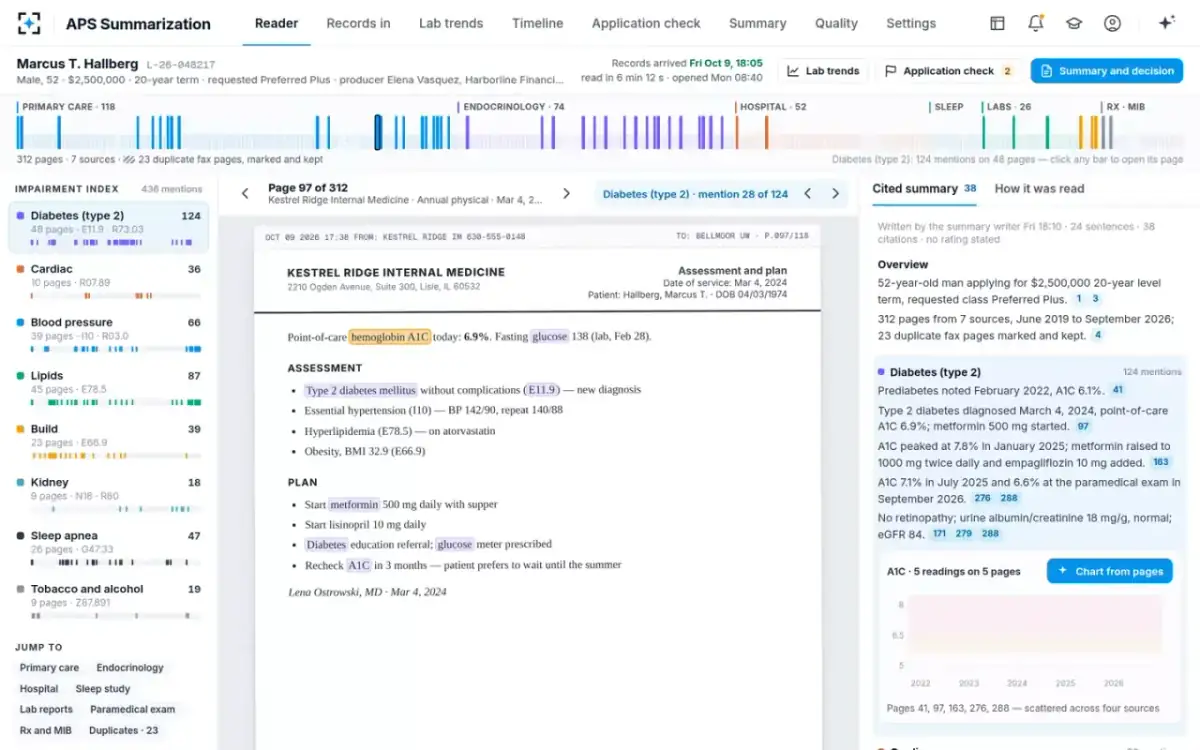
It does not fit as a retrieval service. It does not order records, chase doctors' offices or pay copy fees; those stay with your case managers or your retrieval firm. And it does not replace the underwriting nurse's judgement on what a finding means. A carrier that buys retrieval and reads in-house with agents keeps the reading, and its audit trail, on its own side. The sample case is on the APS Summarization page.
Questions people ask
What is APS retrieval?
The work of getting an attending physician statement from the applicant's doctors: sending the signed authorization to each office, following up, paying the copy fee and forwarding the records. It is separate from reading them. On the fictional sample case the APS took 18 days from order to arrival.
How do insurers order an APS?
With the applicant's signed HIPAA authorization, sent to each provider the insurer needs records from, either by the insurer's case managers or through a retrieval firm. The authorization must describe the information, who may release it, who may receive it, the purpose and an expiration date or event.
How much does an attending physician statement cost?
It depends on the state, the provider and the retrieval firm's charges. Under Florida's physician rule an insurer can be charged up to $1.00 a page, so a 118-page chart could cost up to $118 in copy fees alone, against $48.25 for the same chart requested by the patient.
Should the summary be outsourced if retrieval is?
Not necessarily. Retrieval is chasing; the summary is reading, and what the underwriter inherits depends on whether every statement can be traced to a page. Many carriers can buy retrieval and keep the reading in-house, by hand or with agents.
Do accelerated underwriting programs still need APS reading?
Yes. In the Society of Actuaries' 2022 survey of 24 companies, by authors at Milliman, post-issue audits covered an average of 6% of eligible policies, and 80% of respondents used an APS as the primary audit tool. Hybrid programs also use an APS or electronic health records on some cases.