A medical underwriting nurse is a registered nurse who works for a life insurer reading the medical evidence on an application: the attending physician statement (APS), hospital and specialist records, lab results, the prescription history and the MIB report. The nurse turns that stack into what the underwriter needs to rate the case: each impairment, when it was diagnosed, how it is treated, its latest values, and where the records and the application disagree. The work is hard because the records arrive as hundreds of faxed pages in no order, and the reading has to be complete. Botminds' APS Summarization exists for that reading: its agents sort, index, chart and cite every page before the case is opened, so the nurse's hours go to judgement instead of page-turning.
The examples come from a fictional sample case as it runs through the solution: a 52-year-old applicant for $2,500,000 of 20-year term at a fictional carrier, whose records arrive as 312 pages from seven sources. The research figures come from federal agencies, the NAIC and the Society of Actuaries, linked where they appear.
The medical underwriting nurse and three seats around one APS, before and with APS Summarization
Today
Reads the whole APS, page by page, to find every diagnosis, medicine, lab value and hospital stay; types the abstract the underwriter will rate from.
With agents
Opens a file already sorted, indexed and charted; checks what the agents found against the pages and writes the clinical judgement only a nurse can.
Still theirs: what a finding means clinically, what is missing, and when to say "ask the medical director"
Today
Waits for the nurse’s abstract, or reads the records personally when no nurse is free.
With agents
Starts from a cited two-page summary and the application check; reads the pages that change the class.
Still theirs: the rating, the requirements ordered, and the signature within authority
Today
Gets a referral note with single values copied by hand.
With agents
Gets the trend lines, the timeline and every flag, each point linked to its page.
Still theirs: the medical opinion on referred cases
Today
Orders the APS, chases the office, then watches the file wait for a free reader.
With agents
Sees the file read the evening it lands and is copied on any amendment request.
Still theirs: the contact with the producer and the doctor’s office
What does a medical underwriting nurse do on a life case?
The nurse reads the medical evidence and writes it down in a form an underwriter can rate from; the nurse does not decide the case. In practice that means four jobs. Abstract every impairment from the records. Put lab values and vital signs in date order so a trend can be read. Compare the records with the applicant's Part II medical answers, the prescription history and the MIB report. And note what is missing, such as a referral with no specialist note behind it, so the underwriter can decide whether to order more.
The seat exists because the evidence is clinical and the decision is not. An underwriter is trained in the carrier's manual and its rating classes; reading a cardiology note, an echocardiogram report or a sleep study is a clinician's skill. The Bureau of Labor Statistics lists among an underwriter's duties that they "Contact field representatives, medical personnel, and others to obtain additional information". At a carrier that staffs nurses, the medical personnel are inside the building, and the nurse is the first of them to see the file.
Titles vary. Searches and job titles use medical underwriting nurse, clinical underwriting nurse and underwriting nurse for overlapping roles, and at a carrier without nurses the underwriter does the same reading. The solution's own problem statement names both: "An underwriter or underwriting nurse then reads it end to end."
Why does an APS arrive as hundreds of pages?
Because the authorization the applicant signs lets the doctor send everything it describes, and HIPAA does not ask the doctor to trim it. A doctor's office is a HIPAA covered entity, and it releases records to a life insurer under a signed authorization. That authorization must describe the information "in a specific and meaningful fashion", but once it does, the rule that normally makes a covered entity send only what is needed is switched off. Minimum necessary, says the Privacy Rule, does not apply to "Uses or disclosures made pursuant to an authorization under § 164.508".
So the office copies the chart. On the sample case that meant 118 pages from the primary care practice, 74 from the endocrinologist, 52 from the hospital, a sleep study, outside lab reports, the paramedical exam, and the prescription history and MIB report: 312 pages covering June 2019 to September 2026, 23 of them duplicate fax pages. Nothing in the stack says which pages matter. The nurse finds out by reading all of them.
The authorization decides what the doctor may send. Nothing decides what the doctor must leave out. The nurse is the filter the law does not provide.
What does an underwriting nurse look for in an APS?
Diagnoses, treatments, test results and anything that contradicts the application. The list is the carrier's, set in its underwriting manual, but the categories repeat on almost every file: chronic conditions such as diabetes, hypertension and lipid disorders; cardiac events and their work-up; build; kidney function; sleep apnea; tobacco and alcohol; cancer history; mental health. For each, the nurse needs the date it first appears, the treatment and whether it changed, the latest value and the trend.
Lab values are where precision matters most. A1C is the standard example: the CDC calls below 5.7% normal, 5.7% to 6.4% prediabetes and 6.5% or above diabetes. On the sample case five A1C readings sit on five pages from four sources, from 6.1% in 2022 to a peak of 7.8% in January 2025 and 6.6% at the paramedical exam. Read alone, the peak over-rates the applicant and the latest value hides the diagnosis. The nurse's job is to write the line, and our guide to A1C levels for life insurance follows one of those readings from the page to the decision.
Two outside reports frame the read. Both are consumer reports under federal law, and the CFPB lists their providers: MIB, which the CFPB says reports medical conditions to life and health insurers with the applicant's authorization, and prescription-history services, which the CFPB describes as collecting pharmacy purchase histories to score applicants' relative mortality risk; what that report shows and misses is set out in the prescription history report. A medicine in the prescription history with no matching diagnosis in the APS is one of the first things a nurse looks for.
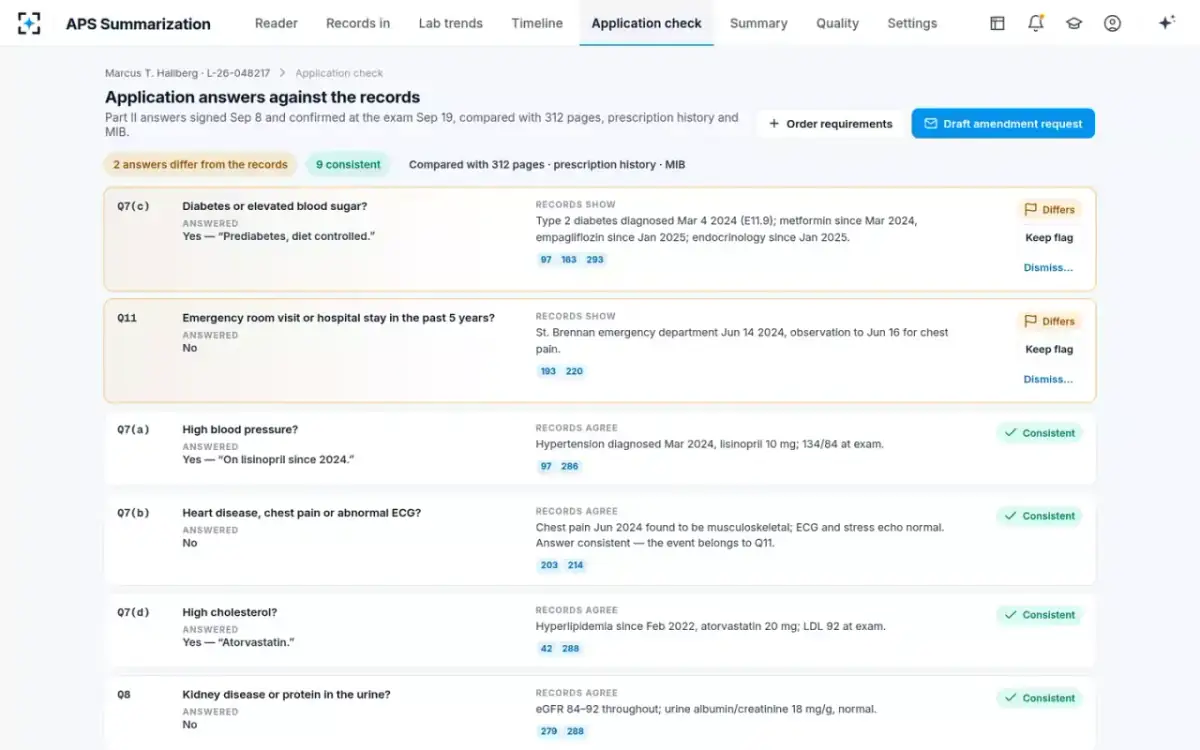
The application check: Part II answers beside what the records show
Where a nurse's hours go on a 300-page file
Mostly into reading pages that turn out not to matter. Our estimate for a file of about 300 pages read by hand is about three hours, and half of it is the end-to-end read for diagnoses, medicines and tests. The rest is putting pages in order and spotting duplicates, collecting lab values scattered across reports, checking the application, and writing the notes. The estimate is ours, built from the solution's sample case; no public body measures APS reading time, and a carrier should replace it with its own.
Half of a medical underwriting nurse's time on a 300-page APS is the end-to-end read
By hand, about 3 hours
- Reading every page · 50%
- Collecting lab values · 17%
- Checking the application · 17%
- Ordering pages and duplicates · 8%
- Writing the notes · 8%
With APS Summarization, about 24 minutes
- Reading the pages that matter · 50%
- Checking the flags · 25%
- Writing the notes · 25%
The second bar is not an empty bar. What remains is the part of the read that needs a clinician: opening the pages the index points to, deciding whether a flag is a real difference or a wording problem, and writing the medical note in the carrier's own terms. On the sample case the reading itself, 312 pages sorted, indexed, charted and summarised, took the agents 6 minutes 12 seconds on the Friday evening the records arrived.
Do life insurance companies hire nurses? What the federal data shows
Yes, but the federal statistics do not count them as a group. The Bureau of Labor Statistics publishes one profile for insurance underwriters and one for registered nurses, and the underwriting nurse sits between them. The underwriter profile does not mention nurses; the nurse profile names insurance companies only in a list of employers that also includes hospitals, pharmaceutical manufacturers and managed care organizations. Anyone sizing this workforce from public data is estimating.
The two federal profiles the underwriting nurse sits between
125,600
insurance underwriter jobs in 2025, all lines
$81,370
median underwriter wage, May 2025
$97,550
median registered nurse wage, May 2025, all settings
−4%
projected change in underwriter jobs, 2025–2035
The wages carry an argument. At the medians, an hour of a registered nurse costs about a fifth more than an hour of an underwriter. A carrier that staffs nurses to read records is paying clinical rates for the reading, and every hour spent sorting fax pages is an hour of that rate spent on clerical work. The medical underwriting nurse salary question that job seekers type is answered for the profession as a whole; inside a carrier, the better question is how much of that salary buys judgement.
Accelerated underwriting did not retire the APS
Accelerated programs skip the exam and the fluids on many cases, but they still lean on medical records, at the edges and afterwards. The NAIC describes traditional underwriting as requiring "the collection of extensive medical information including a physical exam and fluids testing (blood, urine, and saliva)", and accelerated programs as replacing some of that with outside data. Records come back in two places.
First, in hybrid programs. In the Society of Actuaries Research Institute's 2022 survey of 24 direct writers, conducted by authors at the consultancy Milliman, 13 companies ran a hybrid program as their most prevalent one, which the survey describes as "the use of EHR or APS plus underwriter judgement" to decide whether a case can be issued without fluids. Second, in audits: the same survey found that four in five respondents used an APS as the primary tool for post-issue audits (SOA survey). A case accelerated at issue can still produce an APS for someone to read months later, and the same records are read again at a contestable claim.
Which hours move to agents, and which judgement stays with the nurse
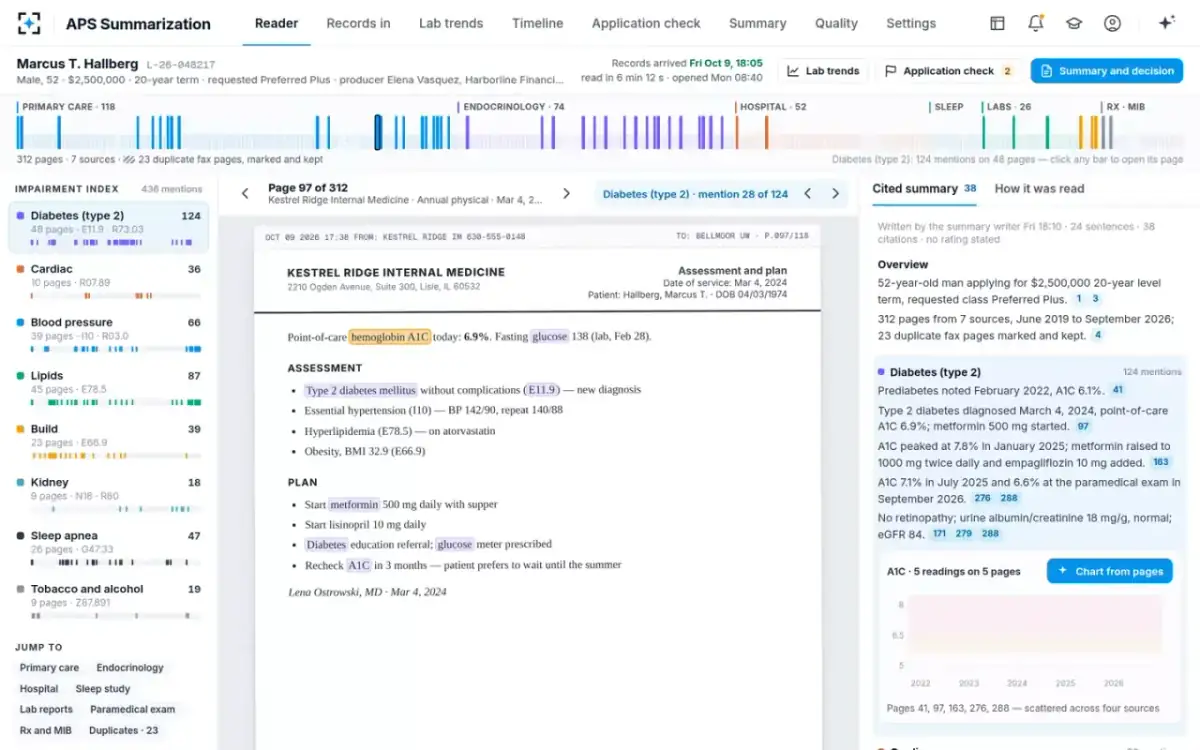
The mechanical reading moves; the clinical reading stays. In APS Summarization six agents divide the work: a record sorter splits the file into source documents, dates every page and marks duplicate fax pages without removing them; an impairment indexer records every mention of each impairment with its page; a lab extractor charts every value without filling gaps; a disclosure checker sets the Part II answers beside the records, the prescription history and the MIB report; a requirements suggester quotes the manual section behind each suggestion; and a summary writer produces two pages with every sentence cited. None of them states a rating or a class, orders a requirement or contacts anyone.
What the nurse opens in APS Summarization: pages by source, an index and a cited summary
What stays with the medical underwriting nurse when agents do the reading
- Whether a finding is clinically significant
An index can show 47 mentions of sleep apnea; only a clinician reads whether CPAP use on 92% of nights means it is controlled.
- What is missing from the file
A referral with no specialist note, a test ordered but never reported. The agents list what is on the pages; the nurse notices the silence.
- Whether a flagged difference is real
A "prediabetes" answer against a diabetes diagnosis is a difference; whether the applicant could reasonably have known is a human question.
- When to refer
The carrier sets referral rules (in the sample, over $2,000,000 with two or more impairments); the nurse can always ask for a medical director.
- Checking the agents
Every sentence and chart point opens its page. A citation that cannot be found on its page blocks signing; the nurse is the one who looks.
Will AI replace underwriting nurses?
The federal outlook expects fewer underwriters and gives automation as the reason, but the work it automates is processing, not clinical judgement. The BLS credits automated underwriting software with letting fewer underwriters process applications faster. Life insurers are already using these tools where the nurse works: in the NAIC's survey of 161 life insurers, underwriting accounted for 34% of the AI and machine-learning models in use, second only to marketing at 36% (NAIC life insurer AI/ML survey).
Reading an APS is a different task from scoring an application. A score can be wrong silently; a summary of a medical record can be checked, sentence by sentence, against the page it came from. That is the design choice that keeps the nurse in the seat: if every statement carries its page, the nurse's role shifts from finding facts to verifying them and judging what they mean, and the hours released go to the cases that need a clinician. A seat that verifies needs fewer hours per file, not fewer clinicians on hard files.
The rules point the same way. Regulators expect an insurer that uses AI in underwriting to stay accountable for every decision it supports, a subject our guide to AI medical record review in life underwriting takes rule by rule. The APS Summarization page shows the full sample case, from the Friday evening the records land to the medical director's sign-off.
Questions people ask
What is a medical underwriting nurse in life insurance?
A registered nurse employed by a life insurer, or by a firm working for one, who reads the medical records on applications and abstracts them for the underwriter. The nurse reviews the attending physician statement, hospital and lab records, the prescription history and the MIB report, and flags differences from the application. The underwriter, not the nurse, decides the rating.
What is the difference between an underwriting nurse and an underwriter?
The nurse reads and interprets the clinical evidence; the underwriter applies the carrier's manual, sets the class and signs within an authority limit. The BLS profile of underwriters lists contacting "medical personnel" for more information among their duties, which is the hand-off the nurse seat formalises. At carriers without nurses, underwriters do both jobs.
What is a medical underwriting nurse's salary?
No federal series measures it. The closest public figure is the BLS median for all registered nurses, $97,550 in May 2025, against $81,370 for insurance underwriters. Pay for underwriting nurses depends on the carrier, the location and whether the role is staff or contract.
Do life insurance companies need medical records for every applicant?
No. Accelerated programs waive exams and fluids on many cases; in the Society of Actuaries' 2022 survey of 24 companies, written by authors at Milliman, an average of 46% of eligible policies were expected to have them waived. Records are still ordered on larger or older applicants, on hybrid programs and in post-issue audits, where an APS was the main tool for 80% of respondents.
Why is reading an APS so slow?
Because a signed authorization lets the doctor send the whole chart: HIPAA's minimum-necessary rule does not apply to disclosures made under an authorization. The result is hundreds of pages in fax order, with duplicates, and the relevant lab values on different pages from different labs. On the fictional sample case, 312 pages came from seven sources.
Can an underwriting nurse work from the summary alone?
Only if every statement in it can be checked. In APS Summarization each of the 24 sentences in the sample summary carries its page, 38 citations in all, and a citation that cannot be found on its page blocks signing. The nurse still opens the pages that change the class.