In medical record underwriting, life insurance companies check records as far back as the records go, within limits set by four different things, and no single federal rule sets one number. The application's medical questions each name a period, often several years, and those periods decide what an applicant must disclose. The attending physician statement (APS) carries whatever the doctor's office still holds, and state rules make doctors keep records for years: at least five from the last patient contact in Florida, at least six in New York. Consumer reports such as MIB's are bound by federal law's seven-year limit on adverse information, except for life insurance of $150,000 or more. And after the policy is issued, a two-year contestable period gives the insurer one more look. Botminds' APS Summarization reads every page that arrives, dates it, and lays the history out on a timeline so the underwriter can see which findings fall inside each question's window.
How far back life insurance companies can look, and what sets each limit
| What sets the limit | How far back | The rule |
|---|---|---|
| The application’s questions | The period each question names; the sample’s emergency-visit question asked about 5 years | Carrier’s own form, approved by the state |
| What the applicant’s doctors still hold | At least 5 years from the last visit in Florida, at least 6 years in New York; often longer | State record-retention rules for physicians and licensed professionals |
| Consumer reports such as MIB | Adverse items over 7 years old are barred, except for life insurance of $150,000 or more | 15 U.S.C. § 1681c(a)(5) and (b)(2) |
| When the authorization works | A form signed for a life application lasts no more than 30 months in Virginia; it limits when records are fetched, not how old they are | Va. Code § 38.2-606 |
| After issue | Two years of contestability from the issue date | State law, e.g. N.Y. Ins. Law § 3203 |
How far back do life insurance companies look at medical records? The application sets the window
The application's questions set the lookback that matters most, because they define what a truthful answer covers. A question that asks about treatment "in the past 5 years" is answered correctly by someone who disclosed everything in that window, whatever is older. On the fictional sample case, question 11 asked about an emergency room visit or hospital stay in the past five years; the records showed an emergency visit about 27 months before the application was signed, inside the window, which is why the answer "No" was flagged. Older history still matters to the rating, but it is not a disclosure question.
Each carrier writes its own questions and periods, so the answer to "how far back" for any one policy is on the application form itself. Underwriters read the APS against those windows, question by question, and a summary that puts every finding on a dated timeline makes the comparison mechanical instead of a search.
How far back does the APS go? As far as the doctors keep records
An APS carries the chart the doctor still has, and state rules set minimums, not maximums. Florida's Board of Medicine requires a physician to maintain patient records "for a period of at least five years from the last patient contact". New York's rules for licensed professionals say "Unless otherwise provided by law, all patient records must be retained for at least six years." Both count from the last contact or later, so a patient seen every year has a chart that can run back decades. Hospitals and other providers have their own rules.
How far back the rules reach, in years
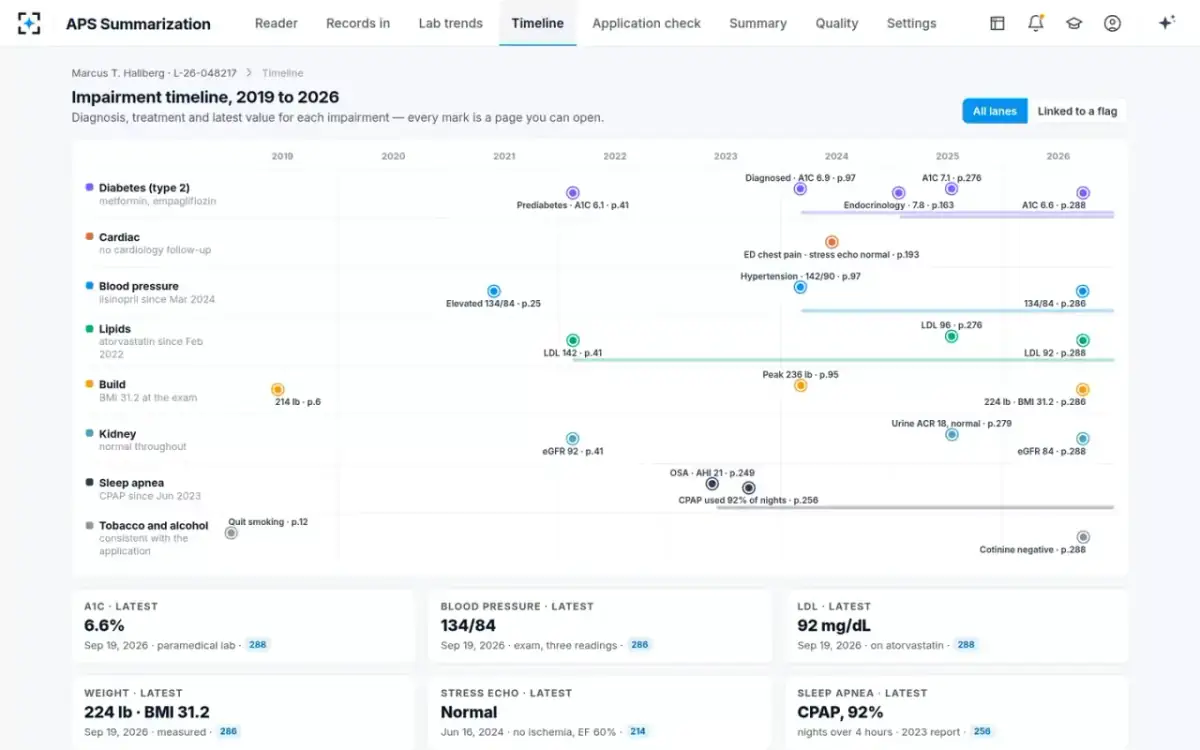
On the sample case the oldest record was from June 2019, a primary care chart the practice had kept for a patient seen there since 2014. The impairment timeline runs from that first page to the paramedical exam in September 2026, and every mark on it opens its page.
The impairment timeline in APS Summarization: seven years, one lane per condition
How far back each source reached on one sample file
Each source in an APS has its own reach, and the oldest page usually comes from the doctor who has known the applicant longest. On the fictional sample case the seven sources covered very different spans: the primary care practice reached back more than seven years, the hospital record covered three days, and the prescription and MIB reports were pulled in the same month as the exam. The span matters because a finding can only be weighed against a question whose window it falls in.
How far back each source reached on the sample APS
| Source | Pages | Dates covered | What it settled |
|---|---|---|---|
| Primary care practice | p. 1–118 | Jun 2019 – Oct 2026 | Prediabetes in 2022, the 2024 diabetes diagnosis, blood pressure and lipids history |
| Endocrinology practice | p. 119–192 | Jan 2025 – Feb 2026 | The A1C peak and the second medicine |
| Hospital | p. 193–244 | Jun 2024 | The emergency visit inside the five-year question, and the normal stress echo |
| Sleep center | p. 245–258 | May 2023 | Sleep apnea and CPAP use |
| Outside laboratories | p. 259–284 | Mar 2023 – Jul 2025 | Lab values between visits, including the 7.1% A1C |
| Paramedical exam and labs | p. 285–290 | Sep 2026 | Current values: A1C 6.6%, LDL 92, eGFR 84, cotinine negative |
| Prescription history and MIB report | p. 291–312 | Sep 2026 | Medicines dispensed, checked against the answers |
How far back do MIB and prescription reports go?
Federal law usually bars old adverse information from consumer reports, but not for larger life policies. The Fair Credit Reporting Act bars a consumer reporting agency from reporting "Any other adverse item of information, other than records of convictions of crimes which antedates the report by more than seven years." It then exempts reports used in connection with "the underwriting of life insurance involving, or which may reasonably be expected to involve, a face amount of $150,000 or more". On a $2,500,000 application like the sample's, the seven-year limit does not apply.
The CFPB lists both report types among consumer reporting companies: MIB, which collects information about medical conditions and hazardous avocations and reports it to life and health insurers with the applicant's authorization, and prescription-history services, one of which the CFPB describes as collecting drug purchase histories to quantify life insurance applicants' relative mortality risk. Because they are consumer reports, applicants can ask for their own; MIB provides a free report every 12 months if it has a file.
What are red flags in life insurance underwriting? Where answers and records part
A red flag is a fact in the records that the application did not lead the underwriter to expect. Most fall into a handful of patterns, and nearly all of them are visible only when the answers, the APS, the prescription history and the MIB report are read side by side. Direct writers in the SOA Research Institute's 2022 survey of 24 companies, by authors at Milliman, ranked prescription history data first among sources that best assess mortality in accelerated programs, ahead of application data and MIB data, which says where underwriters expect the surprises.
Life insurance underwriting red flags, written the neutral way
- A medicine with no matching diagnosis
The prescription history shows a drug for a condition the application and the records do not mention. Written: "Prescription for X since date; no diagnosis found in the pages read."
- A treating doctor the application did not name
A provider appears in the prescription history, MIB report or records but not in the applicant’s list. Often the reason to order another APS.
- A hospital or emergency visit inside a question’s window
On the sample case, an emergency visit about 27 months before signing, against a question about the past five years answered "No".
- An answer that understates a diagnosis
"Prediabetes, diet controlled" against type 2 diabetes on metformin since March 2024 and a second medicine since January 2025.
- A rising lab trend
A1C, liver enzymes, kidney function or blood pressure moving one way across several sources, even when each value alone looks borderline.
- A referral with nothing after it
A specialist referral, scan or test ordered with no result in the file. A gap, not a finding, until someone asks.
Why underwriters avoid the word misrepresentation
Because materiality is a legal conclusion, and the records alone cannot make it. New York's statute treats a misstatement as material only if the insurer would have refused the policy had it known the truth, and it adds a rule that makes treatment history central: a misstatement that the applicant has had no medical treatment, consultation or hospital care is treated, for materiality, as a statement that the applicant did not have the condition behind it.
In New York, leaving out a hospital visit is treated, for materiality, as hiding the illness the visit was for (Insurance Law § 3105(d)).
The full text of that rule, and how courts apply it, is in material misrepresentation in life insurance, in plain words.
That is why an unanswered emergency visit is more than paperwork, and why the sample's disclosure checker writes it with care. On the sample case the visit was for chest pain, ruled musculoskeletal after a normal stress echo; the checker set the "No" answer beside the hospital pages, the underwriter asked for an amendment, and the case moved on. The same difference found after death would be argued under this statute, a path followed in do life insurance companies check medical records after death?
The disclosure check: what was answered, what the records show, and the pages

What makes an underwriter order more records?
A gap or a pointer: a provider the file mentions but does not contain, a test with no result, or a finding the manual says needs a specialist's view. The reverse matters as much. On the sample case the requirements suggester quoted the manual for a diabetes questionnaire and an amendment, and said what was not needed and why: no cardiology APS, because the stress echo on page 214 was normal; no repeat A1C, because the paramedical result was three weeks old. Each record not ordered is weeks not waited, which is the subject of APS retrieval and summary services vs in-house vs agents.
Questions people ask
How far back does life insurance look at medical history?
As far as each application question asks for disclosure, and as far as the records go for rating. Doctors must keep records for years, at least five from the last visit in Florida and six in New York, so an APS can cover a decade or more. The fictional sample case's records ran from June 2019 to September 2026.
Do life insurance companies check medical records for every applicant?
No. Accelerated programs skip records and exams on many applicants; in the SOA's 2022 survey of 24 companies, by Milliman authors, an average of 46% of eligible policies had fluids or exams waived. Larger and older applicants, and cases where something needs explaining, usually get an APS.
What shows up on an MIB report?
Information about medical conditions and hazardous avocations, which MIB reports to life and health insurers, with the applicant's authorization, during individual underwriting, according to the CFPB's list of consumer reporting companies. It is a consumer report: if MIB has a file on you, it provides one free report every 12 months on request.
What prescriptions affect life insurance?
Any prescription can, because it points to a condition; the underwriter asks whether the condition is disclosed, what it is and how it is controlled. A drug in the prescription history with no matching diagnosis in the records is one of the most common reasons to look further.
How long do doctors keep medical records?
It depends on the state and the provider. Florida physicians must keep records at least five years from the last patient contact; New York requires licensed professionals to keep patient records at least six years, longer for minors and obstetrical records.