An APS summary for the insurance underwriter is the short document that stands between an attending physician statement and a rating: what each impairment is, when it began, how it is treated, its latest value and trend, where the records differ from the application, and what more might be needed. Writing it by hand means reading every page of a file that often runs to hundreds of faxed pages from several offices. Botminds' APS Summarization writes it with agents, and the test of any such summary is the one this guide applies: can the underwriter trace every sentence back to a page, and see what the agents were not allowed to do?
The trace follows one fictional sample case. A 52-year-old applicant asks for $2,500,000 of 20-year level term at Preferred Plus. The case manager orders the APS on 21 September; the Part II answers were signed on 8 September and the paramedical exam was done on 19 September. On Friday 9 October at 18:05 the records arrive: 312 pages from seven sources.
The APS summary took six minutes; the records took eighteen days to arrive
- Doctors’ offices assemble and send records21 Sep – 9 Oct · 18 days
- Read in 6 minFri 18:05–18:11
- DecidedMon 08:40–15:20
What is an APS summary, and what does the underwriter need from it?
It is the underwriter's working copy of the medical evidence: a page or two that replaces a read of the whole file for most purposes, and points into the file for the rest. An underwriter needs it to answer four questions quickly. What impairments does this applicant have? How severe and how controlled are they now, compared with when they began? Do the records agree with what the applicant told us? And is there enough here to decide, or does something else have to be ordered?
Those questions shape the format. A summary written as a narrative of visits ("seen in March for…") makes the underwriter rebuild the impairments in their head. A summary written by impairment, each with its timeline and latest value, answers the first two questions directly. The application check answers the third, and the suggested follow-up the fourth. Traditional underwriting, as the NAIC describes it, gathers extensive medical information; the summary is where that collection becomes a decision.
Friday 18:05 to 18:11: six agents, in order
The reading is a chain, and each link has a limit. The file arrives as a fax stream with no table of contents; by 18:11 it has become sorted sources, an index of 436 impairment mentions, 50 charted lab readings, an application check and a two-page summary with 38 citations. The order matters because each agent works on the output of the one before: the indexer cannot cite a page the sorter has not dated, and the summary writer cannot cite a value the lab extractor has not placed.
How APS Summarization builds the APS summary for the insurance underwriter
Agent
Record sorterSplits the faxed file into its seven source documents, dates every page, puts each source in order and marks 23 duplicate fax pages, each linked to its original.
Never: deletes or hides a page; unreadable pages go to a person
Agent
Impairment indexerRecords every mention of eight impairments (diagnosis, ICD-10 code, medicine, test, result) with its page, passage and date: 436 mentions in all.
Never: infers a diagnosis that is not written
Agent
Lab extractorPulls 50 readings from 25 pages and six sources with date, unit, laboratory and page; merges a repeated reading; charts each test over time.
Never: fills a gap or smooths a line
Agent
Disclosure checkerSets the eleven Part II answers beside the pages, the prescription history and the MIB report: nine consistent, two different, each with its pages.
Never: calls a difference misrepresentation or contacts anyone
Agent
Requirements suggesterSuggests a diabetes questionnaire and an amendment, quoting the manual section; says a cardiology APS and a repeat A1C are not needed, and why.
Never: orders anything
Agent
Summary writerWrites two pages: sources, one section per impairment, the application check, the suggested follow-up. 24 sentences, 38 citations, each checked on its page.
Never: writes a sentence without a page, or states a rating or class
A person decides
Senior underwriterOpens the case Monday, reads the flagged pages, sends the amendment request, proposes Standard and refers the case.
A person decides
Medical directorReviews the summary, trends, timeline and both flags; agrees Standard, subject to the signed amendment.
Two details in that chain do more for accuracy than any model choice. The sorter keeps every page, including the 23 duplicates, so a citation can never point at a page that has gone. And the lab extractor merges a repeated reading rather than charting it twice: on the sample case an A1C of 7.1% from an outside lab in July 2025 is also quoted in an endocrinology note on page 175, and the chart shows one point, with both pages behind it.
What goes in an APS summary for underwriting: the two-page format, sentence by sentence
Sources first, then one section per impairment, then the application check and the follow-up, and nothing that is not on a page. That is the whole format, and it is also the answer to the broader question of how to summarize medical records for any reader who must act on them: lead with where the information came from, group it by the decision it informs, and make every line checkable.
Anatomy of a two-page APS summary
| Section | What it holds | On the sample case |
|---|---|---|
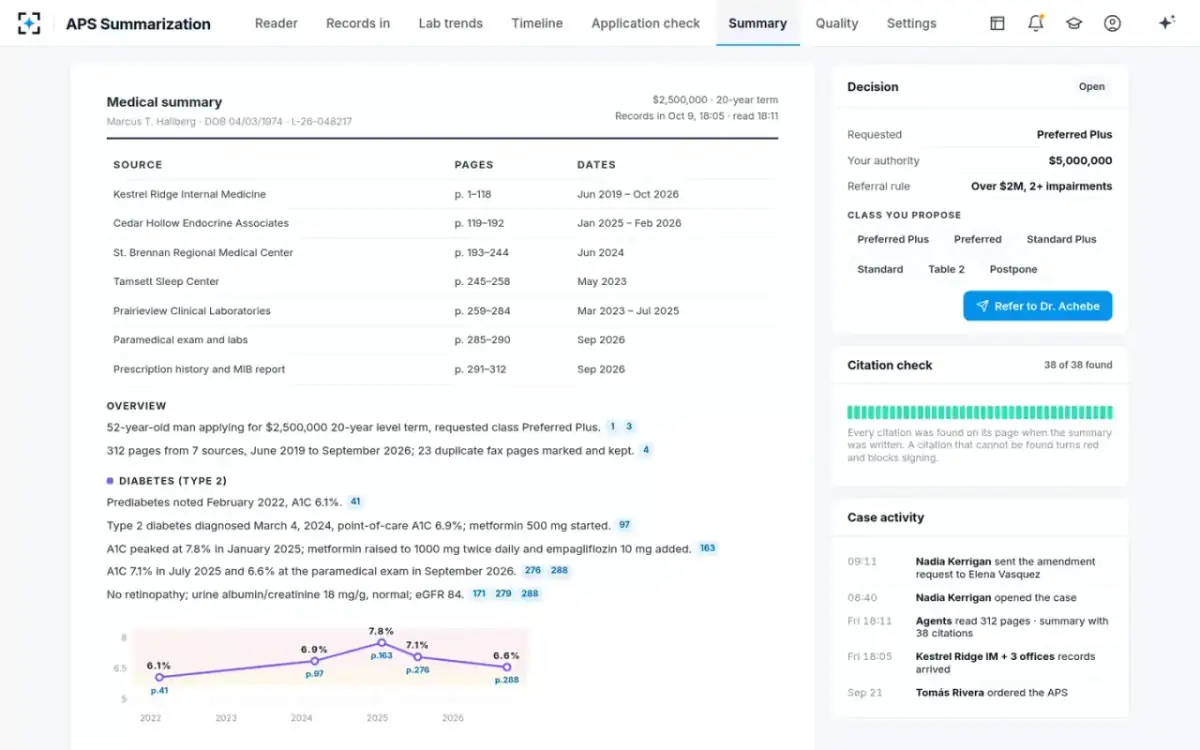
| Sources | Each provider, its page range and its dates | Seven sources: primary care p. 1–118 (Jun 2019 – Oct 2026), endocrinology p. 119–192, hospital p. 193–244, sleep center p. 245–258, outside labs p. 259–284, paramedical p. 285–290, prescription history and MIB p. 291–312 |
| Overview | Who is applying for what, and how much paper there is | Applicant, $2,500,000 20-year term, Preferred Plus requested; 312 pages, 23 duplicate fax pages marked and kept |
| One section per impairment | First mention, diagnosis, treatment changes, latest value and trend | Diabetes: prediabetes 2022 (A1C 6.1%, p. 41); diagnosed March 2024 (6.9%, p. 97); peak 7.8% January 2025 (p. 163); 6.6% at the exam (p. 288) |
| Application check | Each answer that differs, stated as answered and as recorded | 2 of 11 differ: 7(c) and 11, with pages |
| Suggested follow-up | What the manual asks for, and what is not needed and why | Diabetes questionnaire and amendment suggested; cardiology APS and repeat A1C not needed |
| Closing line | Who did what | “Prepared by agents from the pages cited; no rating or class is stated by an agent. Decision by the underwriter.” |
The diabetes section shows why the format is by impairment. Five sentences carry the whole history: when it was first noted, when it was diagnosed, when it peaked and what was changed, and where it is now. A medical director reading it knows within seconds that this is controlled type 2 diabetes on two oral medicines with normal kidney function, and can open any of the seven pages behind it to check.
The APS summary in APS Summarization, with the decision panel beside it
Where each citation comes from, and why a sentence without a page is never written
Every sentence in the summary is assembled from indexed passages, and the page travels with the passage. The summary writer does not read the file afresh; it writes from what the indexer and lab extractor recorded, each with a page number. That is why its rule can be absolute: a sentence that cannot point to a page is not written. When the summary is finished, each citation is checked again against its page. On the sample case all 38 were found.
The check catches more than invention. In the fictional carrier's monthly audit of 1,644 citations, the seven corrections were a lab value cited to the next page, a reading merged from two pages but cited only to the later one, a sleep study date misread through a fax smudge, a weight cited to the exam that was really the application answer, a blood pressure cited to a duplicate page, a citation pointing at a cover sheet, and an eGFR shown in the wrong unit. None was a fabricated fact. All were the kind of slip a human abstractor also makes, and every one was findable because the page was named.
A summary that cites its pages can be wrong in ways a reader can find. A summary that does not can only be trusted or re-read.
How accurate is an AI summary of medical records? What the published studies measured
Good enough to do the reading, not good enough to go unchecked, and humans are not error-free either. The most detailed error count comes from a 2025 paper in npj Digital Medicine by authors who all worked for Tortus AI, a company that builds clinical documentation software. Clinicians labelled 12,999 sentences of AI-written clinical notes, and the paper sets the results against earlier research it cites, in which "studies estimate that human-generated clinical notes have, on average, at least 1 error and 4 omissions". The authors also found that instructions mattered: a set of prompt changes that included telling the model to "output the status “unknown” for instances where information was missing" cut major omissions and hallucinations.
A larger reader study in Nature Medicine, by Van Veen and colleagues at Stanford, compared adapted language models with medical experts on four summarisation tasks, from radiology reports to doctor–patient dialogue. Physicians judged most model summaries at least as good as the experts'. The abstract's own caution is the useful part for underwriting: "The ensuing safety analysis highlights challenges faced by both LLMs and medical experts".
Neither study is an APS study, and their rates do not transfer to a 312-page file. What transfers is the design lesson. Errors fall when the system is told to say what it cannot find instead of filling the gap, and they become harmless when every statement is checkable. That is the role of the rules in the chain above: no interpolated lab values, no inferred diagnoses, no sentence without a page.
Monday 08:40 to 15:20: what the underwriter and the medical director do with it
They read the pages that change the decision, and they decide. The senior underwriter opens the case at 08:40 to the reader, with the summary on the right and the impairment index on the left. Two answers differ from the records, so she sends the drafted amendment request to the producer at 09:11. Because the case is over $2,000,000 with two or more impairments, the carrier's rule sends it to the medical director, and she refers it at 11:40 proposing Standard.
The APS summary at work: one Monday, minute by minute
| Time | Who | What happens | What the summary supplied |
|---|---|---|---|
| 08:40 | Senior underwriter | Opens the case to the reader | Index of 436 mentions; the cited summary |
| 09:11 | Senior underwriter | Sends the edited amendment request to the producer | Two neutral flags, 7(c) and 11, with pages |
| 11:40 | Senior underwriter | Refers to the medical director, proposing Standard | Summary, lab trends, timeline, both flags |
| 14:58 | Medical director | Agrees Standard, subject to the signed amendment | “The trend is the story — controlled on two oral agents, no complications.” |
| 15:20 | Senior underwriter | Signs the decision | Citation check: 38 of 38 found |
The medical director's note is the reason the summary is built around trends. A single A1C of 7.8% reads as poorly controlled diabetes; a single 6.6% hides that there is a diagnosis at all. The line from 6.1% to 7.8% and back to 6.6% on two medicines is what he rated, and the A1C guide in this series follows one of those readings from the faxed page to the chart.
What the agents never do: no inferred diagnosis, no rating
The limits are as much a part of the summary as its content. The indexer records only what is written: if a note says, for instance, "elevated sugars" and nothing else, the summary says that, not "diabetes". The disclosure checker writes a difference as what was answered and what the records show, and never uses the word misrepresentation, because materiality is a legal question decided later, by people. The requirements suggester quotes the manual and stops. The summary closes by saying that no rating or class is stated by an agent.
These limits matter beyond accuracy. The applicant signed an authorization naming a purpose, and HIPAA requires that purpose to be described (45 CFR 164.508(c)(1)(iv)); a summary that drifts into conclusions the underwriter never reached is a document nobody can defend. The underwriter remains the author of the decision, and the summary remains evidence. How regulators frame that split is set out in AI medical record review in life underwriting: what the rules require.
How long does it take to summarize an APS?
By hand, our estimate is two to four hours for a file of about 300 pages; with agents, minutes. No public body measures APS reading time, so both figures are ours: the first is a planning estimate, the second comes from the solution's sample queue. In that queue, nine files with records in since Friday ranged from 64 pages read in 1 minute 22 seconds to the 312-page sample file read in 6 minutes 12 seconds.
The records-in queue: every file read as it lands, night or weekend
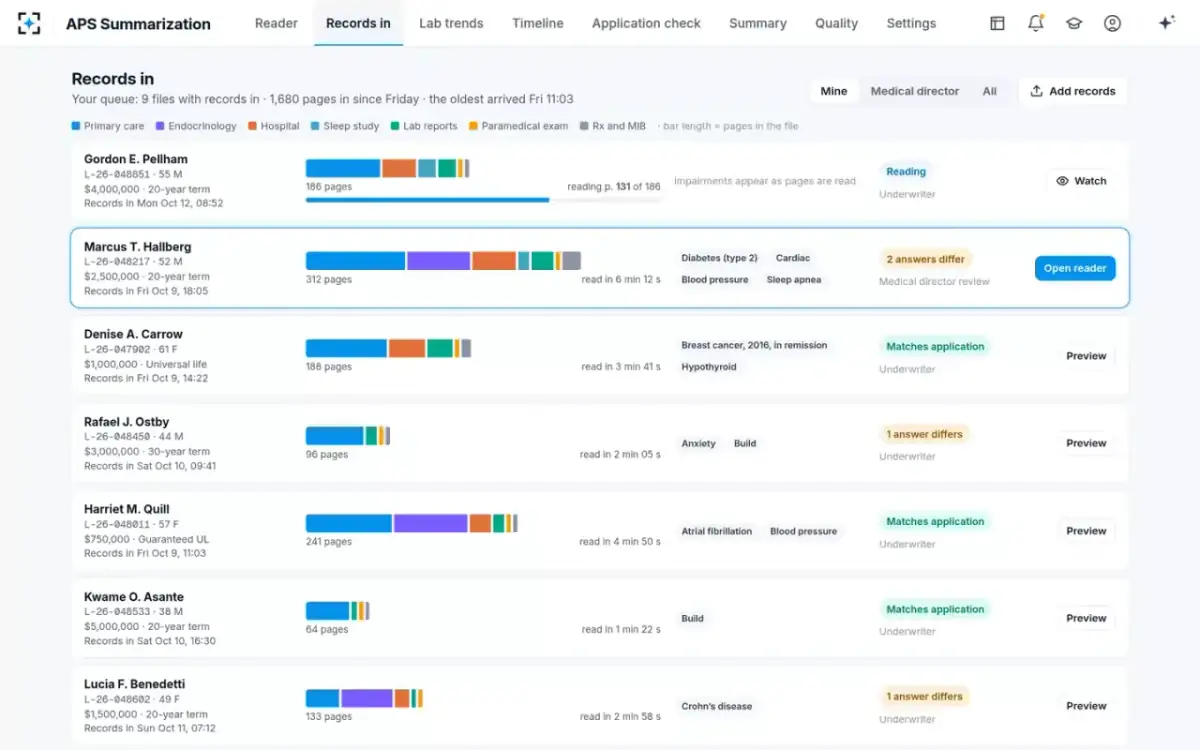
The time that matters to the applicant is not the read but the wait for a reader. Records that land on a Friday evening, read by hand, start their three hours whenever an underwriter or nurse picks them up. Read by agents, the file is waiting for the underwriter on Monday morning instead of the other way round. The cost side of that trade, per file and per year, is worked through in APS retrieval and summary services vs in-house vs agents; the full sample case is on the APS Summarization page.
Questions people ask
What does APS mean in life insurance?
An attending physician statement: the records a life insurer requests from an applicant's doctors, with the applicant's signed authorization. In practice it is often the doctor's chart notes, labs and correspondence rather than a single form. On the fictional sample case the APS and related records ran to 312 pages from seven sources.
Who writes the medical summary for underwriting?
Traditionally an underwriting nurse or the underwriter, sometimes an outside firm. In APS Summarization a summary-writer agent drafts it from indexed passages, every sentence cited to its page, and the underwriter reads, checks and decides. The agents never state a rating or class.
What is an impairment summary?
A summary organised by medical condition rather than by visit: for each impairment, when it first appears, the diagnosis, treatment changes, the latest value and the trend. On the sample case the diabetes section needs five sentences and seven cited pages to carry its history from 2022 to 2026.
How do underwriters read an attending physician statement quickly?
By starting from an index rather than page one. With every impairment mention indexed to its page, the underwriter reads the passages that matter and steps through them; on the sample case, 36 cardiac mentions on 10 pages, including a normal stress echo on page 214.
Can AI summarize an attending physician statement accurately?
Published studies on clinical text find model summaries often as good as experts', with measurable errors on both sides. The safeguard is a citation on every sentence, checked against its page: in the fictional carrier's monthly audit, 1,637 of 1,644 citations were found, against a 99% target.