The automatic nonforfeiture option in life insurance is the benefit a carrier applies on lapse when the owner makes no election, and it is one of the nonforfeiture options a cash-value policy must still give when premiums stop: the cash surrender value, reduced paid-up insurance for a smaller amount with no further premiums, or extended term insurance for the full amount for a limited time. Which one applies is decided first by the policy, which must name an option that takes effect automatically, and then by the owner, who can choose another within 60 days of the missed premium's due date. The rules come from each state's Standard Nonforfeiture Law, modelled on the NAIC's Model #808, and market conduct examiners test that the options are explained to the owner and applied as the contract provides. For a service representative, the answer to "what happens if I stop paying?" therefore sits in the contract's nonforfeiture clause and its table of values. Botminds' In-Force Policy Servicing reads that clause and table for the form version the policy was issued on, with today's values, and drafts the answer with each figure cited. This guide works through which option applies, and why.
Rules are quoted from the NAIC model and New York's Insurance Law, which follows it closely. The sample policy, a 1979 whole life policy at a fictional carrier, comes from the solution's demonstration.
When premiums stop: how a nonforfeiture answer is put together from the contract
Agent
Policy finderIdentifies the form and state variant issued, the premium due date missed and whether the caller may be told.
Never: assumes the current form’s options apply to an old policy.
Agent
Contract readerReads the nonforfeiture section: the options offered, which one is automatic, the 60-day election window and the table of values.
Never: paraphrases a value from the table: it quotes it.
Agent
Values agentReads today’s cash value, paid-up additions, dividends and any loan from the admin system.
Never: recalculates a value the system holds.
Agent
Answer checkerMatches each option’s figure to the table or the valuation, and stops if the form on file and the issue state disagree.
A person decides
RepresentativeExplains the automatic option, the alternatives and the deadline for choosing, and sends the answer in writing.
A person decides
PolicyownerChooses an option in writing within 60 days of the missed premium’s due date, or lets the automatic option apply.
What are the nonforfeiture options in life insurance?
There are three in most whole life and endowment policies. Cash: surrender the policy for its cash surrender value. Reduced paid-up insurance: keep a smaller, permanent policy with no more premiums. Extended term insurance: keep the full death benefit, less any loan, as term insurance for as long as the value will buy. The NAIC model requires a paid-up benefit on a plan the policy stipulates, which may be reduced paid-up or extended term, and a cash value once premiums have been paid long enough.
The model's language is precise. In the event of default in any premium payment, the company "will grant, upon proper request not later than sixty (60) days after the due date of the premium in default, a paid-up nonforfeiture benefit on a plan stipulated in the policy". In place of that benefit it may offer "an actuarially equivalent alternative paid-up nonforfeiture benefit which provides a greater amount or longer period of death benefits". And "upon surrender of the policy within sixty (60) days after the due date of any premium payment in default after premiums have been paid for at least three (3) full years in the case of ordinary insurance", it "will pay, in lieu of any paid-up nonforfeiture benefit, a cash surrender value" (NAIC Model #808, §2A–B). New York's statute uses almost the same words (N.Y. Ins. Law §4221(a)).
Which nonforfeiture option is the default? The one the policy names
The default is whichever option the policy specifies; the law requires a default but does not choose it. The model requires a provision "That a specified paid-up nonforfeiture benefit shall become effective as specified in the policy unless the person entitled to make the election elects another available option not later than sixty (60) days after the due date of the premium in default" (§2C).
Policies differ: some name extended term insurance, which keeps the full face amount in force for a period; some name reduced paid-up. The only reliable answer is the contract the owner holds, and on an older block that means the form version and state variant actually issued. Two policies sold under the same product name, a decade apart, can have different automatic options. A separate option, the automatic premium loan, is not a nonforfeiture benefit at all: it pays the premium with a policy loan, and the policy continues as if premiums were paid while the loan grows; how life insurance loan interest works covers that path.
How long does the owner have to choose a nonforfeiture option? Sixty days from the missed premium
Sixty days after the due date of the premium in default, under the NAIC model and New York's law. Within that window the owner can ask for the paid-up benefit, an alternative the policy offers, or the cash value; after it, the policy's automatic option is in effect.
The clock runs from the due date, not from the end of the grace period, so in practice a large part of it overlaps the grace period. In California, where the grace period is at least 60 days from the due date and does not run concurrently with paid coverage, the grace period alone can use most of the window; California's grace period rules set out that timeline. The election should be made in writing, and the representative's answer should give the date by which it must arrive.
Reduced paid-up vs extended term: the same value, two shapes
Reduced paid-up and extended term spend the same cash value in different ways. Reduced paid-up buys a smaller amount of permanent insurance; extended term buys the original amount for a limited period. Both are computed so that, as the model puts it, the benefit's "present value as of the anniversary shall be at least equal to the cash surrender value then provided for by the policy" (§4).
Reduced paid-up and extended term, side by side
Reduced paid-up insurance: A smaller amount, for life.
Extended term insurance: The full face amount, less any loan, for a set period.
Reduced paid-up insurance: For the rest of the insured’s life, like the original policy.
Extended term insurance: Until the period the value buys runs out; then coverage ends.
Reduced paid-up insurance: None.
Extended term insurance: None.
Reduced paid-up insurance: Has a cash value, payable on surrender within 30 days after any anniversary (§2D).
Extended term insurance: Also has a cash value under §2D, payable on surrender the same way.
Reduced paid-up insurance: Wants some coverage that will be there whenever death comes.
Extended term insurance: Needs the full amount for a known number of years.
Reduced paid-up insurance: A 1979 whole life policy: $18,420 of reduced paid-up insurance, no further premiums.
Extended term insurance: Read from the same contract’s table when the owner asks.
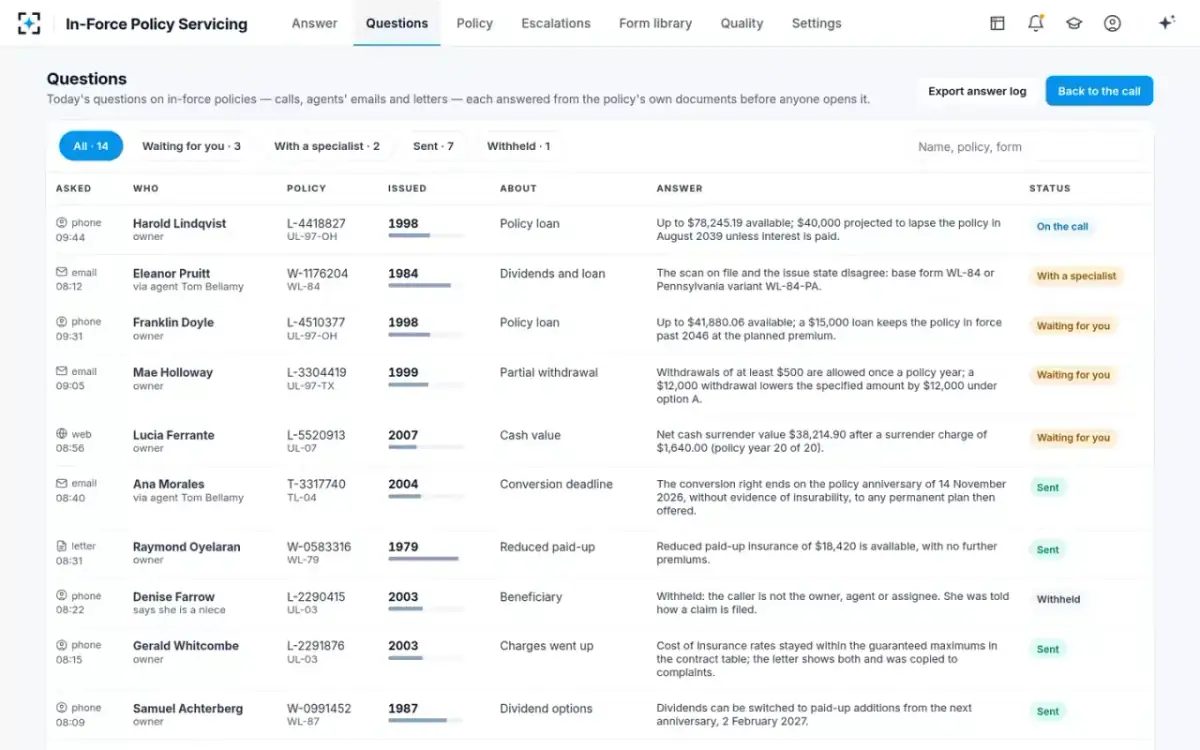
The figures for both come from the policy, not a calculator. The model requires each policy to contain "a table showing the cash surrender value, if any, and paid-up nonforfeiture benefit, if any, available under the policy on each policy anniversary either during the first twenty (20) policy years or during the term of the policy, whichever is shorter", calculated as if there were no dividends, paid-up additions or loans (§2E). Beyond the table, the policy must state the method for later years (§2F). That is why the sample answer for the 1979 policy quoted $18,420 from the contract's own table rather than estimating it.
A reduced paid-up quote answered from a 1979 contract's table
What is cash surrender value, and can the insurer delay paying it?
Cash surrender value is what the policy pays if the owner gives it up: under the model, at least the present value of the policy's future guaranteed benefits, less the present value of the "adjusted premiums" still to come, less "The amount of any indebtedness to the company on the policy" (§3A). It is a floor set by law; the policy's table shows the guaranteed figures and the insurer's admin system the current ones.
And yes, the insurer can delay it. "The company shall reserve the right to defer the payment of any cash surrender value for a period of six (6) months after demand therefor with surrender of the policy" (§2; New York's §4221(a) has the same sentence). A representative asked "how fast will I get my money?" should know it exists and quote the carrier's own practice, not promise a date the contract does not.
The Standard Nonforfeiture Law's provisions, and what each means on a call
| Provision | What the model requires | What the representative tells the caller |
|---|---|---|
| §2A | A paid-up benefit on request within 60 days of the missed premium’s due date, or an actuarially equivalent alternative | Which paid-up option the policy offers, and the date the request must reach us |
| §2B | A cash surrender value instead, on surrender within the same 60 days, once premiums have been paid three full years (ordinary insurance) | Whether cash is available yet, and how much |
| §2C | A specified option that takes effect automatically unless another is elected within 60 days | What happens if they do nothing |
| §2D | On a paid-up policy, a cash value available on surrender within 30 days after any anniversary | When a paid-up policy can later be cashed in |
| §2E–F | A table of values for the first 20 years, assuming no loans or additions, and the method for later years | Where the figures come from, and how a loan or paid-up additions change them |
| §2, last sentence | The insurer may defer paying a cash surrender value for up to six months | The carrier’s actual timing, without promising more than the contract allows |
How a policy loan changes every option
A loan reduces every nonforfeiture value. The cash surrender value is computed net of "any indebtedness to the company on the policy", and the paid-up and extended term benefits are bought with what is left. The policy's table cannot show this, because it is calculated assuming "that there is no indebtedness"; the model instead requires "an explanation of the manner in which the cash surrender values and the paid-up nonforfeiture benefits are altered by the existence of any paid-up additions credited to the policy or any indebtedness" (§2E–F).
On a call, that means the table is the starting point and the admin system's loan and paid-up additions are the adjustment, applied by the contract's own method. An owner with a large loan who stops premiums may find the extended term period much shorter, or the reduced paid-up amount much smaller, than the table suggests. Dividends work the other way: paid-up additions bought with dividends add value to the options.
Do term policies have nonforfeiture options?
Usually not. The model exempts a term policy of uniform amount "which provides no guaranteed nonforfeiture or endowment benefits", for a term of twenty years or less expiring before age 71, with uniform premiums for the whole term (§9E), and certain decreasing term policies (§9F). It also exempts any policy whose cash value or paid-up benefit never exceeds 2.5% of the amount of insurance at the start of a policy year (§9G).
Longer or level-to-older-age term policies can have small values, so the answer still comes from the contract. Universal life handles a stopped premium differently again: the policy continues as long as its value covers the monthly deductions, and lapses, unless the policy says otherwise, on the day its net cash surrender value reaches zero (NAIC Model #585, §7F).
What examiners test: options communicated and applied as the contract says
State market conduct examiners test that nonforfeiture options are explained and applied correctly. The life and annuity standard in the NAIC handbook asks that the options be explained to the owner and applied exactly as the contract provides (NAIC Market Regulation Handbook, 2024 summary, Chapter 23, standard 2); the service standards a desk is examined against are set out in policy servicing in life insurance.
What a correct nonforfeiture answer rests on
- The form version and state variant actually issued
The automatic option and the table belong to that form, not to the product’s current version.
- The missed premium’s due date
The 60-day election window runs from it.
- Premiums paid in full years
Under the model, cash is owed on ordinary insurance after three full years of premiums.
- Loans, paid-up additions and dividends
The table assumes none; the contract’s method adjusts for each.
- The automatic option, in the contract’s words
What happens if the owner does nothing.
- The notice the state requires
In New York, insurers that skip premium notices on monthly policies must write within six months after lapse “stating the type and amount of any automatic nonforfeiture benefit in force”.
- A written answer with the figures cited
Evidence for the examiner that the option was communicated and correctly applied.
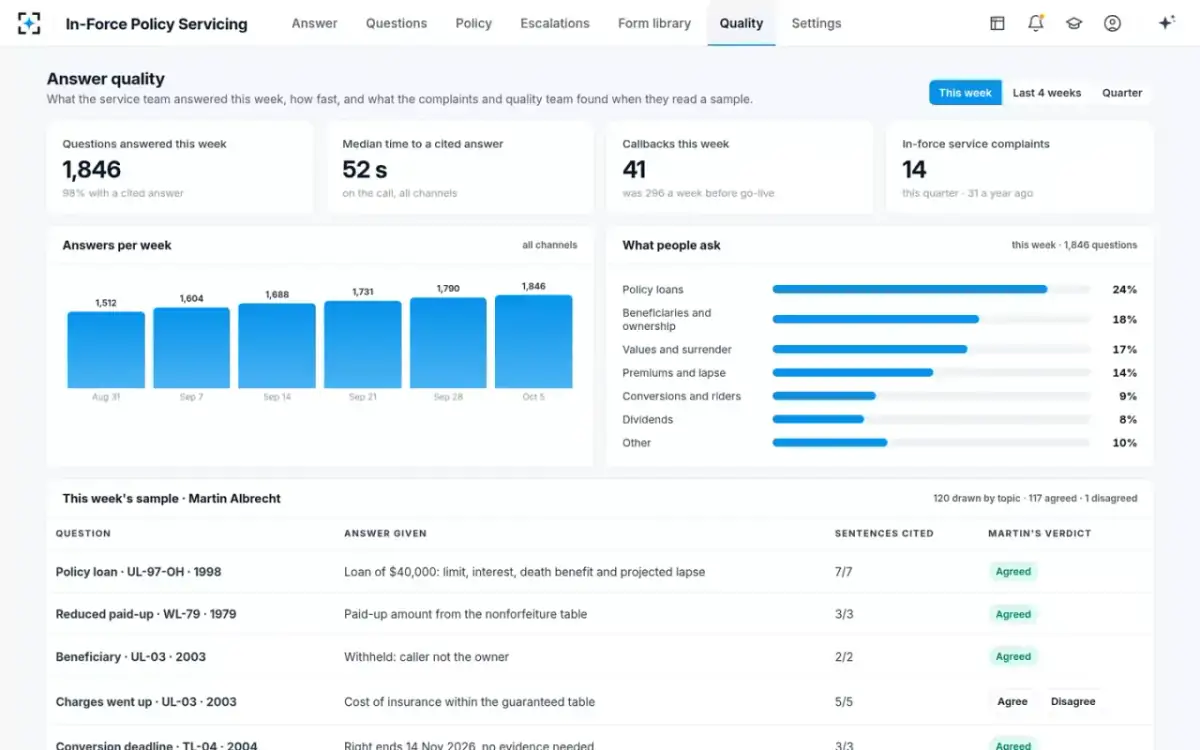
The examiners' standard explains why the sample carrier's quality lead reads nonforfeiture answers in the weekly sample. In the sample week, a reduced paid-up answer on a 1979 whole life form, "Paid-up amount from the nonforfeiture table", was read with three of three sentences cited and agreed.
The weekly quality sample, with a reduced paid-up answer read and agreed
A caller who stops premiums on a whole life policy is making one of the largest decisions about it, usually without an adviser on the line. The answer should give the automatic option, the alternatives with their figures, the effect of any loan and the date by which to choose. To see such an answer drafted from a 1979 contract, start from In-Force Policy Servicing; the other in-force requests that need the contract are in policy servicing in life insurance.
Questions people ask
What is reduced paid-up insurance?
A nonforfeiture option that uses the policy's cash value to buy a smaller amount of permanent insurance with no further premiums. The amount is shown in the policy's nonforfeiture table for each anniversary, adjusted for loans and paid-up additions, and the paid-up policy keeps a cash value of its own.
What is extended term insurance?
A nonforfeiture option that uses the cash value to keep the full death benefit, less any loan, in force as term insurance for as long as the value will pay for it. When the period ends, coverage ends; the policy's table shows the period for each anniversary.
Which nonforfeiture option gives the highest death benefit?
Extended term keeps the highest amount, the full face less any loan, but only for a limited period. Reduced paid-up gives a lower amount that lasts for life. Which is worth more depends on how long the insured lives, which is why the choice belongs to the owner, with the contract's figures in hand.
What happens if the owner does not choose a nonforfeiture option?
The option the policy specifies takes effect automatically. Under the NAIC model, it becomes effective "as specified in the policy" unless the owner elects another available option within 60 days after the due date of the missed premium.
Do universal life policies have nonforfeiture options?
Not in the same form. A universal life policy keeps going while its value covers the monthly deductions and lapses when the net cash surrender value reaches zero, unless the policy defines lapse otherwise, after the notice the policy and state law require. The owner can surrender it for its net cash value at any time.
Can I reinstate a policy after a nonforfeiture option takes effect?
Often, under the policy's reinstatement clause, which sets its own conditions, such as a time limit, evidence of insurability or payment of the missed premiums. Examiners test that reinstatement follows the policy's own provisions, applied the same way every time, so the answer comes from the contract, not a general rule.