Life insurance loan interest works like interest on any loan secured by the policy's cash value, with one difference that decides most outcomes: if the owner does not pay it, the insurer adds it to the loan, and the next year's interest is charged on the larger balance. The rate is set by the contract, either fixed (the NAIC model allows up to 8% a year) or adjustable within a cap. Nothing has to be repaid on a schedule, but the loan and its interest come out of the death benefit and the cash value, and once the loan reaches the cash value the policy can end after a notice. On a universal life policy that can happen years before anyone expects, and the lapse can then create taxable income with no cash to pay it. Botminds' In-Force Policy Servicing answers loan questions from the policy's own loan clauses and runs the company's projection engine month by month, so the representative can tell the caller the year the loan would overtake the policy, and what paying the interest would change. This guide works one sample loan through to that year.
The loan follows Harold Lindqvist, 71, and his 1998 universal life policy at a fictional carrier; all figures about him come from the solution's sample projection. The rules are quoted from the NAIC models, New York law and federal tax authority.
Of the $250,000 face in September 2031, how much goes to the loan
Interest added each March
- To the loan · $73,418 · 29%
- To his daughters · $176,582 · 71%
Interest paid each March
- To the loan · $54,862 · 22%
- To his daughters · $195,138 · 78%
How does life insurance loan interest work?
The insurer lends against the policy's cash value, charges interest at the contract's rate, and keeps the loan as a debt against the policy rather than a debt the owner must repay. Interest falls due on dates the contract sets, usually each policy anniversary; if it is not paid, it is added to the loan.
Harold's contract shows each step. Loan interest is 6% a year, charged in arrears each anniversary, 14 March, and unpaid interest is added to the loan (§7.2). The part of the account value equal to the loan is still credited interest, but at the contract's loaned rate, "not less than 4%", while the rest earns the current 4.25%. Any indebtedness is "deducted from the death proceeds and from the Cash Surrender Value". And "If at any time the Indebtedness equals or exceeds the Cash Surrender Value, this policy will terminate 31 days after we have mailed notice of that fact to you and to any assignee of record". Those are the clauses of a fictional Ohio contract; every real policy has its own, which is why the answer has to come from the contract issued.
His existing loan shows what unpaid interest does on its own. He borrowed $11,300 in June 2021. By the October 2026 valuation, with nothing more borrowed, the loan stood at $14,862.40; the March 2026 statement alone added $841.27 of interest.
What is the interest rate on a life insurance loan? Fixed, or adjustable within a cap
Whatever the contract says, within limits most states took from the NAIC's Model Policy Loan Interest Rate Bill. A policy may carry "a maximum interest rate of not more than eight percent (8%) per annum", or "an adjustable maximum interest rate established from time to time by the life insurer as permitted by law" (NAIC Model #590, §3A).
An adjustable rate has a ceiling and a rhythm. It may not exceed the higher of the Moody's corporate bond monthly average "for the calendar month ending two (2) months before the date on which the rate is determined", or "the rate used to compute the cash surrender values under the policy during the applicable period plus one percent per annum" (§3B). It must be set "at least once every twelve (12) months, but not more frequently than once in any three-month period"; it may rise only when the formula moves it up by half a point or more, and must fall when the formula moves it down by half a point or more (§3D).
Owners are told. The insurer must notify the owner "at the time a cash loan is made of the initial rate of interest on the loan" and send "reasonable advance notice of any increase in the rate" (§3E). And a rate change alone cannot end a policy mid-year: "no policy shall terminate in a policy year as the sole result of change in the interest rate during that policy year" (§3F). The model applies only to policies issued after a state adopts it, unless the owner agrees in writing (§4), so a 1980s whole life policy may carry an older fixed rate written before it.
How is policy loan interest calculated? The sample loan, year by year
Interest is the contract rate times the loan balance for the period, and unpaid interest joins the balance. On Harold's projected total of $54,862.40, 6% is $3,291.74 in the first year; if it is added, the next year's interest is charged on $58,154, and so on. The balance grows by 6% a year, compounding, while the cash value it is measured against is shrinking under the monthly deductions.
With interest added each March, the sample loan more than doubles by 2039
The arithmetic is simple; what it does to the policy is not. While the loan grows by 6%, the loaned part of the account value is credited at 4%, so the loan's net cost inside the policy is the 2-point spread on the borrowed amount plus the monthly deductions the shrinking free value must still cover. That combination is what a month-by-month projection captures and a rule of thumb misses.
Do you have to pay back a life insurance loan?
No, not on a schedule. A policy loan can usually be repaid "in whole or in part at any time while the Insured is living and this policy is in force", as Harold's contract puts it, and whatever is unpaid at death is deducted from the death benefit. The cost of not repaying is paid by the beneficiaries and, if the loan overtakes the cash value, by the policy itself.
Repaying has a trap. Harold's contract applies any payment received while a loan is outstanding "as a premium unless you tell us in writing that it is a loan repayment". An owner who sends a cheque meaning to cover the interest, without saying so, may find it credited as premium and the interest added to the loan anyway. In the solution the answer says this in the representative's words: "the payment must be marked as loan interest or it is applied as premium".
One sample loan: $40,000 on top of $14,862.40 already borrowed
6%
fixed loan interest in his contract, charged each 14 March in arrears
$3,291.74
interest a year on a total loan of $54,862.40
Aug 2039
projected lapse at 84 if the interest is added to the loan
Nov 2047
projected in force to 92 if the interest is paid each March
Can a policy loan cause a lapse? The month the loan passes the cash value
Yes. When the loan and its unpaid interest reach the policy's cash value, the policy can end after a notice period, even though the owner never missed a planned premium. On universal life the trigger comes sooner than the face amount suggests, because the cash value is falling while the loan rises.
The answer on the call: the year the loan overtakes the policy
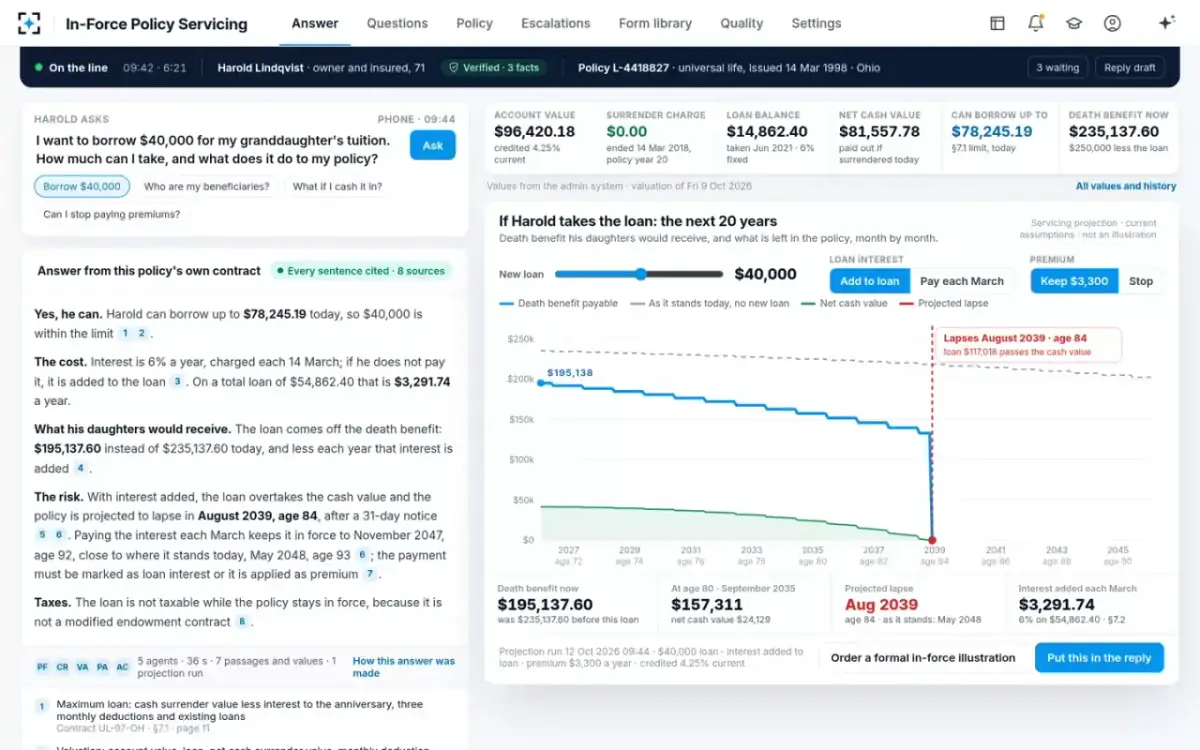
The law around that moment varies by state and by policy type. For universal life, the NAIC model says that "Unless otherwise defined in the policy, lapse shall occur on that date on which the net cash surrender value first equals zero", with written notice "at least thirty (30) days prior to termination of coverage" (NAIC Model #585, §7F). New York goes further: no policy "shall terminate or lapse by reason of default in payment of any premium, installment, or interest on any policy loan in less than one year after such default" unless the required notice was mailed (N.Y. Ins. Law §3211(a)(1)). The policy's own clause and the state's rule together decide how much warning the owner gets; California's 60-day grace and designee notice shows how much a state can add.
Paying the interest each March, or letting it add to the loan
Interest added to the loan: Nothing out of pocket.
Interest paid each March: $3,291.74 a year, marked as loan interest.
Interest added to the loan: $73,418
Interest paid each March: $54,862
Interest added to the loan: $176,582
Interest paid each March: $195,138
Interest added to the loan: $24,129
Interest paid each March: $62,449
Interest added to the loan: Lapse in August 2039, at 84
Interest paid each March: In force to November 2047, at 92
The comparison is the part of the answer a values screen alone cannot give. A representative who can only say "yes, you can borrow $40,000 at 6%" has answered the question asked and missed the one that matters. In the solution, any reply whose projection lapses within 15 years goes to an in-force specialist before it is sent; the co-pilot trace shows how the projection is produced and checked.
Is a life insurance loan taxable? Not while the policy lasts, often when it ends
A loan from a policy that is not a modified endowment contract is not taxable when taken. Section 72 treats loans as distributions only for modified endowment contracts (26 U.S.C. §72(e)(4)(A), (e)(10)), which the 7 pay test guide covers.
The tax arrives if the policy ends with the loan outstanding. When a policy is surrendered or terminated, the cash value used to pay off the loan counts as an amount received, taxable to the extent it exceeds the owner's investment in the contract. The Seventh Circuit put it plainly in a case where a whole life policy was cancelled for a loan that exceeded its cash value by $30.42: taxable income of $29,093.30 arose "even though Brown had received no cash because the cash value of the policy had been used to pay off the loans", and "It is also irrelevant that no money changed hands" (Brown v. Commissioner, No. 11-2508, 7th Cir. 2012). The IRS defines the investment as premiums paid "less any refunded premiums, rebates, dividends, or unrepaid loans that weren't included in your income", and the insurer reports the surrender on Form 1099-R (IRS Publication 525).
For an older owner the timing is the worst part: a lapse at 84 can bring an income tax bill in the same year the death benefit disappears. In-Force Policy Servicing limits tax wording to a policy's tax status and Form 1099-R reporting and gives no tax advice; the projection's lapse year is what tells the owner, and his adviser, that the question needs asking now.
What is an automatic premium loan?
An automatic premium loan is a policy loan the insurer makes to pay a premium the owner did not pay, usually under an option the owner elected. It keeps the policy in force without a lapse, but it is a loan like any other, charged interest and deducted from the death benefit.
The NAIC model treats it that way: "The term 'policy loan' includes any premium loan made under a policy to pay one or more premiums that were not paid to the life insurer as they fell due" (§3H(2)). The notice rule is looser than for a cash loan: the insurer must tell the owner the initial rate "as soon as it is reasonably practical to do so after making the initial loan", and need not give notice of each further premium loan (§3E(2)). An owner whose premiums have been paid by automatic loans for years may have a large loan and no recent letter about it, which is exactly the caller a projection helps.
Alternatives a caller may ask about
Callers weighing a loan often ask about the alternatives, and each has a different effect on the policy. The representative's job is to say what the contract allows and what each would do; whether one suits the caller is a decision for the owner and an adviser.
A partial withdrawal from universal life takes value out without interest but usually lowers the death benefit; on the sample queue a $12,000 withdrawal on a 1999 Texas policy lowered the specified amount by $12,000 under option A. A full surrender ends the policy and is taxed on proceeds above its cost. On whole life, the owner can stop premiums and take a nonforfeiture option, such as reduced paid-up insurance; which nonforfeiture option applies works through them. Selling the policy to a third party is a separate market with its own tax rules and is outside what a service desk should advise on. To see a loan answer, its projection and the reply letter in the solution, start from In-Force Policy Servicing.
Questions people ask
What happens if you don't repay a policy loan?
Nothing immediately: interest is added to the loan and the balance compounds. At death the loan is deducted from the death benefit. If the loan grows to equal the cash value first, the policy can end after the notice the contract and state law require, and the ended policy can create taxable income.
How do life insurance loans work on whole life compared with universal life?
The interest mechanics are the same: a contract rate, unpaid interest added to the loan. The difference is the cash value it is measured against. Whole life cash values generally grow under the contract's guarantees, while universal life values depend on premiums paid and monthly deductions, so a universal life loan can overtake the value much sooner.
Can the insurer raise my policy loan rate?
Only if the policy has an adjustable rate. Under the NAIC model, the rate may be reset at most every three months and at least every twelve, within a cap tied to a corporate bond average or the policy's cash value rate plus one point, with advance notice of any increase; a fixed-rate policy keeps its rate.
Is policy loan interest tax deductible?
Generally not for a personal loan. The Seventh Circuit noted in Brown that the debt repaid from the policy's value "was a personal rather than a business debt and therefore was not deductible". Business-owned policies have their own rules; ask a tax adviser.
Does a policy loan reduce the death benefit?
Yes, by the loan and any unpaid interest at the date of death. On the sample policy, a $40,000 loan on top of the existing $14,862.40 takes the death benefit from $235,137.60 to $195,137.60 at once, and with interest added it falls each March after that.