The pros and cons of a registered index-linked annuity come down to one trade the SEC describes plainly: "RILAs limit or reduce downside risk, but also limit upside performance." In return for a buffer or floor on index losses, the buyer accepts a cap or participation rate on index gains, and, on many contracts, pays no explicit ongoing fee for the arrangement. Against that sit early-withdrawal costs, surrender charges and interim value adjustments, complexity that investors in the SEC's own testing found confusing, and the plain fact that a RILA can lose a significant amount of money. Because a RILA is a registered security as well as an annuity, its sale answers to the SEC's Regulation Best Interest and FINRA's supervision as well as the state's annuity rule, which makes it one of the hardest products for a pre-issue reviewer. Botminds' Annuity Suitability Review reads each RILA sale against the buyer's risk tolerance, liquidity and exchange history before issue, with the rule for every finding.
The sales and carrier in the examples are fictional sample data from the solution. Rules and descriptions are quoted from the SEC's 2024 RILA rule, FINRA's 2026 oversight report and the NAIC model, linked where they appear. This page explains how RILAs are reviewed; it is not advice about any purchase.
Registered index-linked annuity vs fixed indexed annuity, as a reviewer sees them
Registered index-linked annuity (RILA): An annuity whose offering is registered with the SEC on Form N-4; a security.
Fixed indexed annuity: An insurance product under state law; certain such annuities are exempt from the Securities Act.
Registered index-linked annuity (RILA): Losses limited by a buffer or a floor; losses beyond the buffer, or down to the floor, are the buyer’s.
Fixed indexed annuity: Index losses are not passed to contract value where credits have a 0% floor, as in the sample contract; terms vary.
Registered index-linked annuity (RILA): Index gains limited by a cap or participation rate; typically excludes dividends.
Fixed indexed annuity: Index-linked credits, limited as the contract states.
Registered index-linked annuity (RILA): Surrender charges, interim value adjustments and sometimes market value adjustments.
Fixed indexed annuity: Surrender charges and sometimes market value adjustments.
Registered index-linked annuity (RILA): Reg BI for the broker-dealer, and the state annuity rule; FINRA treats Rule 2330-style controls as an effective practice.
Fixed indexed annuity: The state best-interest rule: Model #275, or Regulation 187 in New York.
Registered index-linked annuity (RILA): Registered representatives; the SEC understands RILAs are predominantly sold by broker-dealers.
Fixed indexed annuity: Licensed insurance producers.
What is a registered index linked annuity?
A registered index-linked annuity is an annuity in which the buyer's returns, both gains and losses, follow an index over a set period, within contractual limits, and whose offering is registered with the SEC. In the SEC's words, an investor in a RILA "allocates purchase payments to one or more investment options under which the investor's returns (both gains and losses) are based at least in part on the performance of an index or other benchmark" over a crediting period. At the end of each period the insurer credits positive or negative interest based in part on the index.
Congress required a tailored registration form for RILAs in the Consolidated Appropriations Act, 2023, and the SEC answered by moving RILAs onto Form N-4, the variable annuity form, adapted for their features. The rule took effect on 23 September 2024, with a compliance date of 1 May 2026 for most of it. A RILA sold today comes with a prospectus built for its bounded returns, contract adjustments and limits.
Registered index linked annuity pros and cons, side by side
The pros are protection against part of an index's losses, participation in part of its gains, and, for many contracts, no explicit ongoing fee. The cons are limits on gains that can change at renewal, losses beyond the protection, costs for leaving early, and complexity. The SEC lays out each element, and its definitions are the clearest place to start.
The limits come in four shapes. "A cap rate places an upper limit on an investor's ability to participate in the index's upside performance directly. A participation rate sets an investor's return to some specified percentage of the index's return. A buffer limits the investor's exposure to losses up to a fixed percentage. A floor places a lower limit on the investor's exposure to loss." The SEC adds that insurers typically choose indexes whose gains do not include dividends, so a capped index return is already a price return.
The absence of a fee is real but partial. The SEC notes that for many RILAs "the investor pays no direct or explicit ongoing fees and expenses", and that this is sometimes a selling point, but that the bounded return structure "requires investors to agree to tradeoffs that come with their own economic costs." The cost of the buffer is the gains given up above the cap. And the limits are not fixed for life: contracts typically renew the buyer into a similar option at the end of each crediting period, "often with a new limit on gains."
How a 10% buffer, a 10% floor and a 12% cap credit the same index returns
| Index return over the crediting period | With a 10% buffer | With a -10% floor | With a 12% cap on gains |
|---|---|---|---|
| +20% | Gain limited by the cap or rate that comes with it | Gain limited by the cap or rate that comes with it | +12% |
| +8% | Up to +8%, within the cap | Up to +8%, within the cap | +8% |
| −5% | 0%: the buffer absorbs it | −5% | — |
| −15% | −5% | −10%: the floor stops it | — |
| −25% | −15% | −10% | — |
| −40% | −30% | −10% | — |
Can you lose money in a RILA?
Yes. The SEC is direct: "despite the bounded return structure, a RILA is not necessarily a low-risk investment product as the investor could lose a significant amount of money if the index performs poorly." With a buffer, losses beyond the buffer are the buyer's; with a floor, losses down to the floor are. Money can also be lost by leaving early, even when the index has risen.
Whether a RILA is safe, then, depends on the buyer's capacity to bear the loss the contract allows and to leave the money in place for the crediting period. That is a suitability question, not a product rating. A buyer who describes himself as conservative and wants principal protection is describing a different product: in the sample queue, one RILA sale is flagged exactly for that, a conservative risk tolerance against a 10% buffer.
What is an interim value adjustment?
An interim value adjustment is a change to the contract value when money leaves an index-linked option before the end of its crediting period, because the index result for the period is not yet known. The SEC describes IVAs as adjustments that "adjust the investor's contract value if amounts are withdrawn (for instance, because of movements to a different investment option, movements out of the contract, or payment of certain benefits) from an index-linked option before the end of its crediting period".
FINRA's report explains why reviewers should care. Interim value risk is the potential variability in the value if an investor takes money out before the end of the segment; the interim valuation is "based on a calculation separate from index performance, which therefore may not align with the initial expectations of the contract holder and which may result in significant loss." Its examiners list among Reg BI care violations "recommending partial withdrawals or full surrenders from RILAs ‘mid-segment’ without considering interim value risk." The SEC adds that adjustments can apply even to an otherwise permitted withdrawal, can reduce surrender values and death benefits, and can stack with surrender charges. What a reviewer tests in the surrender charge schedule itself is set out in annuity surrender charge schedule.
Investors find the term hard. In the SEC's investor testing, participants indicated "significant confusion about the features and fees associated with RILAs" and named terms such as "interim value adjustment" and "buffer" as confusing. A review that checks only whether the prospectus was delivered is checking the wrong thing.
Who regulates RILAs?
RILAs are regulated as securities by the SEC and, for the broker-dealers that sell them, by FINRA, and as annuities by the state insurance regulator. The SEC governs registration and disclosure on Form N-4; its Regulation Best Interest governs the recommendation by a broker-dealer. FINRA's 2026 report states that Reg BI applies to recommendations "of any securities transaction or investment strategy involving securities, including recommendations of variable annuities and RILAs."
The state rule applies too, because a RILA is still an annuity issued by an insurer. Model #275 offers a safe harbor for sales made under comparable standards, naming Regulation Best Interest for broker-dealers, but the insurer must still have a reasonable basis before it issues and must monitor the broker-dealer's relevant conduct. So the carrier's reviewer sees RILA sales after a broker-dealer has, and still decides. How the federal fiduciary picture changed in 2026 is covered in the DOL fiduciary rule in 2026.
RILAs under the securities rules, in four numbers
2026
year most of the SEC’s RILA registration rule took effect for compliance, on 1 May
36
months of exchange history FINRA’s effective practices gather for RILAs, as for variable annuities
60
months of exchange or replacement history the state best-interest rule names
23.4%
growth in net considerations for indexed annuities in 2025, NAIC statutory data
Does FINRA Rule 2330 apply to RILAs?
Not by its terms: Rule 2330 applies to "recommended purchases and exchanges of deferred variable annuities". But FINRA's 2026 report describes, as an effective practice, building the same heightened procedures into a firm's supervision of RILAs, including requiring "a registered representative to document and sign his or her rationale for a recommendation of a RILA based on the client’s specific needs and investor profile" and a registered principal to review and approve or reject each RILA purchase or exchange.
The practice list goes further: gathering whether customers have had RILA exchanges, or replacements of variable annuities with RILAs and the reverse, in the preceding 36 months; surveillance of representatives' exchange rates; guidance on how interest is calculated and credited, automatic renewals, and contract adjustments; and exchange disclosures that compare fees, including for RILAs "the economic costs of their bounded return structure as well as IVAs and MVAs". Its findings name the failure the practices prevent: recommending, without a reasonable basis, that customers surrender variable annuities or RILAs to buy RILAs.
A reviewer's checklist for a RILA sale
A pre-issue review of a RILA asks the state rule's questions and the securities rules' questions together. The checklist below draws on both.
Nine checks for a registered index-linked annuity sale before issue
- Risk tolerance matches the loss the contract allows
A conservative buyer and a 10% buffer is a contradiction until the file explains it.
- Time horizon covers the crediting periods and the surrender schedule
Money needed mid-segment meets an interim value adjustment as well as a surrender charge.
- Liquidity needs are dated and paid outside the contract
The same runway test as any annuity, with IVAs added to the cost of leaving.
- The rationale is specific and signed
Based on the client’s needs and profile, not a template sentence.
- The buyer was told how interest is credited and limited
Cap or participation rate, buffer or floor, dividends excluded, renewal terms.
- Prior exchanges in the past 36 and 60 months
FINRA’s look-back for RILAs and variable annuities, and the state rule’s.
- On an exchange, what is given up
Surrender charges, living or death benefits, a benefit base above contract value.
- Concentration in illiquid products
FINRA lists over-concentration in variable annuities or RILAs as a supervisory gap.
- A principal’s approval, where the firm requires one
Documented and signed, with the basis for approving or rejecting.
Two RILA sales in a sample review queue
The checklist is easier to see on live files. Take the solution's sample carrier on one Monday morning: of nine sales waiting for a reviewer, two are its six-year RILA, and each is flagged for a different reason.
Two RILA sales in today's queue, each with what the agents found
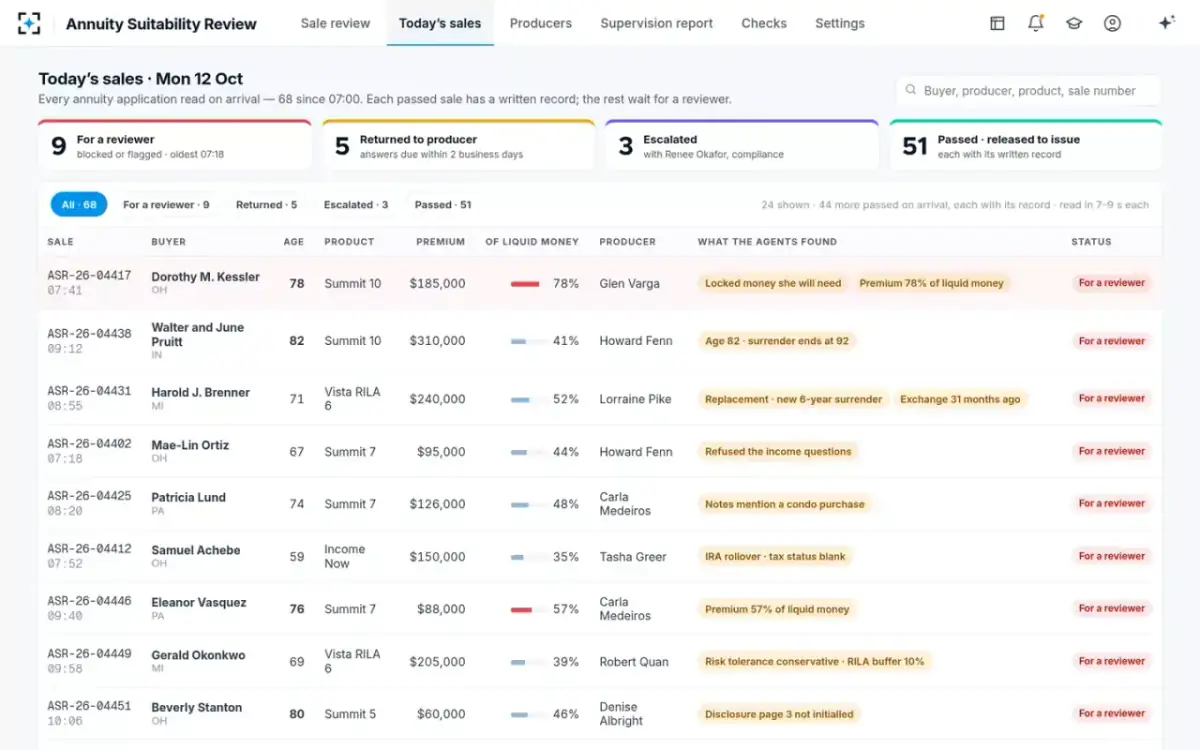
The first is a replacement that starts a new six-year surrender schedule for a buyer whose last exchange was 31 months ago: inside FINRA's 36-month window and the state rule's 60. The questions are the model's exchange questions, whether the buyer pays a surrender charge, starts a new surrender period or loses benefits, and whether the new contract would substantially benefit the buyer over its life compared with the one it replaces. The second is the contradiction above: a buyer who calls himself conservative, sold a product whose buffer leaves him exposed to losses beyond 10%.
The checks that apply to every sale, including risk tolerance against the product
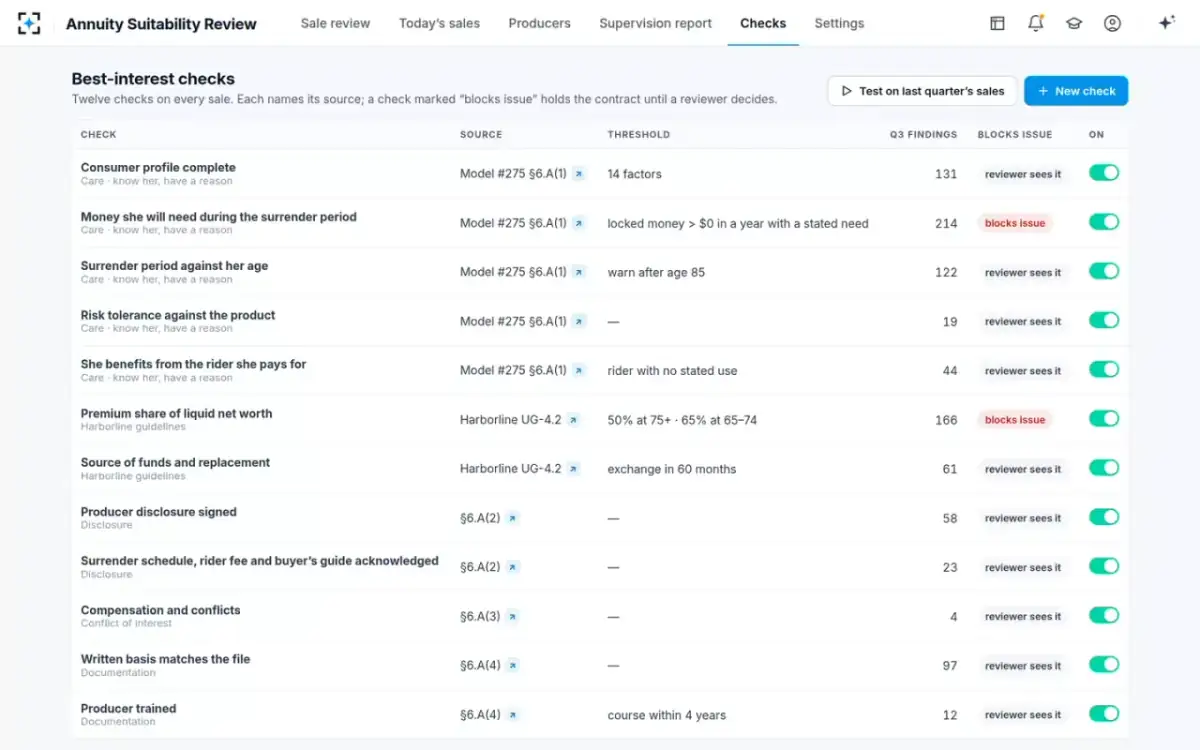
Where the solution fits and where it does not: it reads the RILA sale file, compares the stated risk tolerance and needs with the contract's buffer, floor, cap and schedule, checks exchange history against both look-backs, and puts contradictions in front of a reviewer with the rule. It does not value an interim value adjustment, price the contract or replace a broker-dealer's principal review, and the agents never approve a sale. The extra checks a carrier runs on sales to older buyers are in selling annuities to seniors; the solution is at Annuity Suitability Review.
Questions people ask
Is a RILA the same as a variable annuity?
No. A variable annuity passes on the returns of the subaccounts the buyer chooses, without a contractual buffer or cap on index returns; a RILA credits index-linked returns within limits. Both are registered on Form N-4 after the SEC's 2024 rule, and both are sold by broker-dealers under Reg BI.
Are RILA caps guaranteed?
Usually only for the current crediting period. The SEC notes that contracts typically renew into the same or a similar option, often with a new limit on gains, and that insurers may change or remove key features such as cap rates, floors or even the index.
Do RILAs have surrender charges?
Many do. The SEC lists surrender charges among the costs of early withdrawal, alongside interim value adjustments and market value adjustments, and says these charges and adjustments are not always mutually exclusive, so an early withdrawal can meet more than one.
Can a RILA replace an existing annuity?
It can, and that is where regulators find problems. FINRA's 2026 report lists recommending, without a reasonable basis, surrenders of variable annuities or RILAs to buy RILAs, and failing to weigh the cost of lost living benefits, among its findings.
Who reviews a RILA sale before the insurer issues it?
The broker-dealer supervises the recommendation under Reg BI, and FINRA describes principal review of RILA purchases and exchanges as an effective practice. The insurer must still have its own reasonable basis before it issues, under the state's version of Model #275.