An annuity suitability questionnaire is the form a producer completes with the buyer to collect the consumer profile information that the best-interest rule requires before an annuity is recommended. NAIC Model #275 defines that information as what is "reasonably appropriate to determine whether a recommendation addresses the consumer’s financial situation, insurance needs and financial objectives, including, at a minimum" fourteen factors: age, annual income, financial situation and needs, financial experience, insurance needs, financial objectives, intended use, time horizon, existing assets, liquidity needs, liquid net worth, risk tolerance, the financial resources used to fund the annuity, and tax status. Filling in the boxes is easy; the hard part is that the answers have to agree with each other and with the rest of the file, and the most important ones can be contradicted somewhere the form never looks. Botminds' Annuity Suitability Review fills the fourteen factors from the whole sale file, each with the page it came from, and marks where the documents disagree.
The example sale and carrier are fictional sample data from the solution. The rules are quoted from the NAIC model, Florida's statute, New York's Department of Financial Services, FINRA and the SEC, linked where they appear.
The 14 consumer-profile factors: the question that asks each, and what confirms it
| Model #275 factor | A questionnaire field that asks it | What else in the file confirms or contradicts it |
|---|---|---|
| 1. Age | Date of birth | Application; sets age-based review rules and when the surrender period ends |
| 2. Annual income | Household income, by source | Producer notes; income named in the application (pension, Social Security) |
| 3. Financial situation and needs, including debts and other obligations | Monthly expenses; debts | Notes on rent, care costs, loans; income against expenses |
| 4. Financial experience | Products owned before | Existing-assets answer; notes such as “CDs and savings only” |
| 5. Insurance needs | Why insurance, not another product | Rider elections; whether a death or income benefit is wanted |
| 6. Financial objectives | Safety, growth, income | The written basis for the recommendation |
| 7. Intended use of the annuity | What the money is for | Notes; beneficiary designations; any stated purchase |
| 8. Financial time horizon | Under 5, 5–10, 10+ years | The surrender schedule; age when it ends |
| 9. Existing assets or financial products, including investment, annuity and insurance holdings | Existing annuities and life policies | Source of funds; replacement forms; recent exchanges |
| 10. Liquidity needs | Access to the money during the surrender period | Producer notes; dated needs anywhere in the file |
| 11. Liquid net worth | Cash, savings, CDs | Statements; the premium as a share of it |
| 12. Risk tolerance, including willingness to accept non-guaranteed elements | Conservative, moderate, aggressive | The product’s floors, caps and non-guaranteed elements |
| 13. Financial resources used to fund the annuity | Source of funds | Transfer forms; whether another annuity or policy is surrendered |
| 14. Tax status | Qualified or non-qualified; tax situation | Rollover paperwork; the account the money comes from |
What is on an annuity suitability questionnaire?
An annuity suitability questionnaire asks, at a minimum, for the fourteen consumer-profile factors the model lists, plus whatever else the insurer or the state requires. The model's list is a floor, "at a minimum", and the care obligation adds that the factors carry different weight from case to case but are never to be weighed one at a time. A questionnaire is the raw material for that judgment, not the judgment itself.
States that adopt the model keep the list. Florida's statute, for example, defines consumer profile information with the same fourteen items, ending with "Financial resources used to fund the annuity" and "Tax status". The form's layout, question wording and answer choices are the insurer's; some states approve forms, and the model's drafting notes leave room for that.
What is consumer profile information?
Consumer profile information is the model's term for what a producer must try to learn about the buyer before recommending an annuity: the fourteen factors and anything else reasonably appropriate to judging whether the recommendation fits. The care obligation requires "making reasonable efforts to obtain consumer profile information from the consumer prior to the recommendation of an annuity", and the reasonable basis for the recommendation is judged against that profile.
The insurer's duty runs on the same information. It may not issue a recommended annuity unless there is a reasonable basis that it would effectively address the consumer's situation, needs and objectives "based on the consumer’s consumer profile information", and its procedures to detect non-compliant recommendations may include confirming that information with the consumer, before or after issue.
What is liquid net worth on a suitability form?
Liquid net worth on a suitability form is the buyer's money that can be reached quickly without a large loss: cash, savings, certificates of deposit near maturity, and similar holdings, less what is owed against them. The model lists it as factor 11, next to liquidity needs, and does not define it further, so the insurer's form should say what counts.
It matters because it decides how much of the buyer's accessible money the premium would lock up. In the solution's sample sale, a 78-year-old widow reports $236,400 of liquid net worth, and the recommended premium is $185,000: 78.3%, leaving $51,400 outside the annuity. The sample carrier's own guideline blocks issue when a buyer 75 or older would put more than 50% of liquid net worth into the contract. That threshold is a house rule, not the model's, which is why the solution labels it as the carrier's guideline when it fails. The dollars that a high share locks behind the surrender schedule are tested year by year in annuity surrender charge schedule.
What is source of funds for an annuity?
Source of funds is where the premium comes from: maturing certificates, savings, the sale of a house, a rollover from a retirement plan, or the surrender of another annuity or life policy. Model #275 lists it as factor 13, "Financial resources used to fund the annuity", and New York's rule names it inside the buyer's financial situation: its suitability information includes "financial situation and needs (including the financial resources used for the funding of the annuity)".
The answer decides which other rules apply. Money from another annuity or policy makes the sale a replacement or exchange, which brings the model's three exchange questions, the replacement forms and, for a buyer with recent exchanges, a closer look; the model names exchanges in the preceding 60 months specifically. Money from a retirement plan brings tax status and, sometimes, ERISA. In the sample sale the source is maturing CDs of $142,000 and savings of $43,000, which together make up the $185,000 premium and involve no replacement.
What if a client refuses to answer suitability questions?
If a client refuses, the producer documents the refusal on a signed form substantially similar to the model's Appendix B, and the insurer must have procedures to spot refusals that look steered. The form tells the buyer plainly that a refusal has consequences: "You may lose protections under the Insurance Code of [this state] if You sign this form or provide inaccurate information." It offers two choices, refusing the information or giving limited information.
What happens next depends on the recommendation. If the buyer refuses relevant information and the transaction is not recommended, the producer's care obligation does not apply to it. If the buyer buys an annuity that was not recommended at all, the producer obtains a signed Appendix C statement. On the insurer's side, section 6.C(2)(g) requires procedures "to identify and address suspicious consumer refusals to provide consumer profile information", and section 6.D forbids producers and insurers from dissuading a consumer from truthfully answering an insurer's request to confirm the profile.
A refusal is suspicious when the pattern, not the single sale, says so: one producer whose buyers refuse the income questions far more often than other producers' buyers, refusals clustered on one product, or a refusal on a large premium from an older buyer. In the sample queue, one sale is flagged simply as "refused the income questions", and the producer's history shows it is not the first.
When the questionnaire and the producer's notes disagree
When the questionnaire and the notes disagree, the reviewer should not pick one; the producer must resolve it with the buyer, because a recommendation built on the wrong answer fails the care obligation either way. The disagreement is common enough to design for: at the solution's sample carrier, reading producer notes against the questionnaire on every sale found 91 contradictions in one quarter.
The questionnaire, the producer's call notes and the written basis, side by side
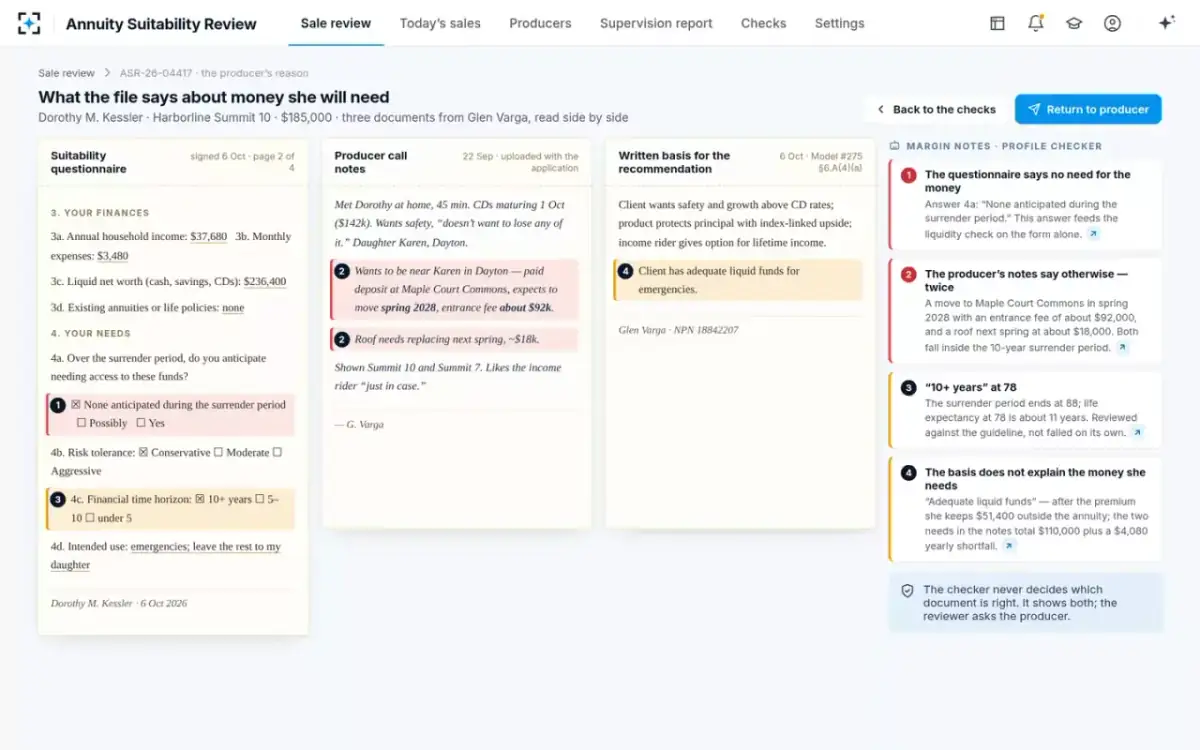
The sample shows why the liquidity field, factor 10, deserves a better question than a yes-or-no box. The questionnaire's question is about access "over the surrender period", and the buyer's answer, none anticipated, feeds every rule that reads the form. The notes describe two dated needs inside the period: a roof next spring and a move in spring 2028. A field that asked for dated needs and their amounts, rather than a yes or no, would have put both on the form.
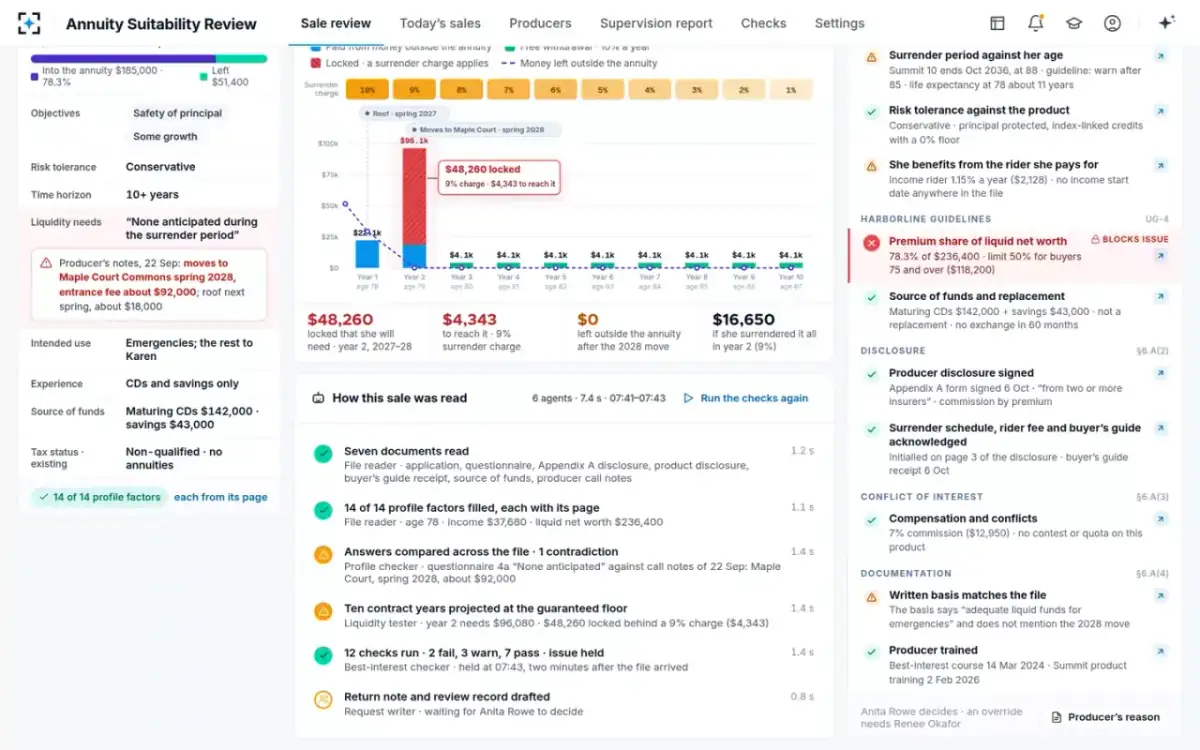
One sample sale, read in full before issue
7
documents read: application, questionnaire, two disclosures, buyer’s guide receipt, source of funds, call notes
14of 14
profile factors filled, each from its page
1
contradiction found between the questionnaire and the notes
131
quarterly findings for a profile incomplete or refused, across the sample carrier
How the sale was read: documents, factors, the contradiction, the checks
How long are suitability forms kept?
As long as the state says: Model #275 leaves the number of years blank, and its drafting note says that "For some states this time period may be five (5) years." Florida, for example, requires insurers and agents to keep "records of the information collected from the consumer and other information used in making the recommendations that were the basis for insurance transactions for 5 years after the insurance transaction is completed by the insurer."
The model's retention duty covers more than the questionnaire: the information collected from the consumer, the disclosures made, summaries of spoken disclosures included, and other information used in the recommendation. Producer call notes fall squarely in that last category, which is one more reason to read them before issue rather than discover them in an examination. Records may be kept on paper or electronically, and an insurer may keep them for its producers.
Four profile lists compared: Model #275, New York, FINRA and Reg BI
A carrier that also takes business from broker-dealers will see profiles collected under three other lists, and they do not match the model's fourteen. The differences matter when a questionnaire built for one rule arrives on a sale governed by another.
Which profile factors each rule names
| Factor | NAIC Model #275 | New York (DFS, 2016) | FINRA Rule 2330 | SEC Reg BI |
|---|---|---|---|---|
| Age, financial situation and needs, liquidity needs, risk tolerance, tax status | Named | Named | Named | Named |
| Annual income | Named | Named | Named | Not named separately |
| Experience, objectives, time horizon | Named | Named | Named, as investment terms | Named, as investment terms |
| Existing assets | Including investment, annuity and insurance holdings | Including investment and life insurance holdings | Including investment and life insurance holdings | “Other investments” |
| Liquid net worth | Named | Named | Named | Not named |
| Intended use of the annuity | Named | Named | Named | Not named |
| Insurance needs | Named | Not named separately | Not named | Not named |
| Financial resources used to fund it | Named | Inside financial situation and needs | Not named | Not named |
Two gaps stand out. Neither FINRA's variable annuity rule nor Reg BI names the source of funds or insurance needs, both of which the model treats as minimum factors; a broker-dealer's form can be complete under its own rule and still leave the insurer's review short. And Reg BI does not name liquid net worth, the factor a premium-share guideline like the sample carrier's depends on. Under the model's safe harbor the insurer may base its analysis on information from the broker-dealer, but it still needs a reasonable basis before it issues.
What to look for in a suitability questionnaire, and in the review behind it
A good questionnaire asks each factor in a way that produces evidence a reviewer can test, and a good review reads it against everything else in the file. The checklist below is ours.
Eight tests for an annuity suitability questionnaire and its review
- All fourteen model factors, plus any your states add
Including source of funds and tax status, which some securities-side forms omit.
- Liquidity needs asked as dated amounts, not yes or no
A move, a roof, care costs: when, and roughly how much.
- Liquid net worth defined on the form
Say what counts, so the premium share is computed the same way every time.
- Time horizon compared with the surrender schedule and age
A ten-year horizon at 78 is an answer worth a second look.
- Refusals captured on the state’s form, and counted by producer
Suspicious refusals are a pattern, not a single file.
- Every answer read against the producer’s notes and written basis
Contradictions are shown on both documents and resolved by the producer.
- A blank stays blank
An empty factor becomes a finding; it is never inferred from another document.
- Retention set by state
Five years where the state says five; longer where your own policy requires it.
Where Annuity Suitability Review fits: it does not design your form or collect answers from the buyer. It reads the completed questionnaire with the rest of the file, fills each factor from its page, leaves blanks blank, compares answers across documents and flags contradictions and refusal patterns for a reviewer. The person who reads the result is described in the annuity suitability review analyst, and how the findings roll up into the annual report in the annuity suitability report. The solution is at Annuity Suitability Review.
Questions people ask
Is there a standard annuity suitability form?
No single national form. Model #275 sets the minimum factors and provides model forms only for the producer disclosure (Appendix A), a refusal to give information (Appendix B) and a purchase not based on a recommendation (Appendix C). Insurers design their own questionnaires, and some states approve or prescribe forms.
When should consumer profile information be collected?
Before the recommendation. The care obligation requires reasonable efforts to obtain it from the consumer prior to recommending an annuity, and the documentation obligation requires the written record of the recommendation and its basis at the time of the recommendation or sale.
Can the insurer check the answers with the buyer?
Yes. The model lists confirmation of the consumer profile information, customer surveys, interviews and confirmation letters among the insurer's detection procedures, allows confirmation after issue or delivery, and forbids producers and insurers from dissuading the consumer from answering truthfully.
What if the buyer gave inaccurate information?
A recommendation later found to rest on materially inaccurate information provided by the consumer falls outside the producer's care obligation. The insurer's issuance must still be reasonable under all the circumstances actually known to it at the time, so a contradiction visible in the file is not excused.
Does a questionnaire signed by the buyer prove the sale was suitable?
No. It proves what the buyer said. The model asks for a reasonable basis that the annuity addresses her needs over the life of the product, judged on all the factors together, and the insurer's review must look at the product and the rest of the file as well as the form.