Selling annuities to seniors is lawful at any age; what changes is the review. No NAIC model sets a maximum issue age, but the best-interest model lists age first among the consumer-profile factors, asks for a reasonable basis that the annuity fits the buyer "over the life of the product", and bars the insurer from issuing a recommended annuity without one. For a buyer of 78 sold a ten-year contract, the life of the product runs to 88, so the carrier has to test money she will need, the share of her liquid assets committed and the age at which the last surrender charge ends. Some states add their own limits, and FINRA adds protections for customers 65 and over where the product is a security. Botminds' Annuity Suitability Review runs extra checks on every sale to a buyer 65 or older and stricter guidelines from 75, in the carrier's own settings, before the contract is issued.
The buyers, producers and carrier in the examples are fictional sample data in the solution. The rules are quoted from the NAIC, state statutes, FINRA and the New York Department of Financial Services, linked where they appear.
What weak senior-sale controls have cost insurers in one state
13
life insurers settling New York’s deferred-to-immediate annuity investigation by May 2022
$29M
approximate restitution and penalties across those settlements
$5.4M
restitution in the largest single settlement, in 2020, plus $5,529,000 in penalties
What rules apply when selling annuities to seniors?
The rules that apply are the general best-interest and suitability rules, read with age in view, plus a handful of age-specific provisions in state law and FINRA's rules. NAIC Model #275, adopted in some form by almost every state, sets the producer's care, disclosure, conflict-of-interest and documentation obligations and the insurer's supervision duties; its list of consumer-profile information begins "(1) Age" and includes financial time horizon, liquidity needs and liquid net worth (NAIC Model #275). The model itself contains no age threshold. The thresholds come from states, from FINRA, and from each carrier's own guidelines.
The provisions that change a sale when the buyer is older
| Provision | Who it binds | Age | What it requires |
|---|---|---|---|
| NAIC Model #275 §2.C, §6.A, §6.C | Producers and insurers | Any; age is a profile factor | A reasonable basis over the life of the product; insurer review before issue |
| Fla. Stat. §627.4554(9) | Insurers issuing in Florida | 65 and over | Surrender charge at most 10%, none after the tenth policy year |
| Cal. Ins. Code §785 | Insurers, brokers, agents | 65 and over | A duty of honesty, good faith and fair dealing to the prospective insured |
| Cal. Ins. Code §10127.10 | Insurers delivering in California | 60 and over | At least a 30-day free look and a cover notice naming the surrender charge |
| FINRA Rule 2165 | Broker-dealers | 65 and over, or impaired adults | May place a temporary hold where exploitation is reasonably believed |
| FINRA Rule 4512 | Broker-dealers | Any customer | Reasonable efforts to obtain a trusted contact person |
California's provisions show how a state can raise the bar without a cap. Section 785 says "All insurers, brokers, agents, and others engaged in the transaction of insurance owe a prospective insured who is 65 years of age or older, a duty of honesty, good faith, and fair dealing", and makes conduct during the offer and sale relevant to a later claim that the duty was breached. Section 10127.10 gives buyers 60 or older at least 30 days to return an individual annuity and puts the surrender charge on the cover: "After 30 days, cancellation may result in a substantial penalty, known as a surrender charge."
Why age is a review trigger, not a bar
Age raises the cost of a mistake and shortens the time to recover from one, and there is evidence that some financial decisions get harder with age. A study of ten credit markets by Sumit Agarwal, John Driscoll, Xavier Gabaix and David Laibson found that younger and older adults pay more in interest and fees than the middle-aged.
"Fee and interest payments are minimized around age 53."
Agarwal, Driscoll, Gabaix and Laibson, 'The Age of Reason: Financial Decisions Over the Lifecycle', NBER Working Paper 13191
The study is about borrowing, not annuities, and its authors discuss several causes. It is a reason for care, not a measure of annuity outcomes. Regulators' own findings supply those. FINRA's 2026 oversight report lists, among supervisory gaps at member firms, procedures that did not cover "consideration of the customer’s age in assessing whether the recommendation to purchase an annuity complies with FINRA Rule 2330 or Reg BI" (FINRA, 2026 Annual Regulatory Oversight Report: Annuities). New York's industry-wide investigation of deferred-to-immediate annuity replacements found insurers that failed to disclose income comparisons and suitability information; the 2022 settlement described the consumers affected as "primarily elderly individuals".
What these findings share is that the harm was visible in the file at the time: a time horizon, a liquidity need, a cheaper existing contract. A carrier that reviews each recommendation before issue, as Model #275 requires, is the last party able to see it before the money moves.
The checks a carrier runs at 65 and at 75
A careful carrier tiers its review by age: extra checks for every buyer from one age, stricter limits from a second, and a warning when the surrender period would end past a third. The thresholds are the carrier's own, approved by sales-practice compliance; the rule asks only that the review be reasonably designed. The sample carrier in the solution runs extra checks from 65 and stricter guidelines from 75, limits the premium to 65% of liquid net worth at 65 to 74 and 50% at 75 and over, and warns when a surrender period would end after 85.
An older buyer's sale through review before issue
Agent
File readerReads the application, questionnaire, disclosures, source of funds and the producer’s notes; fills the 14 profile factors, each from its page.
Never: fills a missing factor by guessing
Agent
Profile checkerCompares answers across documents and flags contradictions and suspicious refusals to give profile information.
Never: decides which document is right
Agent
Liquidity testerPlaces each stated need in a contract year and pays it against the surrender schedule at the guaranteed floor.
Never: projects a need the buyer did not state
Agent
Best-interest checkerRuns the twelve checks with the age-tiered thresholds; a failed blocking check holds issue.
Never: approves a sale or removes a hold
A person decides
Suitability reviewerPasses, returns to the producer, or escalates to sales-practice compliance; an override needs a second signature.
The surrender-period warning is the age check that matters most for older buyers, because it sets the age at which the money comes free. On the sample carrier it fired 122 times in one quarter. It does not block issue; it sends the reviewer to the file for a reason a long lock suits this buyer, such as care costs provided for elsewhere or a stated aim to leave the contract to heirs. The arithmetic of the schedule itself is set out in annuity surrender charge schedule.
How much of an older buyer's liquid assets should one annuity hold?
As much as leaves her able to meet every need she has stated, and no more than the carrier's guideline for her age; the model sets no percentage, so the guideline is the carrier's to set and defend. A premium-share limit is crude on its own, because two buyers with the same share can have very different needs. It works best paired with a liquidity test that places each stated need in a contract year.
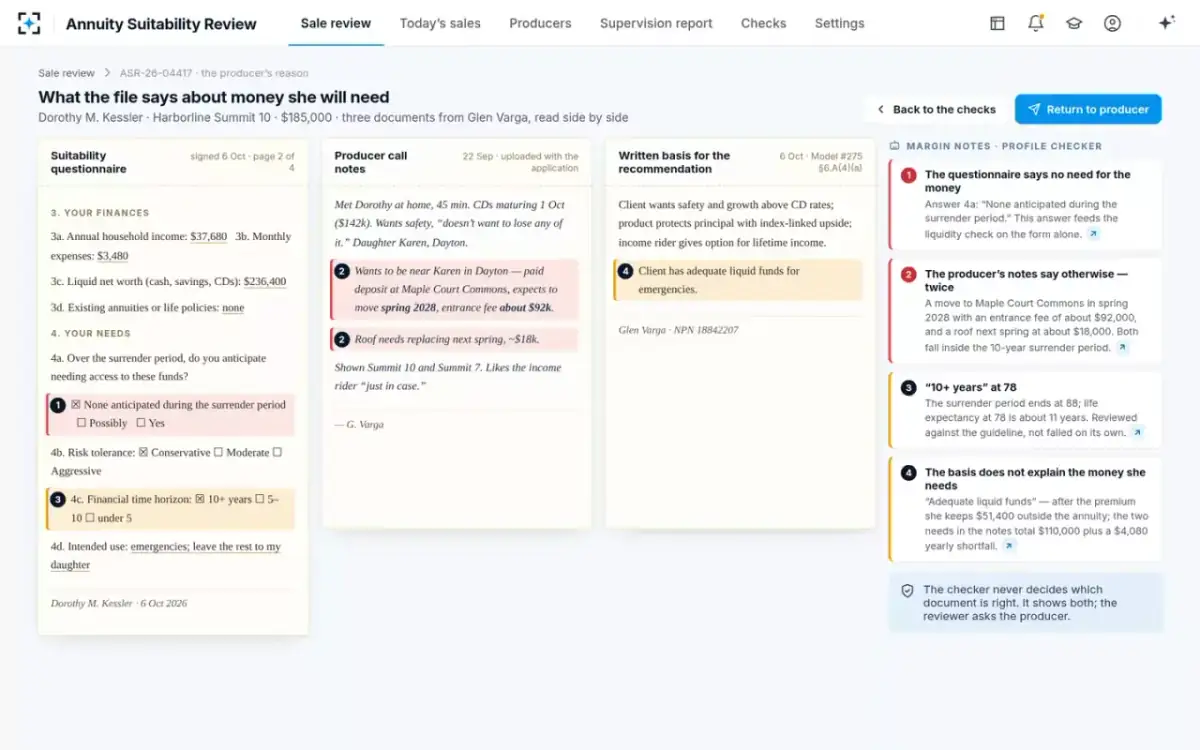
The sample sale shows both. The buyer is 78, widowed, renting, with income of $37,680 against expenses of $41,760, short $4,080 a year. Her liquid net worth is $236,400, and the applied premium of $185,000 is 78.3% of it, against the carrier's 50% limit for buyers 75 and over. The producer's notes record a move in contract year two with an entrance fee of about $92,000, and a roof next spring at about $18,000. At the applied premium, $48,260 of her year-two need would be locked behind a 9% surrender charge.
Where one 78-year-old's liquid money would go, at two premiums
Applied: $185,000 of $236,400
- Into the annuity, $185,000 · 78.3%
- Left outside, $51,400 · 21.7%
Guideline: $118,200 of $236,400
- Into the annuity, $118,200 · 50%
- Left outside, $118,200 · 50%
Moving the premium to the guideline is not the end of the review. At $118,200 no check fails, but the buyer would have $40 left outside the annuity after the move. A reviewer who returns the sale can put the alternative in front of the producer as a starting point, not a verdict.
When an older buyer's form and the producer's notes disagree
When they disagree, the carrier should treat the disagreement itself as the finding and ask the producer, not pick a document. The model expects procedures to detect recommendations that fall short, naming "confirmation of the consumer’s consumer profile information, systematic customer surveys, producer and consumer interviews, confirmation letters, producer statements or attestations and programs of internal monitoring", and procedures "to identify and address suspicious consumer refusals to provide consumer profile information" (Model #275 §6.C(2)(e), (g)).
On the sample sale the questionnaire answer to 4a reads "None anticipated during the surrender period" and the time horizon "10+ years". The producer's call notes describe the move and the roof. The written basis says the client "has adequate liquid funds for emergencies". Each is accurate to what someone wrote; read together they do not support the recommendation, and nobody reading only the form would know.
Three documents from one producer, read side by side
Protecting the buyer's own voice in the review
The model protects the buyer's ability to answer the carrier directly. Neither a producer nor an insurer may dissuade, or attempt to dissuade, a consumer from "Truthfully responding to an insurer’s request for confirmation of the consumer profile information", from filing a complaint, or from cooperating with the investigation of one (Model #275 §6.D). For an older buyer, a confirmation call or letter on a flagged sale is one of the few points where the carrier hears from the buyer rather than about her.
The model also closes a route around the review. A producer has no best-interest obligation where no recommendation was made, where the buyer refused to give profile information and the annuity was not recommended, or where the buyer decided to buy without a recommendation; but the insurer's issuance in those cases "shall be reasonable under all the circumstances actually known to the insurer at the time the annuity is issued." A non-recommendation form on a 78-year-old's file with call notes describing a move is a circumstance the insurer knows.
Where suitability review meets elder exploitation
Suitability review asks whether a sale fits the buyer; exploitation review asks whether someone is taking advantage of her, and an older buyer's sale can raise both. For broker-dealers FINRA provides tools. Rule 2165 defines a Specified Adult as "a natural person age 65 and older" or an adult the firm reasonably believes has an impairment that leaves the person unable to protect his or her own interests, and lets the firm place a temporary hold on a disbursement or transaction where it reasonably believes financial exploitation has occurred or been attempted: up to 15 business days, extendable by 10, and by a further 30 where the firm has reported to a state regulator, agency or court. Rule 4512 requires reasonable efforts to obtain "a trusted contact person age 18 or older who may be contacted about the customer's account".
Rule 2165 binds FINRA members, not insurers. An insurer that sees signs of exploitation in an annuity file acts under its own procedures and the state's elder-abuse reporting law. Model #275 does not supply a hold; the best-interest review supplies the evidence, and the carrier's escalation path decides what happens next. On the sample carrier, a reviewer's escalation goes to sales-practice compliance with the file and the findings attached.
Patterns with older buyers belong in the supervision report
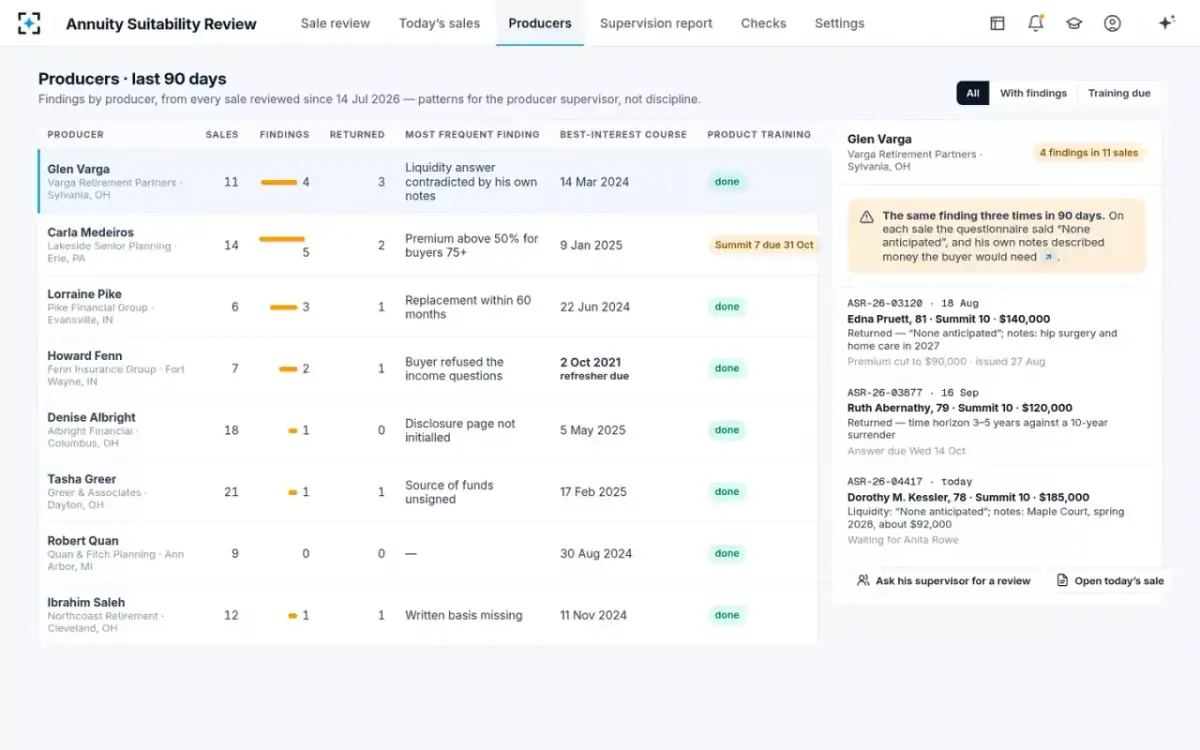
One unsuitable sale to an older buyer is a file problem; the same finding three times from one producer is a supervision problem. The model requires an annual written report to senior management on "the effectiveness of the supervision system, the exceptions found, and corrective action taken or recommended", and FINRA's 2026 report counts among effective practices exception reports and surveillance across representatives, customers, products and branches.
On the sample carrier one producer had the same finding three times in 90 days, each with an older buyer: a questionnaire saying no money would be needed and notes describing a need. A buyer of 81 with hip surgery and home care planned for the next year, a buyer of 79 with a three-to-five-year time horizon against a ten-year schedule, and the 78-year-old above. The first sale was issued at a lower premium after the return. The pattern went to the producer's supervisor as a pattern, not a verdict. How the yearly report is built from the reviews is in annuity suitability report.
Producers over 90 days: a repeated finding with older buyers
Where Annuity Suitability Review fits in senior sales, and where it stops
The solution reads each sale as it arrives, applies the age-tiered thresholds the carrier set, and holds issue when a blocking check fails. The reviewer sees the buyer, the product, the liquidity runway and the twelve checks together, can test a lower premium or a shorter product, and sends the producer a return with each item's evidence and rule. An override needs a written reason and a second signature from sales-practice compliance, and every sale, passed or not, has a written review kept five years by default. Changes to thresholds are tested on last quarter's sales and approved before they apply.
It does not decide whether a sale is suitable, contact the buyer or her family, judge intent, or replace the carrier's elder-abuse escalation; the agents read, compare, project and draft, and people decide. Its numbers on this page are sample data on fictional people, not a carrier's results. The full sample sale is at Annuity Suitability Review.
Questions people ask
Is there a maximum age to sell an annuity?
No NAIC model or federal rule sets one. Insurers set their own maximum issue ages by product and their own review thresholds; the best-interest rule asks only for a reasonable basis that the annuity fits the buyer over the life of the product, with age the first profile factor.
What is a senior consumer under Florida annuity law?
For the surrender charge limit, a buyer age 65 or older. Florida bars a surrender charge above 10% of the amount withdrawn on an annuity issued to a senior consumer and requires the charge to end after the tenth policy year, or ten years after each premium, whichever is later.
Does FINRA Rule 2165 apply to insurance companies?
No. Rule 2165 applies to FINRA member broker-dealers and the accounts customers hold with them. An insurer handles suspected exploitation under its own procedures and state law.
What is a trusted contact person?
A person 18 or older whom a broker-dealer may contact about a customer's account, under FINRA Rule 4512, to address possible financial exploitation or confirm the customer's health status, contact information or legal representative. Firms must make reasonable efforts to obtain one, but its absence does not prevent opening the account.
How long is the free look for seniors in California?
At least 30 days for a buyer 60 or older on the date of purchase. The cover of a non-variable annuity must say the policy may be returned within 30 days for a full refund and that cancellation afterwards may result in a surrender charge.
Can a carrier issue an annuity an older buyer chose without a recommendation?
Yes, but under Model #275 the insurer's issuance must still be reasonable under all the circumstances actually known to it at the time of issue. A file that shows a need for the money is one of those circumstances.