An annuity supervision system is the set of procedures an insurer keeps so that the annuity recommendations it issues comply with the best-interest rule: training producers, reviewing each recommendation before issue, detecting the ones that slipped through, checking disclosures, handling refusals of information, removing product-specific sales contests, and reporting on all of it once a year. NAIC Model #275 requires one, "reasonably designed to achieve the insurer’s and its producers’ compliance with this regulation", and it allows the pre-issue review to be done by a screening system, electronically. The hard part is not the software; it is that reviewers will only act on a flag they trust, and a system they second-guess adds work instead of removing it. Botminds' Annuity Suitability Review is built around that problem: each check names its rule and its evidence, a failed blocking check holds issue, and only a reviewer can release the hold.
The carrier, people and figures from the solution on this page are fictional sample data. The requirements are quoted from the NAIC model and FINRA's 2026 oversight report, linked where they appear; the 90-day plan is ours.
What each person needs to see before trusting an annuity supervision system
Today
Distrusts a flag that says “high risk” without saying why, and a pass that cannot show what was read.
With agents
Trusts a flag that quotes the conflicting pages and cites the rule, and a pass with its written review.
Still theirs: every decision on a flagged sale
Today
Worries that thresholds drift silently and that overrides go unseen until the annual test.
With agents
Approves every threshold change as a draft, tested on last quarter’s sales first, and signs each override.
Still theirs: the rules and the overrides
Today
Needs to tell senior management the system works, with testing, not with a vendor’s description.
With agents
Gets counts, exceptions and corrective actions from the written reviews, and an independent sample to test.
Still theirs: the annual report
Today
Fears a tool that brands producers on thin evidence.
With agents
Sees repeated findings by producer, framed as patterns to coach, never as discipline.
Still theirs: coaching and any discipline
What is an annuity supervision system?
An annuity supervision system is the insurer's machinery for meeting section 6.C of Model #275: it must stop the insurer issuing a recommended annuity without a reasonable basis, and keep a list of procedures running underneath. The model names them: informing producers of the rules and putting them in training manuals; standards for producer product training; product-specific training on all material features; procedures for reviewing each recommendation before the annuity is issued; procedures to detect recommendations that do not comply; procedures to check that the producer gave the consumer the required information; procedures to identify and address suspicious refusals to give profile information; procedures to eliminate sales contests and quotas based on specific annuities; and a yearly written report to senior management.
Software can carry some of those procedures and support others; none moves the duty. Mapping the list onto a system is the first thing to do when evaluating one, because it shows what a product covers and what will still be run by hand.
Model #275's supervision duties, and what an annuity supervision system can carry
What section 6.C(2) requires: Procedures for the review of each recommendation before issue; may use a screening system, electronically or otherwise.
What a system can do, and what stays with people: Read every file, run the checks, hold issue on a failure. A reviewer decides each flagged sale.
What section 6.C(2) requires: Procedures to detect non-compliant recommendations; confirmation, surveys, interviews, attestations, internal monitoring, sampling.
What a system can do, and what stays with people: Find contradictions across documents and repeated findings by producer. Confirming answers with a buyer stays with people.
What section 6.C(2) requires: Assess, before or on issue, whether the producer gave the consumer what the regulation requires.
What a system can do, and what stays with people: Check that the disclosure form, product disclosure and buyer’s guide receipt are present and signed.
What section 6.C(2) requires: Identify and address suspicious refusals to give consumer profile information.
What a system can do, and what stays with people: Count refusals by producer and flag patterns. Deciding a refusal is suspicious stays with people.
What section 6.C(2) requires: Identify and eliminate contests, quotas, bonuses and non-cash compensation tied to specific annuities within a limited period.
What a system can do, and what stays with people: Little: incentive programmes live in distribution agreements, outside the sale file.
What section 6.C(2) requires: Product training standards; verify the producer’s annuity course before the first sale.
What a system can do, and what stays with people: Show training status beside each sale. The licensing and course records come from the licensing system.
What section 6.C(2) requires: A written report to senior management on a tested review, the exceptions and corrective action.
What a system can do, and what stays with people: Draft from the written reviews. The independent test and the signature stay with compliance.
What does the NAIC require insurers to supervise?
The NAIC requires an insurer to supervise recommendations of its own annuities, by its own producers, from the profile collected to the contract issued. Model #275 says the insurer is not required to include in its system a producer's recommendations of products other than the insurer's annuities, or comparison with options available to the producer outside the insurer's products.
Two extensions catch out buyers of software. Functions the insurer contracts out stay inside the system: the insurer must monitor the contractor, audit where appropriate, and obtain an annual certification from the senior manager responsible, and it remains "responsible for taking appropriate corrective action" either way. A vendor's system is one of those functions. And sales made by broker-dealer representatives under comparable standards fall within the model's safe harbor only if the insurer monitors the relevant conduct and gives the supervising firm the information and reports that help it run its own supervision. A system that cannot export findings by producer and firm cannot support that half of the safe harbor.
Can annuity review be automated?
The screening can be; the decision cannot be handed over. Model #275 says the review procedures "may apply a screening system for the purpose of identifying selected transactions for additional review and may be accomplished electronically or through other means including, but not limited to, physical review", and that the system may require additional review only of the transactions its criteria select. So software may decide which sales a person reads. It may not take the insurer's reasonable-basis judgment off the person who signs for it.
FINRA's examiners describe the same design on the securities side and treat it as good practice. Their 2026 report lists, among effective practices, using automated tools, exception reports and surveillance to review variable annuity and RILA exchanges, standardizing review thresholds, and "implementing second-level supervision of supervisory reviews of exchange-related exception reports and account applications." It also lists data integrity as a practice in itself: confirming the data received from insurance carriers and third parties, and "Establishing a supervisory system that collects and uses key transaction data to supervise transactions and identify patterns."
A screening system that uses machine learning or a language model is also an AI system in the regulators' sense. Where a state has adopted the NAIC's AI model bulletin, insurers are expected to keep a written programme for AI systems that make or support decisions in regulated insurance practices, and a pre-issue screen supports exactly such decisions. That obligation is covered in the NAIC AI bulletin requirements; for a supervision system it means documenting what each check does, testing it, and keeping a person accountable for its outcomes.
Screening a sample of fields, or reading every sale
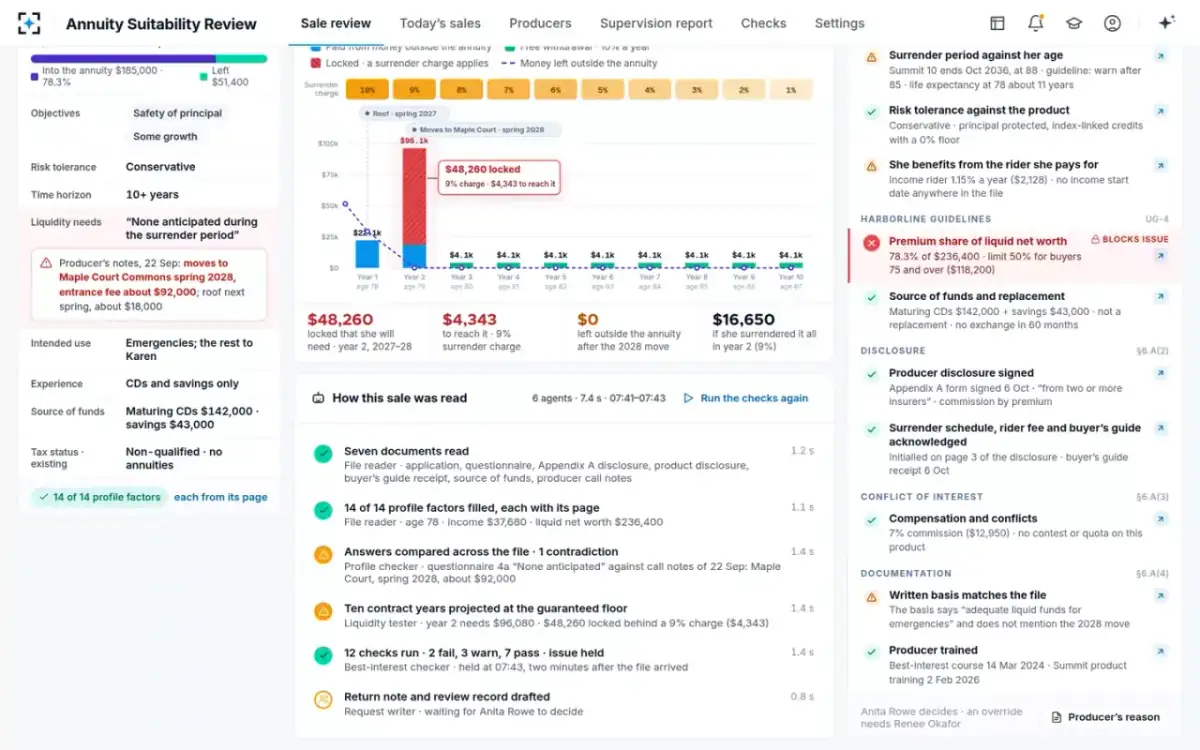
A screening system that tests the questionnaire's fields finds what the questionnaire says, and the risky answers can be somewhere else. In the solution's sample sale, the questionnaire says the 78-year-old buyer anticipates no need for her money during a ten-year surrender period, and every field-based rule passes on that answer. The producer's own call notes say she has paid a deposit on a senior community with an entrance fee of about $92,000, due in her second contract year.
That is why the design goal is to read every sale in full, notes included, before issue: a target, not a measured result. At the fictional sample carrier, reading producer notes against the questionnaire on every sale began on 1 April 2026 as a corrective action, and found 91 contradictions in the third quarter. The model allows either approach; what changes is what the screen can see.
How one sale was read: each step, what it found and how long it took
A 90-day path from shadow to flags reviewers act on
Trust in a supervision system is earned in three steps of about a month each: run it in the shadow on sales already decided, run it beside the reviewers on live sales while they still decide everything, then let passes release while flagged sales go to people. Each step ends with a measured agreement rate and a decision to move on, made by compliance.
Ninety days from first install to reviewers acting on the flags
- Shadow: replay last quarterDays 1–30
- Assisted: live, reviewers decide allDays 31–60
- Flags to people, passes releaseDays 61–90
- Agreement with past decisionsby check
- Flags reviewers mark right or wrongby reviewer
- Independent re-review of passessampled
Days 1–30, shadow. Replay last quarter's issued sales through the checks and compare each flag with what the reviewers decided at the time. Disagreements are the useful output: a flag on a sale reviewers passed is either a check set too tight or a sale that should not have passed, and only a person can tell which. In the solution a change to a check can be tested on last quarter's sales first, and settings are saved as a draft for compliance to approve.
Days 31–60, assisted. Run on live sales, with reviewers still deciding every one. Each flag is marked right or wrong by the reviewer who saw it, with a reason. Checks whose flags reviewers mark wrong more than they mark right are re-tuned or switched off before the next step; a known fault is not carried forward.
Days 61–90, flags to people. Sales with no flag release to issue with their written review; flagged sales go to reviewers; a sample of the passes is re-reviewed independently each week. This is the step the model describes, a screening system that requires additional review only of the transactions it selects, and the independent sample is what lets the annual report say the screen was tested.
What makes a flag trustworthy: rule, evidence, threshold, consequence
A flag earns trust when it carries four things: the rule it applies, the evidence it found with the page it came from, the threshold it used, and what happens next. FINRA's 2026 report makes the same point about written rationales, recommending that firms confirm rationales "address the specific circumstances for each customer and are not generic or insufficient". A flag that is generic fails for the same reason.
Each check names its source, its threshold and whether it blocks issue
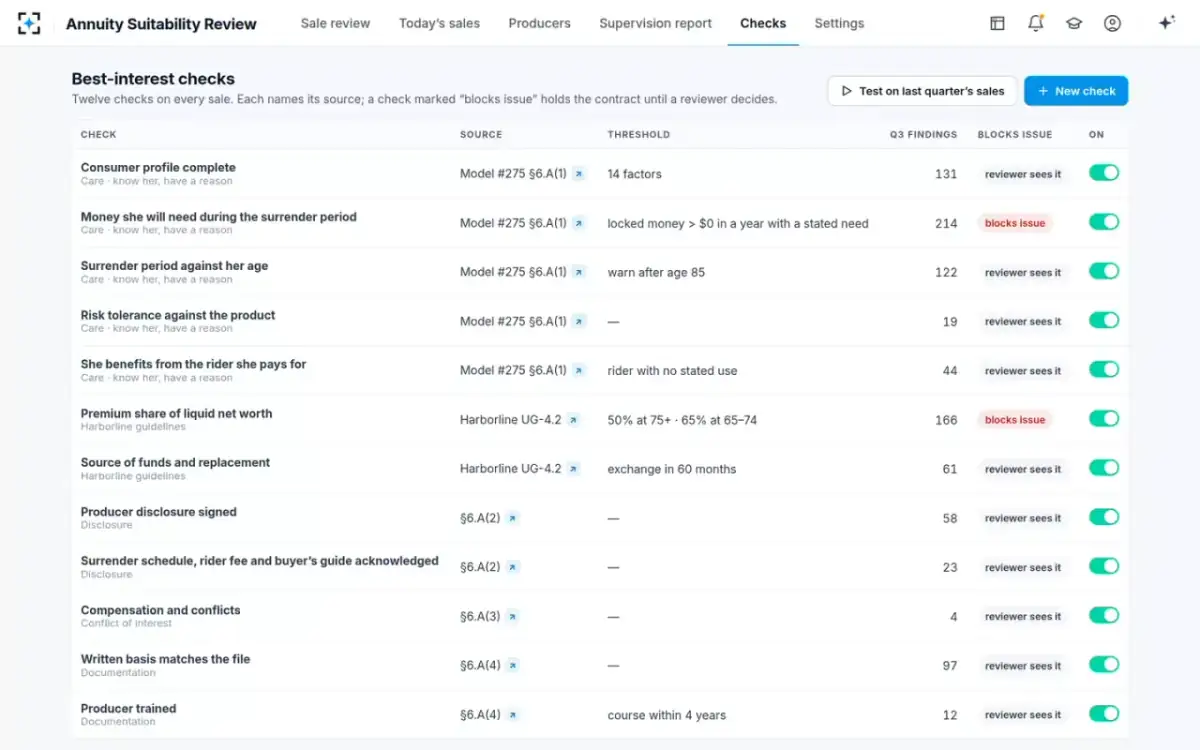
Separating the rule from house policy matters more than it looks. In the sample, one blocking check rests on the model's care obligation, money the buyer will need locked behind a surrender charge, and the other on the carrier's own guideline that a buyer 75 or older should not put more than half her liquid net worth into the contract. A reviewer can weigh an override of the second differently from the first, and the annual report can show which kind of exception occurred.
Who approves suitability overrides?
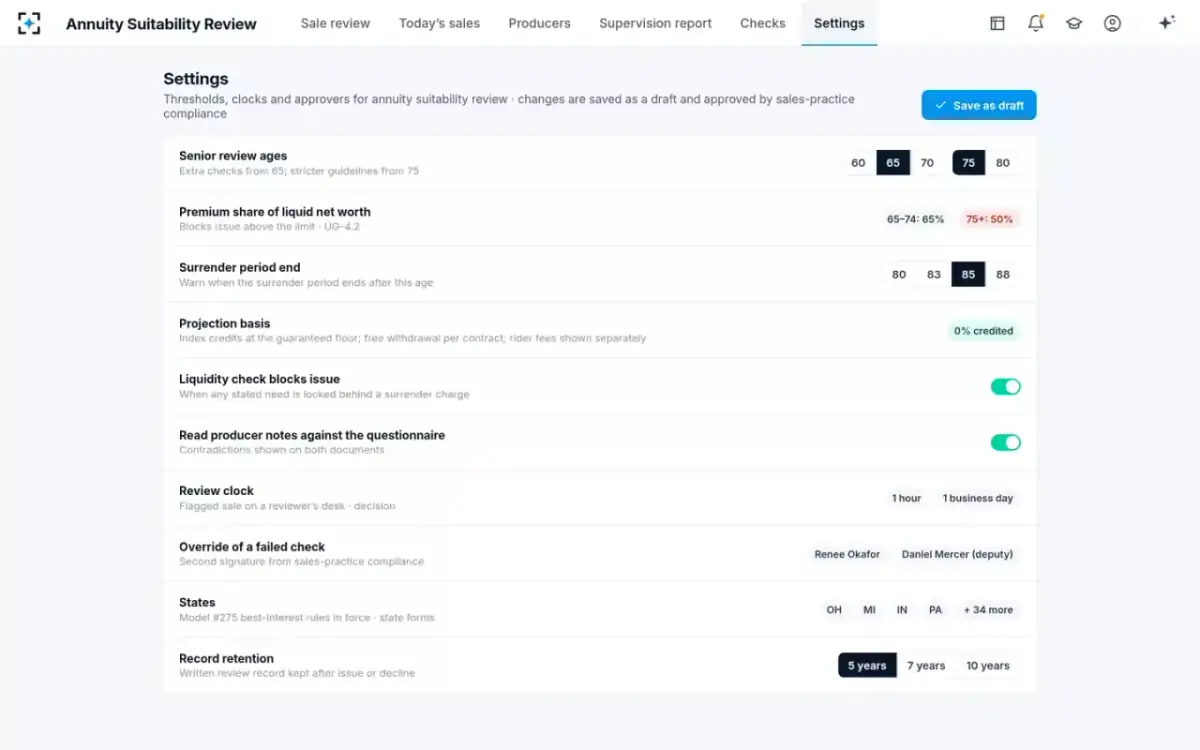
The person who owns the rules should approve an override: in the sample carrier, a named officer in sales-practice compliance, with a deputy. The model does not prescribe who signs; it requires a system reasonably designed to achieve compliance and a yearly report of exceptions and corrective action, and an issued sale with a failed check is the most likely exception. A second signature makes each one visible when it happens rather than at the annual test.
Settings: thresholds, clocks and override approvers, saved as a draft for compliance
How do you get reviewers to use new tools?
Reviewers use a new tool when it saves them reading they already distrust and never asks them to sign something they cannot see. Three practices do most of the work. Show the reading: every flag opens on the pages it quotes, and every pass has a log of what was read. Let reviewers be right: the assisted month exists so that a reviewer's "this flag is wrong" changes the check, and reviewers can see that it did. And count the right thing first: agreement and missed problems before speed. Speed comes anyway; in the sample, the median time from arrival to a reviewer's desk for a flagged sale was 52 minutes against a one-hour setting.
The analyst seat these practices are written for is described in the annuity suitability review analyst, and the monthly signals that tell compliance the screen is still working after go-live are in the annuity suitability report.
What to look for when buying an annuity supervision system
Buy for the evidence trail and the controls on change, not for the number of rules in a catalogue. The checklist below is what we would ask of any system, ours included.
Ten questions to ask of an annuity supervision system before you buy
- Does it read the whole file, including producer notes and the source of funds?
Field-only screening misses what the questionnaire does not say.
- Does every flag cite its rule and the page its evidence came from?
A reviewer must be able to check a flag in under a minute.
- Does a failed blocking check hold issue until a person decides?
And can only a person release the hold?
- Does an override take a written reason and a second signature?
Each override is a likely exception in the annual report.
- Can a threshold change be tested on past sales before it goes live?
And is every change a draft until compliance approves it?
- Does it keep a written review for passes, not only for flags?
The annual test samples passed sales too.
- Can it show findings by producer and by supervising firm?
Producer patterns, and the information the safe harbor requires the insurer to share.
- Are its projections conservative by design?
Guaranteed floor only, and never a need the buyer did not state.
- Can it be run in the shadow first, and measured?
Agreement with past decisions, check by check.
- Is it documented for your AI governance programme?
What each check does, how it was tested, who owns its outcomes.
Where Annuity Suitability Review fits and where it does not, plainly. It reads each sale before issue, runs the carrier's checks with their sources, projects stated needs against the surrender schedule, holds issue on a failed blocking check, drafts returns and the written review, and builds the supervision report. It does not manage producer licences and appointments, which belong in a licence management system; it does not replace a broker-dealer's principal review under FINRA Rule 2330; it does not price products or run illustrations; and it does not decide any sale. The agents never approve a sale, contact the buyer or change the application. The solution is at Annuity Suitability Review.
Questions people ask
What are annuity supervision system requirements?
Under NAIC Model #275 section 6.C, an insurer must keep a system reasonably designed to achieve compliance, including producer training standards, pre-issue review of each recommendation, detection procedures, checks that required information was given, handling of suspicious refusals, elimination of product-specific sales contests, and a yearly written report to senior management.
Does the insurer have to review every annuity sale?
It must have procedures to review each recommendation before issue, and it may use a screening system that sends only selected transactions for additional review. Every sale is reviewed; not every sale must be read by a person.
Can an insurer rely on a broker-dealer's review?
Partly. The model's safe harbor covers sales made under comparable standards such as Reg BI, but the insurer must monitor the relevant conduct, share information with the supervising firm, and still have its own reasonable basis before issuing under section 6C(1).
How long does it take to put a supervision system in place?
There is no regulatory timetable. Our plan above uses about 90 days for one product line: a month in the shadow on last quarter's sales, a month beside the reviewers on live sales, and a month with passes releasing and flags going to people.
What is the difference between screening and supervision?
Screening is one procedure inside the supervision system: choosing which sales get additional review. Supervision also covers training, detection after issue, disclosures, refusals, sales incentives and the annual report, and it stays the insurer's duty however much of it a system performs.