Form CRS must be delivered to a new retail investor before or at the earliest of three events if you are a broker-dealer: a recommendation of an account type, a securities transaction or an investment strategy; placing an order for the investor; or the opening of a brokerage account. An investment adviser must deliver it before or at the time it enters into an advisory contract. Existing customers get it again when they open a different kind of account, receive a rollover recommendation or are offered a new service, and anyone who asks gets a current copy within 30 days. Delivery is half the duty. The other half is a record of the date, and that is where firms are cited. Wealth Client Onboarding, Botminds' agentic solution for opening wealth accounts, finds the delivery in the firm's e-delivery log on every new-account packet and checks that its timestamp comes before the account opens, so the proof exists before the question is asked.
The rules below are quoted from the current text of 17 CFR 240.17a-14 for broker-dealers and 275.204-5 for advisers, with the SEC staff's answers to frequently asked questions where the rule is silent. The worked examples come from the solution's fictional sample firm, Quillfield Private Wealth, and its sample client households.
When Form CRS must be delivered, trigger by trigger
| Who receives it | Broker-dealer (Rule 17a-14) | Investment adviser (Rule 204-5) |
|---|---|---|
| A new retail investor | Before or at the earliest of a recommendation (account type, transaction or strategy), placing an order, or opening a brokerage account | Before or at the time the adviser enters into an investment advisory contract |
| An existing customer opening a different account | Before or at the time a new account that is different from the existing account(s) is opened | The same, for a new account different from the existing one(s) |
| An existing customer and a rollover | Before or at the time of recommending a roll-over of assets from a retirement account into a new or existing account or investment | The same |
| An existing customer and a new service | Before or at the time of recommending or providing a new brokerage service or investment that is not held in an existing account | The same, for a new advisory service or investment |
| Anyone who asks | A current Form CRS within 30 days of the request | The same |
| Existing customers, after an amendment | The changes communicated within 60 days after the amendments are required to be made, without charge | The same |
When must Form CRS be delivered to a new retail client?
For a broker-dealer, the deadline is the first of three events, whichever comes earliest. The rule says the firm must deliver its current Form CRS "before or at the earliest of" a recommendation of an account type, a securities transaction or an investment strategy; placing an order for the retail investor; or "the opening of a brokerage account for the retail investor" (17 CFR 240.17a-14(c)(1)). In a wealth practice the first of these is usually the recommendation: an advisor who suggests a managed account in the first meeting has started the clock before any paperwork exists.
The SEC staff have said how early that can be. Asked whether a firm must deliver Form CRS to someone met in an informal setting, the staff answered that "if you engage in a communication that rises to the level of a 'recommendation' to a retail investor, whether in the context of a 'hire me' conversation or otherwise, the recommendation will trigger the delivery obligation" (SEC Form CRS FAQ, January 10, 2020). That is why a firm cannot rely on the account application to carry Form CRS: the application often arrives after the trigger.
For an investment adviser the rule is simpler. Delivery is due "before or at the time you enter into an investment advisory contract with that retail investor" (17 CFR 275.204-5(b)(1)). A dually registered firm answers to both rules, which in practice means the earliest trigger in either one governs. The staff's answers contemplate both shapes: a dual registrant may prepare "a single relationship summary" or two separate ones, and in a December 2023 answer about firms trading under other names the staff expect both summaries delivered "with equal prominence and at the same time."
"Retail investor" is the same in both rules: "a natural person, or the legal representative of such natural person, who seeks to receive or receives services primarily for personal, family or household purposes." An account opened by a guardian for a person in their care still counts. An account for a company does not, because the definition starts with a natural person, and a firm with no retail investors at all is, in the staff's words, "not required to prepare or file a relationship summary."
What triggers delivery to an existing customer?
Three events trigger delivery again for someone who is already a client: opening "a new account that is different from the retail investor's existing account(s)"; a recommendation to roll over assets from a retirement account; and a recommendation of a new service or investment that will not sit in an existing account (17a-14(c)(2)). Of the three, the different-account trigger catches most wealth households, because they rarely open one account at a time. The rollover trigger comes with a rulebook of its own, set out in PTE 2020-02 requirements.
A conversion counts. The SEC staff were asked whether a dually registered firm must deliver a new relationship summary when a client converts an advisory account to a brokerage account, and answered yes: "Opening a new account that is different from the retail investor's existing account triggers delivery of the relationship summary," and that holds "even if the converted account does not have a different name or account number" (SEC Form CRS FAQ, modified June 26, 2020). A household that adds an IRA beside its joint brokerage account, or moves from commission to fee-based, has given the firm a new delivery date to record.
This is one reason onboarding a household with several accounts at once needs one delivery record per retail investor, dated before the first of the household's openings, rather than one per packet.
Is a rollover recommendation a Form CRS trigger?
Yes, for existing customers of both broker-dealers and advisers. The firm must deliver its current Form CRS "before or at the time you" recommend that the retail investor "roll over assets from a retirement account into a new or existing account or investment" (17a-14(c)(2)(ii); 204-5(b)(2)(ii)). The trigger is the recommendation, not the transfer: a rollover that the client decides on unprompted and the firm merely processes is a different case, although opening the receiving IRA may itself be a new, different account.
For a new client, a rollover recommendation is simply a recommendation, so it falls under the first trigger. Either way the record needs the same thing: a delivery date that precedes the recommendation's date, which means the firm has to know when the recommendation was made. A delivery log that is never compared with the advisor's meeting notes cannot show that.
Can Form CRS be delivered electronically?
Yes, under the SEC's existing guidance on electronic delivery, with one condition the staff have spelled out: when it is delivered electronically, "it must be presented prominently in the electronic medium, for example, as a direct link" or in the body of the email or message (SEC Form CRS FAQ, November 26, 2019). A Form CRS that is the eleventh attachment to an account-opening envelope is unlikely to meet that standard. On paper the staff are just as specific: in a package of documents, "the relationship summary is the first among any documents that are delivered at that time."
Access is not delivery. When firms communicate a change through another disclosure, the staff wrote that "merely providing notice of or access to another disclosure or the relationship summary would not satisfy this requirement" (SEC Form CRS FAQ, March 5, 2021). Posting the current version on the website is a separate duty, not a substitute for delivering it.
That may change. On July 21, 2026 the SEC published proposed Regulation E-Delivery, which "sets forth conditions for covered entities to deliver covered information to covered recipients electronically without first obtaining their affirmative consent," and it lists "disclosures pursuant to Form CRS" among the broker-dealer documents covered (91 FR 45884). Comments closed on September 21, 2026. It is a proposal: until a final rule is published, the existing guidance applies, and nothing in the proposal removes the duty to record the date.
What record of Form CRS delivery is required, and for how long?
A broker-dealer must make "a record of the date that each Form CRS was provided to each retail investor, including any Form CRS provided before such retail investor opens an account" (17 CFR 240.17a-3(a)(24)), and keep it, with a copy of each Form CRS, "until at least six years after such record or Form CRS is created" (17a-4(e)(10)). An adviser keeps "a record of the dates" that each Form CRS was given to any client or prospective client who becomes a client (17 CFR 275.204-2(a)(14)(i)), for at least five years from the end of the fiscal year of the last entry, the first two in an appropriate office of the adviser.
Read the broker-dealer rule closely and the record has three parts, not one: who received it (each retail investor, not each account), which Form CRS (the current version on that date) and when. A household of two owners opening a joint account needs two delivery dates. A firm that amended its Form CRS in March has to show that a client who signed in April received the March version, not the one before it.
The Form CRS clocks, in the rules' own numbers
30days
to deliver a current Form CRS to anyone who asks
60days
to tell existing customers about an amendment
6years
a broker-dealer keeps the dated delivery record
5years
an adviser keeps its record of delivery dates
What examiners find: the date, more than the delivery
FINRA's 2026 oversight report lists its Form CRS findings plainly. Under "Failing to Properly Deliver Form CRS" the first finding reads: "Failing to deliver or not creating a record of the date on which the firm provided each Form CRS." The second concerns electronic delivery: "If the relationship summary is delivered electronically, failing to present it prominently" (FINRA, 2026 Annual Regulatory Oversight Report).
Failing to deliver or not creating a record of the date on which the firm provided each Form CRS.
FINRA, 2026 Annual Regulatory Oversight Report, Reg BI and Form CRS
The two failures in that sentence are joined by "or" for a reason. A firm that delivered every Form CRS but cannot show when has the same finding as one that delivered none, because the regulator has no other way to tell them apart. FINRA's matching effective practice is about evidence, not delivery: "automating mechanisms to evidence delivery of Form CRS and other relevant disclosures."
The SEC has brought cases at the other end of the scale. In July 2021 it charged 27 firms, 21 advisers and six broker-dealers, finding that "none of the firms filed or delivered its Form CRS, or posted it to its website, until being twice reminded of the missed deadlines by their regulators," with civil penalties from $10,000 to $97,523 (SEC press release 2021-139). Twelve more firms settled in February 2022 (SEC press release 2022-27). Those were firms that never started. The routine exposure for a firm that did start is a delivery it cannot date.
How Wealth Client Onboarding proves delivery came first
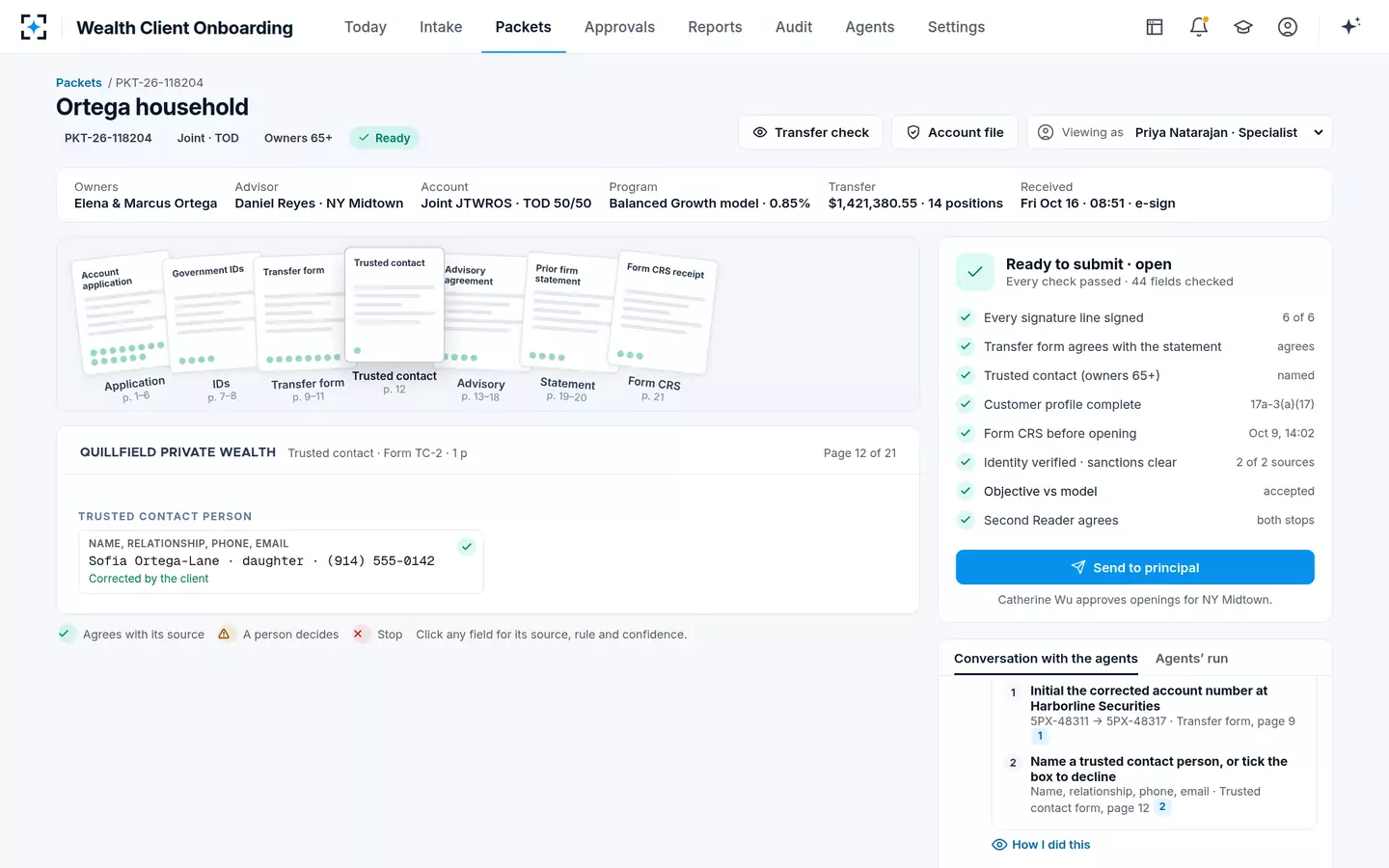
Proving that delivery came first takes two timestamps and a comparison, and the comparison is the step most packets skip. The solution's Profile & Disclosure Checker reads the firm's e-delivery log for each owner, finds the Form CRS delivery and its version, and compares that timestamp with the earliest trigger the packet shows: the account opening, an order, or a recommendation recorded in the CRM. A delivery that is missing, late or of a superseded version stops the packet before submission, and a person decides what happens next.
How Wealth Client Onboarding evidences Form CRS on each new-account packet
Agent
Profile & Disclosure Checker finds the deliveryLooks up each retail investor on the packet in the firm’s e-delivery log and reads the delivery timestamp and the Form CRS version sent.
Never: counts a website posting or a link in a footer as delivery
Agent
It compares the date with the earliest triggerChecks the timestamp against the opening date, any order and any recommendation logged in the CRM, and against the date the current version took effect.
Agent
Good-Order Checker stamps the fieldGreen when delivery came first, with the log entry as its source; red when it is missing, later than a trigger or the wrong version.
Never: waives the rule
A person decides
The specialist decides a redSends the current Form CRS and records why the packet waits, or returns it to the advisor when the trigger was a recommendation already made.
Agent
The account file keeps the lineWrites the delivery date, version and log reference into the account file under 17a-3(a)(24), kept with the opening.
On the sample Ortega household the check is a single line, and it is the line an examiner asks for. The account file shows "Form CRS delivered before opening" with the time it was sent, October 9, 2026 at 14:02:11, the time it was opened, the version in force (March 2026) and the rule it answers, 17a-3(a)(24). The account itself opened a week later. In the sample firm's week of 2,184 packets, the Form CRS rule stopped 11 before submission, the smallest of its stop reasons but one of the hardest to repair after the fact.
One line of the account file answers 'when was Form CRS delivered?'
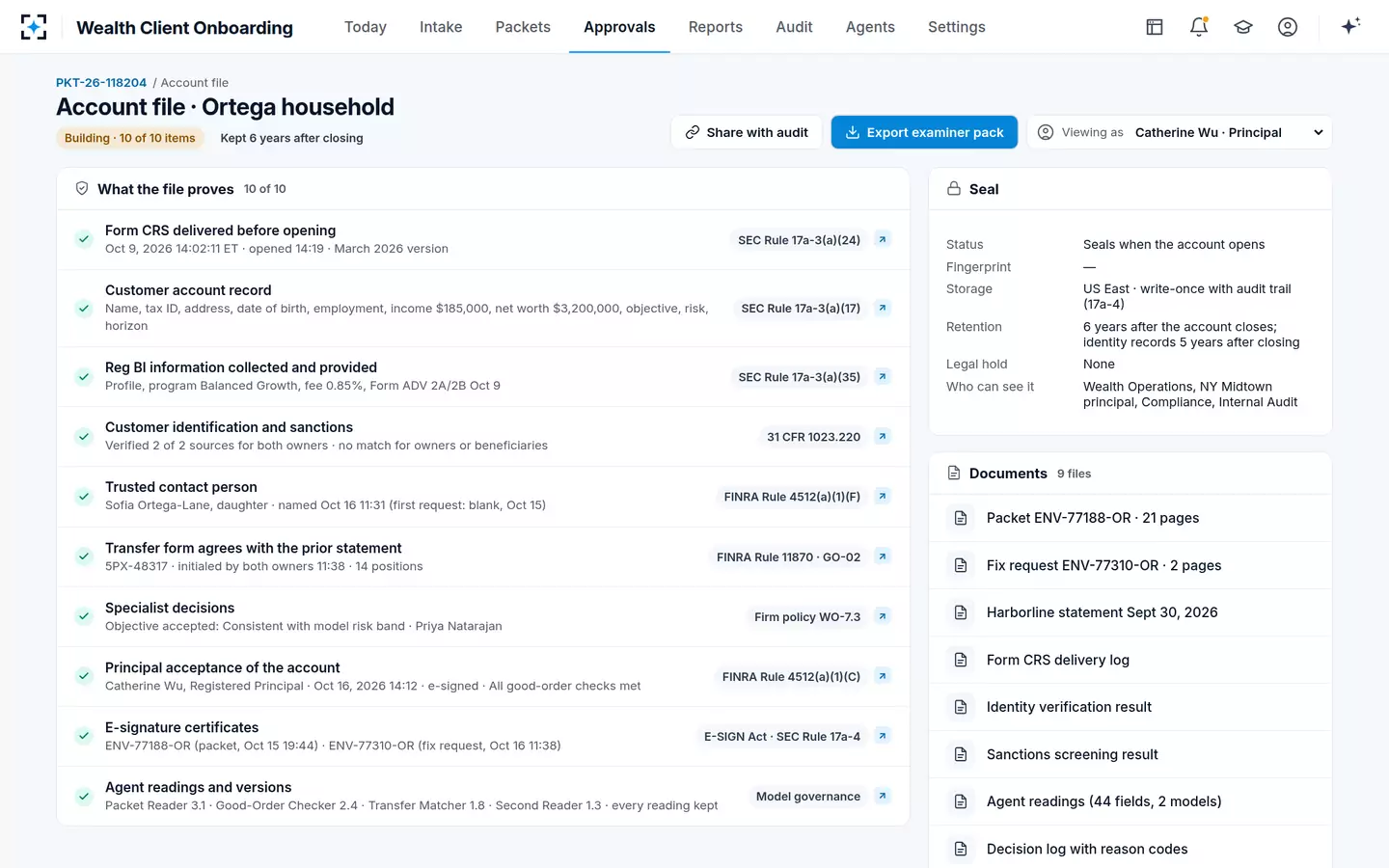
The design choice that matters is where the check sits. A delivery-date control that runs at month-end can only report a gap. One that runs before submission can still close it, by delivering the current version and recording why the opening waited. That is the same reasoning that puts the FINRA Rule 4512 and 17a-3(a)(17) account fields through a source check before the principal signs.
Form CRS before opening is one of the checks a packet must pass in Wealth Client Onboarding
A Form CRS delivery checklist for every new account
A delivery record holds up when it answers the regulator's questions without a follow-up email. The list below is drawn from the rule text and the staff's answers, not from any one firm's procedures.
Seven checks on the Form CRS line of a new-account file
- One delivery per retail investor
Each joint owner, trustee or legal representative who is a retail investor has a date of their own (17a-3(a)(24) says "each retail investor").
- Dated before the earliest trigger
Before or at the first recommendation, order or opening for a broker-dealer; before or at the advisory contract for an adviser.
- The version in force on that date
A client who signs after an amendment received the amended Form CRS, or the file shows the change was communicated.
- Delivered, not posted
Electronic delivery presented prominently, such as a direct link; on paper, first in the package.
- A new date for a different account
A conversion, a new IRA or a new service for an existing client triggers delivery again.
- Requests answered within 30 days
A request log shows the date asked and the date sent.
- Kept for the full period
Six years after the record is created for a broker-dealer; five years from the end of the fiscal year of the last entry for an adviser.
When must firms update their Form CRS, and tell existing customers?
A firm amends its Form CRS as the form's instructions require, files the amendment, and then has 60 days to tell existing retail customers: the rule requires it to "communicate any changes made to Form CRS to each retail investor who is an existing customer within 60 days after the amendments are required to be made and without charge" (17a-14(c)(4)). The communication can be the amended form itself or another disclosure that carries the information, delivered rather than merely made available.
The 60-day window creates an onboarding problem that is easy to miss. Packets signed in the weeks around an amendment carry whichever version the advisor had to hand. A delivery check that reads only "Form CRS: yes" will pass a superseded version; one that reads the version and its effective date will not. In the sample firm's settings the version is part of the rule, which is why the Ortega line names the March 2026 version rather than just a date.
Choosing software for this is less about the check and more about where the data lives: an e-delivery log the agents can read, a CRM that dates recommendations and an archive that keeps the line for six years. Client onboarding software that sits beside the custodian covers those connections in detail.
Questions people ask
When must Form CRS be delivered to a new retail client?
A broker-dealer must deliver it before or at the earliest of a recommendation, placing an order or opening a brokerage account, so in practice usually at the first recommendation. An investment adviser delivers it before or at the time it enters into the advisory contract. A dual registrant must satisfy both rules.
How often does Form CRS need to be delivered?
There is no annual delivery. It is delivered at the start of the relationship, again to existing customers at three triggers (a different new account, a rollover recommendation, a new service or investment), within 30 days of any request, and amendments are communicated to existing customers within 60 days. The current version must also stay posted on the firm's website.
Is Form CRS only for retail customers?
Yes. Both delivery rules apply to retail investors, defined as natural persons, or their legal representatives, who seek or receive services primarily for personal, family or household purposes. A firm with no retail investors does not need to prepare one, according to the SEC staff's FAQs.
Can a firm rely on the client's e-signature envelope as the delivery record?
Only if the envelope shows that Form CRS was presented prominently and when, and the date comes before the earliest trigger. An envelope signed at account opening cannot prove delivery before an earlier recommendation, which is why the record should be compared with the CRM's recommendation date.
How long is the Form CRS delivery record kept?
A broker-dealer keeps the 17a-3(a)(24) record and a copy of each Form CRS until at least six years after the record or the form is created, under 17a-4(e)(10). An adviser keeps its record of delivery dates for at least five years from the end of the fiscal year of the last entry, the first two in an appropriate office.
Does the July 2026 Regulation E-Delivery proposal change Form CRS delivery?
Not yet. The proposal would let firms deliver covered documents, including Form CRS disclosures, electronically without first obtaining affirmative consent, with a paper opt-out. Its comment period closed on September 21, 2026; until a final rule is adopted, the existing electronic delivery guidance and the staff's prominence answer apply.