Client onboarding in wealth management is the work of opening a new household's accounts, in good order, and moving its assets in: the applications, identity documents, transfer forms with the prior firms' statements, trusted contact forms, the advisory agreement, tax forms and beneficiary designations, checked against the firm's rules, evidenced for the regulators and approved by a principal. What makes it harder than opening a single brokerage account is that a wealth client is a household. A couple may open a joint account with transfer-on-death beneficiaries, an IRA each and an account for their trust in the same week, each with different owners, signers, forms and transfers, and the errors cluster where those accounts meet: a beneficiary named one way on the TOD form and another on the IRA, a trust titled differently on the transfer form and the statement, a Form CRS delivered to one spouse but not the other. Wealth Client Onboarding, Botminds' agentic solution for opening wealth accounts, reads every packet of a household together and checks each field against its source, so those joins are tested before anything reaches the custodian.
The household used below is illustrative, a couple with an adult child abroad; the screens show the solution's own fictional sample household, Elena and Marcus Ortega, at its fictional sample firm, Quillfield Private Wealth. Rules are quoted from FINRA, the SEC, FinCEN and the IRS.
One household, four accounts: each branch needs its own forms and signatures
The household
Two spouses in their sixties, one adult child living abroad, assets at two prior firms
Joint account, JTWROS, with TOD
Both spouses own; two adult children named as TOD beneficiaries
Forms
Application with both owners’ details · IDs for both · TOD designation with shares per beneficiary · transfer form and prior statement · trusted contact for each owner
Signs
Both owners
Traditional IRA, one spouse
One owner; spouse and children as beneficiaries by tier
Forms
IRA application · beneficiary designation, primary and contingent, each tier totalling 100% · transfer form and the old custodian’s statement
Signs
The IRA owner
Revocable trust account
The trust, with both spouses as trustees
Forms
Certification of trust · trustee IDs · trust’s address · transfer form if moving from another firm, titled as the old firm titles it
Signs
The trustees, as the trust instrument and the firm require
Account for an adult child abroad
One owner, a non-US person
Forms
Application · passport number and country of issuance · W-8BEN · Form CRS
Signs
The owner
What is client onboarding in wealth management?
It is everything between a household deciding to work with the firm and its accounts being open, funded and on the record. The sequence is familiar to every advisor: the first meeting, where a recommendation may already trigger Form CRS delivery; the paperwork, assembled by the advisor and a client service associate; the review for good order by a new-accounts specialist; any fixes with the client; approval by a registered principal; submission to the custodian; and the transfers in from the old firms, which run on their own clocks.
The SEC's investor bulletin on opening a brokerage account lists what the client will be asked for, and it is a long list for each person: name, Social Security or taxpayer identification number, address, telephone, e-mail, date of birth, government-issued ID, trusted contact information, employment status and occupation, whether employed by a brokerage firm, annual income, net worth, investment objectives and risk tolerance, other investments, experience, time horizon and liquidity needs (SEC investor bulletin, "How to Open a Brokerage Account," June 10, 2021). In a household, that list repeats for every owner, and the accounts add their own forms on top.
What paperwork is needed to open accounts with a financial advisor?
The account application and identity documents for each owner, then whatever each account type adds, and a transfer form for every account coming from another firm. The table sets out the common pieces by account type and the rule or reason behind each. Each custodian prints its own versions, so the list is a map of what to expect rather than a set of forms.
Paperwork by account type in a wealth household
| Account type | What it adds to the packet | Why |
|---|---|---|
| Every account | Application; ID for each owner; W-9 or W-8BEN; Form CRS delivered and dated; advisory agreement for advisory accounts | Customer identification rule; SEC Rule 17a-3(a)(17) account record; Form CRS rules |
| Joint account | Personal details and signatures of each owner; form of ownership (for example, JTWROS) | 17a-3(a)(17): personal information for each joint owner; financial information may be combined |
| TOD registration | Designation naming beneficiaries and their shares | State law, usually based on the Uniform TOD Security Registration Act; the firm says which accounts are eligible |
| IRA | IRA application; primary and contingent beneficiaries with percentages | The custodian’s requirements; percentages that do not total 100% cannot be carried out |
| Trust account | Certification of trust or trust pages; trustees’ IDs and signatures; the trust’s address | FINRA Rule 2090: the authority of each person acting for the customer; CIP address for a non-individual |
| Family entity, such as an LLC | Formation documents; beneficial owners of 25% or more and one control person | FinCEN’s customer due diligence rule for legal entity customers |
| Any account with assets elsewhere | Transfer form and the old firm’s most recent statement | FINRA Rule 11870: the form must match the old firm’s records |
| Owners of any age | Trusted contact person, or a recorded decline | FINRA Rule 4512(a)(1)(F): reasonable efforts; not a bar to opening |
What is a TOD account?
A TOD account is a brokerage account registered "transfer on death," so that on the owner's death the assets pass directly to named beneficiaries. FINRA's investor guidance describes the essentials: "With a TOD, you keep control of the brokerage account assets during your lifetime"; "You can change beneficiaries or cancel your TOD throughout the life of your account"; and "a TOD plan or other beneficiary document supersedes your will." It is a matter of state law: "This area is governed by state law, and state laws can differ," and "Most states have adopted the Uniform TOD Security Registration Act, although some have modified it" (FINRA, "Plan Now to Smooth the Transfer of Your Brokerage Account Assets on Death," January 17, 2023).
For onboarding, two details matter. The first is the title: with a TOD registration, FINRA notes, "Instead of simply 'Your Name,' the account will be titled 'Your Name, TOD Beneficiary Name.'" A household moving a TOD account from another firm must copy that title onto the transfer form exactly as the old firm has it, and a household adding TOD at the new firm must not put the new title on the transfer form, because the old firm's records do not show it. The second is arithmetic: shares that total 90% or 110% cannot be carried out as written. The solution's sample firm stops any TOD or IRA designation whose percentages do not total 100% for each tier; in its sample week that rule stopped 29 packets.
How does a joint account differ in onboarding?
Everything personal is collected twice, and some things are combined. SEC Rule 17a-3(a)(17) says that "in the case of a joint account, the account record must include personal information for each joint owner who is a natural person; however, financial information for the individual joint owners may be combined" (17 CFR 240.17a-3(a)(17)). So each owner needs a name, tax ID, address, telephone, date of birth and employment status; income, net worth and objectives can be the household's. Each owner is also a retail investor for Form CRS, and the broker-dealer must record the date it gave each of them Form CRS (17a-3(a)(24) and 17a-14); the triggers and the dated record are set out in when Form CRS must be delivered.
The form of ownership matters as much as the owners. Joint tenants with right of survivorship, tenants in common and community property behave differently on death and are different account types to the old firm, so a transfer form that says "joint" where the statement says "tenants in common" is a mismatch. And each owner signs: in the sample Ortega packet all six signature lines were signed before the review started, both owners signed the transfer form, and the trusted contact question is put to the household again when the page comes back blank.
Who signs which account in one household
Today
Sign the application, every transfer form and each designation, sometimes several times when a single form comes back wrong.
With agents
Sign once for the packet, then only the items that need fixing, in one request.
Still theirs: every instruction about their money; no one else changes a value they signed
Today
Sign for the trust, with a certification of trust the firm may ask for twice.
With agents
Sign for the trust; the certification is checked for every trustee signature before submission.
Still theirs: the trust’s authority
Today
Signs as the associated person responsible and calls the household when a form is rejected.
With agents
Hears at 48 hours if a fix request is still open, under their own name.
Still theirs: the relationship and the recommendation
Today
Accepts each account, often from a summary.
With agents
Accepts each account with the household’s evidence in view.
Still theirs: acceptance of every account
Trusts, IRAs and family entities in the same household
Each brings a different rule. For a trust account, the customer identification rule treats the trust as a customer that is not an individual and asks for the address of its principal place of business or another physical location (31 CFR 1023.220), and FINRA Rule 2090 asks the firm to know the authority of everyone who acts for the customer, which for a trust means its trustees. The sample firm's rule, "Certification of trust complete with every trustee signature," stopped four packets in its sample week.
A family LLC or partnership is a legal entity customer under FinCEN's customer due diligence rule, which requires the firm to identify each individual with a stake of 25% or more and one individual with significant control (31 CFR 1010.230). A trust that is not created by a filing with a state office generally falls outside that definition. Since February 13, 2026, FinCEN has granted relief from identifying and verifying a legal entity customer's beneficial owners for every new account; the firm still does it when the entity first opens an account with the institution (FinCEN, February 13, 2026). For a household opening several entity accounts in one week, that means one beneficial-ownership exercise per entity, not one per account.
IRAs add beneficiaries by tier and their own custodial forms. They also tend to arrive as transfers from another custodian, which brings the account-type match into play: an IRA moves to an IRA of the same kind. The rollover decision itself, and the documentation it needs, is a separate subject from opening the account.
Non-US household members: how long is a W-8BEN valid?
Until the end of the third calendar year after the year it was signed. The IRS instructions say a W-8BEN "will remain in effect for purposes of establishing foreign status for a period starting on the date the form is signed and ending on the last day of the third succeeding calendar year, unless a change in circumstances makes any information on the form incorrect," and give the example that a form signed on September 30, 2015 "remains valid through December 31, 2018" (IRS Instructions for Form W-8BEN).
Household dates the onboarding file has to get right
3years
a W-8BEN stays in effect, to the end of the third calendar year after signing
30days
to send each owner a copy of the account record after opening
1day
for each old firm to validate or reject its transfer
100%
what every beneficiary tier must total for the designation to work
For the customer identification rule, a non-US person's identification number may be "a taxpayer identification number, a passport number and country of issuance, an alien identification card number," or another government-issued number with a photograph. An adult child abroad is often the household member whose paperwork arrives last and in a different language; the solution reads Simplified Chinese, Spanish and French pages beside its English reading, and names any page too poor to read rather than guessing.
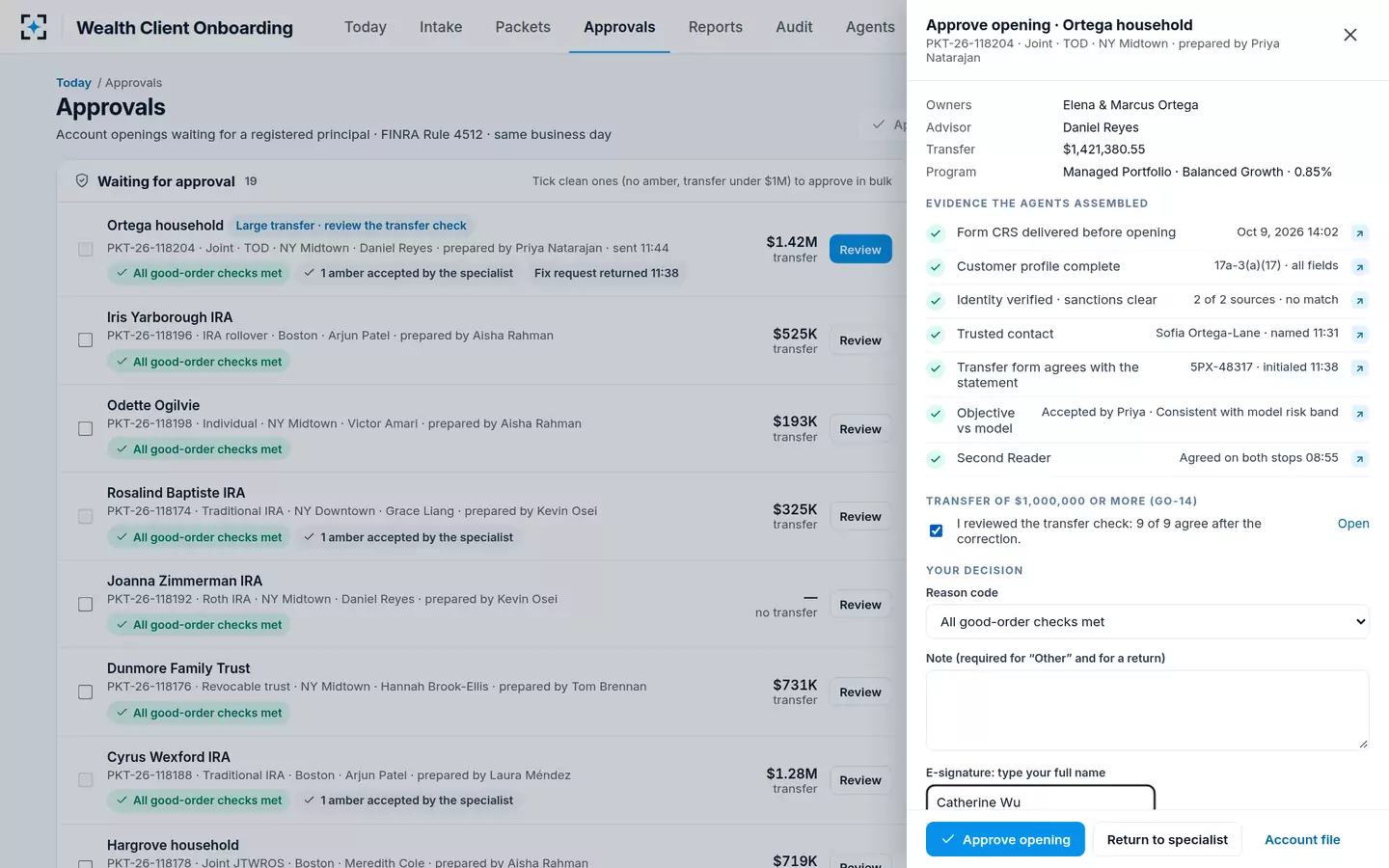
A principal's queue in Wealth Client Onboarding: many account types, one standard of evidence
Why does wealth onboarding take so long?
Because a household opens at the speed of its slowest join. Each account has its own clock, and the transfers in have the clocks of the old firms: one business day to validate each transfer under FINRA Rule 11870, three to complete it, and often far longer outside ACATS. A household with one transfer form wrong, one designation that does not add up and one spouse's trusted contact page blank does not have three small problems; if each is found separately, it has three rounds of calls, signatures and waiting. The detail of those clocks is in the ACATS transfer rules under FINRA Rule 11870. A household the firm rates high risk adds one more join, the evidence of where its money came from, explained in source of wealth vs source of funds.
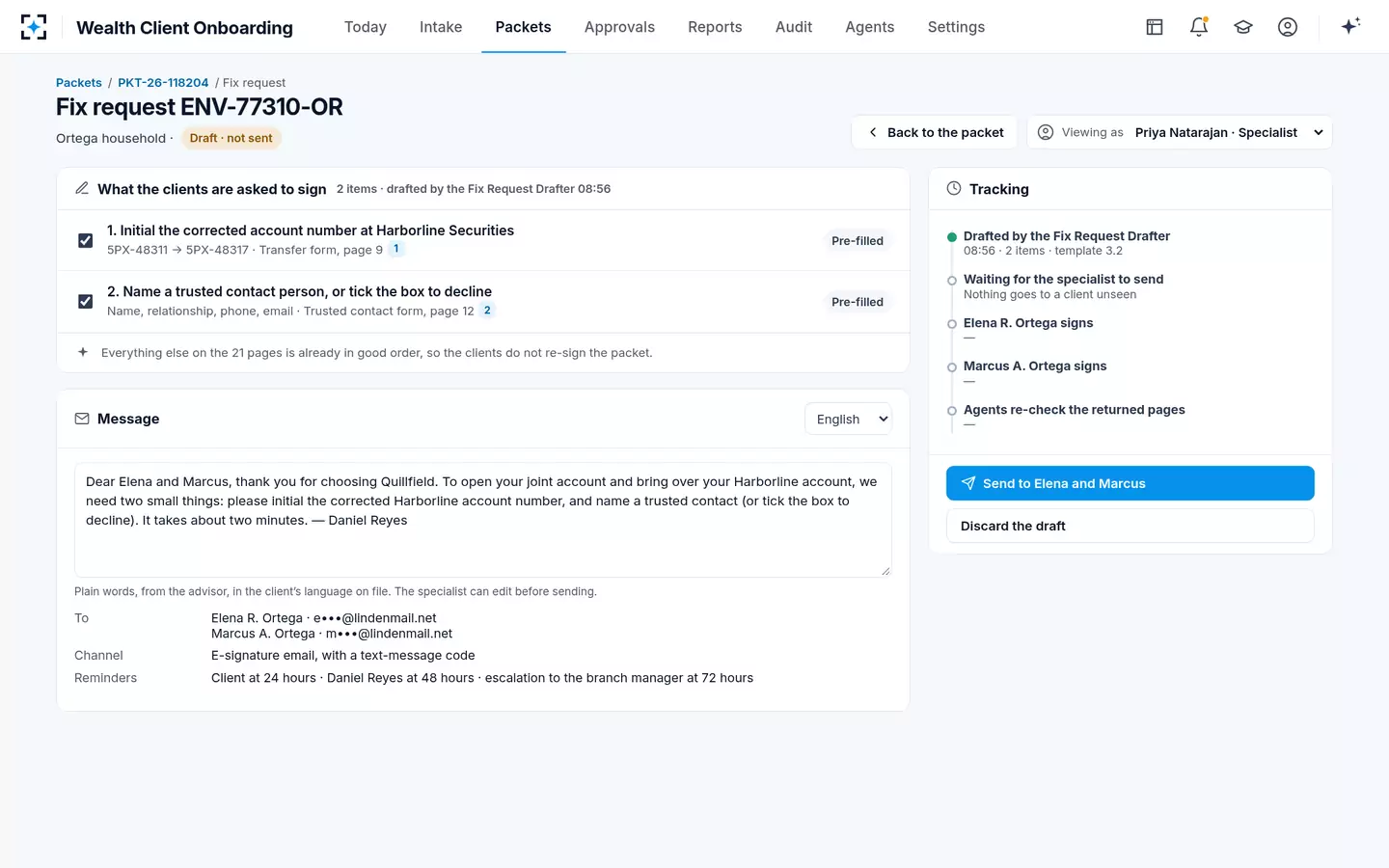
The remedy is to check the household together and ask once. In the sample Ortega packet the solution found two problems, a transfer-form account number one digit off the prior statement and a blank trusted contact page, and sent the couple one request with exactly those two items, pre-filled, under their advisor's name; both signed within 40 minutes. The rest of the 21 pages were already in good order, so they did not sign the packet again. On Botminds' estimate for the design, the largest shares of a household's lost days sit in that fix loop and in transfers rejected after submission, not in the custodian's processing.
One fix request for the household in Wealth Client Onboarding: only what is missing
A financial advisor client onboarding checklist, household first
Most onboarding checklists list documents per account. The checks that prevent rework are about the household: who is in it, which accounts each person is part of, and whether the same fact is written the same way everywhere it appears.
Household onboarding checklist
- Map the household before the paperwork
Every person, every account, every transfer in, and who owns, signs and benefits on each.
- Deliver Form CRS to each retail investor, and date it
Before the first recommendation, order or opening; a new, different account for an existing client is a new trigger.
- Collect identity once per person, use it everywhere
One name, date of birth, address and tax ID per person, and check each form against it.
- Match every transfer form to its own statement
Account number, title, tax ID and type exactly as each old firm has them.
- Make designations consistent and complete
TOD and IRA beneficiaries total 100% per tier; names spelled the same on every account.
- Ask each owner about a trusted contact
Reasonable efforts under FINRA Rule 4512; a decline is recorded, not left blank.
- Check authority for trusts and entities
Trustees and signers named; beneficial owners identified once per entity.
- Send one fix request per household
Every open item for every account in one request, so the client signs once.
A household-first checklist is also the right way to judge software. The question is not whether a product can read an IRA application; it is whether it notices that the IRA's contingent beneficiary is spelled differently from the same person on the TOD form, and whether it asks the household once. The account-by-account fields are mapped in the FINRA Rule 4512 field-to-source map, and the transfer form match covers each transfer in.
Questions people ask
What is the client onboarding process for a financial advisor?
First meeting and Form CRS delivery; collection of the application, IDs, transfer forms, designations and agreements for each account; a good-order review by the firm's new-accounts team; fixes with the client; approval by a registered principal; submission to the custodian; and transfers in from the old firms. For a household, the same steps run for several accounts at once.
Does each joint owner need to provide ID?
Yes. SEC Rule 17a-3(a)(17) requires personal information for each joint owner who is a natural person, and the firm's identity-verification procedures apply to each. Financial information for joint owners may be combined.
Can a TOD beneficiary be changed after the account is opened?
Yes, during the owner's lifetime. FINRA's guidance says owners can change beneficiaries or cancel the TOD throughout the life of the account, and that on death the designations take effect and can no longer be changed. It also suggests asking the firm who it has recorded as the beneficiary for each account.
Is a trust account a legal entity customer?
Usually not. FinCEN's definition covers entities created by filing a public document with a state office, general partnerships and similar foreign entities; most family trusts are not created that way. The firm still needs the trust's address and the trustees' authority under its identification and know-your-customer procedures.
Why do wealth firms ask for so many documents?
Because several rules ask at once: FINRA's account-information and know-your-customer rules, the SEC's account-record and Form CRS rules, FinCEN's identification and due diligence rules and the IRS's tax-status forms, plus the custodian's own requirements for each account type. A household multiplies them by the number of people and accounts.