A transfer initiation form, or TIF, is the client's signed instruction to move an account from one firm to another, and it works only if it matches what the old firm has on its books. FINRA Rule 11870 lets the old firm take exception within one business day for twelve reasons, and four of them are plain mismatches between the form and the carrying firm's records: the account number, the tax ID, the account title and the account type. So the check that stops rejects is not a second read of the form; it is a comparison of the form with the client's most recent statement from the old firm, field by field, before the transfer is entered. Wealth Client Onboarding, Botminds' agentic solution for opening wealth accounts, makes that comparison on every new-account packet with a transfer, and names the exception the old firm would take before it can take it.
The worked example is from the solution's fictional sample firm, Quillfield Private Wealth: Elena and Marcus Ortega's transfer of $1,421,380.55 from a fictional Harborline Securities. The rule text is FINRA's.
The form against the statement: five fields agree, one digit does not
Transfer form, page 9: 5PX-48311
Prior-firm statement, Sept 30: 5PX-48317 (the last digit differs)
Transfer form, page 9: Elena R Ortega & Marcus A Ortega JTWROS
Prior-firm statement, Sept 30: ELENA R ORTEGA & MARCUS A ORTEGA JT TEN WROS (agrees)
Transfer form, page 9: ending 4471
Prior-firm statement, Sept 30: ending 4471 (agrees)
Transfer form, page 9: Joint
Prior-firm statement, Sept 30: Joint tenants with right of survivorship (agrees)
Transfer form, page 9: Harborline Securities, clearing 0417
Prior-firm statement, Sept 30: Harborline Securities, clearing 0417 (agrees)
Transfer form, page 9: Full transfer, in kind where possible
Prior-firm statement, Sept 30: $1,421,380.55 in 14 positions; one proprietary fund cannot move in kind
What is a transfer initiation form?
It is the form the rule is built around. Rule 11870 starts the process "upon receipt from the customer of an authorized broker-to-broker transfer instruction form ('TIF') to receive such customer's securities account assets in whole or in specifically designated part," and the receiving firm must enter it in ACATS for the carrying firm straight away (FINRA Rule 11870(b)(1)). The client signs it at the new firm, never the old one, which is where the SEC's investor bulletin tells investors every transfer begins and ends (SEC investor bulletin, June 27, 2014); the clocks that start once it is entered are in the ACATS transfer rules under FINRA Rule 11870.
The form names the old firm, the account to be moved as the old firm registers it, the owners and their tax ID, the type of account, whether the transfer is full or partial and in kind or in cash, and the owners' authorization. Custodians and firms print their own versions, which is why searches for the form so often carry a firm's name, but the fields that decide whether it is accepted are the same on all of them, because the rule that judges it is the same.
What information is needed for an account transfer?
Everything the old firm will compare against its own records, written exactly as the old firm writes it. The SEC's advice to investors is blunt: "Be sure to provide the requested information exactly as it appears on your old account." A form filled in from memory, from the client's driving licence or from the new account's application uses the new firm's spelling of the client, and the old firm only knows its own.
That is why the most useful document in the packet is not the form but the statement behind it. Rule 11870's sample forms carry a supplementary note: "It is suggested that a copy of the customer's most recent account statement be attached" (Rule 11870.03). FINRA's 2023 notice on fraudulent transfers lists the same step among receiving firms' effective practices, "obtaining a copy of the customer's most recent statement for the account slated for transfer" (Regulatory Notice 23-06). The statement is both the source of truth for the match and a check that the person signing really holds the account.
Why was my account transfer rejected?
Usually because the form disagreed with the old firm's books, or something the old firm needed was missing. Rule 11870(d)(3) lists the twelve exceptions the carrying firm may take, and outside that list it "may not take exception to a transfer instruction" over a dispute about securities positions or money balances. Grouped by what could have caught them, the twelve fall into three kinds.
FINRA's twelve transfer exceptions, and which a check before submission can catch
| Rule 11870(d)(3) | In the rule’s words | Caught before submission? |
|---|---|---|
| (C) Account number | "the account number is invalid (i.e., the account number is not on the carrying member's books)" | Yes: match the form with the prior statement |
| (H) Tax ID | "there is a mismatch of the Social Security number/Tax ID" | Yes: match the form with the statement and the application |
| (I) Account title | "the account title on the transfer instruction does not match that on the carrying member's records" | Yes: match the title as the old firm prints it |
| (J) Account type | "the account type on the transfer instruction does not correspond to that on the carrying member's records" | Yes: match the type, and split any change of type into its own instruction |
| (K) Authorization | "the transfer instruction is missing or contains an improper authorization" | Mostly: every owner as registered has signed |
| (A) Documentation | "Additional documentation is required (e.g., legal documents such as death or marriage certificate)" | Often: a name change or a death shows in the packet |
| (B) Flat account | the account "reflects no transferable assets" | Often: a recent statement shows the balance |
| (D) Duplicate | "it is a duplicate request" | Yes: check open transfers for the household |
| (E) Credit policy | "it violates the member's credit policy" | Partly: margin debits show on the statement |
| (F) Residual credit | "it contains unrecognized residual credit assets" | No: arises after a prior transfer |
| (G) Rescinded | "the customer rescinds the instruction" | No: the client’s decision |
| (L) Possession | "the customer has taken possession of the assets in the account" | Rarely: only if the statement is stale |
Four exceptions are pure matching problems, (C), (H), (I) and (J), and three more are usually visible in the packet if someone looks. Only a handful, the client changing their mind or a residual credit appearing after an earlier transfer, are outside the new firm's control. No regulator publishes how rejects split across those twelve reasons, so the split that matters is your own; the counting method is at the end of this guide.
What does account title mismatch mean?
It means the names and the form of ownership on the transfer form do not match the way the old firm registered the account. The rule's test is the carrying firm's records, not the client's legal name or the new account's title. A middle initial dropped, a maiden name the old firm still uses, a trust named one way on the trust document and another on the statement: each can be a title mismatch, and the remedy for a name change may be the documentation the rule itself names, a marriage certificate.
Two judgements make title matching harder than character matching. The first is abbreviation: in the sample packet the form reads "JTWROS" and the statement "JT TEN WROS," which mean the same thing, joint tenants with right of survivorship, and the matcher records them as agreeing. The second is a registration that is about to change. A transfer-on-death registration changes how an account is titled; FINRA's investor guidance shows it as "Your Name, TOD Beneficiary Name" (FINRA investor insight, January 17, 2023). If the new account will carry a TOD designation and the old one did not, the transfer form must still use the old title, and the new registration belongs on the new account's own forms.
Most account transfer delays occur because the TIF is either incorrect or incomplete.
SEC Office of Investor Education and Advocacy, investor bulletin on transferring an account
Does the account type have to match on a transfer?
Yes: the old firm may take exception when the type on the form "does not correspond to that on the carrying member's records." A joint account moves to a joint account, a traditional IRA to a traditional IRA, an individual account to an individual account. A household that wants to change the type at the same time, say retitle a joint account to one spouse, or move an IRA's assets into a taxable account, is asking for two things, and the transfer form can only carry the first. The second needs its own paperwork, and for retirement accounts, its own tax analysis.
Type mismatches tend to hide in the new firm's own vocabulary. An application that offers "joint" and a statement that says "joint tenants with right of survivorship" agree; a statement that says "tenants in common" does not, and neither does a custodial account for a minor that the form calls "individual." The form must carry the old firm's type, and the new account must be opened as a type that can receive it.
How old can the prior-firm statement be?
No rule sets an age; firms set one. Rule 11870 suggests the "most recent account statement," and FINRA's fraud notice speaks of the "most recent statement for the account slated for transfer." Statement frequency puts a floor under how recent that can be: a FINRA member must send account statements "with a frequency of not less than once every calendar quarter" (FINRA Rule 2231(a)), so a statement more than about three months old is usually not the latest one.
The age limit is therefore a policy choice with a trade-off. Too long, and the statement may show positions the client has since sold, an account the client has since retitled, or a balance that is now zero, which is the (B) "flat" exception. Too short, and clients are sent back for a document they can only get from the firm they are leaving. The sample firm in the solution accepts a statement up to 90 days old and has a proposal to cut that to 60 waiting for its chief compliance officer's approval; under the setting, an older statement is not a stop but a question a specialist decides.
Who signs a transfer initiation form for a joint account?
The rule does not list signatories. It lets the old firm take exception when the form "is missing or contains an improper authorization," and the old firm judges what is proper against its own account agreement. The safe default is a signature from every owner as the account is registered at the old firm, and for a trust account, from the trustees the old firm has on file. The sample Ortega form carries both owners' e-signatures, dated the day before the packet arrived.
The same logic applies to the correction. A digit that is wrong on a signed form should not be changed by the firm: the solution's Transfer Matcher never changes a number, and the fix goes back to the clients for their initials. In the sample, that request had two items, the corrected account number and a trusted contact, and both owners had signed it 40 minutes after it was sent. A firm that corrects the form itself has fixed the digit and created a new problem, an instruction the client did not authorize.
Wealth Client Onboarding: one stamp shows the value, the rule and the sources
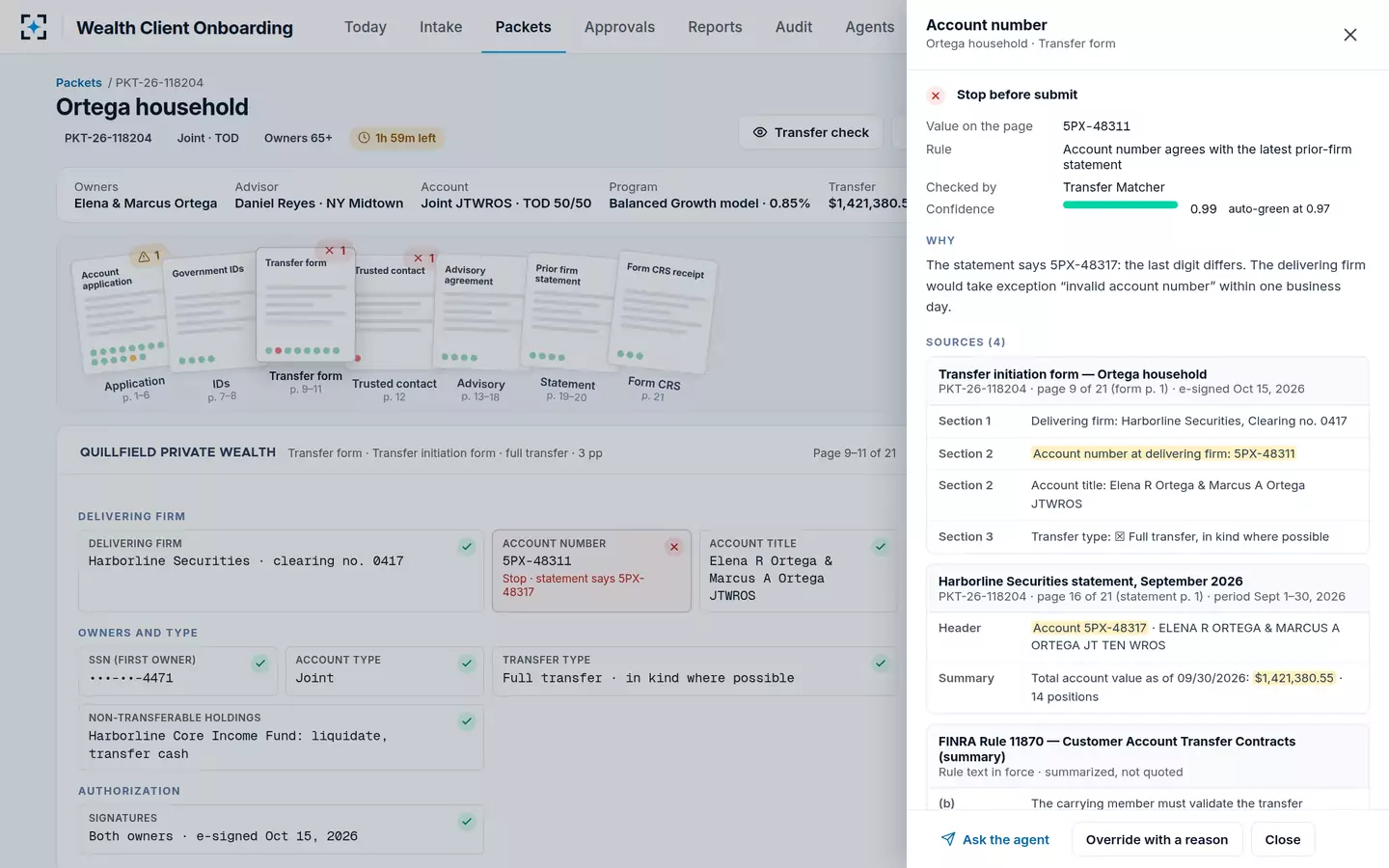
Wealth Client Onboarding sets the transfer form beside the prior statement, field by field
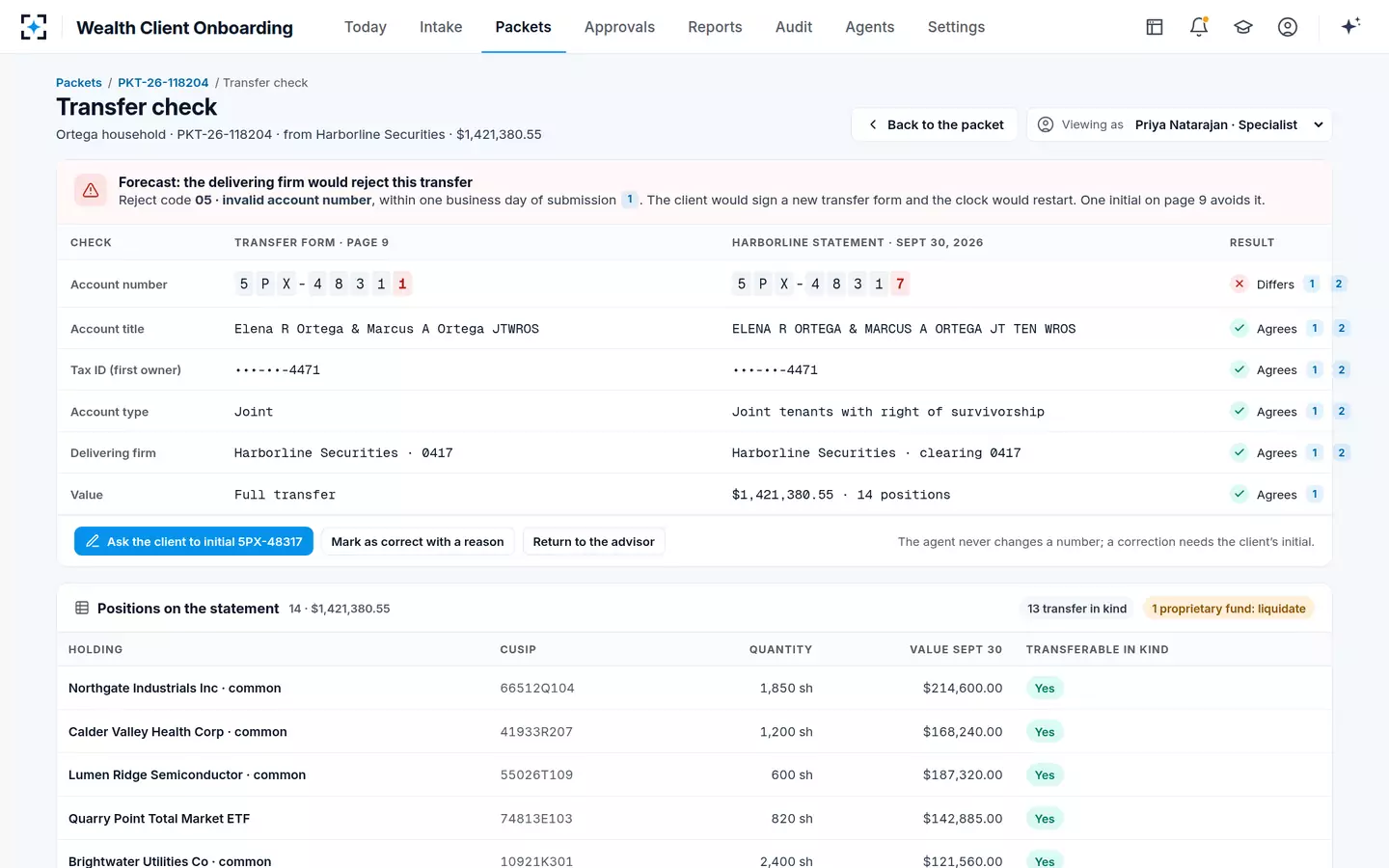
The match, done before submission: what to compare and in what order
A match that prevents rejects compares the form with the statement, not the form with itself. The order matters less than the discipline that each field is read from both documents and the two readings are compared character by character, with abbreviations resolved by a written list rather than by eye. In the sample firm's good-order rules, the transfer rule covers "account number, title, tax ID, type," and it is a stop, not a warning.
Eight comparisons for every transfer initiation form
- Account number
Every character against the statement header, including prefixes and check digits. Exception (C).
- Tax ID of each owner
Against the statement where printed and against the application. Exception (H).
- Account title
As the old firm prints it, with a written list of equivalent abbreviations. Exception (I).
- Account type
Joint to joint, IRA to IRA; any change of type goes on its own instruction. Exception (J).
- Signatures of every registered owner
Dated, and matching the owners on the statement. Exception (K).
- Names that have changed
A marriage, a death or a new trustee needs its document in the packet. Exception (A).
- Statement date and balance
The most recent statement, within the firm’s age limit, showing assets to move. Exception (B).
- Assets that cannot move in kind
Proprietary funds, private placements, fractional shares: the client’s decision recorded before submission.
Two of those comparisons need the CRM as well as the statement: a name change the firm already knows about, and a household with another transfer still open, which is exception (D) waiting to happen. That cross-document reading is most of what an automated check adds; the planted-error test for onboarding automation is how to find out whether a given system really does it.
How to count your own transfer rejects
Count them by the rule's letter, not by free text. FINRA's own list of effective practices includes "documenting the underlying reasons for rejection" and "reviewing the number of times the carrying member has rejected a request," and the same log answers the operations question: which of the twelve reasons cost you the most transfers this quarter?
What Wealth Client Onboarding stopped before submission in one sample week, by cause
The ratio to watch is rejects after submission divided by transfers submitted, split by exception letter, beside the stops your own check made before submission, split the same way. A falling post-submission rate with a steady pre-submission rate means the check is working. Both falling means the packets are getting better at source, which is the job of the branches and the firm's NIGO process. In the sample week, nine of 1,958 submitted accounts were rejected after submission, and the solution's report attributes all nine to changes at the delivering firm after validation.
Questions people ask
Is a transfer initiation form the same as an ACATS transfer form?
Yes, in practice. Rule 11870 calls it "an authorized broker-to-broker transfer instruction form ('TIF')," and the receiving firm enters it into ACATS. Each firm prints its own version, but the old firm judges every version against the same twelve exceptions.
Should I attach a statement to my transfer form?
Yes. Rule 11870's supplementary material suggests attaching the customer's most recent account statement, and FINRA lists obtaining it among receiving firms' effective practices against fraudulent transfers. It lets the new firm copy the account number, title and type exactly as the old firm has them.
What happens if the transfer form has the wrong account number?
The old firm can take exception within one business day because the account number is not on its books, Rule 11870(d)(3)(C). The transfer stops, a corrected form has to be submitted, and the rule's clock starts again. Caught before submission, the fix can be a single initial by the client on the corrected number.
Can a transfer move only part of an account?
Yes. The rule covers a customer's assets "in whole or in specifically designated part." A partial transfer lists the positions or the cash amount to move, and each line should be copied from the statement with the same care as the account number.
Why would the old firm reject a transfer it has no reason to dispute?
Because it may not take exception over disputed positions or balances, but it must take exception when the form does not match its records. Repeated rejections also matter to the old firm for another reason: FINRA lists them among red flags of fraudulent ACATS transfers, so each one invites more scrutiny of the next.