Client onboarding software for financial services, at a wealth firm or broker-dealer, should do one job well: make sure every new-account packet is in good order before it reaches the custodian, and leave behind the evidence that it was. That means reading the packet from wherever it arrives, checking it against the firm's rules and against the other systems that already hold the truth, the CRM, the identity-verification and sanctions results, the e-delivery log and the old firm's statement, drafting one request to the client for what is missing, and handing a clean packet to a principal and then to the custodian. It does not mean replacing the custodian's forms, the e-signature service or the CRM; the strongest designs read from them and write back as little as possible. Wealth Client Onboarding, Botminds' agentic solution for opening wealth accounts, is built to sit beside the custodian in exactly that way, with agents that read, check and draft and people who send and approve.
This guide is for operations, technology and procurement leads choosing client onboarding platform software for brokerage and advisory accounts. Product examples come from the solution's fictional sample firm, Quillfield Private Wealth; the rules are quoted from the SEC's and FINRA's texts.
What onboarding software should connect to, and which system stays the record
| System | What the software reads | What it writes back | System of record for |
|---|---|---|---|
| E-signature service | Packet envelopes as they are completed, with certificates | One fix request with only the items to correct; certificates kept with the account file | Signatures and their audit certificates |
| Branch scans, uploads, mail room | Typed, handwritten and scanned pages in any language | Nothing; an unreadable page is named for rescanning | The original images |
| CRM | Household, owners, advisor notes, recommendations and their dates | Status and the decisions taken, if the firm chooses | The relationship and the advisor’s record |
| Identity verification and sanctions screening | Results for each owner and beneficiary | Nothing; a possible match goes to the AML analyst | Identity and screening results |
| E-delivery log | Form CRS and other disclosures sent, with timestamps and versions | Nothing | Delivery records |
| Custodian and its transfer network | The custodian’s forms and account types | An approved packet for opening; the transfer entered by the firm’s usual route | The account, positions and statements |
| Document archive | Retention rules and legal holds | The sealed account file with every reading and decision | Books and records |
What does client onboarding software for financial services do?
At a wealth firm it turns signed paperwork into an account that can be opened and defended. Concretely, it classifies the pages of each packet, extracts every field, compares the fields with each other and with the CRM, the identity results, the e-delivery log and the prior firm's statement, applies the firm's good-order rules by account type, drafts a single request for anything missing, and assembles the evidence a principal needs to approve the account. The output that matters is not a dashboard; it is a packet the custodian will accept the first time and an account file an examiner can read.
"Client onboarding software" is a broad label, and a lot of what is sold under it is something else: digital forms, e-signature, identity verification, or a CRM workflow. Each is useful, and each is a system the onboarding software should read rather than replace. The question to ask of any product is which of the checks in the integration map it actually performs, and on which documents.
What systems does onboarding software need to connect to?
Six, for a typical wealth firm, and the order of priority follows where errors come from. The e-signature service and the scan channels deliver the packet. The CRM holds what the advisor learned in the first meeting, including the date of any recommendation, which the Form CRS rules care about. The identity-verification and sanctions results decide whether the account can open at all. The e-delivery log proves Form CRS went out on time. The prior firm's statement, which arrives inside the packet, is the source of truth for the transfer form. And the archive keeps the result for as long as the record rules require.
The connection that is most often missing is the last-but-one: the statement. A product that reads the transfer form well but never compares it with the old firm's statement cannot prevent the four FINRA Rule 11870 exceptions that are pure mismatches, the account number, tax ID, title and type, which are the ones that restart the transfer clock (FINRA Rule 11870(d)(3)). Asking a vendor to show that comparison, on your own packet, separates reading from checking quickly.
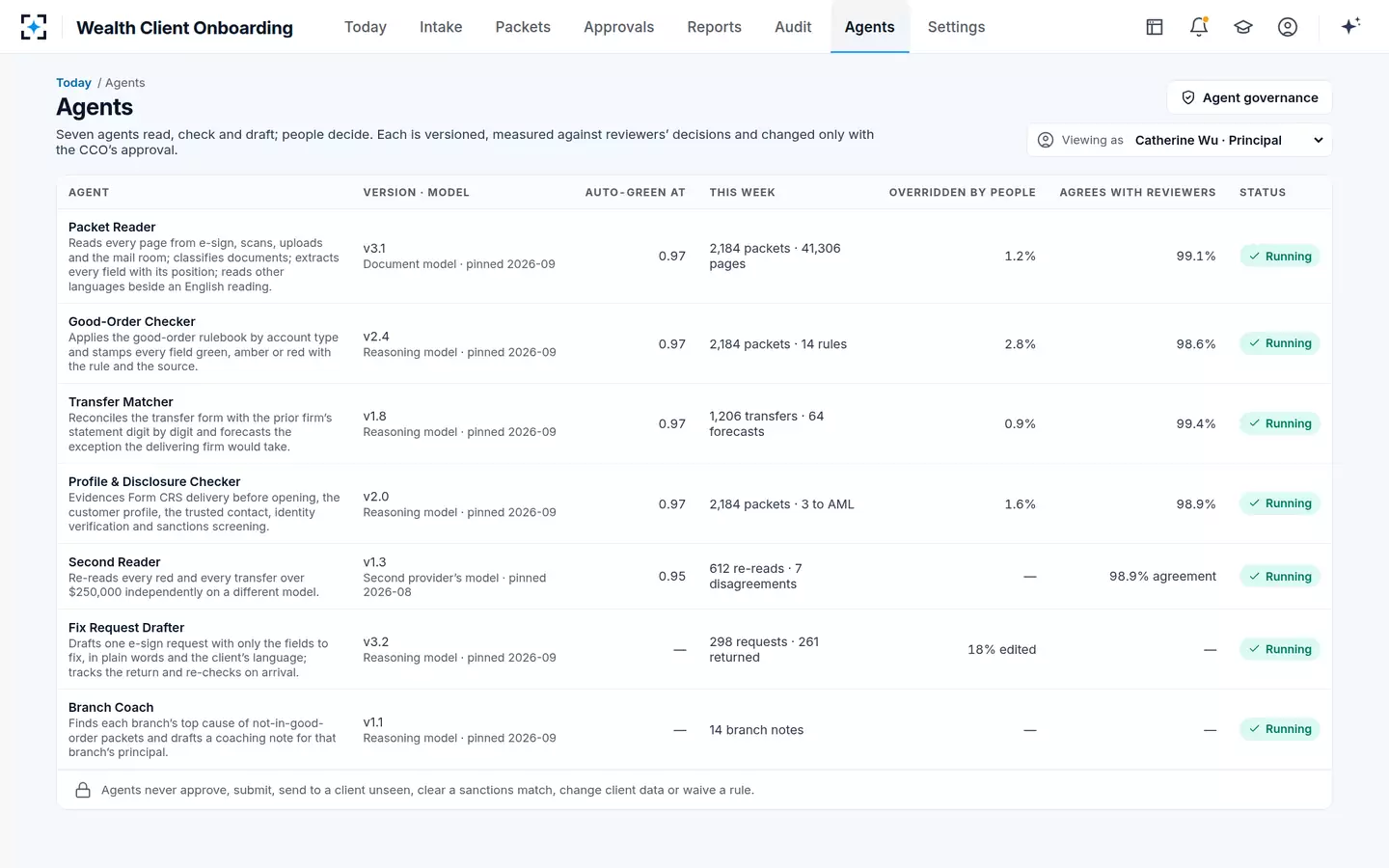
Seven agents in Wealth Client Onboarding, each with its version, its work and how often people overrule it
Does onboarding software replace the custodian's forms?
It should not, and the rules give a reason beyond convenience. The custodian holds the account, sends the statements and is the record of what the client owns; an adviser with custody of client assets must have a reasonable basis, after asking, to believe the qualified custodian sends each client an account statement at least every quarter (17 CFR 275.206(4)-2(a)(3); the SEC proposed changes to the custody rule in October 2026, with comments due December 7, 2026). Software that re-creates the custodian's forms in its own format creates a second version of the client's instructions to reconcile; software that reads the custodian's own forms checks them as the custodian will.
Two ways to buy onboarding software
Replace the stack: Its own forms, mapped to the custodian’s; a second version of every instruction.
Sit beside it: The custodian’s and firm’s own forms, read as they are, including scans and handwriting.
Replace the stack: Re-papering templates, retraining branches, migrating data, often across several releases.
Sit beside it: Connecting to existing systems and loading the firm’s rules; branches keep their forms.
Replace the stack: Another copy of client data held in another system, with its own controls to oversee.
Sit beside it: Reads from systems of record; keeps the readings and the evidence it produced.
Replace the stack: Mostly that its own forms are complete.
Sit beside it: That the packet agrees with the CRM, identity results, e-delivery log and prior statement.
Replace the stack: Hard: the forms and the data live inside it.
Sit beside it: Easier: the custodian, CRM and archive still hold the record.
Can onboarding software read scans and handwriting?
It has to, because wealth packets still arrive on paper. Branch scans, uploads and mail-room envelopes carry handwritten percentages, initials and corrections, and a product that handles only its own digital forms leaves those to people. In the solution the Packet Reader reads typed, handwritten and scanned pages from every channel, and shows a Spanish, Simplified Chinese or French page beside its English reading.
The more important property is what the software does when it cannot read. The solution's rule is that it never fills a value it cannot read: below 200 dpi it will not guess, and it names the one page to rescan. The sample audit trail shows the rule working, a branch scan flagged as unreadable at 41 dpi; under the solution's rule an unreadable page goes to the client service associate for a rescan, not to the client. Ask any vendor to show the same on your worst scan.
What data protection rules apply to onboarding software?
Regulation S-P, as amended in 2024, applies in full: larger firms have had to comply since December 3, 2025 and smaller ones since June 3, 2026, 18 and 24 months after the amendments were published on June 3, 2024 (89 FR 47688). Every covered institution must have written policies "that address administrative, technical, and physical safeguards for the protection of customer information," a response program for unauthorized access, and notice to affected individuals "as soon as practicable, but not later than 30 days, after becoming aware" of an incident that requires it (17 CFR 248.30).
The service-provider paragraph matters most when choosing software. The response program must include due diligence on and monitoring of service providers, and the firm's policies must be reasonably designed so that a provider tells the firm of a breach of a customer information system it maintains as soon as it can, and within 72 hours of learning of it. An onboarding vendor that stores packets, IDs and statements is exactly that kind of provider, and the contract should say so.
Regulation S-P, as amended, in the rule's own numbers
72hours
for a service provider to notify the firm of a breach of a system it maintains
30days
at most to notify affected individuals after becoming aware
Dec 3, 2025
compliance date for larger firms
Jun 3, 2026
compliance date for smaller firms
The SEC's examiners will check both halves. Their fiscal 2027 priorities put firms' incident-response procedures on the list, including how customers are notified and how service providers are overseen, and staff will review identity-theft programs under Regulation S-ID "with a focus on firms' identification and detection of and response to red flags intended to prevent and mitigate against identity theft, particularly during customer account takeovers and fraudulent transfers" (SEC Division of Examinations, Fiscal Year 2027 Examination Priorities). New accounts with transfers in are where those red flags appear first.
What records must the software leave?
Enough to rebuild every decision. A broker-dealer's electronic records must either sit in a non-rewriteable, non-erasable format or be preserved with a complete audit trail, time-stamped, of every modification and deletion, the date and time of each action and, where applicable, who acted (17 CFR 240.17a-4(f)(2)). The customer account record is kept until at least six years after the earlier of the account's closing or the information being collected, provided, replaced or updated.
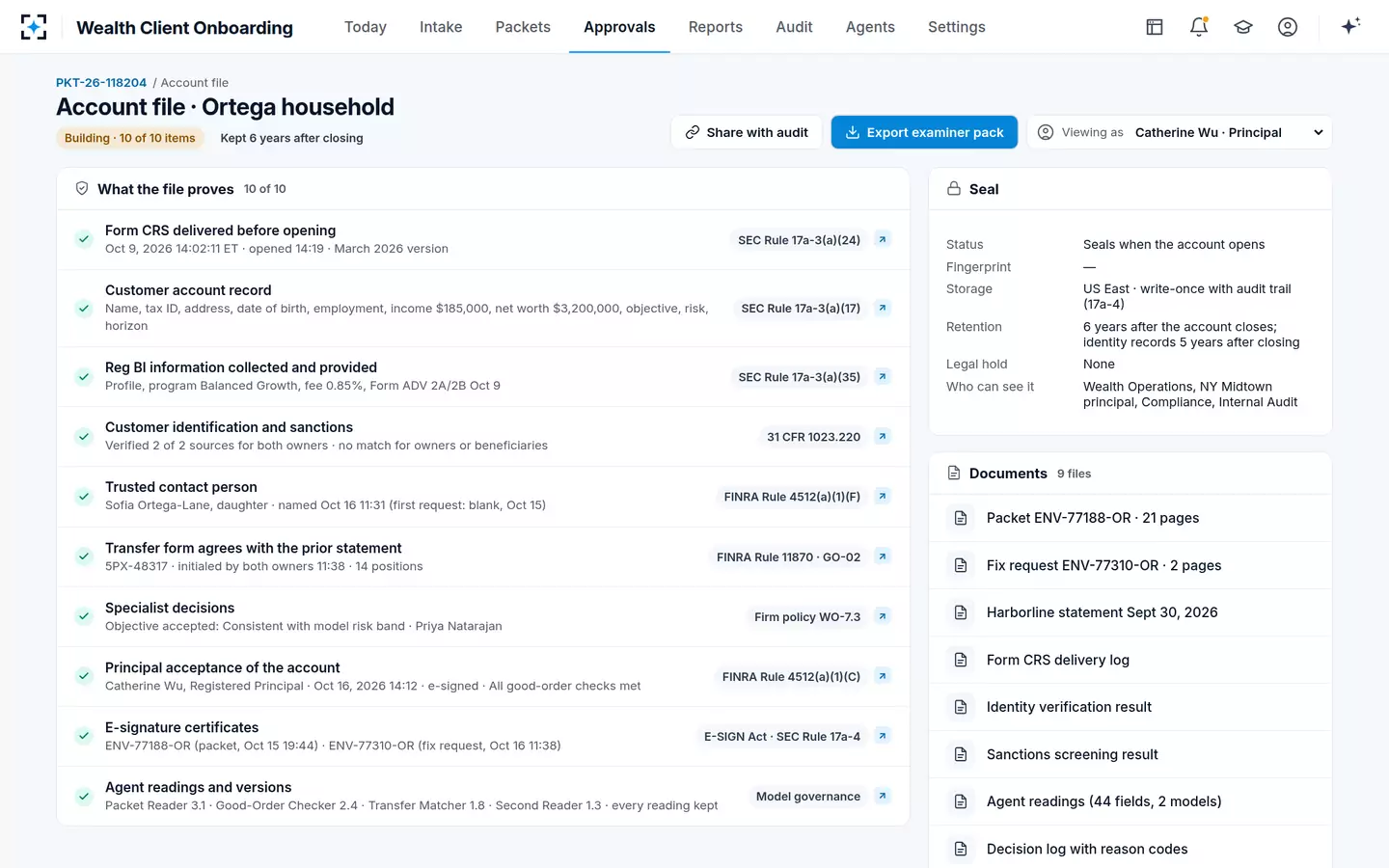
For onboarding software the practical test is whether an examiner can be given, in one step, the account file for any sample of accounts: the packet, each reading and its source, each rule applied, each decision with the person, time and reason, the principal's approval and the e-signature certificates. In the solution that file is built as the work is done and sealed when the account opens, and the audit trail of people and agents is hash-chained and verified.
The account file Wealth Client Onboarding builds as the work is done, for examiners
How long does it take to go live with onboarding software?
It depends mainly on two things the buyer controls: how many systems must be connected, and how quickly the firm can assemble its own rules and a set of past packets to test against. No regulator or independent study publishes typical go-live times for onboarding software, and vendors' quotes are not comparable unless they include the same integrations and the same test. The phases are more useful than a number.
A go-live plan for onboarding software that sits beside the custodian
| Phase | What the firm brings | What is done | What must be true to move on |
|---|---|---|---|
| 1. Rules | The good-order rulebook by account type; thresholds; who decides what | Rules loaded as settings, each with its action: stop, a person decides, AML review, principal review | Compliance has signed off each rule and its action |
| 2. Templates | Packet templates and forms by account type, including the custodian’s | Each document type recognised and its fields mapped | Every template in use is covered, including old versions still arriving |
| 3. Connections | Access to e-signature, CRM, identity results, e-delivery log, archive | Read connections, then the few write-backs the firm chooses | Security review complete; S-P service-provider terms in the contract |
| 4. Test on past packets | A sample of past packets with the decisions people made | Readings and checks compared with those decisions; planted errors added | Agreement and catch rates the firm accepts, signed off by compliance |
| 5. Parallel run | Live packets, reviewed both ways | Specialists see the stamps but still review as before | Override rates stable; no misses on stop rules |
| 6. Live | Named owners for rules, agents and settings | Specialists decide from the stamps; principals approve from the evidence | Weekly override and NIGO reporting in place |
Phase 4 is where most of the value of a pilot lies, and where buyers most often accept a vendor's file instead of their own. The method for doing it properly, including how many planted errors give a meaningful result, is set out in testing onboarding automation with planted errors.
Where Wealth Client Onboarding fits, and where it does not
It fits a broker-dealer, investment adviser or dual registrant opening brokerage and advisory accounts for households, with transfers in, at a volume where specialists cannot compare every transfer form with every statement by hand. It reads typed, handwritten and scanned pages, shows a Spanish, Simplified Chinese or French page beside its English reading, checks against the firm's own rules, and leaves an account file built for examiners. People stay in charge of what goes to clients, what is submitted and which accounts open.
It does not replace the custodian, the e-signature service, the CRM or the identity-verification and screening provider; it reads them. It does not clear a sanctions or identity match; that stays with the anti-money-laundering analyst. It is not built for bank deposit accounts, whose rules differ, and it is not a source-of-wealth or enhanced due diligence review for high-risk clients. If the firm's real problem is that its custodian's forms are wrong for its business, this is not the fix; if the problem is that correct forms arrive filled in wrongly, it is.
Questions to put to any client onboarding software vendor
- Show the transfer form checked against the prior statement
On one of our packets, with the four Rule 11870 mismatch fields.
- Show what happens to a value you cannot read
It should be named for a person or a rescan, never guessed.
- Show the evidence behind one stamp
Page, passage, rule, agent or step, confidence.
- Show the limits enforced
No approval, submission, client contact, sanctions clearance, data change or rule waiver by the software.
- Show the account file an examiner would get
For a sample of accounts, in one export.
- Show the S-P terms
Due diligence and monitoring, 72-hour breach notice, where data is stored, how it is deleted.
- Run it on our packets before we sign
Past packets with our people’s decisions, plus planted errors; scored by error type.
Each of those questions has a page behind it in this series, from the Form CRS delivery record to the second reader, and the strongest single test is still a run on your own packets.
Questions people ask
What is client onboarding platform software?
Software that manages the opening of new client accounts end to end: collecting and reading the paperwork, checking it against the firm's rules and other systems, chasing what is missing and assembling evidence for approval. At a wealth firm it should work with the custodian's forms and the firm's e-signature, CRM, identity-verification and archive systems rather than replace them.
Can onboarding software submit accounts to the custodian automatically?
Technically, often; as a control, it should not decide to. The account must be approved or accepted by a principal under SEC Rule 17a-3(a)(17) and FINRA Rule 4512, and in Wealth Client Onboarding agents never submit; a specialist sends and a registered principal approves.
Is onboarding software a service provider under Regulation S-P?
If it receives, maintains, processes or otherwise has access to customer information through services to the firm, yes: that is how the amended rule defines a service provider. The firm must oversee it through due diligence and monitoring, and ensure it gives notice of a breach within 72 hours.
Does onboarding software help with ACATS fraud?
It can help with two of FINRA's suggested practices: obtaining the customer's most recent statement for the account being transferred and comparing it with the transfer form, and documenting the reasons for each rejection. Fraud decisions themselves stay with the firm's anti-money-laundering and fraud teams.
What should onboarding software cost?
Vendors do not publish prices in a comparable way, so compare on cost per packet in good order, including integration work and the time your specialists still spend. The cost of a rejected packet, which the software is meant to prevent, is worked through in the cost of a not-in-good-order packet.