A NIGO process is the review a wealth firm runs on each new-account packet to find what is not in good order (a missing signature, a blank required page, a form that does not match the prior firm's statement) and get it fixed before the packet is submitted to the custodian or the transfer is entered. It has three parts: a rulebook by account type, a preparer who checks the packet against it, and a registered principal who accepts the account under FINRA Rule 4512. The review is hard because a packet of seven documents and 21 pages holds dozens of fields, the rules differ by account type, and every defect found after submission costs a rejection and a second signature from a client who chose the firm days earlier. Botminds' Wealth Client Onboarding reads each packet, stamps every field against the firm's rules, sends ambers to a person, and holds submission until every red is cleared.
The household, branch and figures in the examples are sample data on fictional people and a fictional firm.
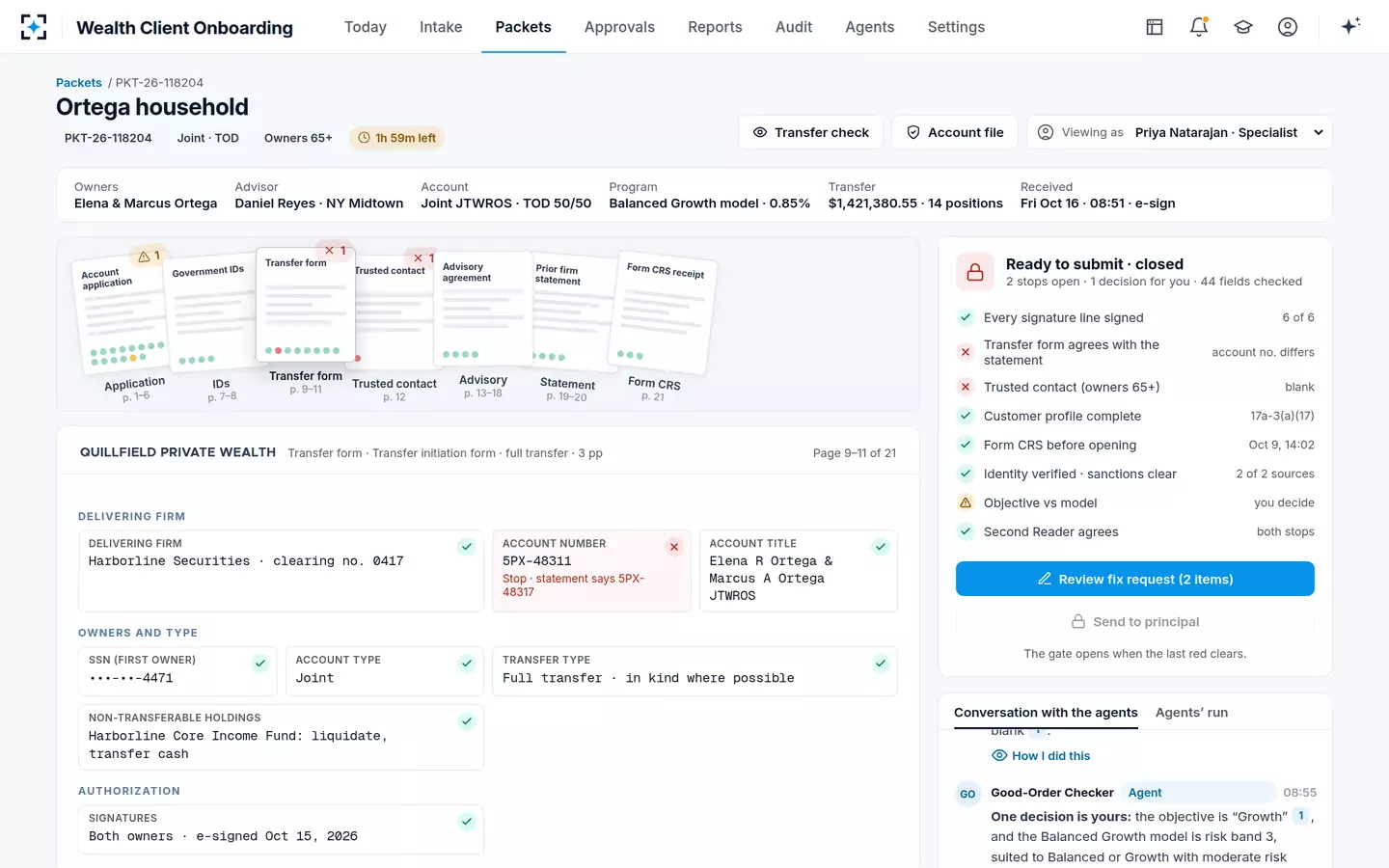
One joint account packet, checked before anyone opened it
44
fields read from 7 documents and 21 pages, each with its place on the page
41
green against the firm's 14 rules for a joint account with transfer on death
1
amber, for a person to decide with a reason code
2
red stops: one digit wrong on the transfer form, one blank trusted contact page
What does a NIGO review check, and against which rules?
It checks the packet against two kinds of rule: what regulation requires the firm to collect and evidence, and what the custodian, the prior firm and the firm's own policy require before they will act. The first kind decides whether the account may open; the second decides whether it will open on the first attempt.
What a wealth account packet is checked against, and where each rule comes from
| Item | Source of the requirement | What NIGO looks like |
|---|---|---|
| Customer account information | SEC Rule 17a-3(a)(17); FINRA Rule 4512 | Missing date of birth, employment, income, net worth or objectives |
| Form CRS delivery date | SEC Rule 17a-3(a)(24) | No record that it was provided before the account opened |
| Identity verification | 31 CFR 1023.220 (customer identification program) | An unverified ID, or a sanctions match not cleared |
| Trusted contact | FINRA Rule 4512(a)(1)(F) and firm policy | A blank page where firm policy makes it required |
| Principal acceptance | FINRA Rule 4512(a)(1)(D) | No signature showing the account was accepted under the firm's procedures |
| Transfer instruction | FINRA Rule 11870; the prior firm's records | Account number, title, tax ID or type that does not match the statement |
| Beneficiary designations, tax forms, agreement | Custodian and firm requirements | A transfer-on-death split that does not total 100%; an unsigned W-9 |
The rules are specific about evidence. Rule 17a-3(a)(24) requires "a record of the date that each Form CRS was provided to each retail investor, including any Form CRS provided before such retail investor opens an account" (17 CFR 240.17a-3). Rule 4512(a)(1)(D) requires the "signature of the partner, officer or manager denoting that the account has been accepted in accordance with the member's policies and procedures for acceptance of accounts" (FINRA Rule 4512). A NIGO review that checks the packet but does not keep the evidence has done half the job; the detail of Rule 4512's fields is in FINRA Rule 4512 customer account information.
Where should a firm catch NIGO: before submit or after?
Before submit, because every defect found later costs more people and more days. A defect caught by the firm's own review costs a fix request; the same defect caught by the custodian or the prior firm costs a rejection, a call from the advisor, a new signature and a restarted clock. On a transfer, the carrying firm takes exception within one business day under FINRA Rule 11870, and the receiving firm then has to resubmit (FINRA Rule 11870).
The same two defects, caught after submit and before it
Caught after submit: The prior firm, which takes exception for an invalid account number
Caught before submit: The firm's own transfer check, comparing the form with the statement
Caught after submit: A later audit, or nobody
Caught before submit: The good-order rule for owners over 65
Caught after submit: Often a whole new packet to re-sign
Caught before submit: One initial and one trusted contact, pre-filled
Caught after submit: Days: the call, the re-sign, the resubmission
Caught before submit: In the sample, 40 minutes from request to second signature
Caught after submit: A rejection code in a custodian report
Caught before submit: The rule, the field, the branch and the cause, kept for coaching
The firm's rejection log tells it which side it is on. In the sample, 14.8% of a week's packets were not in good order at first pass, and 0.46% were rejected after submission; nearly all of the defects were caught on the firm's own side of the line. What each of the late ones costs is worked through in NIGO reduction and the cost of a re-sign.
A good-order rulebook, by account type
The rulebook is the firm's written statement of what good order means for each account type, and the review is only as consistent as the rulebook is explicit. The sample firm keeps 14 rules under a numbered policy; each applies by account type and has one of four outcomes: stop, ask a person to decide, send to the AML analyst, or require principal review.
Thresholds belong in the rulebook too. The sample firm's settings auto-green a field only when the reading's confidence is at least 0.97, send anything below 0.90 to a person, re-read every red and every transfer of $250,000 or more with a second, independent reader, and require the principal to review the transfer check at or above $1,000,000. A prior firm's statement older than 90 days is not accepted as the basis for a transfer match; a change to 60 days was waiting for the chief compliance officer's approval. Each change to a rule needs a second approver and is logged.
Stops, ambers and the decisions that stay with people
A NIGO process needs two kinds of finding: stops that hold the packet until fixed, and ambers that a person decides with a reason. Treating everything as a stop slows clean packets; treating everything as a judgement makes the review depend on who is working that day.
The trusted contact shows why the rulebook must say which is which. FINRA Rule 4512 asks for the name and contact information of a trusted contact person, but adds that "the absence of the name of or contact information for a trusted contact person shall not prevent a member from opening or maintaining an account for a customer, provided that the member makes reasonable efforts to obtain" it. In the sample, both owners were over 65, and firm policy made a blank trusted contact page a stop, so the client was asked to name a contact or tick the box to decline. A firm that writes the rule that way has gone beyond the minimum on purpose, and its review should say so.
The amber was a suitability question. The client's stated objective, "Growth", sat against a Balanced Growth model. The specialist accepted it with the reason code "Consistent with model risk band". The Profile and Disclosure Checker also found Form CRS delivered before opening and cleared an outdated "Retired" employer entry from an older CRM note. None of these is something an agent decides: ambers always go to a person.
Wealth Client Onboarding stamps each field with its rule and source
Who checks each packet: preparer, second reader and principal
Three roles check a packet, and the control that matters is that the person who prepared it cannot approve it. The preparer works the packet against the rulebook and sends fixes; an independent second reading covers the findings most likely to be wrong; the registered principal reviews the evidence and signs the acceptance Rule 4512 requires.
The NIGO process for one packet in Wealth Client Onboarding
Agent
Packet ReaderReads each page from e-sign envelopes, scans and uploads, classifies documents and extracts each field with its position.
Never: Never fills a value it cannot read
Agent
Good-Order Checker and Transfer MatcherStamp each field against the firm's rules; match the transfer form to the prior statement digit by digit and forecast the exception.
Never: Never waives a rule
Agent
Second ReaderRe-reads every red and every transfer of $250,000 or more on a different provider's model, without seeing the first reading.
Never: Cannot approve
A person decides
New accounts specialistDecides ambers with reason codes, sends the fix request, and submits the packet to the principal once every red has cleared.
A person decides
Registered principalReviews the evidence, confirms the transfer check on large transfers, and e-signs the acceptance.
In the sample, the Second Reader agreed with both stops: "Digit 8 is '1' on the form and '7' on the statement; the trusted contact page is blank." The specialist sent the packet to the principal at 11:44. The principal saw it flagged as a large transfer, confirmed the transfer check, 9 of 9 fields agreeing after the correction, chose the reason code "All good-order checks met" and typed a full name as the e-signature at 14:12.
The fix request: ask for what is missing, not a new packet
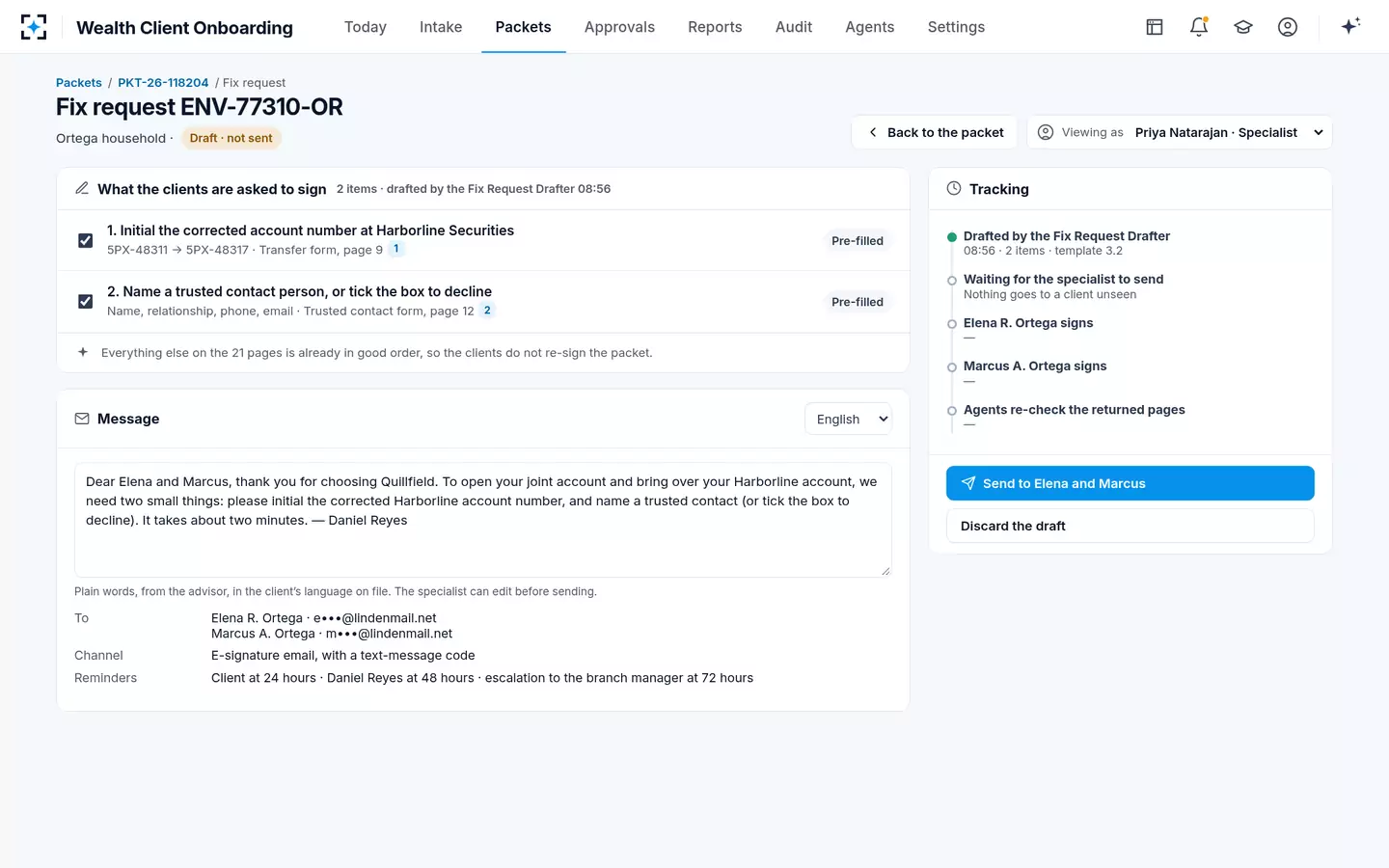
The fix request is where most of a NIGO process's elapsed time goes, and its design decides whether the client signs in minutes or in days. The rule is to ask only for the fields that are wrong, pre-filled, in plain words from the client's advisor, and to leave the rest of the packet signed.
In the sample, the request asked the couple for two things: initial the corrected account number at the prior firm, and name a trusted contact or decline. It was sent at 10:58. One owner signed at 11:31 and the other at 11:38. The Good-Order Checker re-checked pages 9 and 12 on arrival, found the account number matched and the couple's daughter named as trusted contact, and released the packet for submission. The agent never changed the number itself; a correction needed the clients' initials.
One fix request, pre-filled, with only the two fields to fix
How do you measure a NIGO process?
By rate, by stage and by cause, per branch. The rate at first pass shows how good packets are when they arrive; the rate after submit shows how good the review is; the cause shows what to fix. A single firm-wide NIGO percentage hides the branch that produces most of it.
Not in good order at first pass: the trend and the outlier branch
Cause analysis is what turns the rate into an action. Nine of one branch's twelve trusted contact stops traced to one outdated template, a fix that takes an afternoon. The coaching note went to the branch principal only; the solution does not rank advisors publicly.
Controls a principal can test on the NIGO process
Nine tests of a firm's NIGO process on a sample of opened accounts
- Is there a written good-order rulebook by account type?
With each rule's outcome: stop, decide, AML or principal review.
- Were all required fields checked, not a sample?
Every field on every page, against the account type's rules.
- Was each amber decided by a person with a reason code?
And is the reason consistent across specialists?
- Was the transfer form matched to a statement before entry?
Account number, title, tax ID and type, digit by digit.
- Was Form CRS delivery evidenced before opening?
With the date, as Rule 17a-3(a)(24) requires.
- Was identity verified and any sanctions match cleared by AML?
Within a reasonable time, under the customer identification program.
- Did the fix request ask only for what was missing?
A full re-sign is a process failure, not a client failure.
- Did someone other than the preparer accept the account?
A principal's signature under Rule 4512(a)(1)(D).
- Are NIGO rates kept by branch, stage and cause?
And are the top causes fixed at their source?
What Wealth Client Onboarding does in the NIGO process, and what it leaves to people
The agents read, stamp, match, re-read and draft. They never fill a value they cannot read, never waive a rule, never submit a transfer, never change client data, never clear an identity or sanctions match, and never approve. Unreadable pages go to a client service associate; ambers go to the specialist; AML matches go to the AML analyst; acceptance stays with the principal. The account file builds as the work is done, with ten items each tied to the rule it answers, sealed when the account opens and kept six years after closing.
The solution's own estimate for one household with a transfer in puts checking the packet and re-keying it at about a business day by hand and the fix loop at about three; with the checks before submit, a tenth of a day and a fifth of a day. Those are estimates for the design, not measured customer results. A firm testing any tool for this work should give it last quarter's rejected packets and see how many it would have stopped before submission. The transfer side of the same process is set out in the ACATS transfer rules under FINRA Rule 11870.
Questions people ask
What does NIGO mean in account opening?
Not in good order: a form or packet missing something, or carrying something wrong, that the firm, the custodian or the prior firm requires before it will act. Common examples are a missing signature, a blank required page, a beneficiary split that does not total 100% and a transfer form that does not match the prior firm's statement.
Who should approve a new account after the NIGO review?
A registered principal who did not prepare the packet. FINRA Rule 4512(a)(1)(D) requires the signature of a partner, officer or manager showing the account was accepted under the firm's policies and procedures.
Is a trusted contact required to open an account?
Not by FINRA's rule: Rule 4512 says its absence does not prevent opening the account, provided the firm makes reasonable efforts to obtain it. Many firms go further by policy, for example making it a stop for owners over 65, as the sample firm does.
What evidence of Form CRS must the account file hold?
The date it was provided to each retail investor, including any copy provided before the account opened, under SEC Rule 17a-3(a)(24). A packet without that evidence is not in good order for a retail account.
How fast can a NIGO fix be turned around?
When the request asks only for the missing fields, pre-filled, it can be minutes. In the sample, a request for one initial and one trusted contact was sent at 10:58 and both owners had signed by 11:38.
What is a good NIGO rate?
No regulator or independent study publishes a benchmark. A firm can track its own first-pass and after-submit rates by branch and cause; in the sample, the first-pass rate fell from 22.6% to 14.8% in eight weeks, with 0.46% rejected after submission.