NIGO reduction starts with a number most firms do not have: what one not-in-good-order packet costs. NIGO means "not in good order," a form or request that is missing something, or carries something wrong, that the receiving firm, custodian or fund requires before it will act. No regulator or independent study publishes a NIGO rate for US wealth firms, so the benchmarks that circulate are vendors' estimates. What a firm can measure is its own rate, from its reject log, and its own cost per rejected packet: the specialist's and advisor's time, the client asked to sign again, a transfer clock that restarts and fee revenue that begins days later. Priced that way, the causes sort themselves, and the cheapest fix is the one made before submission. Wealth Client Onboarding, Botminds' agentic solution for opening wealth accounts, is built for that point: it reads every packet before it goes to the custodian, stops what is not in good order, and asks the client once for only what is missing.
The cost model below uses published US wage data and simple arithmetic, with every assumption labelled so it can be replaced by your own. The examples from the solution come from its fictional sample firm, Quillfield Private Wealth, and are not a customer's results.
Where one rejected transfer's cost to the firm goes, for a large and a small account
$1,421,380 household transfer: about $284
- Specialist rework, 1.5 hours · 17%
- Advisor time with the client, 0.75 hours · 13%
- Fee revenue lost over 6 days of delay · 70%
$50,000 IRA transfer: about $92
- Specialist rework, 1.5 hours · 51%
- Advisor time with the client, 0.75 hours · 41%
- Fee revenue lost over 6 days of delay · 8%
What does NIGO stand for in finance?
Not in good order. It describes a form, application or instruction that the institution receiving it will not act on as submitted, because something it requires is missing or wrong: a signature, a document, a field that disagrees with its records. Its opposite, "in good order," is the condition for acting. In wealth onboarding the term covers the whole account-opening packet and, most expensively, the transfer form that brings the client's assets across from the old firm.
No rule defines the term in general; each custodian, transfer agent and fund publishes its own requirements. The closest thing to a regulator's NIGO list for transfers is FINRA Rule 11870(d)(3), which sets out the twelve reasons a carrying firm may take exception to a transfer instruction, including an account number the carrying firm does not hold, a tax ID mismatch, an account title or type that does not match its records, and a missing or improper authorization (FINRA Rule 11870). Inside the firm, the list is the firm's own good-order rulebook, by account type.
What is a typical NIGO rate?
There is no published typical rate from a regulator or an independent study, and that is worth saying plainly because buyers are often shown one. Rates that appear in marketing usually come from vendors' own surveys or client bases, mix paper and digital submissions, and rarely say whether they count packets stopped inside the firm or rejected by the receiving institution. Those are different numbers, and the difference between them is the point of NIGO reduction.
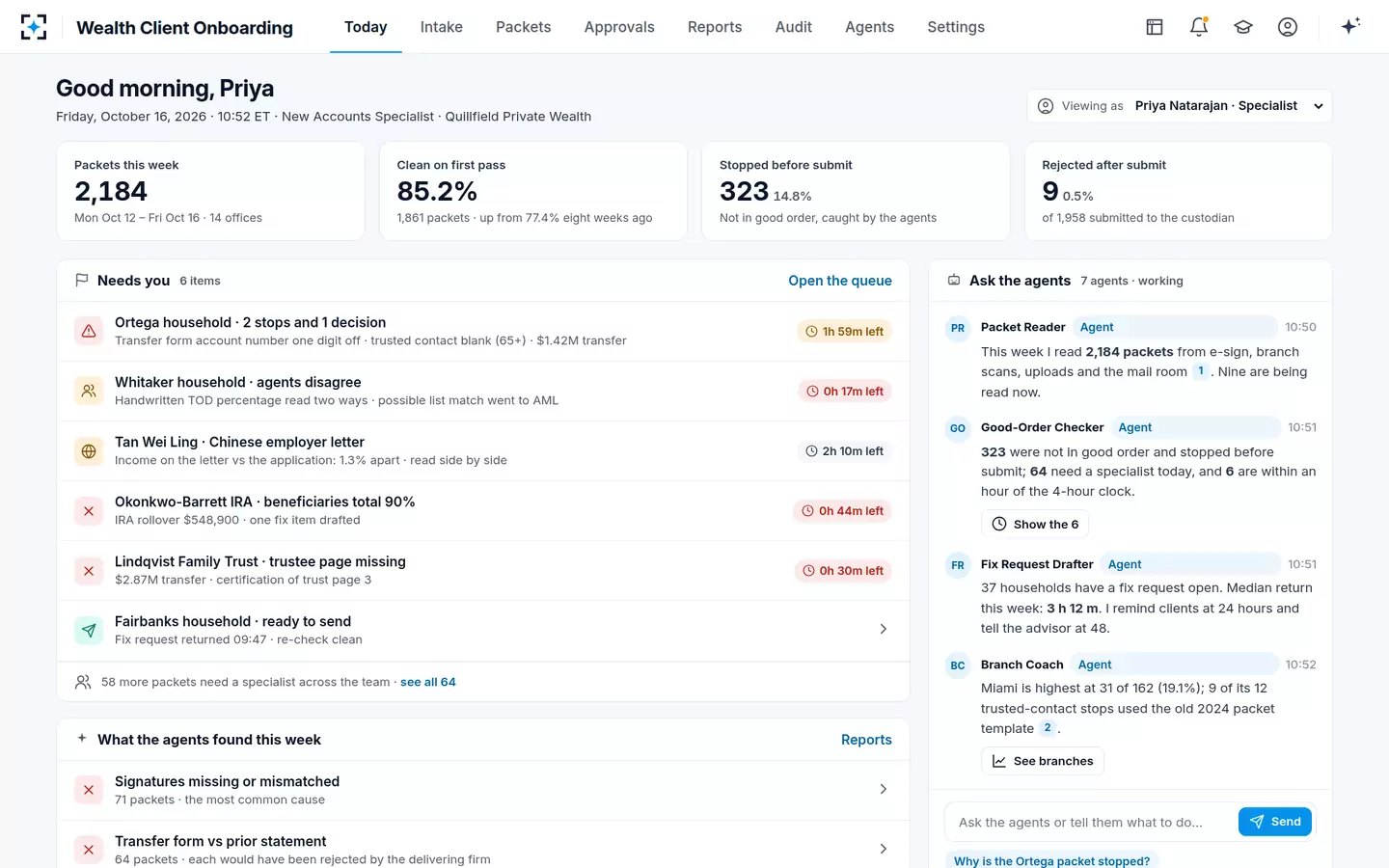
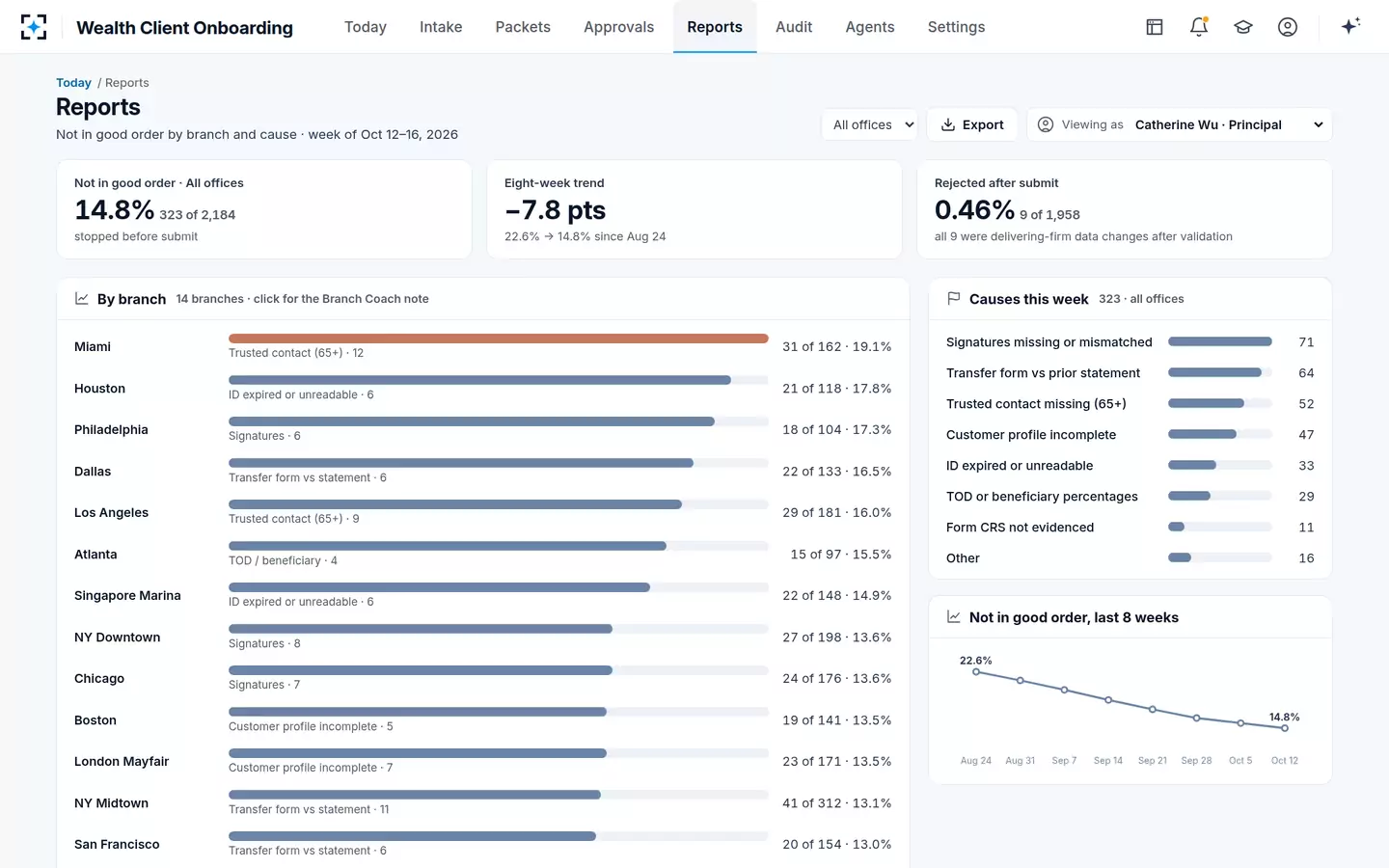
The useful benchmark is your own rate over time, measured the same way each week. In the solution's sample firm, the rate of packets stopped before submission fell from 22.6% to 14.8% over eight weeks, while the rate rejected after submission was 9 of 1,958, or 0.46%. Both are sample-data figures; what matters is the shape. A firm that catches its NIGO inside the building has a high first number and a low second one, and that is the shape to aim for.
Three numbers that describe NIGO, from the solution's sample week
85.2%
of 2,184 packets clean on first pass
14.8%
stopped before submission: 323 packets, fixed before the custodian saw them
0.46%
rejected after submission: 9 of 1,958 sent
Wealth Client Onboarding opens each day with the two NIGO numbers that matter
How do you measure NIGO?
Count two rates, by reason, every week. The first is the share of packets stopped before submission, by your own checks: packets with at least one stop divided by packets received. The second is the share rejected after submission, by the custodian, the old firm or the fund: rejections divided by submissions. Report both by cause, by branch and by channel (e-signature, scan, mail), and keep the definitions fixed so the trend means something.
A NIGO measurement any firm can start this week
- Log every stop and every reject with a reason code
For transfers, use the letter of FINRA Rule 11870(d)(3); for your own stops, the rule in your good-order rulebook.
- Count packets, not defects
A packet with three problems is one NIGO packet; record the three reasons separately.
- Separate before and after submission
Stops inside the firm cost a fix request; rejects outside it cost a re-sign and a restarted clock.
- Split by branch, channel and template
Causes cluster: one office’s old form, one scanner, one advisor’s assistant.
- Time the fix loop
From the stop to the client’s signed correction; this is the client’s experience of NIGO.
- Count repeats per household
FINRA lists repeated rejections of transfer requests as a red flag of fraudulent transfers.
The last item is easy to overlook. FINRA's notice on fraudulent ACATS transfers counts transfer requests rejected again and again among its red flags, alongside a transfer requested soon after a new account opens (FINRA Regulatory Notice 23-06). A household whose transfer form is rejected three times for honest mistakes looks, from the old firm's side, like a pattern it is told to watch.
What does a rejected transfer cost a firm?
Four things, of which the firm can price three. Staff time: the specialist finds the cause, prepares a corrected form and resubmits. Advisor time: someone has to call the client and explain why they must sign again. Revenue: an advisory fee charged on assets starts when the assets arrive, so every day of delay is a day of fee that is not earned. And the fourth, the client's patience, is real but appears on no report; the client chose the firm days ago and is now being asked to repeat themselves.
The cost of one rejected transfer: inputs, and the arithmetic
| Component | How to compute it | Illustration: $1,421,380 household | Illustration: $50,000 IRA |
|---|---|---|---|
| Specialist rework | Hours × hourly cost | 1.5 h × $31.61 = $47.42 | 1.5 h × $31.61 = $47.42 |
| Advisor time | Hours × hourly cost | 0.75 h × $50.51 = $37.88 | 0.75 h × $50.51 = $37.88 |
| Fee revenue lost | Assets × annual fee × days of delay ÷ 365 | $1,421,380.55 × 0.85% × 6 ÷ 365 = $198.60 | $50,000 × 0.85% × 6 ÷ 365 = $6.99 |
| Firm’s cost, total | Sum of the three | about $283.90 | about $92.29 |
| Client’s time out of the market | Not a firm cost; a risk to the client that can cut either way | Six days for $1.42 million | Six days for $50,000 |
The two columns tell different stories, and both matter. For a large household, lost fee revenue dominates: delay is the expensive part, so the priority is to keep the transfer clock from restarting. For a small account, labour dominates: rework is the expensive part, so the priority is to stop the error from being made. A firm with a book of both should price its NIGO by account size band, not as one average, or it will optimise for whichever kind it has more of.
What does NIGO cost the client?
Time, signatures and, for a transfer, days out of the investments the client chose. None of it appears in the firm's numbers, and all of it shapes how the client remembers the first week of the relationship. The SEC's advice to investors who feel a transfer has not happened in time is to "ask to speak to the compliance director at your old and new firm," and then to contact the SEC, FINRA or the state securities regulator (SEC investor bulletin). A household that has to be told twice what to sign is a household more likely to take that advice.
The market exposure is real but has no fixed sign. Six calendar days of delay on $1,421,380.55, at an assumed 4% annual expected return, is about $935 of expected return forgone, our arithmetic on an assumption, and the actual figure could be a gain or a loss depending on what markets do that week. The point is not the number; it is that the client, not the firm, carries it, and that a firm which measures only its own cost will under-rate the transfer errors on its largest households.
Is a stop before submission cheaper than a reject after it?
Much cheaper, because the client signs less and no clock restarts. A packet stopped inside the firm can usually be fixed with a targeted request: the specific items, pre-filled, sent once. A packet rejected by the old firm has already used its submission; the corrected transfer starts the rule's one-business-day validation again, and the client often signs a new form.
The same error, caught before submission or rejected after it
Stopped before submission: Initials or signs only the items that are wrong; in the sample, two items signed 40 minutes after the request went out.
Rejected after submission: Often signs a whole new form, days after choosing the firm.
Stopped before submission: Not started yet; the transfer goes in once.
Rejected after submission: Restarted: a new submission and a new one-business-day validation under Rule 11870.
Stopped before submission: One fix request, re-checked on return.
Rejected after submission: Find the exception reason, correct, re-collect signatures, resubmit, track.
Stopped before submission: Invisible to the old firm.
Rejected after submission: A rejection on the record; repeated ones are a FINRA red flag for fraudulent transfers.
Stopped before submission: The cause, by rule, branch and template, the same day.
Rejected after submission: An exception reason, a day later, often without the page.
That is why the solution's design puts its checks before submission and turns each stop into a single fix request. For the sample Ortega household, the account number on the transfer form was one digit off the statement and the trusted contact page was blank; the clients were asked for exactly those two things, signed in 40 minutes, and did not re-sign the 21-page packet. Botminds' own estimate for a household like this is a fix loop of about three business days by hand against about a fifth of a day with the checks before submission; that is an estimate for the design, not a measured result. The clocks themselves are in the ACATS transfer rules under FINRA Rule 11870.
How do you reduce NIGO? Fix the causes in order of cost
Rank causes by cost, not by count. Multiply each cause's weekly count by its cost per event, using the model above, and work down the list. A cause that is frequent but cheap, a missing date stamp caught and fixed in minutes, can sit below one that is rare but expensive, a transfer-form mismatch on large households that restarts the clock and delays fee revenue.
Then fix each cause where it starts. In the sample firm, the Miami branch had the highest share of stopped packets, 31 of 162, and its top cause was a missing trusted contact for clients 65 and older; nine of those twelve stops came from an old 2024 packet template. The fix is not more checking; it is retiring the template. The solution's Branch Coach drafts that kind of note for the branch principal, and the new-accounts specialist working the NIGO process is the person who usually knows it first.
Wealth Client Onboarding reports NIGO by branch and cause, before and after submission
NIGO in mutual funds: when the price depends on good order
In a fund transaction NIGO has a price consequence as well as a delay. Under the SEC's forward-pricing rule, a fund and the dealers in its shares may only sell or redeem at a price based on the net asset value "next computed after receipt of a tender of such security for redemption or of an order to purchase or sell such security" (17 CFR 270.22c-1(a)). Each fund's prospectus says what a complete order must contain, so a request the fund will not accept as submitted is priced, at the earliest, after the corrected one is received.
For an onboarding team this matters in two places: direct-held fund positions coming across outside ACATS, which the SEC's investor bulletin says can take up to 30 days, and funds the new firm cannot hold, which the client must decide to sell or leave behind before the transfer (SEC investor bulletin). Both are questions to settle in the first meeting, not after a rejection. Private funds raise the stakes again, because a subscription that is not in good order can miss the fund's closing date altogether; that cost is worked through in what each missed close costs.
Questions people ask
What does NIGO mean in finance?
Not in good order: a form or instruction the receiving institution will not process as submitted because something required is missing or wrong. In wealth onboarding it most often means a missing signature, an incomplete profile, an expired ID or a transfer form that does not match the old firm's records.
What is the difference between NIGO and a rejected transfer?
NIGO is the condition; a rejection is one consequence. A packet can be NIGO and caught inside the firm before submission, which costs a fix request, or reach the old firm, which can take exception within one business day under FINRA Rule 11870 and restart the transfer.
How do you calculate a NIGO rate?
Divide packets with at least one not-in-good-order finding by packets received, for a period, and report it separately from the rate rejected after submission, rejections divided by submissions. Keep reason codes so each rate can be split by cause, branch and channel.
Does e-signature eliminate NIGO?
It eliminates some: required fields stop blanks and missing signature lines. It does not catch values that are present and wrong, such as an account number one digit off the prior statement, which is why the solution's sample firm still stopped 64 transfer forms in a week of mostly e-signed packets.
Who pays for a NIGO packet?
The firm pays in staff and advisor time and in fee revenue that starts later; the client pays in time, another signature and days out of their chosen investments, which can help or hurt them. Neither cost appears on a single report unless the firm builds one, which is the point of pricing NIGO.