FINRA Rule 4512 customer account information is the list of facts a broker-dealer must keep for every account: the customer's name and residence, whether the customer is of legal age, the associated person responsible for the account, the signature of the partner, officer or manager who accepted it, the names of anyone authorized to act for an entity, and the name and contact details of a trusted contact person; for non-institutional accounts it adds reasonable efforts to obtain the tax ID, occupation and employer, and whether the customer is associated with another firm. Rule 4512 is not the whole record. SEC Rule 17a-3(a)(17) adds income, net worth and objectives and requires a principal's approval, FINRA Rule 2090 asks for the essential facts, and the customer identification rule sets four items that must be in hand before the account opens. Wealth Client Onboarding, Botminds' agentic solution for opening wealth accounts, checks each of those fields against the page of the packet it should come from, so a missing or contradictory field is found before a principal signs.
Rule text below is quoted from finra.org and from the eCFR as of 26 October 2026. The packet pages and screens come from the solution's fictional sample firm, Quillfield Private Wealth, and its sample household, Elena and Marcus Ortega.
The new-account record, field by field: which rule asks, and where in the packet it comes from
| Field | Rule that asks for it | Source in the packet |
|---|---|---|
| Name and residence | FINRA 4512(a)(1)(A); SEC 17a-3(a)(17); CIP 1023.220 (residential street address) | Application; verified against the ID pages |
| Legal age and date of birth | FINRA 4512(a)(1)(B); 17a-3(a)(17); CIP | Application; ID pages |
| Tax ID or Social Security number | 4512(a)(2)(A), before the first trade settles; 17a-3(a)(17); CIP, before opening | Application; W-9 or W-8BEN; transfer form and prior statement must agree |
| Telephone number | 17a-3(a)(17) | Application |
| Employment status, occupation, employer | 4512(a)(2)(B); 17a-3(a)(17) | Application; compared with the CRM profile |
| Associated with a broker-dealer? | 4512(a)(2)(C); 17a-3(a)(17) | Application |
| Annual income, net worth (excluding primary residence), objectives | 17a-3(a)(17) | Application or profile; objective compared with the chosen program |
| Reg BI investment profile, if recommendations are made | 17a-3(a)(35), with Rule 15l-1 | Profile pages; advisory agreement |
| Persons authorized to act for an entity | 4512(a)(1)(E); FINRA 2090 (authority of each person acting) | Certification of trust, resolution or power of attorney |
| Trusted contact person | 4512(a)(1)(F) and .06 (reasonable efforts) | Trusted contact form, or a recorded decline |
| Discretionary authority | 4512(a)(3) (dated signature of each authorized person) | Advisory or discretion agreement |
| Associated person responsible | 4512(a)(1)(C); 17a-3(a)(17) (signed by that person, if any) | Advisor signature block |
| Acceptance of the account | 4512(a)(1)(D); 17a-3(a)(17) (approved or accepted by a principal) | The principal’s approval, after the checks |
| Identity verified; government lists checked | CIP 1023.220(a)(2)(ii) and (a)(4) | ID pages; identity-verification and sanctions results |
| Form CRS delivery date | 17a-3(a)(24) | E-delivery log or Form CRS receipt |
What is FINRA Rule 4512?
It is FINRA's customer account information rule, the minimum record a member keeps for each account. Paragraph (a)(1) applies to every account: the "customer's name and residence;" "whether customer is of legal age;" the "name(s) of the associated person(s), if any, responsible for the account;" the "signature of the partner, officer or manager denoting that the account has been accepted in accordance with the member's policies and procedures for acceptance of accounts;" for a legal entity, the names of the persons authorized to transact for it; and, subject to the supplementary material, the "name of and contact information for a trusted contact person age 18 or older" (FINRA Rule 4512(a)(1)). The responsible-person and trusted-contact items do not apply to institutional accounts.
Paragraph (a)(2) adds a second tier for non-institutional accounts, with a softer verb and a deadline: the member must make "reasonable efforts to obtain, prior to the settlement of the initial transaction in the account," the "customer's tax identification or Social Security number;" the "occupation of customer and name and address of employer;" and "whether customer is an associated person of another member." Paragraph (a)(3) requires, for a discretionary account, "the dated, signature of each named, associated person of the member authorized to exercise discretion."
Read as a list, Rule 4512 looks short. Read as a record a principal signs, it is the spine the other rules attach to, which is why searching "FINRA 4512 customer information" on its own rarely answers the question an operations team actually has: what must be on this packet before the account opens?
What information does a broker need to open an account?
Four rules answer together, and each adds something the others do not. FINRA Rule 2090 sets the standard: every member "shall use reasonable diligence, in regard to the opening and maintenance of every account," "to know (and retain) the essential facts concerning every customer" and "concerning the authority of each person acting on behalf of such customer" (FINRA Rule 2090). FINRA 4512 lists the minimum fields. SEC Rule 17a-3(a)(17) adds the financial profile and the principal's approval. And the customer identification rule fixes what must be obtained before the account is opened at all.
FINRA Rule 4512 and SEC Rule 17a-3(a)(17) overlap, and each asks for something the other does not
FINRA Rule 4512: Every account; the trusted contact and responsible person not for institutional accounts.
SEC Rule 17a-3(a)(17): Each account with a natural person as customer or owner, where a suitability determination is or was required in the past 36 months.
FINRA Rule 4512: Name, residence, legal age; tax ID with reasonable efforts before the first trade settles.
SEC Rule 17a-3(a)(17): Name, tax ID, address, telephone, date of birth.
FINRA Rule 4512: Occupation, employer name and address; associated with another member.
SEC Rule 17a-3(a)(17): Employment status, including occupation and whether associated with a broker-dealer.
FINRA Rule 4512: Not listed.
SEC Rule 17a-3(a)(17): Annual income, net worth excluding the primary residence, investment objectives.
FINRA Rule 4512: Trusted contact; persons authorized for an entity; persons with discretion.
SEC Rule 17a-3(a)(17): For a joint account, personal information for each joint owner who is a natural person.
FINRA Rule 4512: Signature of the partner, officer or manager accepting the account.
SEC Rule 17a-3(a)(17): Whether signed by the associated person responsible, and approved or accepted by a principal.
FINRA Rule 4512: Reasonable efforts to obtain or update the trusted contact for (a)(17) accounts.
SEC Rule 17a-3(a)(17): A copy to the customer within 30 days of opening, then at least every 36 months.
The overlap is the useful part. A tax ID that appears on the application, the W-9, the transfer form and the prior firm's statement has four chances to disagree, and an employer named in the application may contradict the CRM note the advisor wrote at the first meeting. A field-to-source map makes each of those comparisons explicit: the record is in good order when every field has a source and every source agrees, not when every box is filled.
What are the CIP requirements for broker-dealers?
Four items before the account opens, verification within a reasonable time, and a check against government lists. The customer identification rule says "the broker-dealer must obtain, at a minimum, the following information prior to opening an account": name; date of birth for an individual; an address, which for an individual is a home or business street address; and an identification number, which for a U.S. person is a taxpayer identification number and for a non-U.S. person may be a passport number and country of issuance or another government-issued number (31 CFR 1023.220(a)(2)(i)).
Verification follows: the program must contain procedures to verify every customer's identity within "a reasonable time before or after the customer's account is opened," by documents, non-documentary methods or both. The firm must also determine whether the customer appears on any list of known or suspected terrorists or terrorist organizations that Treasury designates. Identifying information is kept "for five years after the account is closed" and verification records for five years after they are made.
The numbers that bound a new-account record
4
identifying items the CIP rule requires before an account opens
30days
to send the customer a copy of the account record after opening
36months
the longest interval between later copies to the customer
$50M
in total assets makes a person’s account institutional under Rule 4512(c)
The CIP items are the only ones with a hard "prior to opening" deadline, which is why the solution's sample rules treat a possible list match differently from every other finding: it goes to the anti-money-laundering analyst, and no agent can clear it.
FINRA Rule 4512 trusted contact: does a missing one stop an account opening?
No. The supplementary material says the absence of a trusted contact's name or contact information "shall not prevent a member from opening or maintaining an account for a customer," provided the member makes reasonable efforts to obtain it (Rule 4512.06(b)). What the rule does require at opening is a written disclosure, which may be electronic, that the firm or its associated persons may contact the trusted contact person, for example about possible financial exploitation or to confirm the customer's contact details or health.
Firms may go further as a matter of policy, and many treat an older client with no trusted contact and no recorded decline as a packet that waits. The solution's sample firm does exactly that: its rule stops a packet when owners are 65 or older and there is neither a named trusted contact nor a signed decline. That is a firm rule built on top of FINRA's reasonable-efforts duty, not FINRA's rule, and the difference matters when a client simply refuses: a recorded decline satisfies reasonable efforts, and the account can open. How the trusted contact is used after opening, by brokerages and banks alike, is covered in a separate guide on the trusted contact person.
What is an institutional account under FINRA Rule 4512(c)?
An account held by a bank, savings and loan association, insurance company or registered investment company; by an investment adviser registered with the SEC or a state; or by any other person, natural person, corporation, partnership or trust, "with total assets of at least $50 million" (Rule 4512(c)). The definition matters to a wealth firm at the very top of its book: a family office or a natural person above that line holds an institutional account, and the responsible-person, trusted-contact and (a)(2) items fall away.
The exemption is narrower than it sounds. It removes items from Rule 4512, not from the CIP rule, which still requires the four identifying items, and the SEC's own record rule turns on whether a natural person is a customer or owner and whether a suitability determination was required, not on the $50 million line. A family's investment partnership may be institutional under FINRA's rule and still owe beneficial-ownership information under the customer due diligence rule.
What does Rule 17a-3(a)(17) require after the account opens?
A copy to the customer, and a way back for corrections. For each account with a natural person as customer or owner, the firm must show it furnished each customer or owner, "within thirty days of the opening of the account, and thereafter at intervals no greater than thirty-six months, a copy of the account record or an alternate document with all information required" (17 CFR 240.17a-3(a)(17)(i)(B)(1)). The copy may leave out the tax ID and date of birth, must explain any terms used for investment objectives, and must tell the customer prominently to mark any corrections and return the document.
Two provisions limit the duty. If a customer neglects, refuses or is unable to provide information, that "will excuse the member, broker or dealer from obtaining that required information." And the account record requirements apply only to accounts for which the firm "is, or has within the past 36 months been, required to make a suitability determination." Joint accounts get a rule of their own: personal details for every owner who is a natural person, financial details that may be combined (the household case is worked through in client onboarding in wealth management). The record is kept "until at least six years after the earlier of the date the account was closed or the date on which the information was collected, provided, replaced, or updated" (17a-4(e)(5)).
Five tests that make the account record a check that can fail
- Every field has a named source
A page and a line in the packet, a CRM record or a verification result, not "client provided".
- Every source agrees
The tax ID on the application, W-9, transfer form and prior statement; the employer in the application and the CRM.
- Each joint owner is complete
Personal information for each natural-person owner; financial information may be combined.
- Gaps are recorded, not guessed
A refusal or a decline is written down with its date; a blank is never filled by the firm.
- The principal sees the evidence
Approval follows the checks, with the sources in view, by someone who did not prepare the packet.
Those tests are where onboarding automation earns or loses its place. A reader that extracts every field correctly but never compares the application with the statement passes a packet the old firm will reject. A good way to find out which kind you are buying is to plant known errors in real packets and count what comes back.
How Wealth Client Onboarding checks each field against its source
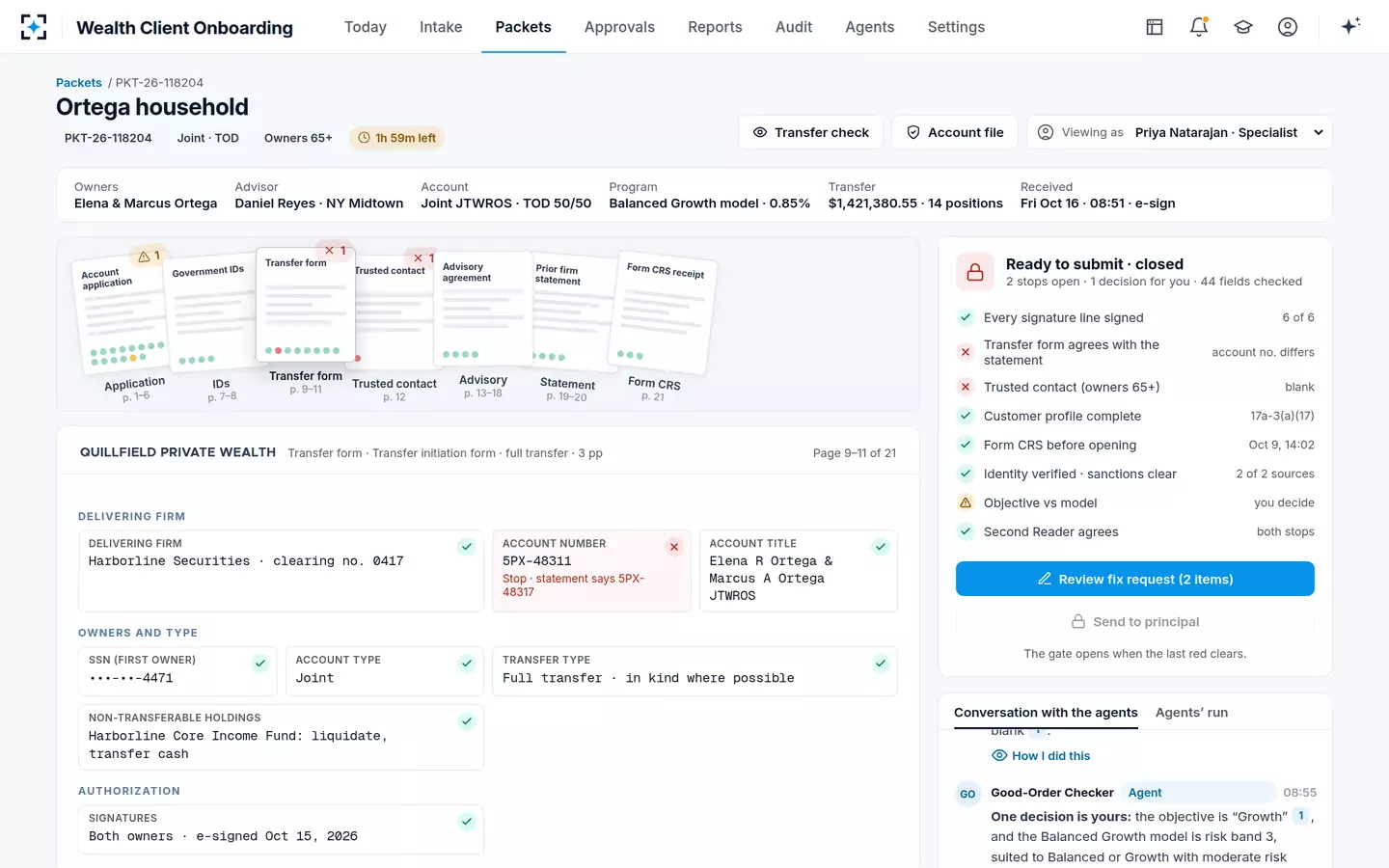
The map becomes a check when every row is read from its source and compared, automatically, before the packet moves. In the solution the Packet Reader extracts each field with its position on the page; the Good-Order Checker applies the firm's rules for the account type and stamps each field green, amber or red with the rule and the passage it was read from; and the Profile & Disclosure Checker compares the profile with the CRM, the identity results and the e-delivery log. A red stops the packet. An amber goes to a person.
The sample firm's rules show how the map's rows turn into settings. "Customer profile complete: income, net worth, objective, risk tolerance, horizon" is a stop, and it stopped 47 packets in the sample week. "Government ID unexpired at opening and readable" stopped 33. "Employer and occupation agree with the CRM profile" is not a stop but a decision for the specialist, because a mismatch often has an innocent explanation: in the sample Ortega packet, Marcus Ortega's employer field reads "Retired," and a CRM note from March 2025 records the retirement, so the field clears with its source cited.
Wealth Client Onboarding stamps each field where it sits, with a stop until the last red clears
Who accepts the account: the principal's signature
The record closes with a signature, and both rules ask for it in different words. FINRA asks for the "signature of the partner, officer or manager denoting that the account has been accepted"; the SEC asks that the record "indicate whether it has been signed by the associated person responsible for the account, if any, and approved or accepted by a principal." In practice that is a registered principal, and the approval is only as good as what the principal could see.
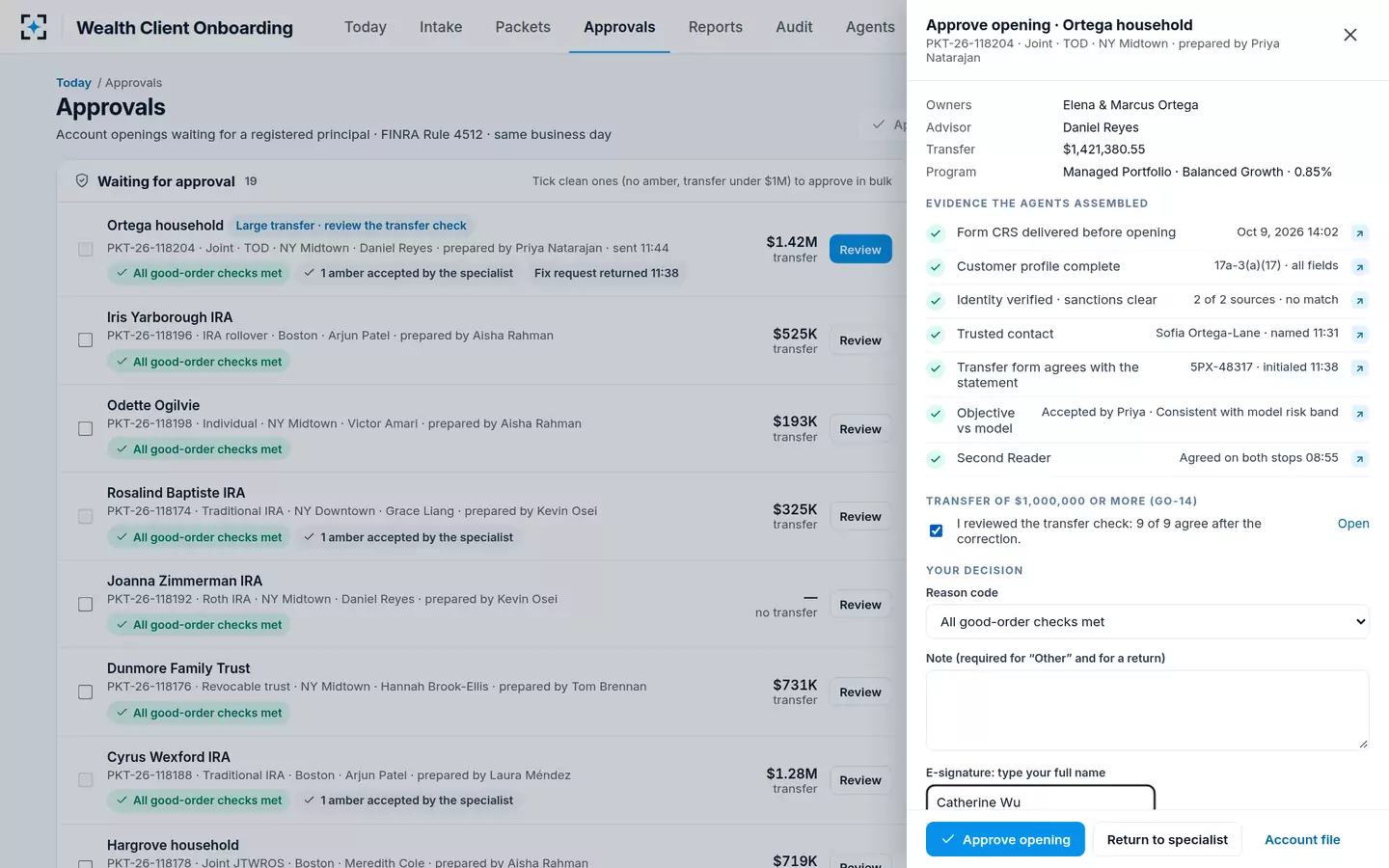
In Wealth Client Onboarding the approval drawer shows the evidence the agents assembled for each line of the map: Form CRS before opening, the customer profile under 17a-3(a)(17), identity and sanctions, the trusted contact, the transfer form against the statement, and every decision the specialist took with its reason. The sample firm adds a rule of its own for transfers of $1,000,000 or more: the principal must confirm having reviewed the transfer check before approving. The specialist who prepared the packet cannot approve it, and neither can any agent.
The principal approves with the field-by-field evidence in view
The map also explains why the delivery date for Form CRS sits in the same file: it is the one field whose value is a time rather than a fact about the client, and the Form CRS delivery rules decide what that time must come before.
Questions people ask
What is the difference between FINRA Rule 4512 and Rule 2090?
Rule 2090, know your customer, sets the standard: reasonable diligence to know and retain the essential facts about every customer and the authority of anyone acting for them. Rule 4512 lists the minimum fields every account record must hold. A firm meets 2090 partly by meeting 4512, but 2090 also covers facts no list names, such as special handling instructions.
When must the tax ID be obtained under Rule 4512?
Rule 4512(a)(2) requires reasonable efforts to obtain it before the settlement of the account's first transaction, for non-institutional accounts. The CIP rule is stricter: an identification number must be obtained before the account is opened, with a narrow exception for a customer who has applied for a taxpayer identification number but not yet received it.
Does a joint account need information on both owners?
Yes. SEC Rule 17a-3(a)(17) requires personal information for each joint owner who is a natural person, while their financial information may be combined. Each owner also signs, and in the solution's sample account file identity is verified against two sources for both owners, not just the first named.
Can a customer refuse to give account information?
Yes, and 17a-3(a)(17) says a customer's neglect, refusal or inability to provide information excuses the firm from obtaining it, while Rule 4512 asks only for reasonable efforts on the trusted contact. The CIP items are different: the program must describe "when the broker-dealer should not open an account" if it cannot form a reasonable belief that it knows the customer's true identity.
How long is customer account information kept?
The 17a-3(a)(17) record is kept until at least six years after the earlier of the date the account closed or the date the information was collected, provided, replaced or updated. CIP identifying information is kept for five years after the account is closed, and verification records for five years after they are made.