A trusted contact person is someone an account holder names, in advance, whom their bank, credit union or brokerage may contact if it cannot reach them or suspects they are being financially exploited. A trusted contact is not an owner, an agent or a co-signer: they cannot see the account, move money or make decisions, unless they hold some other authority such as a power of attorney. Brokerage firms have had to ask for one since 2018 under FINRA Rule 4512; banks and credit unions may offer the option, and the 2024 interagency statement on elder financial exploitation encourages it. Used well, it is the fastest protective step a bank has: a call to someone who knows the customer, made while the money is still in the account. Botminds' Elder Financial Exploitation Detection is software for fraud and BSA teams that shows who the trusted contact is and since when, drafts the call within what the customer agreed to, and leaves the call to a person.
Three people around one call: what each knows today, and what changes
Today
Named a contact years ago. Nobody revisits the consent when a new owner or agent is added to her account.
With agents
Her consent and its scope are on the screen the moment a concern opens, and she is asked before anything wider is shared.
Still theirs: Every decision about her money, and the right to change or revoke her contact at any time.
Today
Hears nothing until after the money is gone, or is told too much.
With agents
Gets a call within the hour, told only what the consent and the customer allow, and asked what they know.
Still theirs: No access to the account. They may decline to get involved.
Today
Hunts for the consent form in a branch file while the customer waits.
With agents
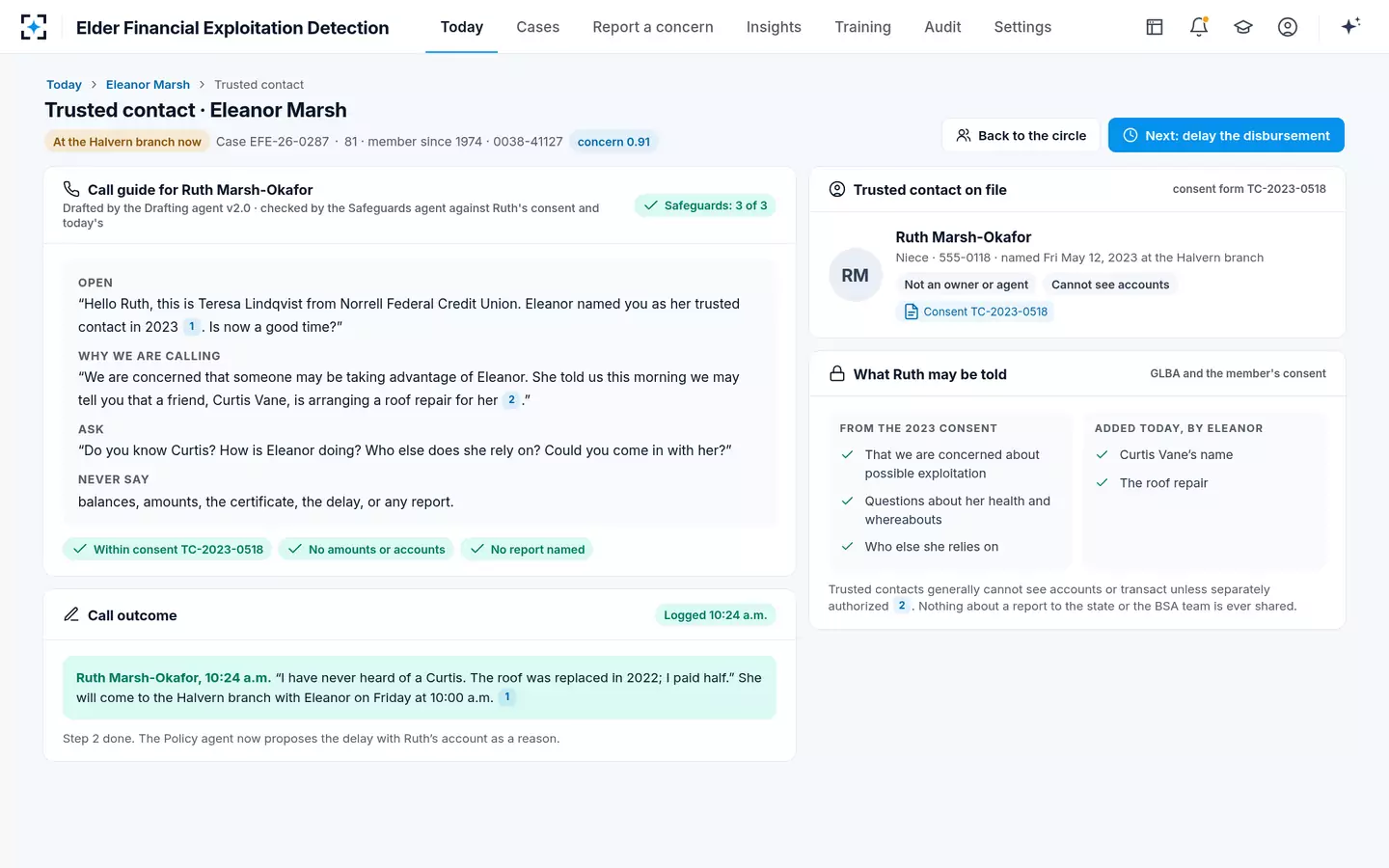
Opens a call guide already checked against the consent: no amounts, no accounts, no report named.
Still theirs: Whether to call, what to ask, and what to do with the answer.
What is a trusted contact person?
An emergency contact for your money: a person aged 18 or over whom your financial institution may call about your account in defined situations, with your written consent. FINRA's rule for broker-dealers describes the person as "a trusted contact person age 18 or older who may be contacted about the customer's account". The CFPB's advisory to banks and credit unions puts it more plainly: "A trusted contact is an emergency financial contact who can step in to help protect the account holder."
For banks, the 2024 interagency statement on elder financial exploitation, revised in June 2026, sets the frame. It says institutions may let account holders name one or more trusted contacts, gives examples of who a contact might be, and lists two occasions for using one: when the institution cannot reach the account holder, or suspects they may be at risk of exploitation. Florida has written the idea into statute: its 2024 delay law defines a trusted contact as a person 18 or older whom the account owner has expressly named in the institution's records as someone who may be contacted to address possible exploitation or confirm the owner's contact details or health.
Can a trusted contact access my account?
No. Naming someone as a trusted contact gives them no right to see your balances or move your money. The interagency statement is explicit: "Unless separately authorized by the account holder, a third-party trusted contact typically would not have authority to view account information or execute transactions." The CFPB suggests banks tell customers exactly that, and clarify that the contact "cannot view the account or make any transactions or decisions about the account unless they have some other legal authority, such as guardianship or power of attorney."
That limit is the point of the role. A trusted contact can be told that the institution is worried, asked what they know, and asked to help, without being handed control. It is why the role suits a relative or friend whom the customer trusts but would not give a power of attorney to.
Is a trusted contact the same as power of attorney?
No. A power of attorney appoints an agent who can act on the account; a trusted contact can only be contacted. The two can be the same person, and in some states the law expects that they sometimes will be, which matters when the agent is the one under suspicion.
Trusted contact, agent under a power of attorney, joint owner: three different relationships to an account
Agent under a power of attorney, or a joint owner: Yes. An agent acts for the owner within the power; a joint owner owns the account.
Trusted contact: None, unless separately authorised.
Agent under a power of attorney, or a joint owner: Every time they transact.
Trusted contact: Only in the situations the consent names: the owner cannot be reached, or exploitation is suspected.
Agent under a power of attorney, or a joint owner: Account information they are entitled to as agent or owner.
Trusted contact: What the owner’s consent allows, and nothing about any report.
Agent under a power of attorney, or a joint owner: Their access continues unless the bank has a lawful basis to refuse.
Trusted contact: The bank does not call them; it looks for a second contact, APS or the police.
Agent under a power of attorney, or a joint owner: Often entitled to notice as an authorised party; some states exclude a suspected party.
Trusted contact: Florida requires written notice to any trusted contact on the account, unless they are reasonably believed to be involved.
What can a bank tell a trusted contact?
What the customer's consent allows, and never anything about a report to the authorities or FinCEN. FINRA's rule gives the clearest list of purposes for a broker-dealer: the firm may contact the person and "disclose information about the customer's account to address possible financial exploitation, to confirm the specifics of the customer's current contact information, health status, or the identity of any legal guardian, executor, trustee or holder of a power of attorney". Banks have no rule, so the consent form does the work. The CFPB recommends that banks "Develop model language for the information that staff may disclose" and consider letting customers choose, from a checklist, the situations in which staff may call.
In the solution's sample case, the member had signed a consent in 2023 that allowed the credit union to tell her niece it was concerned about possible exploitation, to ask about her health and whereabouts, and to ask who else she relied on. On the morning of the concern, she agreed the credit union could also mention the new joint owner's name and the roof repair he was arranging. The call guide used exactly that: the Safeguards agent checked it against the consent before the call and passed it, 3 of 3: within consent, no amounts or accounts, no report named.
A trusted contact person call in Elder Financial Exploitation Detection, within what she agreed to
When will a bank call my trusted contact?
In the situations your consent and the institution's policy name, which are usually when it cannot reach you, when a conversation with you has not relieved its concern about exploitation, or when it needs to confirm your health or a new guardian or agent. The CFPB lists those as examples, including calling the contact "if a discussion with the account holder does not relieve staff concerns about the threat of financial exploitation". The consent form can let you choose which situations apply.
A hold can also trigger a call. Under FINRA Rule 2165, a broker-dealer that places a temporary hold must, within two business days, tell "the Trusted Contact Person(s), unless the Trusted Contact Person is unavailable or the member reasonably believes that the Trusted Contact Person(s) has engaged, is engaged, or will engage in the financial exploitation". Florida's delay law requires a financial institution to give written notice of a delay, with the reason, to any trusted contact on the account within three business days, with the same exception for anyone believed to be involved.
Speed is what makes the contact valuable. In the sample case, the teller reported at 9:52 a.m., the branch manager spoke with the member privately at 10:06, and the specialist reached the niece at 10:24, 32 minutes after the report, while the member was still in the branch and the $42,000 was still in her certificate.
Do banks have to ask for a trusted contact?
No. Brokers do; banks and credit unions may. The difference is regulatory history: FINRA amended Rule 4512 with effect from 5 February 2018 to require member firms to make "reasonable efforts" to obtain a trusted contact, while no federal rule asks the same of banks. The interagency statement points out that trusted contacts "have been widely implemented by investment firms and broker-dealers, as required by FINRA Rule 4512" and invites banks to follow.
Trusted contacts at a broker-dealer and at a bank or credit union
| Question | Broker-dealer (FINRA) | Bank or credit union |
|---|---|---|
| Must the firm ask? | Yes: reasonable efforts at account opening and when records are updated | No federal requirement; the interagency statement encourages it |
| Can the account be opened without one? | Yes, if the firm made reasonable efforts | Yes |
| Minimum age of the contact | 18 | Set by the bank; 18 in Florida’s statutory definition |
| Disclosure to the customer | In writing at opening: that the firm may contact the person and for what purposes | Through the bank’s consent form and policy |
| Notice when a hold is placed | Within 2 business days, unless the contact is unavailable or suspected | Depends on state law; Florida: written notice within 3 business days |
| Who decides to call | The firm, within the purposes disclosed | Staff named in the bank’s policy, within the consent |
A bank that wants contacts on file has to ask, and the CFPB's advisory has suggestions on how: ask at account opening and revisit the consent "on a regular basis and when certain changes or events occur", offer the option to customers of every age, and use a form that makes the choice active. It cites a study finding that customers were more likely to name a contact when the form included a statement about how common fraud is, a statement that most people support the idea, and a requirement to choose yes or no.
Should I add a trusted contact at my bank?
If your bank offers it, usually yes, and choose carefully. The CFPB's guide for consumers gives the reason in one line: "The main benefit of choosing a trusted contact is that if an emergency happens, you have already identified someone who you want your bank or credit union to contact to help protect you." It also suggests asking your bank what it would do if it suspected your trusted contact of taking advantage of you.
Choosing a trusted contact person
- Someone reliable who has your interests at heart
A family member, friend, attorney or someone else you trust; the CFPB lists all of these.
- Ideally, someone who does not handle your money
If your agent or a joint owner is also your only contact, the bank has nobody to call when that person is the worry.
- More than one, if you can
So the bank can reach a second person if the first is unavailable or involved.
- Tell them you have named them
And that your bank may call. A contact who is surprised by the call loses the first ten minutes.
- Read the bank’s consent form
Know which situations allow a call and what may be said. Ask for a checklist if the form allows one.
- Revisit it when your life changes
A new joint owner, a new power of attorney, a move or a bereavement are moments to check it is still right.
You can also change your mind. The CFPB recommends that institutions tell customers they have "the right to revoke the consent at any time or to execute a new consent and name a different trusted contact."
Years on file, not days: why the date a contact was named matters
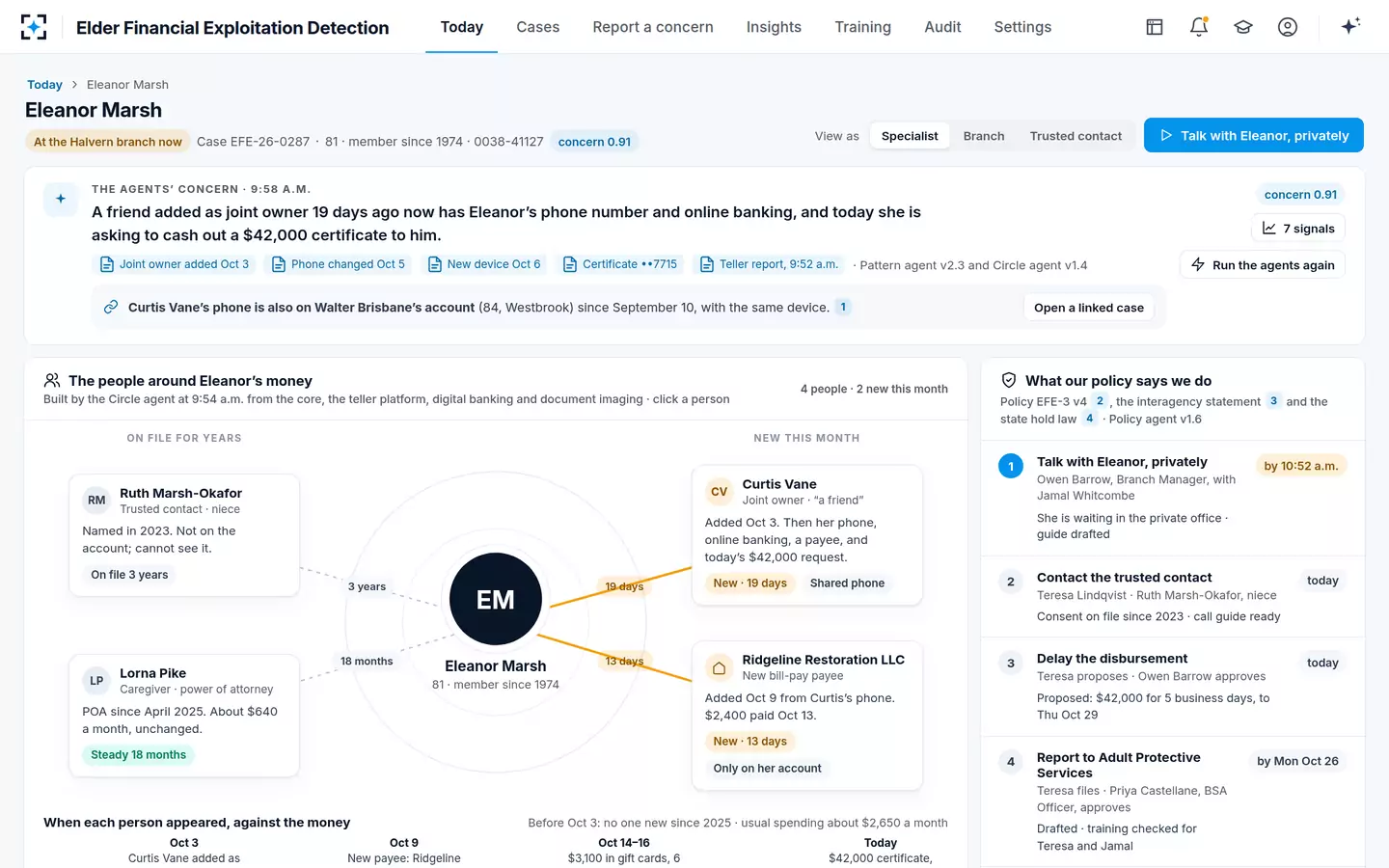
A trusted contact named long before any concern is the most credible person a bank can call; one named in the same weeks as a run of other changes may be part of the problem. In elder exploitation, the new people around an older customer's money tend to arrive together: a new joint owner, a changed phone number, a new device, sometimes a new "trusted" contact. The date each relationship began is evidence.
In the sample case, the member's niece had been her trusted contact since 12 May 2023, more than three years. The new joint owner had been on the account for 19 days and had changed her phone of record two days after he arrived. The Circle agent shows both with their dates, so the specialist can see at a glance whom the customer chose before anyone was pressing her and who appeared just before the request. The CFPB's advice to banks covers the opposite case too: when the trusted contact is the suspected bad actor, staff "could ask the account holder to designate a second trusted contact" and contact adult protective services or the police.
Who is on file for years and who is new this month, in Elder Financial Exploitation Detection
What the solution does not do is choose for the customer or call on its own. It does not add or change a trusted contact, which stays with the customer and branch staff; it does not decide that a contact should be called, which stays with the specialist; and its call guide never names a report to the state or FinCEN. How the call fits among the other steps of a case is in banks' elder fraud prevention, and how a family member can help when the problem is a relative is in elder financial abuse by family members. The full sample case is on the Elder Financial Exploitation Detection page.
Questions people ask
Can a trusted contact be my spouse or a joint owner?
Yes, nothing prevents it, and Florida's statutory definition expressly allows a joint owner or a person with a power of attorney. But if that person ever becomes the concern, the bank has nobody independent to call, so the CFPB suggests naming more than one contact.
Can I have more than one trusted contact?
Usually. The interagency statement refers to "one or more trusted contacts", FINRA's hold rule speaks of trusted contact persons in the plural, and the CFPB recommends banks allow several in case the first is unavailable or suspected.
Does my trusted contact have to agree?
There is no formal acceptance step in FINRA's rule or the CFPB's guidance, but the CFPB encourages account holders to tell their contact that staff may call. It also tells banks that the trusted contact "may decline to get involved in the situation."
Is a trusted contact the same as a beneficiary?
No. A beneficiary receives money on your death; a trusted contact receives a phone call while you are alive and has no claim on the account. The same person can be both, but the roles are separate.
Will my bank tell my trusted contact my balance?
Only if your consent allows it, and many banks design their forms so that it does not. In the sample case in this guide, the call guide forbade mentioning balances, amounts or the certificate, and the specialist asked questions rather than giving account details.