The main elder fraud statistics for 2025 come from the FBI's Internet Crime Complaint Center: people aged 60 and over filed 201,266 complaints and reported $7.748 billion in losses, 37% more complaints and 59% more money than in 2024, at an average of $38,500 per complaint. Those are reported losses, not a complete count, and every other public measure of elder fraud counts something different: FinCEN counts suspicious activity reports, the CFPB studied a sample of them, and researchers estimate prevalence from surveys. Read together, they say the same thing about money that has already left: very little comes back. Botminds' Elder Financial Exploitation Detection is software for bank and credit union fraud and BSA teams that works on the other side of that line, putting an older customer's case in front of a specialist while the money is still in the account. Its fictional sample case runs through this page as the worked example of what one stopped payment is worth.
Money frozen against money lost: older victims, all victims, and one stopped request
FBI Kill Chain incidents with victims 60+, 2025: $65.4 million reported
- Frozen $32.9m · 50.3%
- Not frozen $32.5m · 49.7%
All Kill Chain incidents, 2025: $1.16 billion attempted
- Frozen $679m · 58.3%
- Not frozen $485m · 41.7%
Sample member before her case opened: $47,500 requested or paid
- Delayed $42,000 · 88.4%
- Paid out $5,500 · 11.6%
How much do older adults lose to fraud? The 2025 numbers
Older adults reported $7.748 billion in losses to the FBI in 2025, more than any other age group, from 201,266 complaints. The IC3's elder fraud section gives the headline: "201,266 Complaints", "$7.748 Billion in Losses", "$38,500 Average Loss" and "12,444 Complainants Lost > $100K". People 60 and over made 24.2% of all complaints about cyber-enabled fraud, the largest share of any age group.
The trend over four years is steep. The FBI received 88,262 complaints from people 60 and over in 2022, reporting more than $3 billion, as FinCEN's elder trend analysis recounts; 101,068 complaints and $3.4 billion in 2023; 147,127 complaints and $4.885 billion in 2024; and 201,266 and $7.748 billion in 2025.
Losses reported to the FBI by people 60 and over have more than doubled since 2022
Is elder fraud increasing, or is reporting?
Both, and the data cannot fully separate them. Complaints are self-reported, so a rise can mean more fraud, more awareness or easier reporting. FinCEN says as much about the IC3 figure it quotes: "Given that these are self-reported complaints, it is likely the $3 billion loss represents a smaller proportion of the actual amount lost to EFE each year."
The composition of the 2025 rise shows the problem. Phishing and spoofing complaints from people 60 and over went from 23,252 in 2024 to 48,064 in 2025, and those complaints carry small losses: $77 million across all 48,064. That is one reason the average loss per complaint fell from $83,000 in 2024 to $38,500 in 2025 while total losses rose by more than half. An average that halves in a year is a change in what is being counted, not in what a victim loses.
Suspicious activity reports show the same growth from the banks' side. The CFPB counted 63,500 elder exploitation SARs in 2017, which it called a quadrupling since 2013. FinCEN's count for the year to June 2023 was 155,415. Much of that is the SAR form and FinCEN's 2022 advisory making elder cases easier to mark and find.
Which scams cost older adults the most?
Investment fraud, by a wide margin, followed by tech and customer support scams and romance scams. The IC3's 2025 table of losses reported by people 60 and over puts investment fraud at $3.52 billion, close to half the total.
Where people 60 and over lost money in 2025, by type of fraud
Two further lines in the same report matter for banks. People 60 and over made 6,188 complaints about cryptocurrency ATMs and kiosks in 2025, with $257 million lost: the cash leaves the account at a teller window or an ATM before it is converted. And they filed 2,529 complaints about recovery scams, with $540.5 million in reported losses, which the IC3 notes "may also include losses experienced from previous scams which prompted the contact with the recovery company." A customer who has been robbed once is a target for the people who promise to get the money back.
How much elder fraud is recovered?
Little, unless someone moves within hours. The FBI's Recovery Asset Team runs the Financial Fraud Kill Chain, which asks receiving banks to freeze money sent to fraudulent accounts. In 2025, for victims aged 60 and over, "there were 642 incidents involving victims aged 60+ with a total reported loss of $65,367,648. The FFKC process was able to assist in freezing $32,865,655 of those funds." That is about half, and it is the best case: these are incidents reported fast enough to start the process. The report's advice is blunt: a victim who finds a fraudulent transfer should report it at once, because speed decides what can be frozen.
Most losses never get that far. The 642 incidents are a fraction of the 201,266 complaints from older people, and the half frozen is a fraction of $7.748 billion. The top crime types in those incidents were tech support and account takeover scams (360 incidents), business email compromise (104) and investment fraud (64).
What do FinCEN SARs show about elder exploitation?
FinCEN's April 2024 trend analysis is the largest public look at what banks themselves report. Between 15 June 2022 and 15 June 2023, financial institutions filed "155,415 EFE-related BSA reports associated with more than $27 billion in reported suspicious activity, which may include both actual and attempted transactions." FinCEN cautions that the figure may be overstated by unpaid and attempted payments, duplicates and double counting of inbound and outbound transfers.
Banks filed 72% of those reports; two banks alone filed 33%. Scams by strangers accounted for about 80% of the reported activity and theft by trusted people for about 20%, with a caveat in FinCEN's own words: this "does not necessarily indicate that scams occur more often than theft, but filers are reporting on it more frequently." The majority of scam filings also referenced account takeover. In the scam filings, the average reported amount was $129,483 and the median $33,499; for theft, the average was $98,863 and the median $23,762. Adult children were the most frequently named perpetrators of theft, in nearly 40% of cases, which the hardest case for a bank, abuse by family members, takes up in detail.
What is the average elder fraud loss? It depends on what is counted
Every public figure answers a different question, so the answer ranges from about $14,000 to about $130,000. A specialist presenting numbers to a board should say which one is meant.
Six public measures of elder fraud, and what each one actually counts
| Measure | What it counts | Latest figure | Read it as |
|---|---|---|---|
| FBI IC3 complaints, 60+ | Complaints people choose to file | 201,266 complaints; $7.748bn; average $38,500 (2025) | A floor on reported losses, sensitive to the mix of complaint types |
| FinCEN elder SARs | Bank and other filings using the elder key term or checkbox | 155,415 reports; over $27bn, actual and attempted (June 2022–June 2023) | Suspicious activity, possibly overstated; not losses |
| CFPB SAR study | A sample of elder SARs, 2013–2017 | Average loss $34,200 per older adult who lost money (median $13,900) | Losses per victim where a SAR shows one |
| Kill Chain freezes, 60+ | Fast-reported transfers the FBI tried to freeze | $32.9m frozen of $65.4m (2025) | What speed can still save |
| Burnes et al., meta-analysis | Surveys of fraud and scams among older adults | 5.6% pooled prevalence; about 1 in 18 a year | How common, not how costly |
| AARP estimate, as cited by the regulators | A modelled annual loss | $28.3bn a year | An estimate the interagency statement repeats, not a count |
The survey figure is the reminder that reports are the visible part. Burnes and colleagues' meta-analysis of 12 studies found fraud and scams affecting "approximately 1 of every 18 cognitively intact, community-dwelling older adults each year". The CFPB used a similar prevalence rate to estimate that the 63,500 elder exploitation SARs of 2017 "may account for less than 2 percent of actual incidents". The interagency statement, revised in June 2026, adds the Treasury's 2024 National Money Laundering Risk Assessment, which linked elder exploitation to "more than $3 billion in reported financial losses annually", and repeats the AARP estimate of $28.3 billion, citing AARP as its source.
What one stopped payment saves: the Elder Financial Exploitation Detection sample case
For the customer, a payment stopped before it leaves is worth its full amount; a payment recovered afterwards is worth whatever share comes back, which for older victims reported fast in 2025 was about half. In the solution's sample, Eleanor Marsh, 81, had already lost $5,500 to the new joint owner's payee and to gift cards before anyone at the credit union saw the pattern. Her $42,000 certificate was delayed at the counter, on the morning of the request.
Her money against her own pattern: what changed and what did not
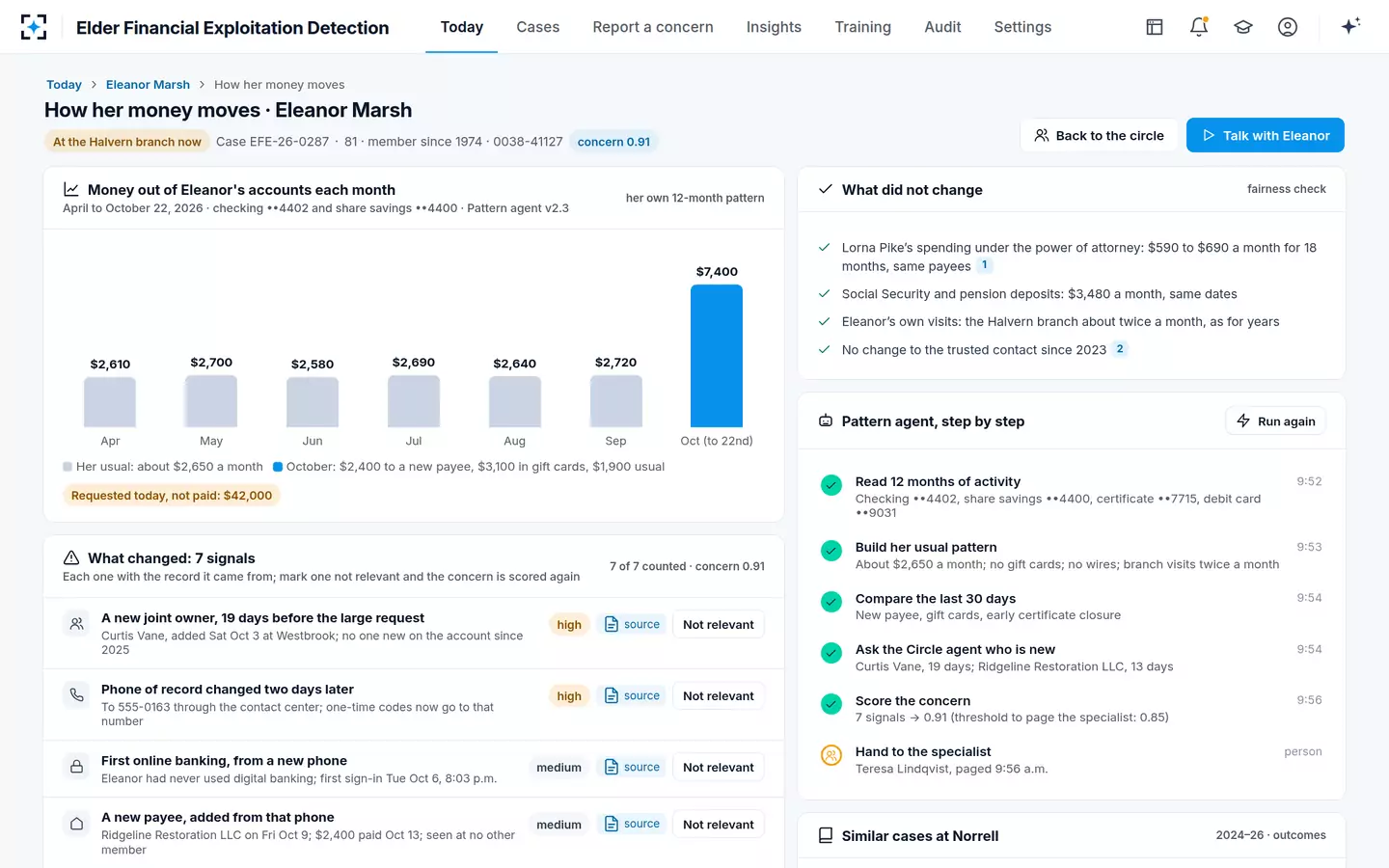
Measured against her own life, the numbers are large. Her outflows ran about $2,650 a month; $42,000 is almost 16 months of that spending, and roughly a year of the $3,480 a month her pension and Social Security pay in (our arithmetic). The IC3's 2025 average for older complainants, $38,500, is in the same range, which is why a single stopped request can be worth more to a customer than any number in a quarterly fraud report.
The institution's own loss is smaller and should not drive the case. In the CFPB's sample of elder SARs, the older adult lost money in about 75 percent of them, while the filer, the institution itself, "lost money in 9 percent of all EFE SARs", with an average loss per filer of $16,700. Elder exploitation is mostly the customer's loss. That is the argument for spending specialist time on it: the value of the work accrues to the person the bank serves, and the cost of missing it lands on them too.
Why stopping the payment beats every recovery route
Because the money does not stop moving, and the victim is often approached again. FinCEN's 2022 advisory notes that "older adults are often re-victimized" after the first exploitation. In the CFPB's study, 7 percent of SARs with a loss to the older adult exceeded $100,000, and in 2025 12,444 older complainants told the FBI they had lost more than $100,000.
The window is short and it is usually at the bank. A hold law gives days, not weeks: five business days in Washington, fifteen in Florida with an extension of up to thirty more if the review supports it. A specialist who sees the whole picture within the hour can use those days to call a trusted contact, report to adult protective services and let the customer reconsider without pressure. In the sample, the agents laid out the circle six minutes after the teller's report, and the delay was approved 33 minutes after that. The design target is a first protective step within an hour while the member is still in the branch. How the case unfolded day by day is in one member's three weeks; the full case is on the Elder Financial Exploitation Detection page.
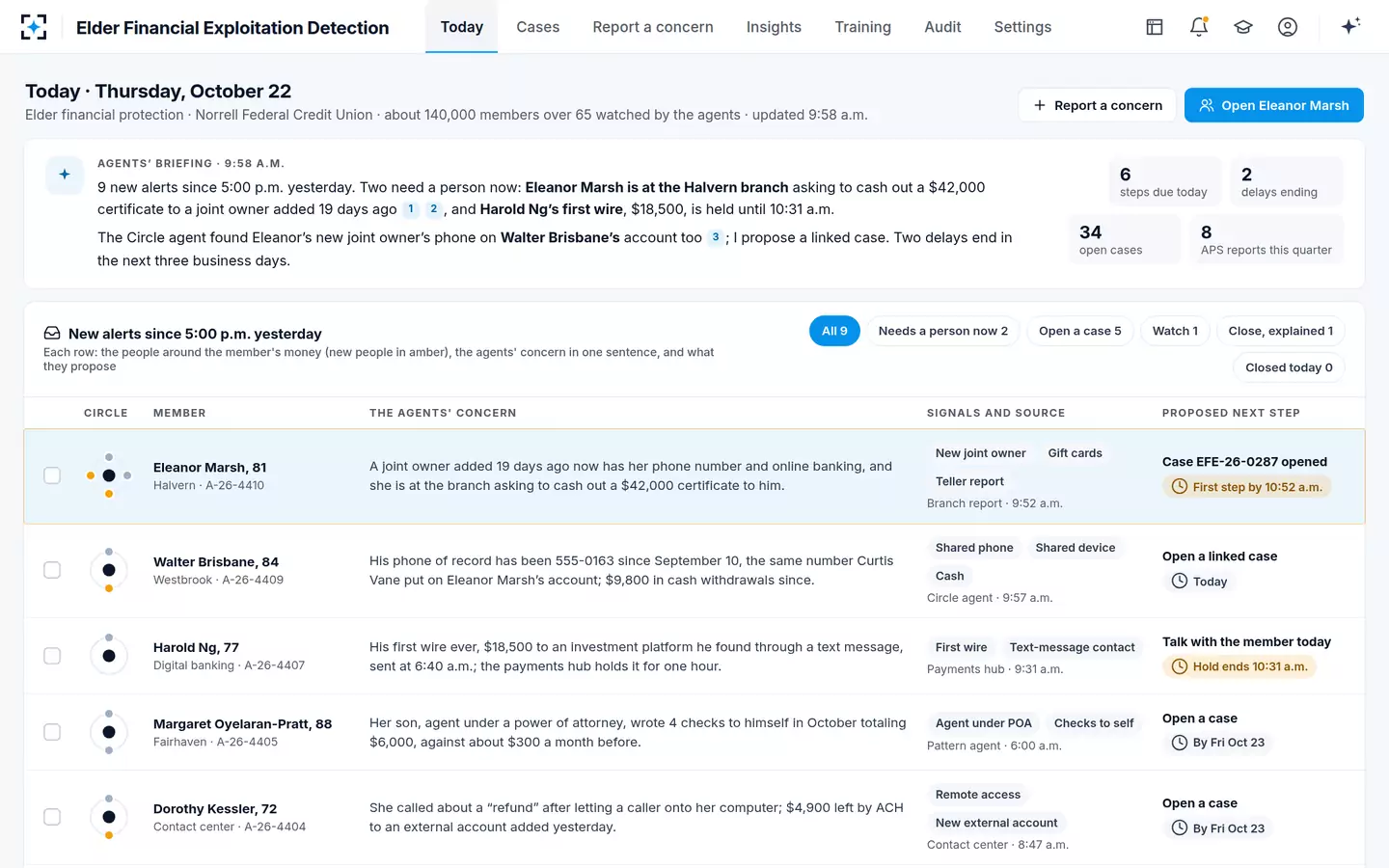
Today's elder alerts in Elder Financial Exploitation Detection, each with the people around the member
Questions people ask
How many elder fraud complaints were filed in 2025?
People aged 60 and over filed 201,266 complaints with the FBI's Internet Crime Complaint Center in 2025, 37% more than in 2024, reporting $7.748 billion in losses. They were the largest group of complainants by age.
Which states had the most elder fraud complaints in 2025?
California, with 22,157 complaints from people 60 and over, then Florida with 17,147 and Texas with 14,410, according to the IC3's 2025 state tables. Those rankings largely follow population, so per-capita comparisons need census data alongside.
What share of elder fraud is scams rather than theft by someone known?
In FinCEN's review of a year of bank and other filings, scams by strangers made up about 80% of reported elder exploitation activity and theft by trusted people about 20%. FinCEN warns this reflects what filers report more often, not necessarily what happens more often, since theft by family is harder to detect.
How much do older adults lose to cryptocurrency scams?
In 2025, complaints from people 60 and over that involved cryptocurrency reported more than $4.3 billion in losses, over half of all their reported losses. Cryptocurrency ATM and kiosk complaints alone accounted for 6,188 complaints and $257 million.
Why did the average elder fraud loss fall in 2025?
Mostly because the mix of complaints changed. Phishing and spoofing complaints from older people roughly doubled to 48,064 and carried small losses, pulling the average down from $83,000 in 2024 to $38,500 in 2025 even as total losses rose 59%.