Elder abuse training for financial institutions teaches the people who serve older customers to recognise the signs of financial exploitation and to report what they see, inside the bank and, where appropriate, to adult protective services or the police. It carries more weight than most compliance courses for two reasons. The teller is often the only person who sees the customer taking instructions on a phone, or a new "friend" answering for her, because no transaction system records either. And under the federal Senior Safe Act, a bank or credit union is shielded from liability for reporting suspected exploitation only if it trained the people the Act describes before the report was made. Botminds' Elder Financial Exploitation Detection is software for fraud and BSA teams that turns a teller's concern into a case within minutes, checks each reporting employee's training before a report goes, and leaves every hold and report to a person.
The sample case on this page comes from the solution running on fictional data: Norrell Federal Credit Union, its Halvern branch, and an 81-year-old member, Eleanor Marsh, who arrives on a Thursday morning to cash out a certificate. Every person and figure in that case is invented; every rule and statistic is linked to its public source.
What the teller sees that no monitoring system can
Most exploitation is designed to avoid a teller, which is exactly why the cases that do reach the window matter. FinCEN's review of a year of elder exploitation reports found that perpetrators "mostly rely on unsophisticated means to steal funds that minimize direct contact with financial institution employees". When the customer does come in, the evidence is behavioural. Filers describing in-person scams noted victims who "struggled to maintain a consistent reason for sending their attempted transaction, and may have been on the phone with someone directing their activities throughout the interaction."
What the teller sees in one minute, and what only the systems hold
Monitoring and core systems: Early closure of a 24-month certificate: $42,000, a $604 penalty, an official check. Unusual for her, but made by the owner.
The teller at the window: She is not sure what the money is for.
Monitoring and core systems: Not captured. No system records who answers the teller.
The teller at the window: The man beside her answers every question.
Monitoring and core systems: A joint owner added 19 days ago at another branch. No rule fires on a joint owner.
The teller at the window: The same man is at her side, and the check is to be payable to him.
Monitoring and core systems: A changed phone number, first online banking, a new payee, first gift cards: each in a different system.
The teller at the window: Invisible from the window.
Monitoring and core systems: The check prints if the balance is there.
The teller at the window: One button, Report a concern, while she is still in the branch.
FinCEN's 2022 advisory makes the same point from the other side: for some victims, "their only outside contact may involve visiting or communicating with their local financial institution". A course that teaches staff to read transaction reports is teaching the wrong layer. The teller's job is the remainder that never reaches a report: who is in the room, who is talking, and whether the customer can say in her own words what the money is for.
That workforce is large and turns over. O*NET counts 339,200 tellers in the United States, at a median of $43,030 a year (2025 data). Any training programme has to reach people who are new, part-time and rotating between branches, and still produce the same minute at the window.
What training is required for elder financial exploitation?
No federal law makes elder exploitation training mandatory for banks or credit unions; the Senior Safe Act makes it the condition of protection instead. The statute says an institution "may provide" the training, then ties immunity from suit to it. A report made without trained staff is still lawful, but it is not protected by the Act.
The Act, 12 U.S.C. 3423, passed in 2018 as part of the Economic Growth, Regulatory Relief, and Consumer Protection Act, defines a senior citizen as someone "not younger than 65 years of age". It covers credit unions, depository institutions, investment advisers, broker-dealers, insurance companies and agencies, and transfer agents. The protection is for disclosing "the suspected exploitation of a senior citizen to a covered agency": state financial regulators, the federal agencies that sit on the FFIEC, the SEC, a registered securities association, law enforcement, and state or local adult protective services.
The statute protects two different parties on two different conditions, and training programmes often blur them. A trained individual is protected only if, when the report was made, that person "served as a supervisor or in a compliance or legal function (including as a Bank Secrecy Act officer)", and made it "in good faith" and "with reasonable care". The institution is protected for that person's report only if, before it was made, each individual the Act describes "received the training".
Who the Senior Safe Act protects, and on what condition
| Who | Protected for | Condition | What this means for a teller |
|---|---|---|---|
| A trained supervisor, compliance or legal officer (including the BSA officer) | Their own disclosure to a covered agency | Trained; in that role at the time; good faith; reasonable care | The teller reports internally; a trained supervisor or the BSA officer makes the external report. |
| The bank or credit union | A disclosure made by such an employee | Every employee in the three trained groups trained before the disclosure | One untrained teller in scope can cost the institution its protection. |
| A teller or frontline employee | Not named for individual immunity | Must still be trained for the institution to be protected | Training is for detection and escalation, and for the institution’s shield. |
| A hold on the money | Nothing: the Act covers disclosure | Holds come from state law | A teller who delays a payment relies on the state statute and the bank’s policy, not this Act. |
The last row is the one most often misread. The Senior Safe Act's own rule of construction says it does not limit liability "for any act, omission, or fraud that is not a disclosure". Holding a transaction is not a disclosure. In the states that allow holds, the authority and its protection come from state law, as the state-by-state rules on holds, reporting and age set out.
Who must be trained under the Senior Safe Act?
Three groups, and frontline staff are one of them. The Act describes each officer or employee who is in the supervisory, compliance or legal group; who "may come into contact with a senior citizen as a regular part of the professional duties of the individual"; or who "may review or approve the financial documents, records, or transactions of a senior citizen". In a credit union that means tellers and member service representatives, contact-centre agents, branch managers, lending and deposit operations staff who approve older members' transactions, and the BSA and fraud teams.
The timing is fixed in the statute. Training is to be given "as soon as reasonably practicable" and, for anyone who joined after May 24, 2018, "not later than 1 year after" starting in a covered position. The institution must keep a record of each covered person who completed the training, including training done before they joined, and provide it to its examining agency on request.
One state adds its own condition for holds. Florida's 2024 law lets a financial institution delay a disbursement for a specified adult only after it has trained employees who perform or approve transactions, kept "a written record of all trainings conducted", and trained employees hired after July 1, 2024 within a year of starting. That is one state's rule. It shows how a training file that was only a liability shield in 2018 has become, in some states, a precondition for protecting a customer's money.
What does Senior Safe Act training cover?
The statute sets four requirements for the content, and the 2024 interagency statement on elder financial exploitation adds the practical substance. Under the Act, the training must be kept and shown to an examining agency on request; must "instruct any individual attending the training on how to identify and report the suspected exploitation of a senior citizen internally and, as appropriate, to government officials or law enforcement authorities, including common signs"; must cover protecting customer privacy and integrity; and must be "appropriate to the job responsibilities" of the person attending.
The interagency statement, issued in December 2024 by the Federal Reserve, CFPB, FDIC, FinCEN, NCUA, OCC and state regulators and revised in June 2026, suggests training may cover "identifying red flags for different types of financial exploitation, providing proactive approaches to detecting and preventing elder financial exploitation, and detailing actions for employees to take when they have concerns". It names transactions through "powers of attorney or other agents" and recommends "detailed escalation processes and written procedures". The statement imposes no new requirement; it describes practices, and what the revised statement says, section by section is covered separately.
What a Senior Safe Act course for frontline staff should cover
- The signs, by type of exploitation
Scams by strangers and theft by people the customer trusts look different at the window. The statute requires "common signs"; the statement asks for red flags "for different types".
- The internal report, in one step
Who the teller tells, by what route, within how many minutes, and what to write down. The Act requires instruction on reporting "internally".
- The external report and who makes it
Which agencies are covered, and why the trained supervisor, specialist or BSA officer files, not the teller.
- What never to say
Tipping off a suspect, mentioning a suspicious activity report, or calling the customer a victim. SAR confidentiality applies to every employee.
- Privacy and the customer’s dignity
A required topic under the Act: what may be shared with a trusted contact or family member, and what may not.
- Agents and powers of attorney
How to treat a transaction made through an agent, and what to check when a new agent or joint owner appears.
- Role-specific scenarios
Tellers, contact-centre agents and operations reviewers meet different versions of the same case. The Act requires training "appropriate to the job".
- The evidence trail
Each completion recorded by name and date and exportable for an examiner. The Act requires both the content and the completion records on request.
The red flags a teller can act on in front of the customer
The most useful red flags for a teller are the ones a person can see and nothing else can. FinCEN's 2022 advisory on elder financial exploitation, FIN-2022-A002, lists behavioural signs alongside financial ones, and three of its behavioural signs describe the window directly. One: "During a transaction, an older customer appears to be taking direction from someone with whom they are speaking on a cell phone, and the older customer seems nervous, leery, or unwilling to hang up." Two: an older customer "is agitated or frenzied about the need to send money immediately in the face of a purported emergency of a loved one". Three: a customer who appears "unable to answer basic questions about account activity".
The advisory adds a caution that training should repeat: "no single red flag is determinative". A nervous customer may simply be nervous. What turns a sign into a concern is a combination, or a sign that does not fit the customer's own history. That is the distinction a teller cannot make alone, because the teller does not see the account's last three weeks. Training should teach the teller to report the sign, not to resolve it.
FinCEN also asks institutions to record in the SAR narrative the behavioural warning signs staff saw, and the names of the staff who saw them. A teller's report therefore has to be specific enough to quote: what was said, by whom, at what time. The elder exploitation SAR file depends on it.
What should a teller do if they suspect elder abuse?
Report it at once, while the customer is still in the branch, and leave the decision to the specialist or the manager. The teller should not accuse, should not refuse on their own authority unless the institution's policy allows it, and should not mention any report. In the sample case the teller's minute took one button.
From the window to a protective step: 44 minutes in the sample case
- Report5 min
- Case opened6 min
- Private talk8 min
- Trusted-contact call18 min
- Delay approved7 min
Jamal Whitcombe, the member services representative, pressed Report a concern at 9:52. By 9:58 the agents had assembled everyone around Eleanor's money from the core system, the teller platform, digital banking and document imaging, and found that the man beside her had been added as joint owner 19 days earlier. At 10:06 the branch manager, Owen Barrow, had recorded her purpose in her own words from a guide of six plain questions, with a standing rule never to say "victim", "scam" or "confused".
The conversation guide Elder Financial Exploitation Detection drafted for the branch manager, with her answers
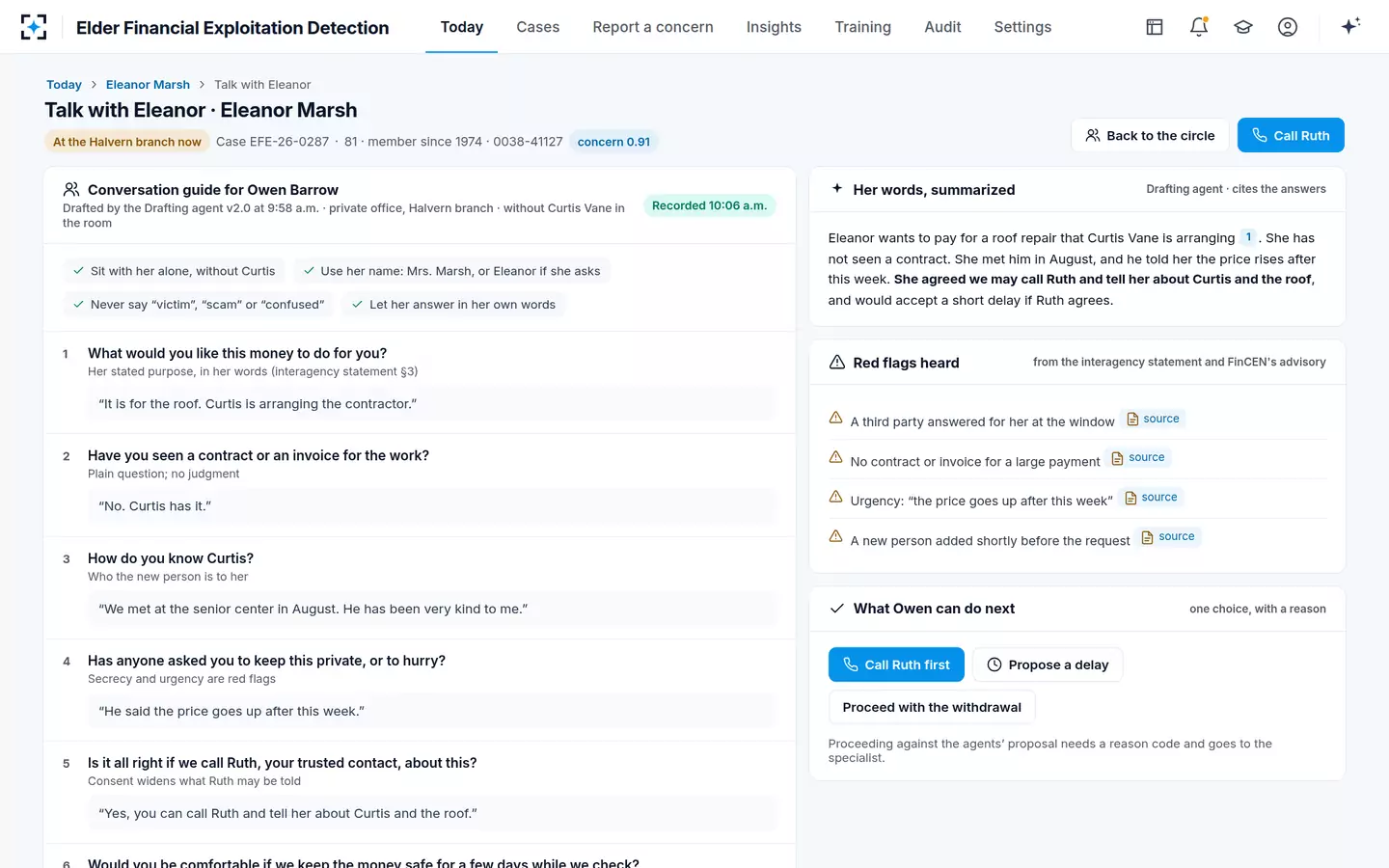
Nothing on that screen is something a course can replace, and nothing in a course is something the screen can replace. The teller still has to notice the man answering for her. What changes is what happens in the next ten minutes: whether the concern reaches someone who can see the whole account before the check prints.
How often should staff be trained on elder exploitation?
The law sets a deadline for new staff and no frequency after that. The Senior Safe Act requires training within a year of starting for anyone hired into a covered role since May 24, 2018. The interagency statement suggests "clear, comprehensive, and recurring training", and the CFPB's 2021 advisory on trusted contacts recommends "Cyclical, recurring training" so that staff "know how to respond when they suspect financial abuse".
Most institutions settle on annual refreshers with an onboarding module, which matches the turnover of frontline roles. Frequency matters less than two other properties. The content should change when the scams change: tech-support and romance scams were the scam types filers named most often in FinCEN's 2022–2023 review, and the FBI's complaint data shows how fast that mix moves. And completion should be checked at the moment it matters, not once a year: on the day an employee makes a report.
Training evidence an examiner can ask to see
The Act gives examiners two things to request: the course content, and a record of each covered employee who completed it. Both must be producible "upon request" to "a covered agency with examination authority". An examiner reviewing an elder exploitation case will also want to see that the person who reported was trained on the day of the report, which is a question of dates, not of averages.
Senior Safe Act training in Elder Financial Exploitation Detection, checked for every employee who reports
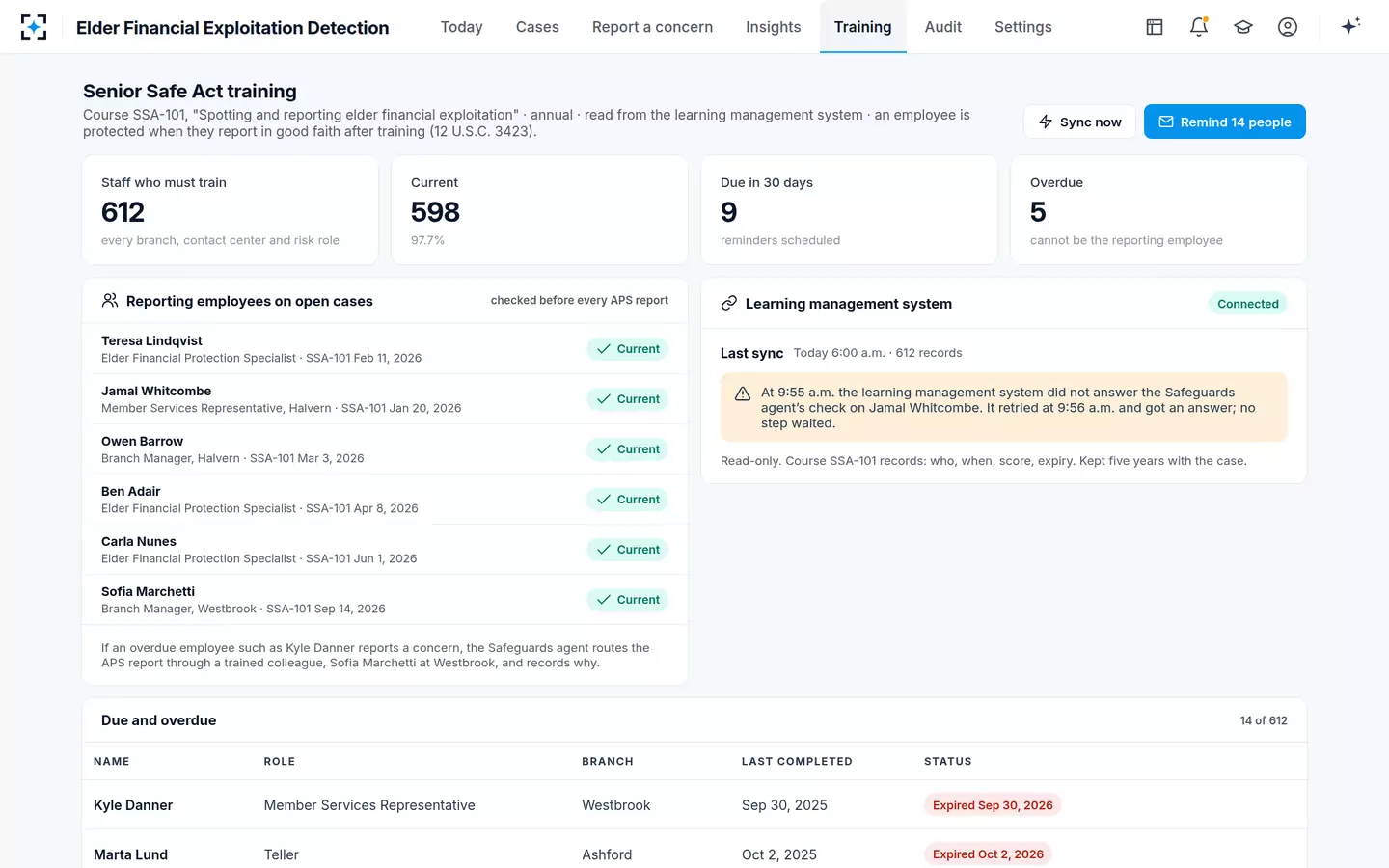
In the sample, 598 of 612 staff in scope were current. Before the adult protective services report was approved, the agents confirmed the training of the specialist who filed it (11 February 2026) and of the teller who first reported (20 January 2026). When the learning management system did not answer at 9:55, the screen said so and waited for the retry rather than assuming. The overdue five cannot be the reporting employee; a trained colleague files instead.
Buying elder abuse training, and the tools around it: what to look for
Training is one purchase; acting on what trained staff see is another, and most programmes buy only the first. A course from a vendor, an association or the institution's own compliance team can satisfy the statute. Whether a teller's concern becomes a protected report, a lawful hold and a defensible file depends on what happens after the course.
Questions to ask of any training programme and the system behind it
- Is the content mapped to the four statutory requirements?
Signs and reporting, internal and external; privacy; job-appropriate; kept for examiners. Ask for the map.
- Is there a version for each covered role?
Tellers, contact centre, operations reviewers and managers face different moments.
- Can you produce a completion record per person, by date?
An examiner asks whether this reporter was trained on that day, not what share of staff completed.
- Does the teller have one action, in the teller system?
A phone tree or an email is where a concern waits while the customer leaves.
- Who checks training before an external report?
If nobody does, the institution learns it was unprotected after the fact.
- Does the training match your state’s rules?
Hold authority, reporting duties and ages differ by state; a national course cannot know your policy.
Where Botminds fits is narrow and specific. Elder Financial Exploitation Detection is not a course and not a learning management system. It reads training records from the system you already use, gives tellers the Report a concern button at their station, and puts the concern in front of a specialist with the member's whole circle already assembled. Its agents never hold money, send a notice or file a report; a person decides each step and a second person approves a delay or an adult protective services report. How those decisions divide between agents and people is set out in banks' elder fraud prevention, step by step. The full sample case is on the Elder Financial Exploitation Detection page.
Questions people ask
Is elder abuse training required for banks?
Not by federal law. The Senior Safe Act says an institution "may provide" training and grants immunity for reports only when the covered staff were trained first. Some state laws attach their own training conditions; Florida, for example, requires training before a financial institution may delay a disbursement under its 2024 statute.
Does the Senior Safe Act protect tellers personally?
Not directly. Individual immunity covers a trained person who reports while serving "as a supervisor or in a compliance or legal function". Tellers are among the staff who must be trained for the institution itself to be protected, which is why the external report is usually made by a trained supervisor, specialist or BSA officer.
What age does the Senior Safe Act cover?
People 65 and older, by the Act's own definition of a senior citizen. FinCEN's advisory treats people 60 and over as older adults, and state laws use 60, 62 or 65, so a policy usually has to handle more than one age.
Can a third party provide Senior Safe Act training?
Yes. The statute allows training by the institution "or a third party selected by" it, and counts training completed before an employee joined. The institution still has to keep the content and a completion record for each covered person and show them to its examiner on request.
Does Senior Safe Act training protect a bank that holds a transaction?
No. The Act protects the disclosure of suspected exploitation to a covered agency, and its rule of construction leaves liability for anything else untouched. Authority and protection for a hold come from state hold laws; the FTC's October 2024 overview lists 24 states with such laws for financial institutions.