Elder financial abuse by family members is the theft or improper use of an older person's money by a relative: most often an adult child, sometimes a grandchild, a spouse or a sibling, and frequently someone who already has lawful access as a joint owner, an agent under a power of attorney or a caregiver. It is common. In a national survey of 5,777 adults aged 60 and over, 5.2% reported current financial abuse by a family member. And in the reports banks file, it is larger and slower than scams by strangers: the CFPB found an average loss of $42,700 when the suspect was a family member, against $17,000 when it was a stranger. For a bank it is the hardest case, because the transactions look authorised, the signs are behavioural, and a careless notice or phone call can warn the person doing it. Botminds' Elder Financial Exploitation Detection is software for fraud and BSA teams that maps everyone around an older customer's money and when each appeared, compares spending with the customer's own history, and leaves every step to a person.
Average loss per older adult in elder exploitation SARs, by who the suspect was
What is elder financial abuse by family members?
It is what FinCEN calls elder theft when the trusted person is a relative: "Schemes involving the theft of an older adult's assets, funds, or income by a trusted person." The federal definition in the Senior Safe Act is wider and names the people a bank most often meets in these cases: exploitation is the "fraudulent or otherwise illegal, unauthorized, or improper act or process of an individual, including a caregiver or a fiduciary", that uses an older person's resources for someone else's benefit or deprives them of access to their own.
It is a different crime from a scam, not a milder one. DeLiema's study of 53 cases from an elder abuse forensic centre found that "Elder financial exploitation, committed by individuals in positions of trust, and elder fraud, committed by predatory strangers, are two forms of financial victimization" with different social settings: fraud victims were more often childless, and fraudsters struck where no trustworthy relative was watching. Family exploitation happens precisely where a relative is watching, and the relative is the problem.
How common is financial abuse by family?
Roughly one older adult in twenty reports it in a given year. The National Elder Mistreatment Study, a representative telephone survey of 5,777 adults aged 60 or older published in the American Journal of Public Health in 2010, found one-year prevalence of "5.2% for current financial abuse by a family member", higher than the rates it found for emotional, physical or sexual abuse.
What family financial abuse looked like in the national survey
In bank filings, family cases appear less often than that prevalence would suggest, and FinCEN says why. In its review of a year of elder exploitation reports, theft by trusted people made up about 20% of reported activity and scams about 80%, but FinCEN cautions that the split may reflect what filers report rather than how often each happens, and that elder theft "is likely to be underreported and can go undetected because the perpetrators are typically individuals who are trusted by the victim." Among the theft reports, adult children were named as perpetrators in nearly 40% of cases. An earlier FinCEN sample of SAR narratives from 2013 to 2019 found a family member involved in 46% of elder theft cases.
Why family cases cost more and run longer
Because the relative does not need to trick anyone to get access, and nobody is looking. In the CFPB's sample, a loss to the older adult occurred in 82% of SARs where a family member was the suspect, against 75% for strangers, and the average loss was two and a half times as large. The suspicious activity in an elder SAR lasted about four months on average, but "when a family member is the suspect (197 days)" it ran longer, and "when a joint account is involved (230 days)" longer still.
FinCEN's description of how relatives take the money explains the duration. Methods are "relatively unsophisticated and straightforward", the perpetrators "made little or no effort to obfuscate the payments", and often "the perpetrator already has access, can quickly gain access, or the victim will give them funds if the victim is adequately trusting, or conversely if the perpetrator is intimidating." A son who writes himself a cheque from his mother's account, with her checkbook, raises no fraud rule. Adult children who exploited a parent, FinCEN found, "tended to live near the parent they were victimizing".
How relatives take the money, and what the bank can see
| Method FinCEN describes | What it looks like in the account | What may show it |
|---|---|---|
| Funds transfers through the victim’s online banking | Transfers to the relative or to their creditors, from the usual device or a new one | New device or payee; a pattern that differs from the customer’s own history |
| Cheques written to themselves | Cheques payable to the relative, signed by the customer or forged | A new payee on cheques; amounts rising month by month |
| The victim’s debit or credit card | Purchases the customer would not make | Merchants, places and times that do not fit the customer’s life |
| Cash, at an ATM or at the counter | Daily maximum withdrawals; the relative escorting the customer to a teller | Withdrawal pattern; what the teller sees at the window |
| Online bill pay | The relative’s own bills paid from the account | A new bill-pay payee in someone else’s name |
| Wires | The least common method, often large and international | A first-ever wire |
How do banks spot family financial abuse?
By watching the people around the money as closely as the money, and by comparing a customer's activity with their own past rather than with anyone else's. FinCEN's 2022 advisory lists behavioural red flags that describe family cases closely. One: "A caregiver or other individual shows excessive interest in the older customer's finances or assets, does not allow the older customer to speak for himself or herself, or is reluctant to leave the older customer's side during conversations." Another: "An older customer shows an unusual degree of fear or submissiveness toward a caregiver, or expresses a fear of eviction or nursing home placement if money is not given to a caretaker." A third: "A new caretaker, relative, or friend suddenly begins conducting financial transactions on behalf of an older customer without proper documentation."
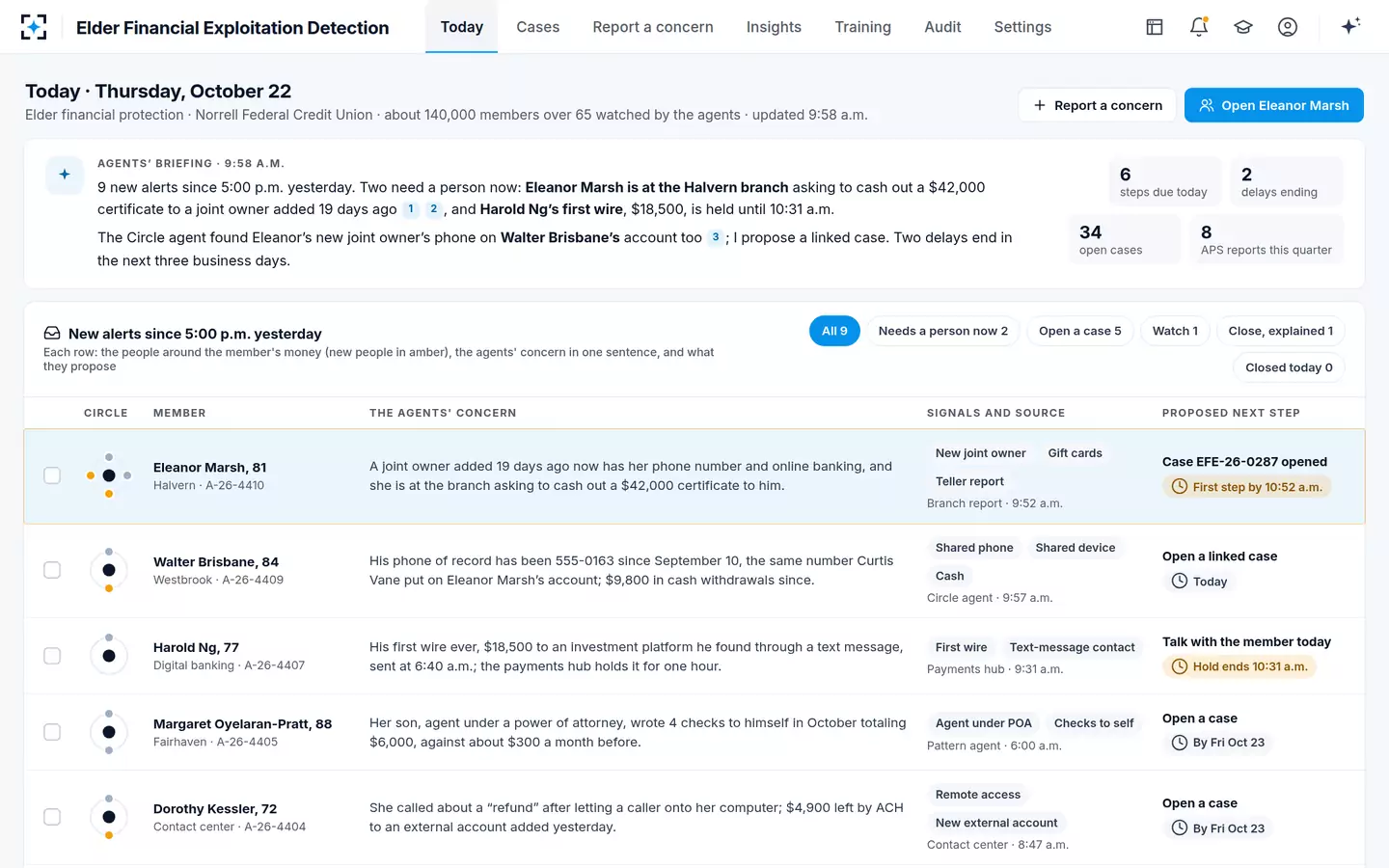
The account-side sign is a change in a long pattern. In the solution's fictional sample, one overnight alert concerned Margaret Oyelaran-Pratt, 88: her son, her agent under a power of attorney, had written four cheques to himself in October totalling $6,000, against about $300 a month before. Nothing about any single cheque was unusual for an agent. The change was.
An overnight alert in Elder Financial Exploitation Detection: a son with a power of attorney, and a change against her own history
Can a power of attorney be abuse?
Yes, and the losses are the largest of any group. A power of attorney gives an agent lawful access to the principal's money for the principal's benefit; using it for the agent's own benefit is exploitation. FinCEN's advisory names "the exploitation of legal guardianships and power of attorney arrangements" among the ways trusted people take control, and lists as a red flag a sudden change of financial management "through a change of power of attorney, trust, or estate planning vehicles, to a different family member or a new individual". In the CFPB's sample, about 7 percent of elder SARs named a fiduciary as a suspect, and those had the highest average loss: $83,600.
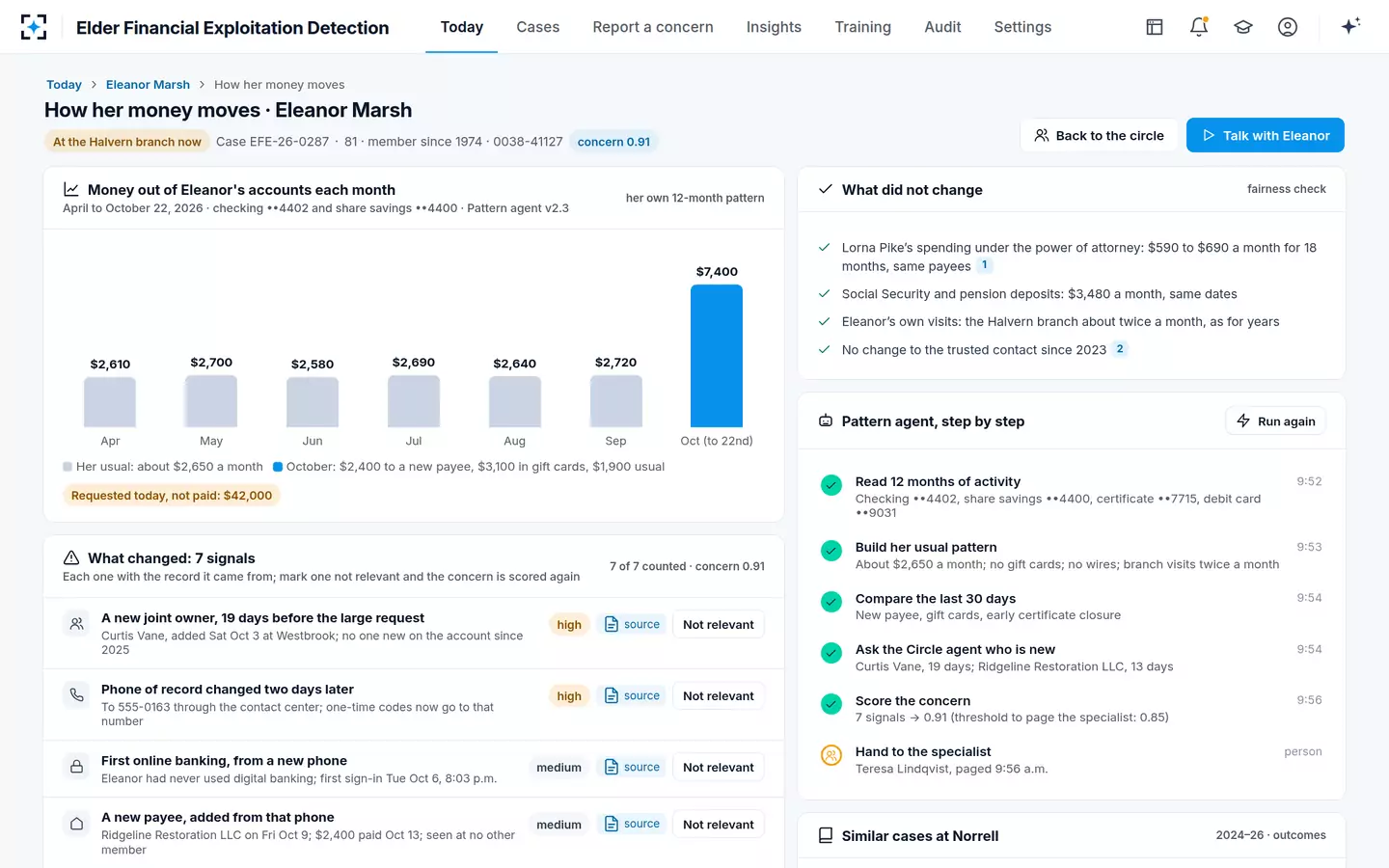
The same tool cuts the other way. Many agents and caregivers manage an older person's money exactly as they should, for years, and a policy that treats every agent as a suspect will humiliate the people doing the most for the customer and teach staff to ignore alerts. The test is whether the agent's own pattern has changed. In the sample case, the member's caregiver had held a power of attorney for 18 months and spent $590 to $690 a month throughout; the agents showed that alongside the new joint owner's activity, so she was not treated as a suspect.
What did not change: Elder Financial Exploitation Detection's fairness check on a caregiver's steady 18 months
Is it elder abuse if a son uses mom's money?
It depends on authority and benefit. If he has no authority and takes it, it is theft. If he has authority, as a joint owner or an agent under a power of attorney, the question is whether he used it for her benefit and within what she agreed to. A son who pays his mother's bills from her account is doing his job; one who pays his own, or writes himself cheques she does not know about, is using her resources "for monetary or personal benefit, profit, or gain", in the Senior Safe Act's words. A gift she freely chooses to make is hers to make; one extracted by pressure or from someone who no longer understands the decision is not.
That last distinction is why banks talk with the customer alone. FinCEN asks institutions to watch for a customer who "lacks knowledge about his or her financial status, or shows a sudden reluctance to discuss financial matters". In a private conversation, an older customer can say what the money is for, and whether anyone asked them to hurry or keep it quiet, without the relative in the room.
What can a bank do if a family member is stealing?
Talk with the customer privately, call a trusted contact who is not involved, delay the payment where the state allows, report to adult protective services and the police, and file a SAR where the rules require one, all without alerting the relative. Each step has a family-specific trap. The trusted contact may be the suspect: Florida's law defines a trusted contact so that it "may include a joint account owner or an individual or entity who has been granted a power of attorney". The delay notice may reach the suspect: Washington's statute tells institutions to notify everyone authorised to transact on the account, with no exception written in, while Florida's excludes anyone the institution reasonably believes is involved. And a joint owner sees the statements.
Washington's law does give one tool aimed squarely at family cases: a refusal may cover not only the vulnerable adult's account but also the account "Of a person suspected of perpetrating financial exploitation". How much each state allows, and for how long, is set out in elder financial abuse laws by state. The suspicious activity report must never be mentioned to anyone involved, which in a family case can mean most of the people on the account; what the file must show is in the elder exploitation SAR guide.
What happens when you report a family member?
Adult protective services decides whether to investigate and what help to offer; the police get involved if a crime may have been committed. Adult protective services, in the description FinCEN quotes from the National Adult Protective Services Association, is "a social service program authorized by law in every state to receive and investigate reports of elder or vulnerable adult maltreatment and to intervene to protect the victims to the extent possible." Its purpose, in the same description, is to "promote the safety, independence, and quality-of-life" of vulnerable adults.
For a family member who suspects a sibling or other relative, the routes are the same as a bank's. Report to the state's adult protective services agency, to the police if money has been taken, or to the Justice Department's National Elder Fraud Hotline, 833-372-8311, which helps people report to the right agency. Tell the bank too: in Washington, information from adult protective services, the police or a prosecutor can support a bank's decision to refuse a disbursement. The bank may not be able to tell you what it does next. Without the account holder's consent or legal authority, privacy law limits what it can share, and it may never reveal a suspicious activity report.
If you think a relative is taking an older family member's money
- Write down what you have seen, with dates
Withdrawals, cheques, new cards or accounts, changes to the will or power of attorney, someone who will not leave them alone.
- Report to adult protective services in their state
Social services, available in every state, can investigate and offer help. In an emergency, call the police.
- Call the National Elder Fraud Hotline: 833-372-8311
Run by the Justice Department to help people report to the right agencies.
- Tell their bank or credit union, in writing
Describe what you saw. The bank may not reply in detail, but your information can support a delay where state law allows one.
- Encourage them to name a trusted contact who is not involved
A contact the bank may call if it is worried, with no power over the account.
- Do not confront the relative before the money is safe
A warned exploiter can move money faster than any bank can delay it.
The person on the account: why access makes the case hard
In a scam, the bank stands between the customer and a stranger. In a family case, the stranger is already inside: a joint owner, an agent or an authorised user whose transactions the bank is bound to honour unless it has a lawful reason not to. That is why the CFPB's data shows joint-account cases running longest, and why the signs that work are the ones that measure change: when each person was added, what they did next, and whether their pattern departed from their own past.
In Elder Financial Exploitation Detection, the Circle agent records each person around a member's money with the date they appeared, links people only on two or more identifiers and never on a name alone, and proposes linked cases when two members share a new person, phone or device. The Pattern agent shows what did not change as well as what did. The decision to open a case, call a contact, delay or report stays with the specialist, a second person and the BSA officer. How those roles divide is in banks' elder fraud prevention; the full sample case, in which the new person is a "friend" rather than a relative, is on the Elder Financial Exploitation Detection page.
Questions people ask
Can a bank stop a joint owner from withdrawing an older customer's money?
Only where state law gives it a basis, and then only for a short time. Washington, for example, lets a bank refuse a disbursement from the account of a person suspected of exploiting a vulnerable adult for up to five business days, with a report to adult protective services and the police; longer holds need a court order.
Will the bank tell me if my sibling is taking money from our mother?
Usually not in detail, unless your mother has named you as a trusted contact or you hold legal authority such as a power of attorney. A trusted contact may be told what the customer's consent allows; nobody outside the bank's reporting channels may be told about a suspicious activity report.
Who exploits older people more, family or caregivers?
In FinCEN's review of elder theft reports, adult children were the most frequently named perpetrators, in nearly 40% of cases, followed by professional caregivers such as aides and in-home care providers. Neighbours and financial advisers appeared in comparatively few filings.
Is elder financial abuse by a family member a crime?
Often, yes: theft, forgery and fraud apply whoever commits them, and federal prosecutors have brought wire fraud and money laundering cases against people who exploited older adults in their care. FinCEN's 2022 advisory describes one such case, in which a housekeeping business owner who fabricated a power of attorney over a widow with dementia was sentenced to 97 months in prison.
How long does family financial abuse usually go on before it is reported?
Longer than other elder exploitation. In the CFPB's study, the suspicious activity in an elder SAR lasted about 120 days on average, but 197 days when a family member was the suspect and 230 days when a joint account was involved.