The 2024 interagency statement on elder financial exploitation is guidance issued on 4 December 2024 by the Federal Reserve Board, the CFPB, the FDIC, FinCEN, the NCUA, the OCC and the state financial regulators, setting out examples of practices that help banks and credit unions identify, prevent and respond to the exploitation of older customers. It covers governance, staff training, transaction holds, trusted contacts, suspicious activity reports, reporting to adult protective services and the police, records requests, community networks and customer outreach. It imposes no new requirement. On 2 June 2026 the agencies revised it to remove its reference to reputational risk; a word-by-word comparison of the two versions shows that one word, "reputational", is the only change. Botminds' Elder Financial Exploitation Detection is software for fraud and BSA teams that maps each case to the statement and to the institution's own policy, prepares every step and leaves each decision to a person.
Fifteen years of federal guidance on elder exploitation, in four stretches
- Advisories and guidance2011–17
- Immunity, holds, trusted contacts2018–21
- Key term and data2022–24
- Statement2024–26
The milestones the 2024 statement builds on, and what each added
| When | What | What it added |
|---|---|---|
| February 2011 | FinCEN advisory on elder SARs | FinCEN’s first advisory on reporting elder exploitation in SARs |
| September 2013 | Interagency guidance on privacy laws | Confirmed privacy law generally does not prevent reports to authorities |
| March 2016 | CFPB recommendations for banks and credit unions | Voluntary practices, including consent to share with trusted third parties |
| August 2017 | Treasury, FinCEN and CFPB memorandum | Coordination among banks, law enforcement and adult protective services |
| February and May 2018 | FINRA Rules 2165 and 4512; the Senior Safe Act | Broker holds and trusted contacts; immunity for trained staff who report |
| February and July 2019 | CFPB SAR study and reporting update | Data on elder SARs; a chart of state reporting mandates |
| November 2021 | CFPB trusted-contact advisory | How banks can offer and use trusted contacts |
| June 2022 | FinCEN Advisory FIN-2022-A002 | Red flags, the key term and the checkbox request |
| April 2024 | FinCEN Financial Trend Analysis | 155,415 reports in a year, analysed |
| 4 December 2024 | Interagency Statement on Elder Financial Exploitation | Nine sections of example practices; no new requirement |
| 2 June 2026 | Revision | One word removed: reputational |
What is the interagency statement on elder financial exploitation?
It is supervisory guidance in which the federal banking and credit union regulators, FinCEN and the state regulators describe practices they have seen work against elder exploitation. In the NCUA's announcement, the agencies issued it "to provide supervised institutions with examples of risk management and other practices that may be effective in combatting elder financial exploitation." The Federal Reserve distributed it as SR 24-8 / CA 24-6, marked as relevant to every institution it supervises, including those with $10 billion or less in assets.
The statement opens with a definition, "the illegal use of an older adult's funds or other resources for the benefit of an unauthorized recipient", and with the numbers that justify it: FinCEN's count of 155,415 elder exploitation reports in the year to June 2023, the Treasury's figure of more than $3 billion in reported losses a year, and an AARP study's estimate of $28.3 billion. It then sets out nine sections and an appendix that lists more than fifty federal and state resources, from the CFPB's trusted-contact advisory to state banking departments' consumer pages.
Does the elder statement create new requirements?
No, and it says so in its second paragraph: "This statement does not replace previous guidance on this subject issued by any of the agencies, does not interpret or establish a compliance standard, and does not impose new regulatory requirements or establish new supervisory expectations." The Federal Reserve's cover letter repeats that it does not "impose new regulatory requirements or establish new supervisory expectations."
That does not make it irrelevant to an examination. The statement's own footnote reminds institutions that they "are expected to operate in a safe and sound manner and in compliance with applicable laws and regulations", among them the consumer protection and anti-money-laundering laws. The duties that bite in an elder case come from those laws: the SAR rules, the Electronic Fund Transfer Act, the prohibition on unfair, deceptive or abusive practices, state hold and reporting statutes. The statement is the regulators' view of how a well-run institution meets them, and a bank that departs from it should be able to say why.
What changed in the June 2026 revision?
One word. The Federal Reserve's cover letter says: "On June 2, 2026: This letter's attachment, Interagency Statement on Elder Financial Exploitation, was revised to remove references to reputational risk." The revised attachment carries a one-line note at its head to the same effect. We compared the current text with the original December 2024 text, as archived in May 2025, word by word. The only difference in the body is the deletion of "reputational" from a sentence in the background section.
The whole of the June 2026 revision, in the sentence it touched
December 2024
"In addition to financial losses, elder financial exploitation can also result in increased reputational, operational, compliance, and other risks for supervised institutions."
June 2026
"In addition to financial losses, elder financial exploitation can also result in increased operational, compliance, and other risks for supervised institutions."
Unchanged
All nine sections, every footnote, the appendix of resources, and the statement that it imposes no new requirement.
The revision therefore changes nothing a bank does. The practices, the examples and the expectations are word for word the same; only the list of risks elder exploitation creates for the institution is shorter. A policy that cites the statement should cite the revised version and its date, and an elder programme that justified itself partly by reputational risk should now justify itself by the risks the statement still names: operational, compliance and the customer's loss.
The nine sections, and what a bank should be able to show for each
Each section describes practices with "may" and "can"; read as an examiner might, each implies evidence a well-run institution would have. The table pairs them.
The statement's nine sections, and the evidence each one implies
| Section | What it describes | What a bank should be able to show |
|---|---|---|
| 1. Governance and oversight | Risk-based policies, controls, monitoring and complaint handling; communication across BSA, fraud and consumer protection; no impermissible age discrimination | A written policy, who owns it, and how fair-lending review was considered |
| 2. Employee training | Recurring training on red flags, proactive detection, escalation; the Senior Safe Act’s protection for trained staff | Course content and a dated record per covered employee |
| 3. Holds and disbursement delays | Holds under state law; weighing the customer’s explanation, disclosures and UDAAP; enforcement actions on account access | Each hold’s legal basis, length, notice and approver |
| 4. Trusted contacts | Letting customers name contacts; procedures for when and how to disclose concerns; privacy and SAR limits | Consent forms, their scope, and a log of each contact made |
| 5. Suspicious activity reports | Mandatory and voluntary filing; red flags in the narrative; the key term and checkbox; confidentiality | Referrals with the key term, the 30-day clock, and no leaks |
| 6. Reporting to law enforcement and APS | Timely reporting; the 2013 privacy guidance; state mandates; the National Elder Fraud Hotline; IC3 and recovery programmes | Each external report, when, by whom, with its reference |
| 7. Records for authorities | Expediting document requests from APS and police; SAR supporting documentation | Turnaround on requests; supporting documents kept as such |
| 8. Networks | Joining elder fraud prevention and response networks | Membership and named contacts in local networks |
| 9. Consumer outreach | Timely information on trending scams; free government resources | What was sent to customers, and when |
What does the statement say about holds?
That holds and delays are a state-law tool to be used carefully, with a process for the customer to explain. Section 3 notes that institutions have used holds "to prevent consumer losses", that some states permit them, and that the statutes generally set timelines and sometimes immunity. It then lists what a decision should weigh and adds a practice many banks lack: "Supervised institutions may also consider procedures for older adult account holders and their designated representatives to establish the legitimacy of a potentially suspicious transaction."
The footnote to the section is the part to read twice. It cites a Federal Reserve cease-and-desist order against Green Dot Bank and consent orders by the CFPB and the OCC against U.S. Bank, all on restrictions of account access. The statement encourages holds where the law allows them and reminds banks, in the same breath, that cutting a customer off from their money is regulated. The state-by-state rules are in elder financial abuse laws by state, and who should make the call is in banks' elder fraud prevention.
What does the statement say about trusted contacts?
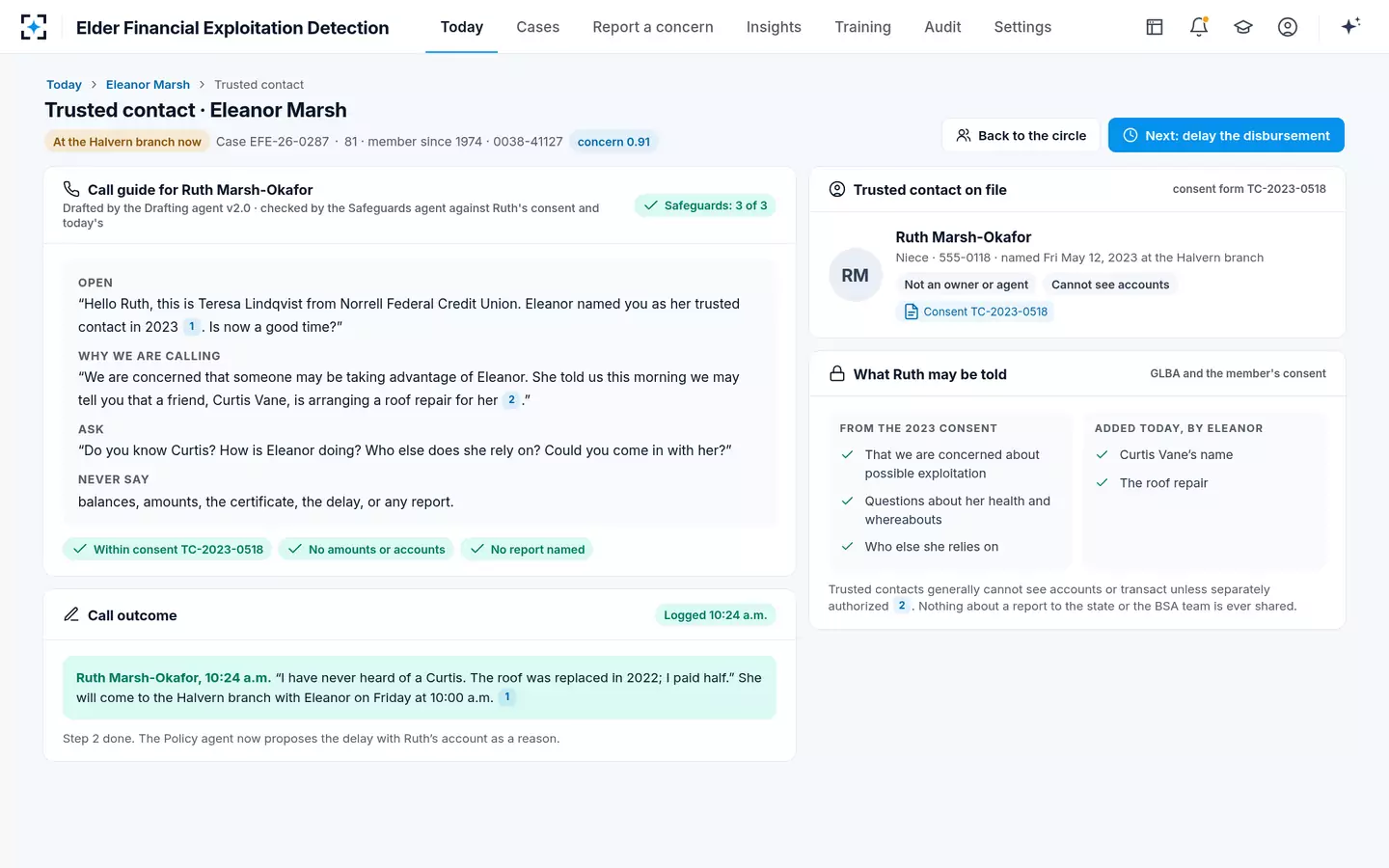
That institutions may let customers name one or more trusted contacts and should decide in advance when and how to use them. Its examples of who a contact might be are "family members, attorneys, accountants, or other trusted individuals", to be called if the institution cannot reach the customer or suspects exploitation. It recommends procedures "for when and how to disclose to the account holder and trusted contact that one or more transactions have indicated that elder financial exploitation may be occurring." And it sets the limit: any disclosure must respect privacy law and SAR confidentiality.
The statement points to the securities industry as the model, noting that trusted contacts have been widely adopted by broker-dealers "as required by FINRA Rule 4512". That rule requires a broker-dealer to make "reasonable efforts to obtain the name of and contact information for a trusted contact person" but lets it open the account without one. Banks have no equivalent rule. How a bank's trusted contact works in practice, and what a contact may be told, is the subject of the trusted contact person guide.
A trusted-contact call guide in Elder Financial Exploitation Detection, checked against the member's consent
Training, reporting, records, networks and outreach: sections 2 and 6 to 9
The remaining sections set the rest of a programme. Section 2 recommends recurring training on red flags and escalation and reminds institutions that federal law, the Senior Safe Act, protects a timely-trained institution and certain employees who disclose suspected exploitation to covered agencies. Section 6 recalls the 2013 guidance confirming that privacy law generally does not prevent reports to authorities, notes that some states require them, and suggests referring customers to the Justice Department's National Elder Fraud Hotline, 833-372-8311.
Section 6 also names the recovery routes. The FBI's Recovery Asset Team exists to "streamline communication between financial institutions and assist FBI field offices with the freezing of funds for those who made transfers to fraudulent accounts under false pretenses", and FinCEN's Rapid Response Program works internationally. Section 7 encourages institutions to expedite records requests from adult protective services and police in active cases. Section 8 points to local elder fraud networks, which can be found through the Justice Department's network locator or the Eldercare Locator. Section 9 argues that informed customers are less likely to lose money and encourages sharing free government material.
Section 5, on suspicious activity reports, restates FinCEN's 2022 request that filers mark field 38(d) and include "EFE FIN-2022-A002" in field 2 and the narrative, and adds a reminder that matters in every elder case: no institution or employee may tell a person involved in a transaction that it has been reported. FinCEN's own advisory goes further on the narrative, asking for the names of staff who witnessed behavioural red flags; what the elder SAR file must show covers it in full.
Who issued the elder exploitation statement?
Five federal financial regulators, FinCEN and the state financial regulators: the Board of Governors of the Federal Reserve System, the Consumer Financial Protection Bureau, the Federal Deposit Insurance Corporation, the National Credit Union Administration, the Office of the Comptroller of the Currency, the Financial Crimes Enforcement Network and the state regulators. The NCUA's announcement describes them as "Five federal financial regulatory agencies, the Financial Crimes Enforcement Network (FinCEN), and state financial regulators". Because the NCUA is an issuer, the statement applies to credit unions as fully as to banks.
Two agencies that appear often in elder work are not issuers: the FTC and the SEC. They joined the 2013 privacy guidance the statement relies on, and their material appears in its appendix, but the 2024 statement is the bank and credit union regulators' document.
What should banks do under the statement?
Be able to show, case by case, the practices it describes: a policy with owners, trained staff with dated records, holds with a legal basis, trusted contacts with recorded consent, SAR referrals that never leak, and reports to the authorities made promptly. The statement asks for nothing new, so the work is in the evidence.
What a bank or credit union should be able to produce under the statement
- The policy, dated and owned
Mapped to the nine sections, citing the June 2026 revision, with the fair-lending review recorded.
- Training content and a per-person completion record
Including the date each reporting employee was trained before each external report.
- For every hold: the statute, the length, the notice and two names
Who proposed it, who approved it, and the customer’s own explanation as recorded.
- Trusted-contact consents and a log of each call
What was said, within what scope, and what the contact told the institution.
- Each external report and its reference
Adult protective services, police, the hotline referral, with times.
- SAR referrals with the key term and the 30-day clock
And proof that no customer-facing document mentions them.
- Customer outreach sent, and to whom
Scam alerts and resources, dated.
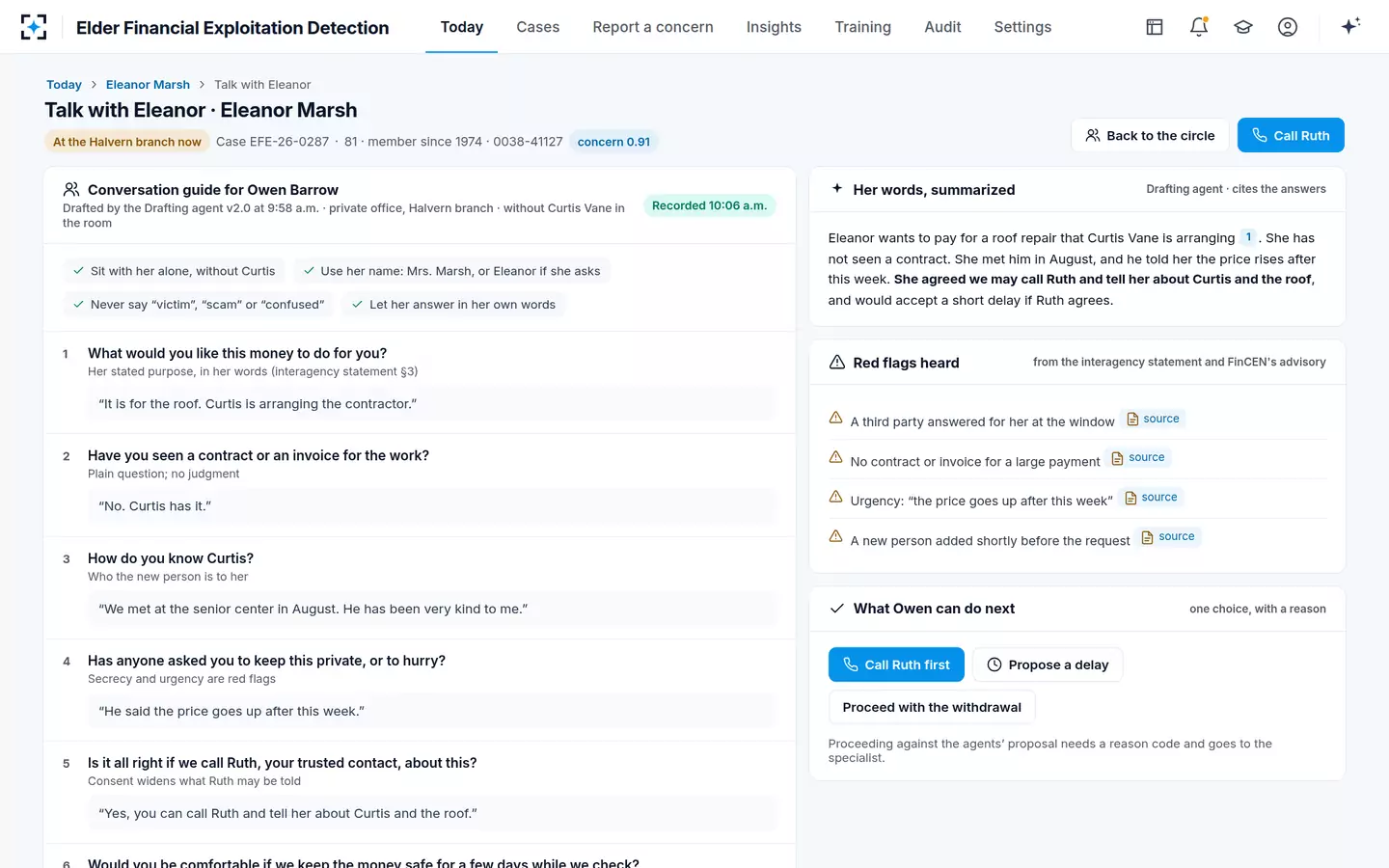
In Elder Financial Exploitation Detection, the Policy agent maps the facts of each case to the statement and to the institution's own policy, and the drafts cite the section they rely on. The conversation guide's first question, about what the customer wants the money to do, is marked as section 3 of the statement, because the account holder's explanation is one of the factors that section names.
A conversation guide in Elder Financial Exploitation Detection whose first question cites section 3 of the statement
What the solution cannot do is decide how your institution reads a "may" in the statement. That is a policy choice for the BSA officer and the board, and the solution's settings record the choice made. The full sample case is on the Elder Financial Exploitation Detection page.
Questions people ask
Is the interagency statement on elder financial exploitation binding?
No. It states that it does not interpret or establish a compliance standard, impose new requirements or create new supervisory expectations. The underlying laws it refers to, such as the SAR rules, the Senior Safe Act and state hold and reporting statutes, are binding on their own terms.
When was the elder statement issued and revised?
The agencies issued it on 4 December 2024; the Federal Reserve's cover letter, SR 24-8 / CA 24-6, is dated 5 December 2024. It was revised on 2 June 2026 to remove the reference to reputational risk, and the reposted attachment carries a note saying so.
Does the statement apply to credit unions?
Yes. The NCUA is one of the issuing agencies, and the statement is addressed to all institutions the agencies supervise. Credit unions are also covered financial institutions under the Senior Safe Act.
Where does the $28.3 billion figure in the statement come from?
From a June 2023 AARP study by Jilenne Gunther, which the statement cites in its footnote 3 as "A recent study". It is a modelled estimate, not a count; the statement sets it beside FinCEN's count of 155,415 reports and the Treasury's figure of more than $3 billion in reported losses a year.
Does the statement say what age counts as elder?
Not directly. It quotes the Elder Justice Act's definition of exploitation and refers to the Senior Safe Act, which covers people 65 and older, and to FinCEN's advisory, which treats people 60 and over as older adults. It also notes that Regulation B gives special protections to credit applicants 62 or older.