The ACATS transfer rules, set out in FINRA Rule 11870 and aligned with NSCC Rule 50, give the carrying firm one business day after a transfer instruction is entered to validate it or take exception, and three business days after validation to complete the transfer. The receiving firm's obligation comes first: on receipt of the customer's signed transfer instruction form it "must immediately submit such instruction" through ACATS. That makes the receiving firm the owner of everything before the rule's clock starts, and of every restart: the carrying firm may take exception for only twelve reasons, and most of them are errors on the form the receiving firm submitted. A wealth firm that wants transfers measured in days rather than weeks has to check the form before it enters it. Botminds' Wealth Client Onboarding reads every new-account packet and matches the transfer form against the prior firm's statement, digit by digit, before the transfer is submitted.
The household and firms in the examples are sample data on fictional people, used across the series.
The ACATS clock in Rule 11870's own numbers
1day
for the carrying firm to validate or take exception
3days
from validation to a completed transfer
12
grounds on which the carrying firm may take exception
10days
to start a buy-in on a fail, 30 for listed instruments
What do the ACATS transfer rules require of each firm?
They split the work into a receiving firm that initiates and a carrying firm that validates and delivers, each with its own deadlines. The table sets out the sequence as the rule writes it.
Rule 11870 step by step: who acts, and on what clock
| Step | Firm | Clock | Rule text |
|---|---|---|---|
| Submit the transfer instruction | Receiving | On receipt of an authorised form | "must immediately submit such instruction to the carrying member by establishing such instruction in ACATS" (b)(1) |
| Validate, with all positions and balances, or take exception | Carrying | One business day | "within one business day following the establishment of such account transfer instructions" (b)(1) |
| Freeze the account | Carrying | On validation | Open orders cancelled, except options expiring within seven business days; no new orders (d)(1) |
| Resolve exceptions | Both | Promptly | "must promptly resolve any exceptions taken to the transfer instruction" (b)(2) |
| Complete the transfer | Carrying | Three business days after validation | Undelivered positions become fail contracts at current market value (e) |
| Chase fails | Receiving | 10 business days after delivery was due; 30 for listed instruments | Steps to obtain possession, by buy-in or otherwise (f)(1) |
One provision protects the receiving firm's client from a slow or reluctant carrying firm: the carrying firm "may not take exception to a transfer instruction, and therefore deny validation of the transfer instruction, because of a dispute over securities positions or the money balance in the account." It must transfer what its books show. Disputes over the contents are resolved after the move, not used to delay it.
The SEC's investor bulletin puts the practical result at "approximately three to five business days to complete from the time the new firm enters the transfer form into ACATS", if there are no problems; outside ACATS, "it is not uncommon for the account transfer process … to take up to thirty (30) days" (SEC, Transferring Your Investment Account).
The twelve exceptions, and which ones the receiving firm causes
The carrying firm may take exception only on the grounds listed in Rule 11870(d)(3), and most of them describe a defect in the instruction the receiving firm entered. That is the point of control: a receiving firm that checks the form against the prior firm's statement before submission removes most of the reasons the clock can restart.
The grounds for exception in Rule 11870(d)(3), sorted by who can prevent them
| Ground for exception | Preventable by the receiving firm before entry? | The check that prevents it |
|---|---|---|
| Invalid account number | Yes | Match the number on the form to the latest statement |
| Tax ID mismatch | Yes | Match the form to the statement and the client's documents |
| Account title does not match | Yes | Match owners, order and registration wording |
| Account type does not correspond | Yes | Match individual, joint, IRA, trust and the like |
| Missing or improper authorisation | Yes | All signatures, initials, custodial and successor-custodian acceptances |
| Duplicate request | Yes | Check open transfers for the same account |
| Additional documentation required | Mostly | Death or marriage certificates, trust papers, collected with the packet |
| Account is "flat", no transferable assets | Partly | A current statement; resubmission requires the most recent statement attached |
| Unrecognised residual credit assets | Partly | Identify the customer for residual sweeps |
| Customer rescinds the instruction | No | — |
| Violates the carrying firm's credit policy | No | — |
| Customer has taken possession of the assets | No | — |
Six of the twelve are entirely within the receiving firm's reach, and three more partly. A rejected instruction costs the client at least the validation day, plus however long it takes to reach the client, get a correction signed and resubmit. On a household transfer the correction is usually one initial, but obtaining it can take days. The detailed field-by-field match is set out in matching the transfer initiation form.
How long does an ACATS transfer take once rejections are counted?
From the client's signature, the realistic answer is the rule's four business days plus whatever the receiving firm spends before entry and after each exception. The solution's estimate for one household with a transfer in, by hand and with one rejected form, is about 13 business days; with the form checked before entry, about 4.7.
The rule's four days come last: one household's transfer, by hand and checked before entry
- Read and check2
- Fix loop3
- Principal1
- Reject, redo3
- Validate1
- Complete3
- Checks0.7
- Validate1
- Complete3
The difference is almost entirely on the receiving firm's side of the line. The carrying firm's days are fixed by rule; the receiving firm's are fixed by its own process.
Nontransferable assets: what the receiving firm must tell the client
Some assets cannot move through ACATS, and the rule assigns the client notice to whichever firm causes the problem. Rule 11870(c)(1)(D) defines a nontransferable asset to include a proprietary product of the carrying firm, a third-party fund "with which the receiving member does not maintain the relationship or arrangement necessary to receive/carry the asset", an asset outside the receiving firm's permitted business, certain bankrupt or foreign issues, and limited partnership interests in retail accounts.
For a third-party fund the receiving firm cannot hold, the receiving firm must give the client a list of the assets and "request, in writing and prior to the time it makes such designation, further instructions" on disposition: liquidation, with any redemption fees stated, retention by the carrying firm, or transfer directly to the client. For the carrying firm's proprietary products, the carrying firm sends the same request at or before validation. Either way, the question is best asked when the client signs, not when a validation report arrives.
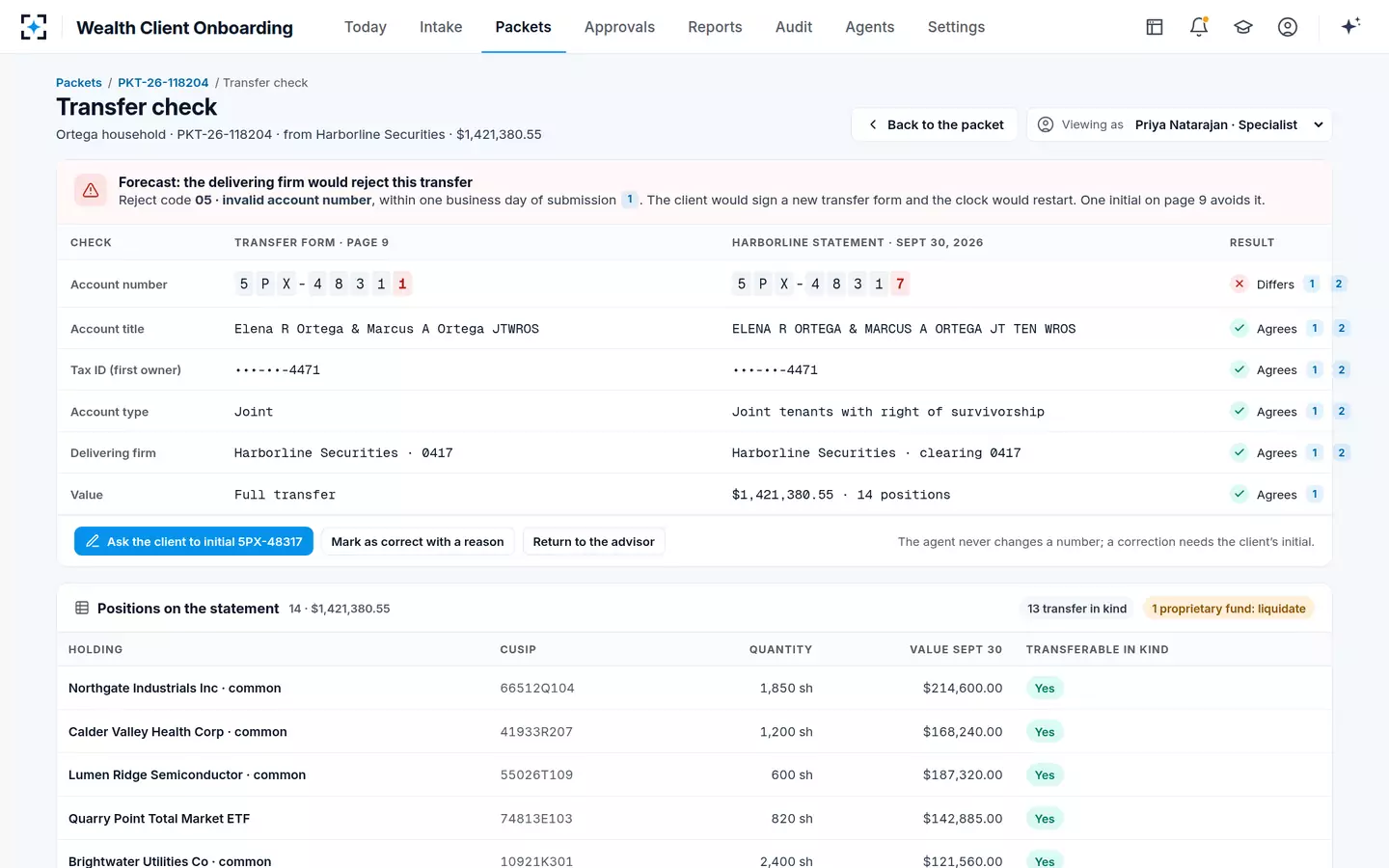
In the sample, the prior firm's statement listed 14 positions: 13 to transfer in kind and one proprietary fund to liquidate. Because the fund was identified from the statement before entry, the disposition question could go to the client with the rest of the fix request instead of waiting for a validation report.
Wealth Client Onboarding forecasts the exception before the transfer is entered
Fails and buy-ins after validation
Validation does not guarantee delivery, and the rule makes the receiving firm chase what does not arrive. At the end of the three days, both firms "must immediately establish fail-to-receive and fail-to-deliver contracts at then-current market values" for undelivered positions, and the customer's assets "shall thereupon be deemed transferred". The receiving firm then has 10 business days after delivery was due to take steps to obtain the securities "by initiating a buy-in procedure or otherwise", or 30 business days for a listed set of instruments including municipal bonds, foreign securities, limited partnership interests and transferable mutual fund shares.
The carrying firm "may not reject ('DK') a fail contract" for assets in an account that has transferred. For the receiving firm's operations team, the control is an aged-fails report keyed to the 10- and 30-day clocks, with the client's advisor told when positions are still missing.
Why repeated rejections are also a fraud signal
A receiving firm that sees the same customer's transfer rejected again and again has an operational problem or a fraud problem, and FINRA has said so. Its Regulatory Notice 23-06 describes bad actors who open accounts online with stolen identities and use ACATS to pull a legitimate customer's assets from another firm, and lists among the indicators "Repeated Rejections of TIFs (Transfer Requests) – Due to incomplete or inaccurate information, such as errors in account type or other basic account information" and requests to move assets out "soon after the assets have been moved into a new brokerage account" (FINRA Regulatory Notice 23-06; see also Regulatory Notice 22-21).
The practices the notice reports include principal review of automated approval of multiple accounts opened by one customer in a short period, and verifying identity with technology and follow-up questions. A transfer check that compares the form with the prior firm's statement also produces evidence for this purpose: a form whose tax ID or title does not match a genuine statement is either a typing error or a person who does not hold the account.
Where a receiving firm's transfer days actually go
The solution's estimate for one household shows where the receiving firm can act. The largest share by hand is the fix loop: reaching the client, explaining what is wrong and getting a new signature, often on a whole new packet.
One household's business days before the rule's clock starts, by hand
By hand
- Fix loop with the client · 50%
- Checklist review and re-keying · 17%
- Waiting for the principal · 17%
- Transfer form against statement · 8%
- Form CRS, profile, identity · 8%
In the sample, the fix request asked the couple for two things only, pre-filled: initial the corrected account number and name a trusted contact. It was sent at 10:58; the owners signed at 11:31 and 11:38; the re-check passed and the packet reached the registered principal at 11:44. Because the transfer exceeded $1,000,000, the principal confirmed the transfer check had been reviewed before approving. What a not-in-good-order packet costs a firm in total is worked through in the cost of NIGO.
Controls a supervising principal can test on transfers
Rule 11870's written-procedures requirement is where these controls belong, and each can be tested on closed transfers.
Nine controls on incoming ACATS transfers
- Is the transfer form matched to a recent statement before entry?
Account number, title, tax ID and account type; the sample firm requires a statement no older than 90 days.
- Are all signatures, initials and custodial acceptances present?
Missing authorisation is a ground for exception.
- Is the instruction entered immediately once in good order?
The rule's word; measure the gap between approval and entry.
- Are nontransferable assets identified at signing?
With the client's disposition instruction in writing.
- Is every exception logged with its ground and its cause?
So the top causes can be fixed at the branch that produces them.
- Are repeated rejections for one customer escalated?
FINRA lists them as an ACATS fraud indicator.
- Are fails aged against the 10- and 30-day clocks?
With the buy-in or other step recorded.
- Does a principal review large transfers?
The sample firm's rule: at or above $1,000,000.
- Are the six timestamps kept?
Signature, good order, entry, validation or exception, completion, positions posted.
What Wealth Client Onboarding checks, and what it does not
The Transfer Matcher reconciles the transfer form with the prior firm's statement digit by digit and forecasts the exception the carrying firm would take. The Second Reader re-reads every red finding and every transfer of $250,000 or more on a different provider's model without seeing the first reading. The Fix Request Drafter prepares one e-sign request with only the fields to fix.
The limits are deliberate. The agents never submit a transfer, never change a number on a client's form, and never approve an account; specialists prepare, principals approve, and the person who prepared a packet cannot approve it. The solution cannot prevent the exceptions the receiving firm does not control, such as a client who rescinds or a carrying firm's credit policy, and it does not replace the firm's identity verification, which goes to the AML analyst when a match needs clearing.
Questions people ask
What are the ACATS transfer rules?
FINRA Rule 11870, aligned with NSCC Rule 50, requires the receiving firm to submit an authorised transfer instruction immediately, the carrying firm to validate or take exception within one business day, and the transfer to complete within three business days of validation.
On what grounds can the carrying firm reject an ACATS transfer?
Only those listed in Rule 11870(d)(3): among them an invalid account number, a tax ID, title or account type mismatch, missing authorisation, a duplicate, a flat account or the customer's rescission. It may not reject because of a dispute over positions or the money balance.
Who notifies the client about nontransferable assets?
The firm whose limitation makes the asset nontransferable: the carrying firm for its own proprietary products, the receiving firm for third-party funds it cannot hold. Each must list the assets and ask for written disposition instructions.
What happens to positions that are not delivered on time?
Both firms set up fail contracts at current market value and the assets are deemed transferred. The receiving firm must take steps to obtain the securities within 10 business days after delivery was due, or 30 for instruments such as municipal bonds and foreign securities.
Can repeated ACATS rejections indicate fraud?
Yes. FINRA Regulatory Notice 23-06 lists repeated rejections of transfer requests for the same customer, caused by errors in basic account information, among the indicators of ACATS fraud using accounts opened with stolen identities.
How long does a transfer outside ACATS take?
Longer, because the firms exchange forms directly: the SEC's investor bulletin says it is not uncommon for a non-ACATS transfer to take up to thirty days.