Agentic AI in client onboarding means software agents that do the reading and checking of a new-account packet on their own: they classify every page, extract every field, compare the transfer form with the prior firm's statement, test each field against the firm's good-order rules and draft a request for whatever is missing. It works well on exactly the part of onboarding people find hardest to do accurately at volume, comparing documents character by character. It fails in a predictable way when the same agent is trusted to check its own reading, because research on language models finds they correct themselves poorly without outside feedback. Wealth Client Onboarding, Botminds' agentic solution for opening wealth accounts, is built on that distinction: one set of agents reads, a second reader on a different provider's model re-reads every stop without seeing the first reading, and people decide every disagreement, every judgement call and every account opening.
The figures from the solution are from its fictional sample firm, Quillfield Private Wealth, in one sample week; they show how the design behaves, not a customer's results. The regulators quoted are FINRA and the SEC; the research is cited where it appears.
How Wealth Client Onboarding separates reading, checking and deciding
Agent
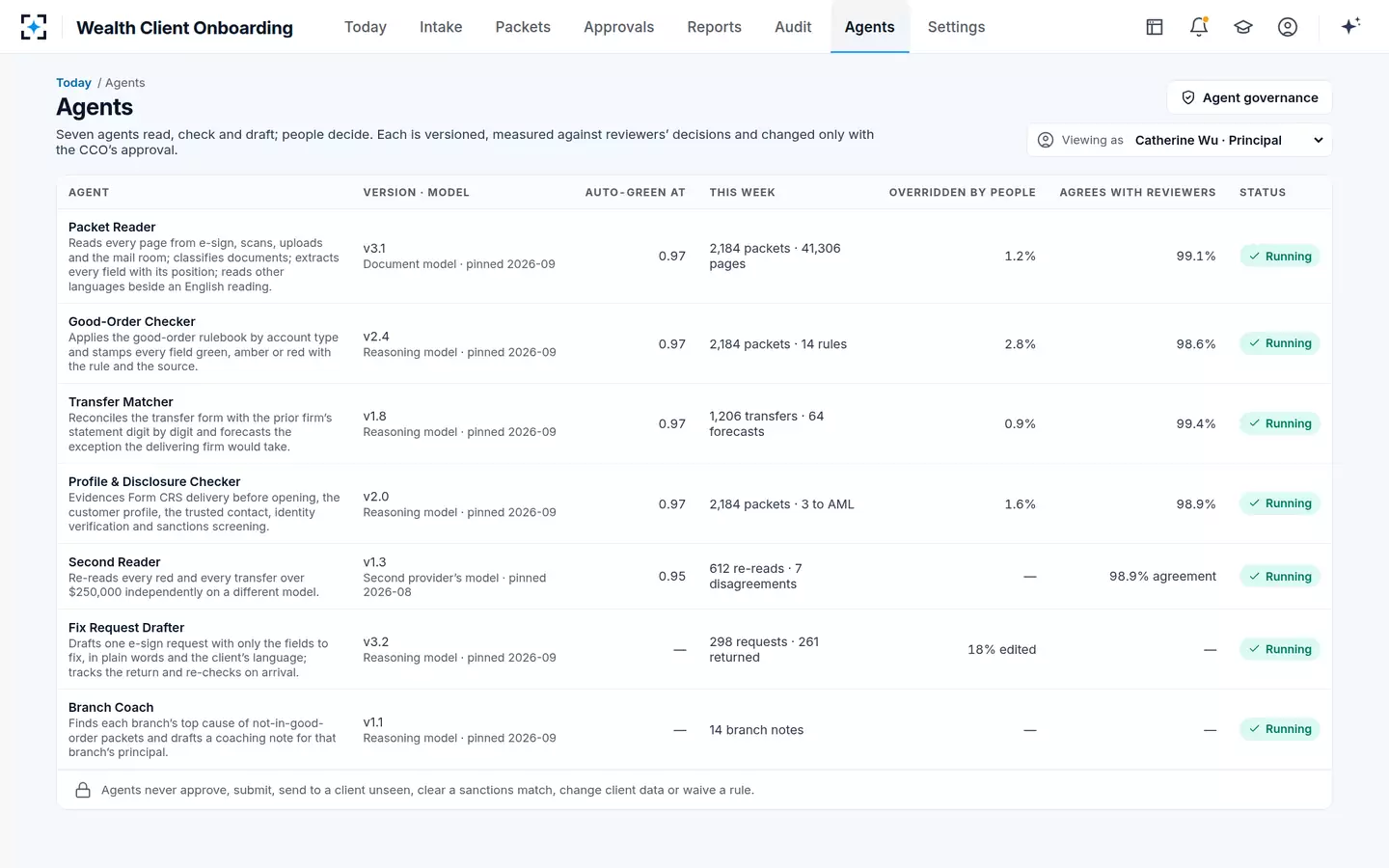
Packet ReaderReads every page from e-signature envelopes, scans, uploads and the mail room; classifies each document and extracts every field with its position.
Never: fills a value it cannot read, or guesses on a page scanned below 200 dpi
Agent
Good-Order Checker and Transfer MatcherApply the firm’s rules by account type and match the transfer form with the prior statement digit by digit; every field stamped green, amber or red with its rule and source.
Never: waives a rule or changes a number
Agent
Second ReaderRe-reads every red, and every transfer above a size the firm sets, on a different provider’s model, without seeing the first reading.
Never: approves, or sees the first reading before forming its own
A person decides
The specialist decidesTakes every amber and every disagreement between the two readings, with both in view; edits and sends the one fix request the drafter prepared.
A person decides
A registered principal accepts the accountApproves with the evidence in view, with a reason code and an e-signature; never the person who prepared the packet.
What is agentic AI in client onboarding?
It is AI that completes onboarding tasks rather than answering questions about them. FINRA's definition is the useful one: "AI agents are systems or programs that can perform and complete tasks autonomously, without human intervention" (FINRA, "Emerging Trend in GenAI: Observations on AI Agents," January 27, 2026). In account opening, the tasks are concrete: read a 21-page packet, find the seven documents in it, extract 44 fields, compare them with the CRM, the identity-verification result, the e-delivery log and the old firm's statement, and say which are wrong.
The word that matters in FINRA's definition is "autonomously," and it is the word a wealth firm should limit. The first two risks FINRA lists for agents follow from it: agents that act on their own with no person validating or approving the step, and agents that go further than the user meant or was entitled to authorise. An onboarding design that is safe to put in front of examiners gives agents autonomy over reading and checking, and none over the decisions the rules give to people: what to send a client, what to submit and whether to accept the account.
Complicated, multi-step agent reasoning tasks can make outcomes difficult to trace or explain, complicating auditability.
FINRA, Observations on AI Agents, January 27, 2026
Can AI check new account paperwork?
Yes, for the parts that are comparisons, and those are most of the errors. The stops in a new-account packet are rarely blank fields, which an electronic form already prevents; they are values present and wrong. In the solution's sample week, the agents read 2,184 packets and stopped 323 before submission, and the largest causes were signatures missing or mismatched (71), transfer forms that disagreed with the prior statement (64), trusted contact pages missing for owners 65 and over (52) and incomplete profiles (47). Each of those is a comparison of one document with a rule or with another document.
The limits are just as concrete. FINRA warns that a general-purpose agent may not know enough about the domain to handle complex, industry-specific tasks, and that the GenAI risks of "bias, hallucinations, privacy" remain present for agents and their outputs. In onboarding the domain knowledge is written down: FINRA Rule 11870's twelve exceptions, the fields in Rule 4512 and SEC Rule 17a-3(a)(17), and the firm's own good-order rules by account type. An agent that is given those rules as settings, and cites the rule behind every stamp, has the domain knowledge in a form a person can check. One that is asked to "review the packet" does not.
Why should an AI reader never check its own work?
Because a model asked to review its own output tends to keep its mistakes, and sometimes adds new ones. A study presented at ICLR 2024 examined "intrinsic self-correction," where a model tries to fix its answers with no outside feedback, and found that models mostly failed to improve their answers that way, and sometimes did worse after trying (Huang and others, "Large Language Models Cannot Self-Correct Reasoning Yet," ICLR 2024). A separate 2024 paper, a preprint, reports a related bias in models used as reviewers: a model asked to grade answers tends to score its own higher than other models' answers that human raters judged just as good (Panickssery and others, arXiv preprint 2404.13076).
For a new-account packet the consequence is specific. If an agent misreads a handwritten 7 as a 1 on the transfer form, a second pass by the same agent over the same image is likely to see the same 1, and an evaluator from the same model family is inclined to agree with it. The check that catches the misread has to be independent of the first reading in the ways that matter: a different model, ideally from a different provider, that reads the source without being shown the first answer.
One reader that checks itself, or two readers and a person
One reader checks itself: Re-read by the same model on the same image; the same misread is likely to survive.
Two independent readers, a person decides: Read again by a different provider’s model that has not seen the first reading; a disagreement surfaces.
One reader checks itself: The agent picks an answer and the confidence looks high.
Two independent readers, a person decides: Below the firm’s line it is an amber, and a person decides with a reason code.
One reader checks itself: Found by the old firm’s exception, a day after submission.
Two independent readers, a person decides: Found before submission when the readers disagree, or by the person reading both.
One reader checks itself: One output and a confidence score.
Two independent readers, a person decides: Both readings, the disagreement, the person’s decision and the reason, each with a time.
What happens when two AI readers disagree?
A person decides, with both readings side by side. In the solution, a disagreement never resolves itself by a vote or by the higher confidence score; it lands in the specialist's queue as a decision. The governance example is a handwritten TOD percentage the two readers read two ways, and in the sample week's queue one household sits exactly there: "agents disagree," a handwritten TOD percentage read two ways.
The second reader in Wealth Client Onboarding's sample week
612
re-reads of red fields and large transfers by the Second Reader
7
disagreements, each sent to a person with both readings
98.9%
agreement between the two readers
0.95
the Second Reader’s auto-accept confidence in the sample settings
The seven disagreements are the point of the design, not a failure of it. Each is a field where at least one reader was wrong, and without a second reader that error would have reached either the principal or the old firm. The 98.9% agreement is equally informative in the other direction: where two independent readers agree on a red, the specialist can act on it quickly, and that is what lets a fix request go out within minutes. On the sample Ortega packet the Second Reader agreed with both stops, "Digit 8 is '1' on the form and '7' on the statement; the trusted contact page is blank," and the request reached the clients the same morning.
Each agent in Wealth Client Onboarding with its version, its week and how often people overrule it
Who approves an account opened with AI?
The same person who approves any account: a principal of the firm. FINRA Rule 4512(a)(1)(D) requires a partner, officer or manager to sign each account record to show the account was accepted under the firm's policies, and SEC Rule 17a-3(a)(17) requires the record to show a principal's approval or acceptance (the field-by-field map is in FINRA Rule 4512 customer account information). Nothing in either rule changes when agents prepared the packet, and nothing in a sound design lets an agent sign.
What changes is what the principal can see. In the solution the approval drawer lists the evidence each agent assembled, the specialist's decisions with their reasons, and for a transfer of $1,000,000 or more the sample firm requires the principal to confirm having reviewed the transfer check. Two separations hold throughout: the specialist who prepared a packet cannot approve it, and no agent can approve anything. That is the maker-checker rule firms already apply to people, extended to software.
Does FINRA allow AI in account opening?
Yes; FINRA's rules apply to it as they apply to any other method. In Regulatory Notice 24-09 FINRA said its rules and guidance are meant to be technologically neutral and that its rules and the securities laws continue to apply when member firms use generative AI (FINRA Regulatory Notice 24-09, June 27, 2024). Its 2026 oversight report goes further for agents, suggesting firms decide where a person must stay in the loop, how agents' actions and decisions will be tracked, and what guardrails will limit what an agent may do (FINRA, 2026 Annual Regulatory Oversight Report, GenAI).
The SEC's examiners are looking at the same thing from their side. The Division of Examinations' fiscal 2027 priorities, published October 23, 2026, call the technology "super intelligence (SI)" and put firms' procedures for monitoring it on the list, naming its use in fraud detection, back-office operations, AML and Reg BI compliance, and trading. Account opening is back-office work that touches all of those. The same document says examiners will assess whether firms are updating identity-theft programs "to address emerging risks, such as those related to SI and stolen credentials" (SEC Division of Examinations, Fiscal Year 2027 Examination Priorities).
What records does an AI onboarding check leave?
It should leave every reading, every decision and every version, because the rules on electronic records already require a trail. A broker-dealer's electronic recordkeeping system must preserve each record with an audit trail, time-stamped and complete, that includes all modifications and deletions, the date and time of each action and, "if applicable, the identity of the individual creating, modifying, or deleting the record," or else keep records in a non-rewriteable, non-erasable format (17 CFR 240.17a-4(f)(2)(i)). When agents create part of the record, the agent and its version are part of the "who."
Every action by people and agents in Wealth Client Onboarding's audit trail, with the evidence
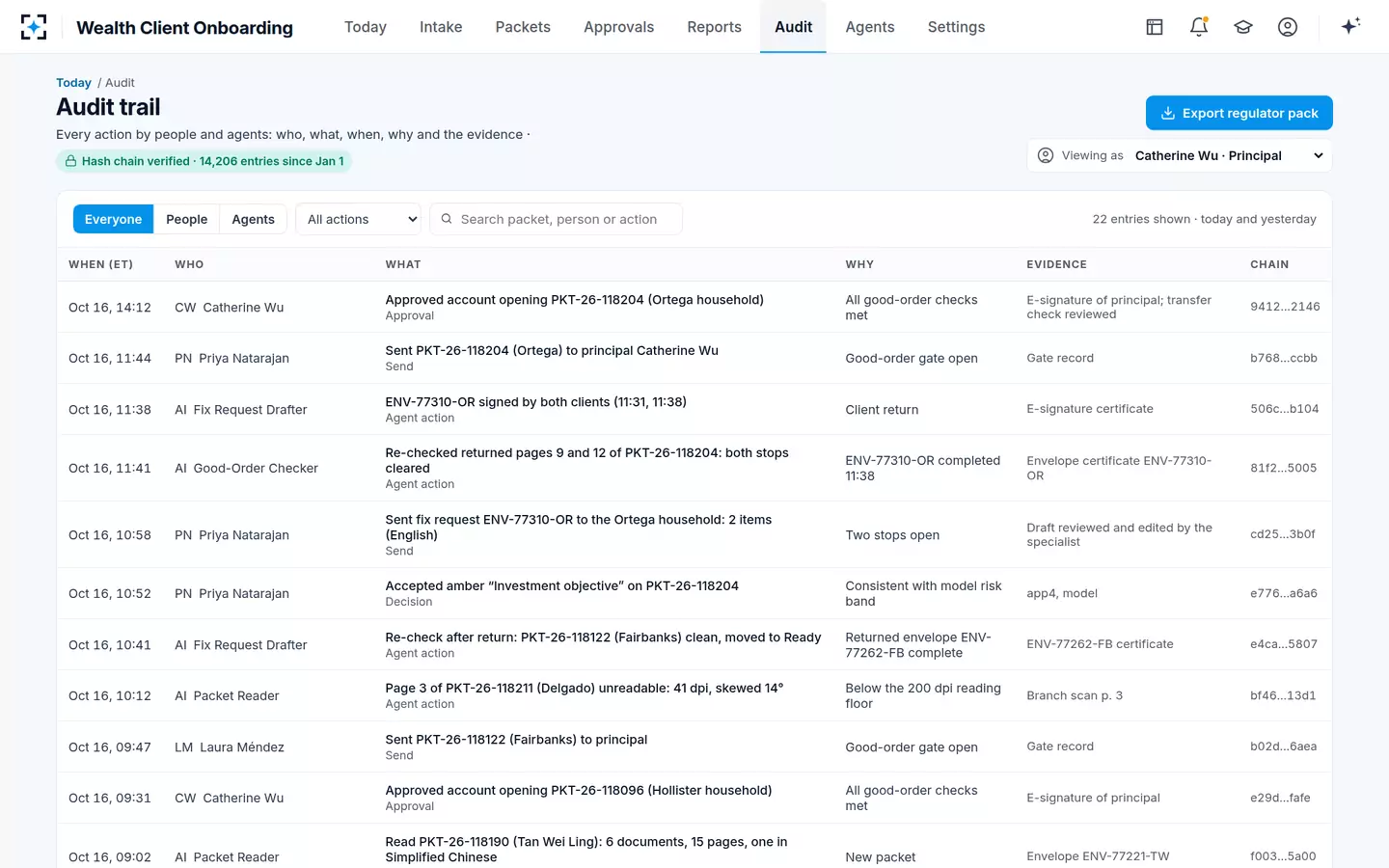
In the sample account file, the last of ten items is "Agent readings and versions": the version of each agent that read the packet, and every reading kept, including the Second Reader's. The solution pins each agent's instructions and model, measures them on a set of 1,200 past packets reviewed against people's decisions, and changes them only with the chief compliance officer's approval, so a reading from October can be traced to the agent that made it even after the agents change.
What to ask before buying agentic onboarding
The questions that separate a safe design from a fast one are about independence, limits and evidence. A useful cautionary case is not about AI at all. In September 2024 the SEC settled with First Horizon Advisors, finding that after a 2021 merger it migrated more than 5,000 brokerage accounts whose customer information was not accurate enough, because the two systems were incompatible, to review structured-note recommendations against its policies; the firm paid a $325,000 penalty (SEC press release 2024-136). Any onboarding system, agentic or not, is only as good as the data it reads and the controls that are actually enforced.
Eight questions for anyone selling agentic AI for client onboarding
- Is the checker independent of the reader?
A different model, ideally from a different provider, reading the source without seeing the first reading.
- What can the agents never do?
Approve, submit, send to a client unseen, clear a sanctions match, change client data, waive a rule. Ask to see it enforced, not described.
- Does every stamp cite its rule and source?
The page and passage it was read from, the rule it tests, the agent and its confidence.
- Where is the line for a person?
A confidence below which a person decides, set by the firm, with reason codes the firm controls.
- What happens to a disagreement?
It goes to a person with both readings, never resolved by a vote or the higher score.
- Are versions pinned and measured?
Each agent’s instructions and model versioned, tested on your own past packets, changed only with approval.
- Can you export the trail?
Who, what, when, why and the evidence, for people and agents, in a form examiners accept.
- How are override rates reported?
How often people overrule each agent, by rule and by branch, so drift shows up in a week, not an exam.
The fairest test of all eight is on your own files: take last month's packets, plant known errors and see what each system catches and what it lets through. The planted-error test sets out the twelve errors and how to score them, and onboarding software beside the custodian covers what the agents connect to.
Questions people ask
How can AI help with onboarding?
By doing the reading and comparing: classifying every page, extracting every field, matching the transfer form with the prior statement, checking each field against the firm's rules and drafting one request for what is missing. In the solution's sample week, agents read 2,184 packets and stopped 323 before submission. People still decide ambers, send requests and approve accounts.
What is the difference between agentic AI and onboarding automation?
Rule-based automation follows fixed steps on structured data; agentic AI can read unstructured pages, scans and handwriting, and carry a task through several steps. That flexibility is why FINRA lists autonomy, scope and auditability among agent risks, and why limits and a second reader matter more for agents than for scripts.
Can an AI agent approve a new account?
It should not. FINRA Rule 4512 requires the signature of a partner, officer or manager accepting the account, and SEC Rule 17a-3(a)(17) requires approval or acceptance by a principal. In Wealth Client Onboarding agents never approve, and the specialist who prepared a packet cannot approve it either.
Is it enough to have the same AI model check its answer twice?
Research says not. A study at ICLR 2024 found language models struggle to self-correct without external feedback, sometimes getting worse, and a 2024 preprint reports that models used as evaluators favour their own outputs. An independent second reader on a different model, plus a person for disagreements, is the safer design.
What does the SEC say about AI in back-office operations?
Its fiscal 2027 examination priorities, which call the technology "super intelligence (SI)," say examiners will prioritize firms' policies and procedures for monitoring SI, including its use in back-office operations, fraud prevention and AML and Reg BI compliance. They will also check that identity-theft programs address risks related to SI and stolen credentials.