Alternative investment platforms give wealth firms and RIAs a shelf of private and semi-liquid funds, electronic subscription documents, order routing to the fund's administrator and reporting after the investment. They make subscriptions travel. Whether a subscription arrives in good order is a different question: the investor's eligibility, the firm's suitability and concentration limits, the signers' authority and the cash are decided by the firm, from documents the platform usually does not read. When a package fails one of those checks at the documents cutoff, it waits for the fund's next close, and that wait has a cost that can be priced. This guide prices it, so a buyer can decide what the platform must do and what needs another layer. Botminds' Alternative Investment Subscription Processing is that other layer: it checks each subscription completely before it travels, and people decide every exception.
One subscription, three paths to the documents cutoff
- Checked, approved and batched1 d
- Log and match½ d
- Checks and principal review3 d
- Round of fixes with the advisor3 d
- Maker, checker, send½ d
- Log and match½ d
- Checks and principal review3 d
- First round of fixes3 d
- Second round3 d
- Maker, checker, send½ d
What does an alternative investment platform do?
An alternative investment platform does distribution: it lists funds the firm has approved, holds their offering documents and diligence materials, presents subscription documents electronically, routes orders, delivers completed packages to fund administrators, and reports positions afterwards. For an RIA or a broker-dealer that offers dozens of funds, that is a large amount of paper and connectivity taken off the desk, and it is the part of the work platforms are built around.
Platforms differ in how much checking they add, and buyers should ask rather than assume. An electronic form can stop a blank field from being submitted and insist on a signature. What a form cannot do is decide whether the answer in a field is true, whether the person who signed had authority to, or whether the firm's own limits allow the subscription. Those depend on statements, trust deeds and the client's profile, which sit outside the platform.
Does an alternative investment platform check eligibility?
It collects the investor's representations; whether it proves eligibility depends on what evidence it reads, and buyers should ask. The distinction matters in law. A fund relying on section 3(c)(7) may admit only investors who are qualified purchasers at the moment they buy (15 U.S.C. 80a-3(c)(7)), and the qualified-purchaser rule's protection reaches persons a fund "reasonably believes" qualify (17 CFR 270.2a51-1(h)). A ticked box shows what the investor said; it does not show why anyone believed it.
Proving eligibility means recomputing it: statements counted line by line, the home excluded, acquisition debt deducted, the evidence dated close to the subscription. A platform that does this for every investor is doing more than distribution. One that does not leaves the work to the desk, where it often happens late, and late is when it causes missed closes. How reviewers disagree about the arithmetic itself is set out in qualified purchaser requirements: when two reviewers disagree.
What happens if a subscription misses the close?
It waits. A private fund with periodic closes takes the subscription at its next close, if it has one and if the investor still wants in. A continuously offered fund, such as an interval fund or a perpetual non-traded BDC, takes it on its next subscription date. In both cases the client's cash sits where it was, the advisor goes back to the client, and the desk re-runs checks it has already run.
Some misses cost more than time. A feeder relying on section 3(c)(1) may have no more than one hundred beneficial owners, so seats in it are finite; a subscription that slips may find the place taken. A fund that closes to new money after its final close does not have a next close. And a subscription held because of an eligibility problem found late may need a different vehicle, a re-signed booklet and a fresh principal decision, all inside a shorter window.
How much does a late subscription cost?
It costs the sum of four terms, each owned by a different party, and each can be priced with numbers the firm already has. No regulator or independent study publishes the cost of a missed close, so the method below is the useful part. Two of the terms are about time and two are about place.
The cost of one subscription missing its close
Time out of the fund
Amount × (fund’s expected return − cash yield) × days waiting ÷ 365
The client’s cost, positive or negative: a delay can help if the fund falls. Use the fund’s stated target, not a hope.
Borne by the client
Rework
Extra fix rounds × (operations hours + advisor hours + principal hours) × hourly cost
Each round re-runs checks and re-contacts the client. Price hours at your own loaded rates.
Borne by the firm
Lost place
Probability the seat or allocation is gone × the amount
Finite 3(c)(1) seats, capped allocations, funds that close for good after a final close.
Borne by client and advisor
Late discovery
Problems found after the cutoff × (re-papering + principal review)
An eligibility gap found late may need a new vehicle, a re-signed booklet and a new decision.
Borne by the desk
A worked example shows the scale; every input here is an assumption to replace with your own. Take a $250,000 subscription that slips one month to the next subscription date of a monthly fund, and assume the fund's target return exceeds the client's cash yield by six percentage points: the first term is about $1,233. Assume two extra fix rounds, each taking an hour and a half of operations time and an hour of the advisor's. At the median annual wage for personal financial advisors of $105,070 in May 2025 (Bureau of Labor Statistics), about $50 an hour before benefits, the advisor's hours alone come to about $50 a round, $100 for the two, before the desk's.
Per subscription, those numbers are modest. Across a close they are not, and the third and fourth terms can dwarf them: a lost seat costs the whole allocation, and a late eligibility finding can cost the subscription. That is why the price of delay should be computed per close, from the firm's own files, and set against what each platform or tool would remove.
A platform that delivers an incomplete package faster has not shortened the close. It has moved the fix round from before the cutoff to after it.
Where the days go before a close
Most days go to waiting for the advisor and the client, and waiting multiplies when problems are found one at a time. In Botminds' estimate for a subscription handled by hand, three of seven business days are one round of fixes. Two rounds, the typical result when the second problem is found only after the first is fixed, push a package arriving seven business days before the cutoff past it.
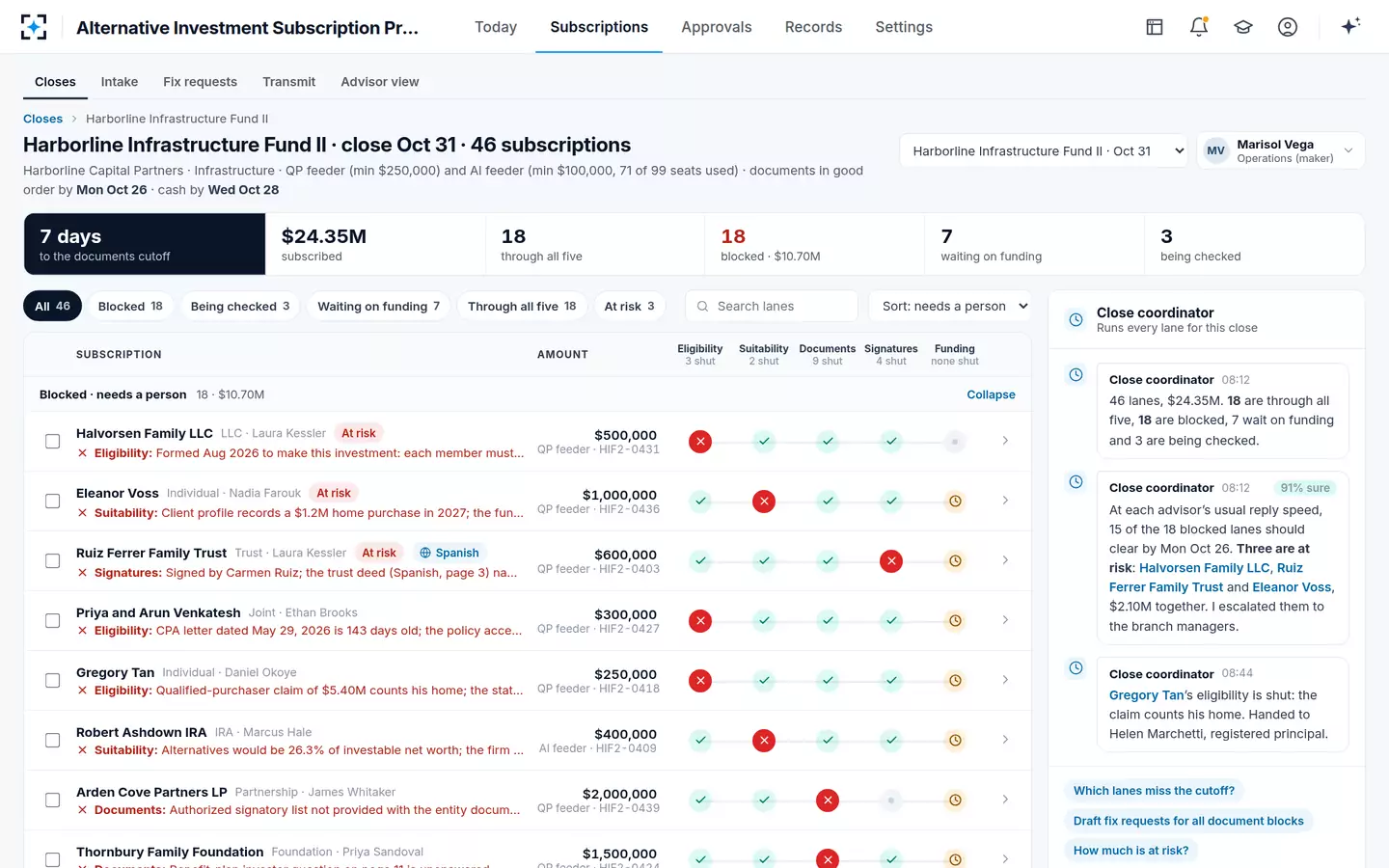
The sample close that runs through Alternative Investment Subscription Processing shows the alternative. With seven days to the cutoff, 18 of a fictional fund's 46 subscriptions were blocked, worth $10.70 million. The Close coordinator, forecasting from each advisor's usual reply speed, expected 15 to clear and named the three that would not, $2.10 million together, and escalated them to branch managers that morning. A forecast does not fix a package; it buys the week in which someone can.
A week before the cutoff: which subscriptions will make it
Price the missed close on your own closes
The inputs are already in the firm's files, and two or three recent closes are enough. For each close, count the subscriptions received, the subscriptions that missed the documents cutoff, their amounts, and the days each waited for the next close or subscription date. For each package that went back to the advisor, count the rounds and the reason for each. Then apply the four terms with your own rates and assumptions, and write those assumptions down.
Two measures do most of the work in a buying decision. The first is the share of subscriptions in good order at the administrator on the first pass, which the solution targets at 95%; a target, to be measured on your closes. The second is the number of fix rounds per subscription that needed fixing. A platform or tool that does not move these two numbers will not change the cost of a missed close, however much faster it moves paper. A one-close pilot that measures both, before anything goes live, is described in private markets for wealth: pilot the subscription desk on one close.
Best alternative investment platforms for RIAs: what to ask
There is no regulator's ranking of alternative investment platforms, and any list depends on which funds a firm needs. What a firm can rank is fit: which of the five checks the platform performs, which it leaves to the desk, and how its audit trail serves the firm's supervision. Regulators are looking at exactly this ground. The SEC's examiners say they will prioritise advisers that recommend illiquid, hard-to-trade or unusual products, naming alternative investment products among them (SEC Division of Examinations, FY2027 priorities). The questions below separate distribution from checking.
Questions for any alternative investment platform
- Which of the five checks does it perform?
Eligibility, suitability and concentration, documents, signatures and authority, funding: performed, assisted or left to you.
- Does it prove eligibility or only collect it?
Recomputed from statements with the home excluded and debt deducted, or the investor’s ticked box.
- Does it read entity and trust documents?
Signers matched to deeds and signatory lists; entities formed to invest looked through.
- What happens when a package fails?
One complete request to the advisor, or a return that surfaces problems one at a time.
- What does the administrator receive?
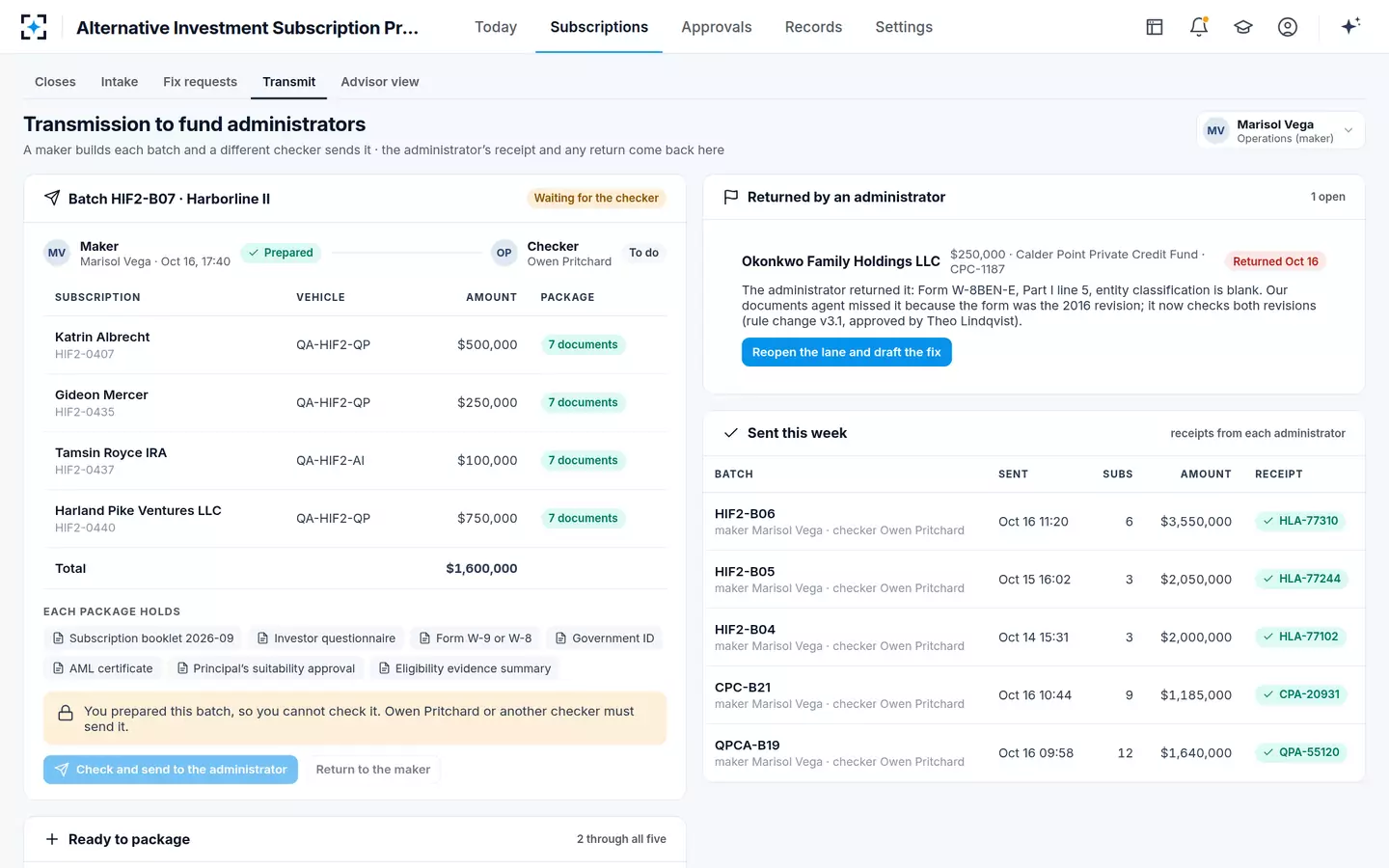
A package checked by a maker and a different checker, with receipts and returns back in the same place.
- What does supervision see?
Each suitability decision with its basis and signer; concentration after the subscription, on verified figures.
- What does it cost per close?
Set its price against the four terms above, priced on two of your own closes.
Where Alternative Investment Subscription Processing fits beside a platform
It sits between the platform and the administrator, and reads from the systems on both sides. Packages come from the alternatives platform, the advisor portal, the desk's mailbox and scanned paper; client profiles from the CRM; balances, reserves and wires from the custodian. Eight agents run the five checks on every package, draft one fix request per subscription, forecast the close and assemble batches. Operations approves every request, a registered principal signs suitability, and a maker and a different checker send each batch to the administrator's portal, where receipts and returns come back.
It does not replace the platform's shelf, orders or e-subscriptions, and it is not the fund's administrator. It does not move money or decide suitability, and nothing opens the eligibility check except evidence. The SEC's count of interval funds, 139 in 2025 against 58 in 2020 (SEC, October 2026), is one measure of how many more booklets, rules and closes a desk now carries; the platform carries the paper, and the checking has to scale with it. The agents and their limits are listed on the Alternative Investment Subscription Processing page.
Batches to administrators, with receipts and returns in one place
Questions people ask
What are alternative investment platforms for RIAs?
They are services that let registered investment advisers offer private funds and semi-liquid funds to clients: a shelf of approved funds, electronic subscription documents, order routing to fund administrators and position reporting. They handle distribution; how much they check each subscription varies, so ask which of eligibility, suitability, documents, signatures and funding they verify.
Do alternative investment platforms replace the operations team?
No. They remove paper handling and connectivity, but the decisions stay with the firm: eligibility on evidence, suitability by a registered principal, approval of what goes to advisors, and a second person before anything reaches the administrator.
How long before a close should subscription documents be in?
The fund sets a documents cutoff and a funding date before each close; in the sample close here they were five and three days before it. Work back from the cutoff by your own measured fix-cycle time: if one round takes three business days, a package that needs two rounds must arrive at least a week before the cutoff.
Is there a NIGO rate for alternative investments?
No regulator or independent study publishes one. Measure your own: subscriptions returned or held at the cutoff divided by subscriptions received, by reason and by advisor, across two or three closes. That number, and the fix rounds per subscription, are the two to bring to any platform conversation.
Can a subscription that misses the close go into the next one?
Usually, if the fund has another close or subscription date and the investor still wants to invest; but a final close, a full feeder or a capped allocation can end that option. The investor's evidence may also need refreshing if the delay pushes it past the firm's age limit.