Private credit in wealth management means offering clients loans to companies, made outside banks, through funds an individual can buy: interval funds and tender offer funds registered with the SEC, non-traded BDCs sold in continuous offerings, listed BDCs, and, for wealthier clients, private BDCs and private credit funds. The Federal Reserve reports that firms in private credit "have been raising more capital from individual investors" through semi-liquid vehicles, which now hold about a fifth of private credit vehicles' net assets (Financial Stability Report, May 2026). The SEC counts 139 interval funds in 2025, against 58 in 2020, with credit strategies about 55% of their net assets (SEC, October 2026). For a wealth firm, every one of those purchases is a subscription to check for eligibility, suitability, liquidity, documents and cash. Botminds' Alternative Investment Subscription Processing exists because that volume is growing faster than the desks that check it.
Private credit has grown more than sevenfold since 2012; retail vehicles are a fast-growing slice
Can retail investors invest in private credit?
Yes, through registered and exchange-listed vehicles, and accredited investors have more routes still. The SEC's 2024 bulletin on BDCs sets out who can buy each kind. A publicly traded BDC: "Anyone." A retail-offered, non-traded BDC: "Only investors who meet state-level suitability requirements, which generally means income and/or net worth minimums." A privately offered BDC: "Generally sold to accredited investors" (SEC Office of Investor Education and Assistance, December 2024). Interval funds and tender offer funds that invest in private credit are registered closed-end funds; private credit funds that are not registered are sold privately, to accredited investors or qualified purchasers.
What do private credit funds for individual investors actually own?
Mostly loans to private companies, held directly or bought in pieces. The SEC's bulletin says what BDCs invest in: they are "a way for retail investors to invest money in small and medium-sized private companies", and "Some BDCs are focused on investing in private credit loans, which generally means they lend money directly to businesses or purchase syndicated loans". The Federal Reserve defines private credit as "loans originated by nonbanks that are negotiated on a bilateral basis between borrowers and lenders", an important source of financing for companies below investment grade.
Private credit funds for retail investors: four doors, four sets of terms
| Vehicle | Who can buy | How the investor gets out | What the wealth firm checks |
|---|---|---|---|
| Listed BDC | Anyone | Sells on an exchange at the market price | Suitability, like any listed security |
| Interval fund | Investors the prospectus admits | Periodic repurchase offers of 5% to 25% of shares under a fundamental policy | Liquidity terms against the client’s needs; concentration |
| Tender offer fund or non-traded BDC | Investors meeting the prospectus’s standards, which for non-traded BDCs include state-level minimums | Repurchases when the board or manager offers them; caps and proration | Prospectus suitability standards with figures; liquidity; concentration |
| Private BDC or private credit fund | Accredited investors; qualified purchasers for 3(c)(7) funds | Limited or none until a liquidity event, which may be years away | Eligibility proven from evidence; suitability; signers’ authority |
Private credit funds for retail investors: what the growth looks like
The growth shows in every measure regulators publish. A Federal Reserve note of October 2026 reports that assets under management in private credit vehicles "have grown from approximately $350 billion in 2012 to over $2.6 trillion as of 2025:Q4, with outstanding private credit loans to U.S. businesses totaling approximately $1.5 trillion" (FEDS Notes, October 16, 2026). The same note found that household net worth had been understated in the national accounts partly because of "the omission of directly held equity shares in private debt funds, closely held BDCs, interval funds, and tender offer funds", a sign that households now own enough of these vehicles to matter in the national accounts.
On the retail side, the Federal Reserve's May 2026 report puts perpetual-life BDCs at $306 billion in gross assets and $161 billion in net assets, and credit-focused interval funds at $119 billion and $80 billion; together, "about 20 percent of net assets under management in private credit vehicles" (Federal Reserve, May 2026). The SEC's figures for all interval funds, 58 funds with $38 billion of net assets in 2020 and 139 with $101 billion in 2025, show the same direction from another angle.
The retail side of private credit in four numbers
139
interval funds in 2025, against 58 in 2020
SEC, Form N-CEN data
55%
of interval fund net assets in credit strategies
SEC, approximately
$306B
gross assets in perpetual-life BDCs
Federal Reserve, May 2026
24.3M
US households meeting the accredited-investor tests in 2022
SEC, from the Survey of Consumer Finances
Who invests in private credit?
Historically institutions; increasingly individuals. The Federal Reserve's account: "Private credit lending has historically relied on raising money from institutional investors via private debt funds that are locked up from 7 to 10 years and do not offer investors an option to redeem their capital. However, in recent years, more private capital has been raised from individual investors" through perpetual-life BDCs and interval funds. The October 2026 note describes the BDC side: public non-traded BDCs offer shares "directly to investors meeting certain suitability criteria with periodic redemptions", while private BDCs offer securities "to either accredited or qualified investors through private placements".
The pool of individuals who may buy the private versions has widened too, because the accredited-investor tests are fixed in dollars. The SEC's data show 24.3 million households, 18.5% of US households, meeting the financial tests in 2022, against 17.0 million and 13.2% in 2019 (SEC, Qualifying households under accredited investor financial criteria). An SEC staff paper notes the share was "around 1.8% in 1983", and that the net worth and income tests have not been raised for inflation since they were set in the early 1980s (SEC Office of the Investor Advocate, June 2025).
The share of US households that meet the accredited-investor financial tests
Eligibility is not ownership. The same SEC staff paper, surveying individuals rather than households, finds that about 12.6% of people qualify as accredited investors, and that among them "4.3% who report owning private market securities, as compared to 1.1% of nonaccredited investors". The headroom is large, and the registered vehicles reach investors beyond the accredited pool altogether.
Is private credit liquid?
Only partly, and only on the vehicle's terms. A listed BDC trades daily; the others offer periodic exits with limits. Perpetual-life BDCs offer quarterly redemptions, and "Most of these BDCs disclosed an intention to cap total investor redemptions at 5 percent of their NAV per quarter"; the Federal Reserve adds that "perpetual BDCs have the ability to not accept any redemptions if they deem that would be in the best interest of the fund" (Federal Reserve, May 2026).
Those terms were tested in 2026. As the Fed tells it, when sentiment turned on rate changes, some defaults and wider worries about asset quality, semi-liquid private credit vehicles "faced notable increases in redemption requests, and in most cases their managers chose to cap redemptions", though requests "have remained manageable". Clients who expected to leave a capped fund in full in the first quarter of 2026 did not. How the caps, proration and interval-fund repurchase rules compare, with the SEC's figures for that quarter, is set out in interval fund vs evergreen fund.
Rising subscriptions are not only a sales trend. Each one is an eligibility test, a liquidity promise and a concentration line that somebody at the wealth firm has to check before the close.
What regulators are watching in retail private credit
Valuation, liquidity, conflicts and the sale itself. The SEC's examiners say they will "review the pricing and valuation of illiquid instruments, such as private credit and private equity" at broker-dealers, and will prioritise advisers recommending products "that are difficult to trade, have unusual features, or are illiquid", naming "loans provided by private funds or business development companies (BDCs)" (SEC Division of Examinations, FY2027 priorities, October 2026).
Three SEC items open in October 2026 could widen access further, and all three are proposals or requests for comment, not rules. The interval fund proposal (comments by December 4, 2026) would make the structure more flexible for less liquid assets. Two notices published the same day ask whether to designate a CFP certification, and passage of an accredited-investor exam to be developed by FINRA, as qualifying people for accredited-investor status; comments on each close December 4, 2026 (CFP notice; exam notice). A separate proposal would let advisers treat accredited investors as qualified clients for performance fees. If adopted, each would add eligible clients and new tests to the same subscription desk.
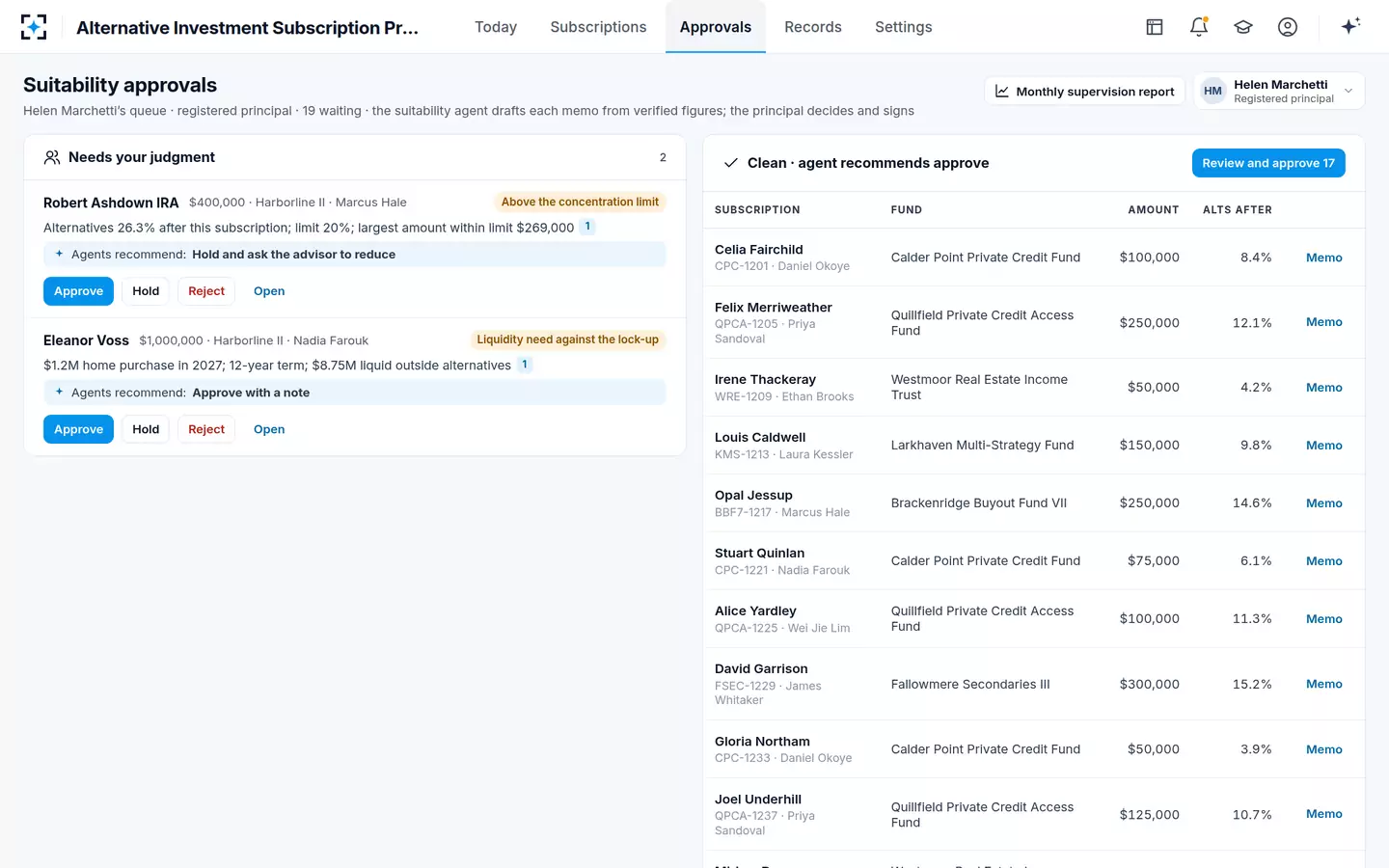
Private credit subscriptions in a principal's queue, each with its concentration after
What rising volume does to the subscription desk
More subscriptions mean more closes, more booklets and more eligibility tests on the same desk, and the work does not scale by adding software that moves paper. Each fund brings its own rules: a qualified-purchaser feeder, an accredited-investor feeder, prospectus suitability standards for a non-traded BDC, liquidity terms for an interval fund. Each subscription still needs its five checks, and the hardest of them, eligibility from evidence, signers against trust deeds, concentration after the new money, need reading, not routing.
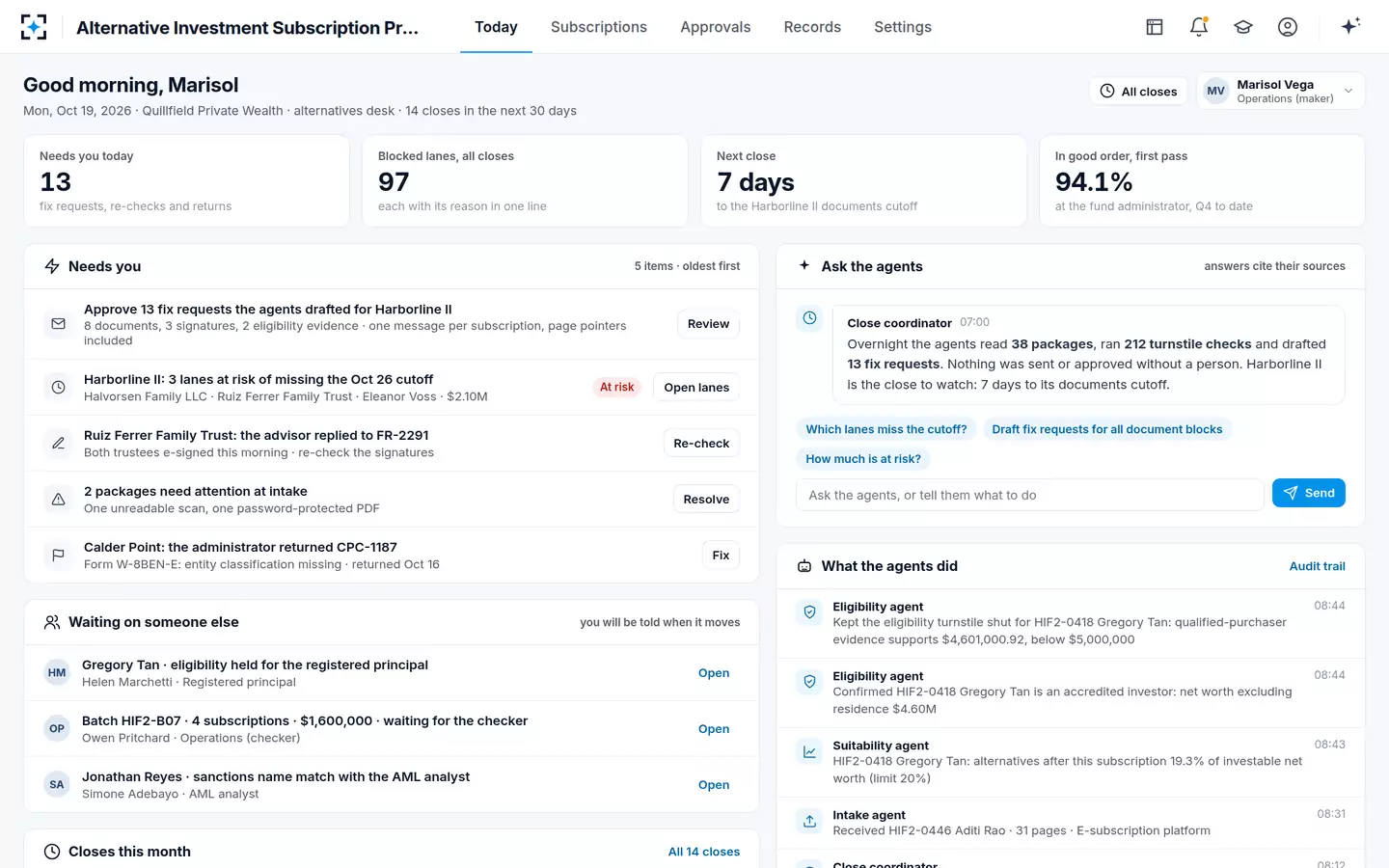
The sample close that runs through Alternative Investment Subscription Processing shows the load in one fund: 46 subscriptions, $24.35 million, documents due five days before the close. Across the fictional firm's month, the operations specialist's home screen shows 14 closes in the next 30 days and 97 blocked subscriptions across them, each with its reason in one line. How those subscriptions move seat by seat through the desk, and where the days go, is set out in alternative investment operations.
One specialist's morning across fourteen closes
What to have in place before the volume arrives
Rules, evidence standards and a division of labour, written down before the next close rather than during it. The checklist below is what a desk taking on more private credit should be able to show; each item is something a principal or an examiner will ask about once the volume is there. The solution builds each of them in: rules as versioned settings, eligibility recomputed from evidence with no override, a principal's signed suitability decision, one fix request per subscription and a maker and a different checker before anything reaches the fund. A way to test that on one of your own past closes is in private markets for wealth: pilot the subscription desk.
Before more private credit reaches the subscription desk
- A rule per vehicle type
Who may buy each fund on the shelf, from its prospectus or offering document, with the date read.
- Eligibility from evidence
Accredited-investor and qualified-purchaser tests recomputed from statements, with a written evidence-age limit.
- Liquidity terms written down
Repurchase interval or cap, first possible exit, early-exit charges: matched to each client’s dated needs.
- Concentration after the subscription
All alternatives counted, held-away included, on verified investable net worth.
- One request per subscription
Every problem found before the advisor is asked, in plain words, with the pages to sign.
- Two people before the fund
A maker builds each batch; a different checker sends it.
- A file an examiner can follow
Who decided what, when, why and on which evidence, for every subscription.
Questions people ask
Is a BDC the same thing as a private credit fund?
A BDC is one kind of private credit vehicle, and the largest in the Federal Reserve's accounts alongside private debt funds; the Fed's October 2026 note says private debt funds and BDCs each hold just under half of private credit loans outstanding. Interval funds, tender offer funds and middle-market CLOs make up the rest, and only some of these are open to individual investors.
What risks must a wealth firm weigh before offering private credit funds?
They carry credit risk, valuation uncertainty and limited liquidity, which is why regulators watch them. The Federal Reserve noted in May 2026 that semi-liquid private credit funds faced rising redemption requests and most capped them; whether a fund suits a client depends on the client's liquidity needs, concentration and understanding of the terms.
How many households are accredited investors?
About 24.3 million US households, 18.5% of the total, met the accredited-investor financial tests in 2022, according to SEC staff analysis of the Federal Reserve's Survey of Consumer Finances. That was up from 13.2% in 2019 and about 1.8% in 1983, largely because the dollar tests have not been raised for inflation since the early 1980s.
Can non-accredited investors buy private credit?
Yes, through listed BDCs, interval funds and tender offer funds that admit them, and non-traded BDCs whose state-level and prospectus suitability standards they meet. Private credit funds and private BDCs sold in private placements are generally limited to accredited investors or qualified purchasers.
Is the SEC widening retail access to private markets?
It has proposed changes that would. In October 2026 it proposed interval fund changes and asked whether a CFP certification or a FINRA accredited-investor exam should qualify people as accredited investors; comments close December 4, 2026. None of these is a rule until the SEC adopts it.