Alternative investment technology for wealth firms mostly solves distribution: a shelf of funds, electronic subscription documents, order routing and delivery to the fund administrator. What it rarely does is check the subscription before it travels, recomputing the investor's eligibility from statements, testing concentration, matching every signer to the trust deed, and telling the advisor everything that is wrong in one message. That gap is where subscriptions lose days, because fixes go back to the advisor one issue at a time. Botminds' Alternative Investment Subscription Processing fills it: its agents read the whole package, find every problem first, draft one fix request with page pointers and a prepared signature envelope, and stop and ask a person when evidence conflicts. People approve every message, every suitability decision and every transmission.
The comparison below is the whole argument in one subscription. On the left, an illustrative package with four problems handled the usual way, each found when the previous fix comes back. On the right, the same package checked completely before anyone writes to the advisor.
One subscription, four problems: five emails over two weeks, or one request
Fixes found one at a time: Email 1: the source-of-funds question on page 6 is blank.
Every problem found first, one request: All five checks run on the whole package. Four problems found, each tied to its page.
Fixes found one at a time: Reply arrives. Email 2: the co-investor has not signed page 19.
Every problem found first, one request: One request approved by operations and sent: page 6 to complete, page 19 for the co-investor, the W-9 to sign, a current CPA letter. E-signature envelopes prepared.
Fixes found one at a time: Reply arrives. Email 3: the Form W-9 is unsigned.
Every problem found first, one request: Reply due in one business day; a reminder at the deadline, the branch manager told at two.
Fixes found one at a time: Reply arrives. Email 4: the CPA letter is 143 days old; the firm accepts 90.
Every problem found first, one request: Replies re-checked against the same five checks; the subscription goes to the checker.
Fixes found one at a time: New letter arrives; the principal reviews again. Email 5 confirms. The documents cutoff has passed.
Every problem found first, one request: In the batch for the administrator, days before the cutoff.
What should alternative investment technology do for a subscription desk?
It should do two jobs, and buyers often get only the first. The first is movement: an alternatives platform that lists funds, takes orders, presents electronic subscription documents and delivers packages to fund administrators. The second is judgment support: reading what arrives, deciding whether it is in good order, proving that each investor is eligible, and putting the hard cases to the right person with the evidence attached. Movement without checking delivers incomplete packages faster.
The second job is harder to automate because the rules are not about fields. An electronic form can force a field to be filled; it cannot tell whether the house counted in a qualified-purchaser claim is the client's home, whether the trustee who signed is one the deed names, or whether a 3(c)(7) fund is about to admit an investor who is not a qualified purchaser at the time of purchase, which the statute forbids (15 U.S.C. 80a-3(c)(7)). Those answers live in statements, deeds and profiles, which is where software has to read.
Why do subscription fixes take so long?
Fixes take long because each round trip is slow and the rounds are sequential. A fix request reaches the advisor, the advisor reaches the client, the client signs or finds a document, the package comes back, someone re-checks it, and only then does the next problem surface. Botminds' estimate for a typical alternative fund subscription handled by hand puts three of its seven business days into one round of fixes. It is an estimate, not a measurement; the shape is the point. Two rounds double it, and a package that needs four will not make a close that is a week away.
The fix is not faster email. It is making the first request complete. That requires running every check before writing anything: eligibility, suitability, documents, signatures and funding, on every page of every package, including the documents the booklet does not contain, such as the trust deed and the client's own statements.
Find everything first: what complete checking looks like
Complete checking means the same five checks on every package, every time, with each finding tied to the page it came from. In the sample close used throughout this series, a fictional firm closing a fictional infrastructure fund, the agents read 38 packages overnight, ran 212 checks and drafted 13 fix requests. Nothing was sent or approved without a person. The next morning the operations specialist started from a list of what needed her, not a stack of PDFs.
From package to one request: who does each step
Agent
Intake agentSplits the package into documents, classifies each page and matches it to the order and the client.
Never: guesses a match below 95%
Agent
Eligibility, Suitability, Documents, Signature and Funding agentsRun all five checks on the whole package, each finding cited to its page.
Never: accept a ticked box as proof of qualified-purchaser status
Agent
Fix-request agentWrites one plain request per subscription: every problem, the pages to sign, a prepared e-signature envelope.
Never: asks a client for anything the fund’s rules do not require
A person decides
Operations approves and sendsReads the draft, edits it if needed, and approves it. Only then does it go to the advisor.
Agent
Fix-request agent, on replyChases on the clock, reads the reply, re-runs the checks and reopens the subscription only when all five pass.
How should NIGO subscriptions be sent back to advisors?
A not-in-good-order subscription should go back once, in plain words, with everything the advisor needs to fix it and nothing the fund does not require. That means every problem in one message; the page and the reason for each; a prepared signature envelope where a signature is needed; a reply date; and, when the investor fails a test, the option the investor does qualify for. It should not mean a list of rule citations, a questionnaire to fill in again, or a request for documents the fund never asked for.
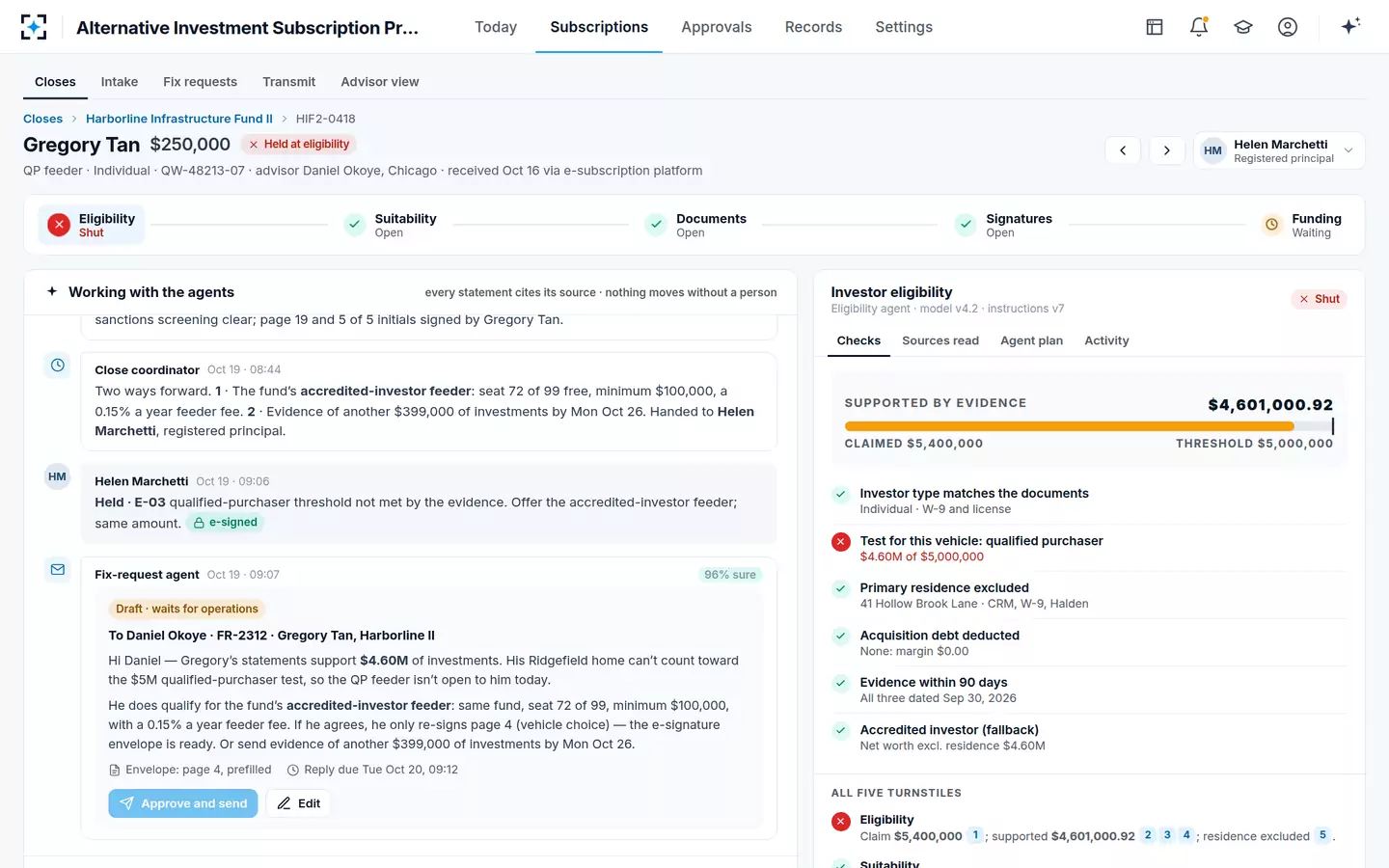
In the sample close, an investor's statements supported $4.60 million of investments against the $5 million qualified-purchaser test, because the house in his claim was his home. The draft to his advisor said exactly that, offered the fund's accredited-investor feeder in the same fund (a free seat, a $100,000 minimum and a 0.15% a year feeder fee), and explained that one re-signed page would move him. The envelope was already prefilled. The draft waited for operations to approve it.
One fix request: the reason, the option, the page to sign
Stop and ask a person when the evidence conflicts
Good alternative investment software knows when not to decide. Three cases come up on every desk: a document the software reads with low confidence, two documents that disagree, and a match against a sanctions list. Each needs a person, and the software's job is to say so, with both readings side by side.
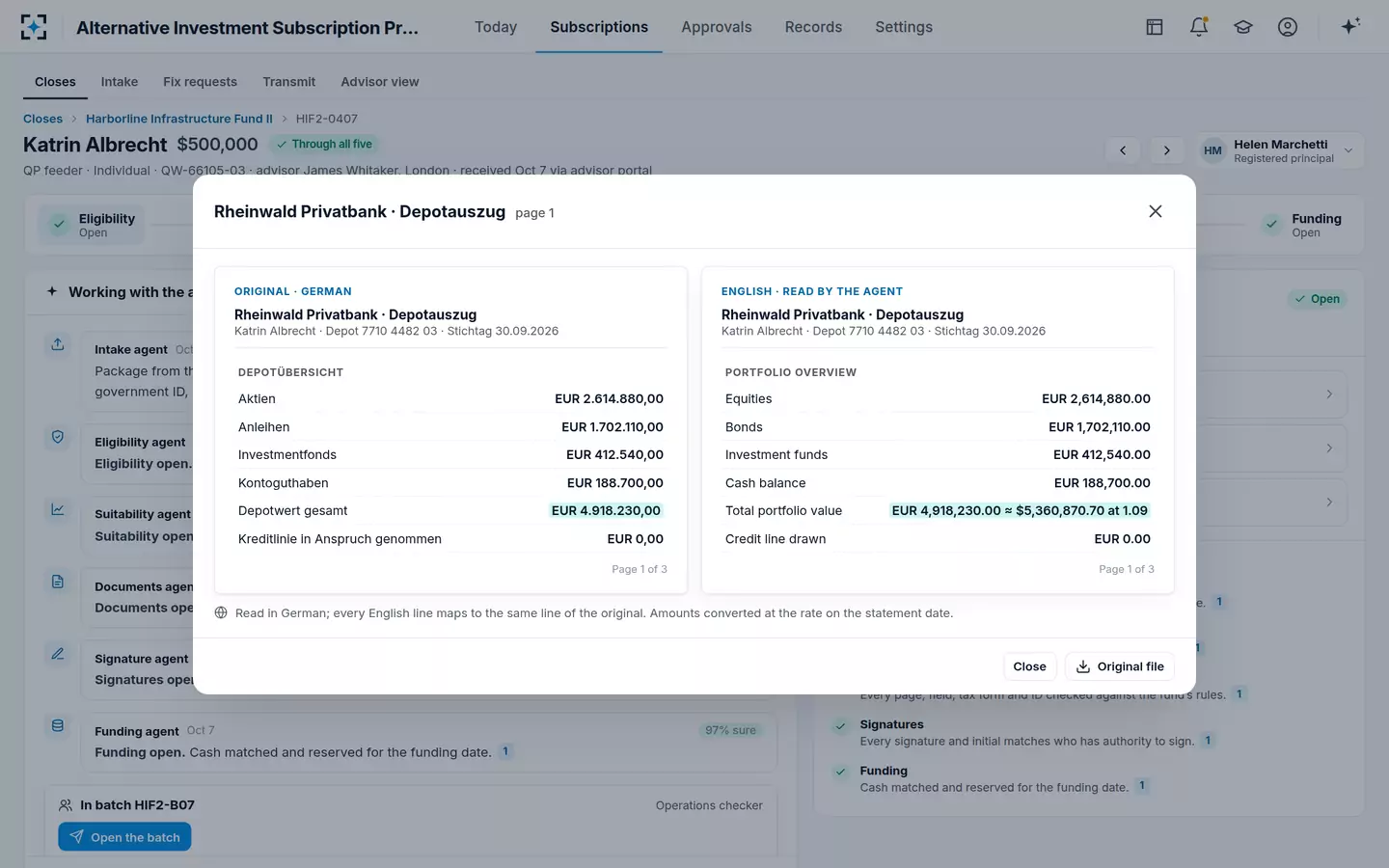
The solution's limits are specific. Below 90% confidence, a person reviews the value before it counts. Foreign-language evidence is shown beside the agent's English reading, line by line: in the sample close, a German bank statement's total of EUR 4,918,230.00 was converted at the statement-date rate to about $5,360,870.70, and the original sat beside the translation for the checker. A sanctions match goes to the AML analyst, who alone clears it. Agents never send to a fund administrator, approve suitability, release a cash reserve or clear a match.
Foreign-language evidence read beside the original, line by line
Who approves an eligibility exception? Nobody, by design
An eligibility exception should not exist: either the evidence supports the test the vehicle requires or it does not. The standard in the qualified-purchaser rule is reasonable belief: the definition includes any person a fund or someone acting for it "reasonably believes" qualifies (17 CFR 270.2a51-1(h)). A belief overridden against the evidence is not reasonable. So in Alternative Investment Subscription Processing the eligibility check has no override; only evidence opens it.
What a person does decide is what happens next. In the sample close, the registered principal held the subscription with a reason code and her signature and offered the accredited-investor feeder; the alternative was more evidence by the cutoff. Suitability is different: there a principal may approve an exception to the firm's own limits with a written reason, and the firm decides when a second principal must sign. The difference between those two kinds of decision is worth testing in any demonstration. Where reviewers disagree about the evidence itself, the place to start is measuring agreement on the qualified purchaser requirements.
The advisor's side: one message, own clients only
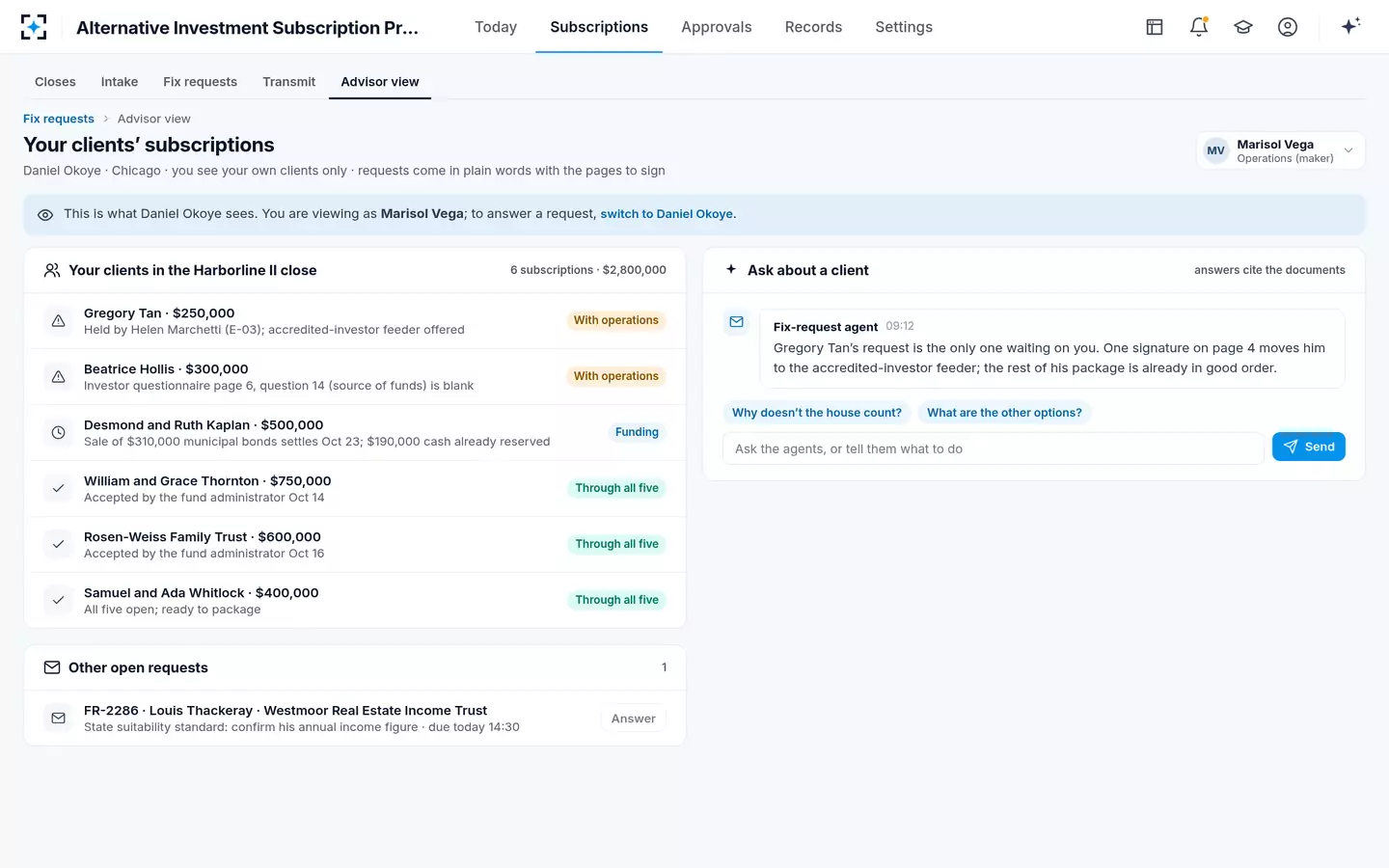
Advisors judge the desk by the requests they receive, so the advisor's view is part of the technology. In the solution, an advisor sees his own clients in a close and nothing else, each with what it needs in a line: a subscription held at eligibility with the feeder offered, a blank source-of-funds question on page 6, a bond sale settling on a named date. He can ask the agent about any of them. The fix requests arrive in the same plain words.
The advisor sees his own clients, and what each one needs
The cheapest fix request is the one that only has to be sent once.
What to ask alternative investment software in a demonstration
Ask it to fail. A demonstration on the vendor's clean sample shows the screens; one on your own past packages, with problems you already know about, shows the checking. Bring a package from a close you remember: one with a residence in the qualified-purchaser claim, a trust signed by the wrong trustee, an old CPA letter, a booklet on last year's version. Then ask the questions below, and count how many of your known problems it finds before it writes to anyone.
Ask too how it will be supervised. The SEC's examiners note that firms now use what they call "super intelligence (SI)" in core operations, from investment analysis to customer management, and they will examine firms' procedures for monitoring it, including in back-office work and AML and Reg BI compliance (what that means for supervision; SEC Division of Examinations, FY2027 priorities, October 2026). A subscription desk's software touches three of those. Each figure it states should link to its source page, and every action by a person or an agent should be on a trail an examiner can follow.
Eight questions for alternative investment software, on your own packages
- Does it recompute eligibility from statements?
Show the qualified-purchaser arithmetic for one of your investors: each line, the home excluded, acquisition debt deducted.
- Does it read the documents the booklet lacks?
Trust deeds, operating agreements, signatory lists, in the language they were written in.
- Does it find every problem before writing?
Count the problems it finds on a known package against the problems you know are there.
- What does the advisor receive?
One message per subscription, with pages and a prepared envelope, or a list of rule numbers?
- Where does it stop and ask?
Low-confidence readings, conflicting documents and sanctions matches should each go to a named person.
- Can anyone override eligibility?
The right answer is no; what happens next should be a person’s signed decision.
- Who sends to the administrator?
A maker and a different checker; the software should prevent a maker from sending her own batch.
- What does the examiner get?
Each decision with who, when, why and the evidence; the basis for each suitability determination kept on file.
Where subscription checking fits beside the platform, and where it stops
It fits beside the systems a subscription already runs through, not in place of them. The alternatives platform keeps the shelf, the orders and the e-subscriptions; the CRM keeps client profiles; the custodian keeps balances, reserves and wires; the fund administrator's portal receives packages; the e-signature service holds envelopes; sanctions screening and the licence registry answer their questions. Alternative Investment Subscription Processing reads from those and writes back what it found, so the desk stops being the place where they are reconciled by hand.
It does not replace the platform, act as the fund's administrator, move money or decide suitability. It does not make an investor eligible. And it does not remove the need for the firm's own rules: its concentration limits, its evidence age, its second-principal threshold. Each is a setting with a source and a version, and a change needs a reason and a principal's signature. For broker-dealers recommending direct participation programs, FINRA Rule 2310 already expects the firm to keep documents in its files showing the basis for each suitability determination (FINRA Rule 2310); the solution assembles that basis as it works. What to measure before relying on any of this is set out in piloting the subscription desk on one close, and the agents and their limits are on the Alternative Investment Subscription Processing page.
Questions people ask
What are alternative investment technology solutions?
They are the systems a wealth firm uses to offer private and semi-liquid funds: platforms that list funds and take electronic subscriptions, connections to fund administrators, and tools that check the subscriptions themselves. The last group is the smallest, and it is where eligibility, suitability and authority are proven before a package travels.
Can software check subscription documents?
Yes, if it reads more than the form. Field checks catch blanks and wrong versions; checking eligibility, signers' authority and concentration needs the client's statements, the trust or entity documents and the profile. In the sample close, agents read 38 packages overnight and ran 212 checks, and every finding was cited to its page for a person to review.
Is alternative investment software the same as an alternatives platform?
Not necessarily. A platform moves subscriptions between advisors, the firm and funds; subscription checking decides whether what moves is in good order and eligible. Many firms run both, and the checking layer reads from the platform rather than replacing it.
What is NIGO in alternative investments?
Not in good order: a subscription the fund administrator cannot accept as submitted, because of a missing page, an unsigned form, an outdated booklet or unproven eligibility. No regulator or independent study publishes NIGO rates for alternatives; measure your own as returns divided by submissions, by reason, over two or three closes.
Will agents send subscriptions to the fund without a person?
Not in this solution. Agents draft, check and recommend; operations approves every message to an advisor, a registered principal signs suitability, and a maker and a different checker send each batch to the administrator.