Alternative investment operations is the team at a wealth firm that takes a client's subscription to a private fund, a non-traded REIT or BDC, or an interval fund, and gets it accepted by the fund's administrator before the close. Every subscription has to answer five questions, and different people own them: is the investor eligible for this vehicle, is the investment suitable and inside the firm's limits, is the package complete and current, did the right people sign, and will the cash arrive on the funding date. The work is hard because the answers depend on evidence scattered across statements, trust deeds and tax forms, and because a close does not wait. Botminds' Alternative Investment Subscription Processing exists to prepare each of those answers from the evidence, with the page it came from, so that the people in each seat decide instead of hunting.
The desk sits between the advisor and the fund. The advisor recommends the fund and collects signatures; the fund's administrator accepts or returns the package; in between, the wealth firm's operations staff, a registered principal, an AML analyst and a second operations reviewer each touch the subscription. To make the seats concrete, this guide follows a sample close as it runs through the solution: Quillfield Private Wealth, a fictional firm, is closing Harborline Infrastructure Fund II, a fictional fund, on October 31, with 46 subscriptions worth $24.35 million and documents due in good order by Monday, October 26. Every name and figure from that close is sample data.
Five seats on one alternative investment subscription
Today
Logs each package, checks every page against a checklist and emails the advisor about each gap as it turns up.
With agents
Opens the close as a list of subscriptions, each saying in one line what blocks it, and approves the one fix request drafted for each.
Still theirs: Approving what goes to the advisor; building the batch.
Today
Reads the investor questionnaire and checks that the right box is ticked; recomputes only when something looks wrong.
With agents
Reads the qualified-purchaser or accredited-investor test rebuilt line by line from the statements, each line cited to its page.
Still theirs: Deciding what the evidence shows when documents conflict.
Today
Judges concentration and liquidity from a PDF under close-week pressure.
With agents
Reads a memo built from verified figures, with the firm limit and the client’s liquidity needs side by side.
Still theirs: Approving, holding or rejecting suitability, with a reason and a signature.
Today
Clears screening hits for names, owners and signers that reach the desk late in the week.
With agents
Receives only real matches, with the documents behind each name.
Still theirs: Clearing or escalating every sanctions match.
Today
Re-reads every package by hand before anything reaches the administrator.
With agents
Checks a batch whose every subscription is through all five checks, and confirms the cash against the funding date.
Still theirs: Sending to the administrator. Never a batch they prepared.
What does an alternative investment operations team do?
An alternative investment operations team makes sure that each subscription is eligible, suitable, complete, properly signed and funded before the fund administrator sees it, and that the firm can show how it knew. Job titles vary: analyst, specialist, associate. The work is the same: read a package, compare it with the fund's requirements and the firm's own rules, send back what is missing, and transmit only what is in good order.
What makes the work different from opening a brokerage account is the vehicle. A private fund relying on section 3(c)(7) of the Investment Company Act may sell its securities only to investors who are qualified purchasers when they buy (how that test runs for a trust is in can a trust be a qualified purchaser; 15 U.S.C. 80a-3(c)(7)). One that relies on section 3(c)(1) instead is limited to securities "beneficially owned by not more than one hundred persons". A wrong eligibility call is therefore not only the distributor's problem; it reaches the fund. Semi-liquid funds bring a different load: liquidity terms the client must understand, and concentration limits the firm sets for itself.
The volume is growing. The SEC counts 139 interval funds in 2025, up from 58 in 2020, with net assets up from $38 billion to $101 billion (SEC interval fund proposal, October 2026). Each new fund on a wealth firm's shelf adds a booklet, a set of eligibility rules and a calendar of closes to the same desk.
One subscription, five questions, in the order they are usually asked
Agent
IntakeSplits the package into its documents, classifies each page and matches it to the order and the client.
Never: alters an original file
Agent
EligibilityRebuilds the qualified-purchaser, accredited-investor or qualified-client test from statements and letters, under the rule.
Never: accepts a ticked box as proof
A person decides
Registered principal: suitabilityDecides on concentration, liquidity and the client’s profile from a memo built on verified figures.
Agent
Documents and signaturesChecks every required page and field, the current booklet version, tax forms and IDs, and each signer against the authority documents.
Never: clears a sanctions match
Agent
FundingMatches cash to the funding date: reserves, scheduled sales, wires and IRA custodian directions.
Never: moves money
A person decides
Maker and checkerOperations approves the fix request and builds the batch; a different person checks it and sends it to the administrator.
Who checks subscription documents, and against what?
Operations checks the subscription documents, page by page, against the fund's current subscription booklet and the administrator's acceptance rules. A subscription booklet is the fund's application: the subscription agreement, the investor questionnaire with its eligibility representations, the tax certification, and pages for entity investors. The checks are mechanical, and there are many of them: every required page present, every field filled, every initial on the representation pages, the booklet on the version the fund now requires, a Form W-9 or the right W-8, a valid ID, and for entities the formation documents and beneficial ownership.
The administrator's returns show where those checks fail. In the sample week, one administrator returned an LLC's package because Part I, line 5 of its Form W-8BEN-E, the entity classification, was blank. The firm's check knew only the current revision of the form, and the investor had used the 2016 one. That is the usual shape of a return: nothing was wrong with the investor, a field on a version nobody expected was empty, and the subscription went back for another round.
Documents are also where the fund's offering terms meet the firm's duties. FINRA reminds broker-dealers that "a member or associated person must conduct a reasonable investigation of any security" it recommends in a private placement (Regulatory Notice 23-08, May 2023), and its 2026 oversight report lists "relying solely on the firm's past experience and knowledge with an issuer" among the findings (FINRA, 2026 Annual Regulatory Oversight Report). That investigation happens before the product reaches the shelf, but its conclusions, such as who the product is not for, should show up as rules the subscription desk applies.
A close as subscriptions through five checks
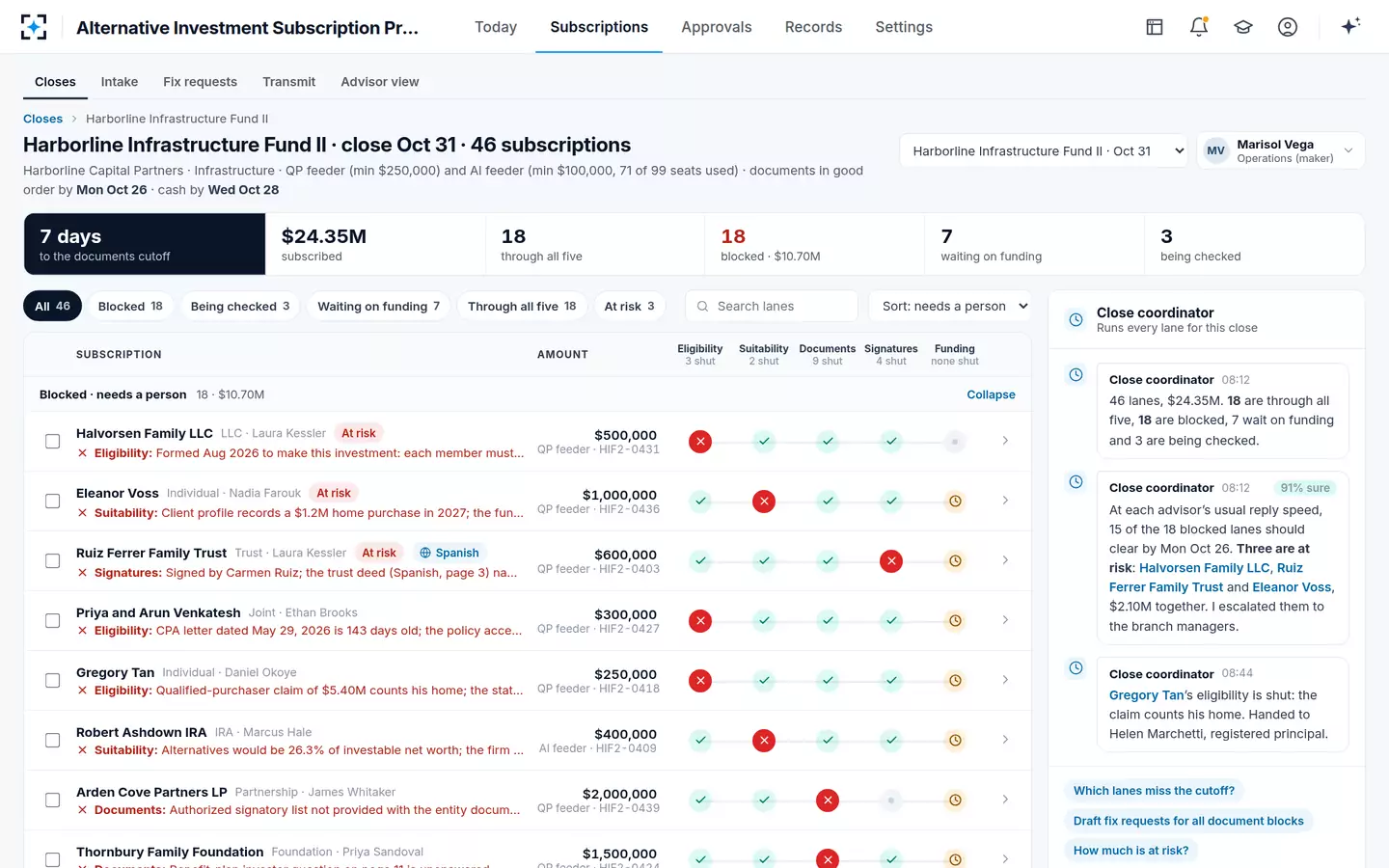
The eligibility seat: a computation, not a checkbox
The eligibility reviewer decides whether the investor meets the test the vehicle requires, and the honest way to decide is to recompute it. A natural person is a qualified purchaser with not less than $5 million in investments, as Rule 2a51-1 defines them: a home the investor lives in is not real estate "held for investment purposes", and debt taken on to buy the investments is deducted (17 CFR 270.2a51-1). Retirement money does count: investments in an IRA or a similar account that the investor directs, held for the investor's benefit, are included.
In the sample close, Gregory Tan subscribed $250,000 to the qualified-purchaser feeder and claimed $5,400,000 of investments on his questionnaire. Three September 30 statements, one of them a rollover IRA, support $4,601,000.92. The other $800,000 is the house at the address on his brokerage statement, his tax form and his client profile, listed as his primary residence. He is short of the test by $398,999.08, and nothing about his package was incomplete: every box was ticked. Trusts and LLCs need the same arithmetic plus a look-through, which can a trust be a qualified purchaser sets out step by step.
Who approves an alternative investment suitability exception?
A registered principal approves, holds or rejects suitability, and an exception to the firm's own limits needs that principal's reasoned, signed decision. For broker-dealers, FINRA's notice is direct: "Members and their associated persons must comply with Reg BI when recommending private placements to retail customers". Firms may also "create guidelines to help ensure that the security is not recommended to customers whose investment profiles may not align" with the product, and that is where concentration limits and minimum horizons come from (FINRA Regulatory Notice 23-08).
For direct participation programs, FINRA Rule 2310 adds its own test: reasonable grounds to believe "the participant has a fair market net worth sufficient to sustain the risks inherent in the program", and a duty to "maintain in the files of the member documents disclosing the basis upon which the determination of suitability" was made (FINRA Rule 2310). The SEC's examiners say they will prioritise advisers that recommend illiquid, hard-to-trade or unusual products, and weigh factors that include "costs (including exit costs)" (SEC Division of Examinations, FY2027 priorities, October 2026).
Two sample cases show the two kinds of exception. Robert Ashdown's IRA would take alternatives to 26.3% of investable net worth against a 20% firm limit; the largest amount inside the limit is $269,000 of his $400,000, so the agents recommend holding and asking the advisor to reduce. Eleanor Voss is inside the limit but her profile shows a $1.2 million home purchase in 2027 against a 12-year fund term, with $8.75 million liquid outside alternatives; the agents recommend approval with a note. Both decisions are the principal's. How concentration should be measured after the new money is the subject of the concentration line for non-traded REITs.
The principal's queue: judgment cases first
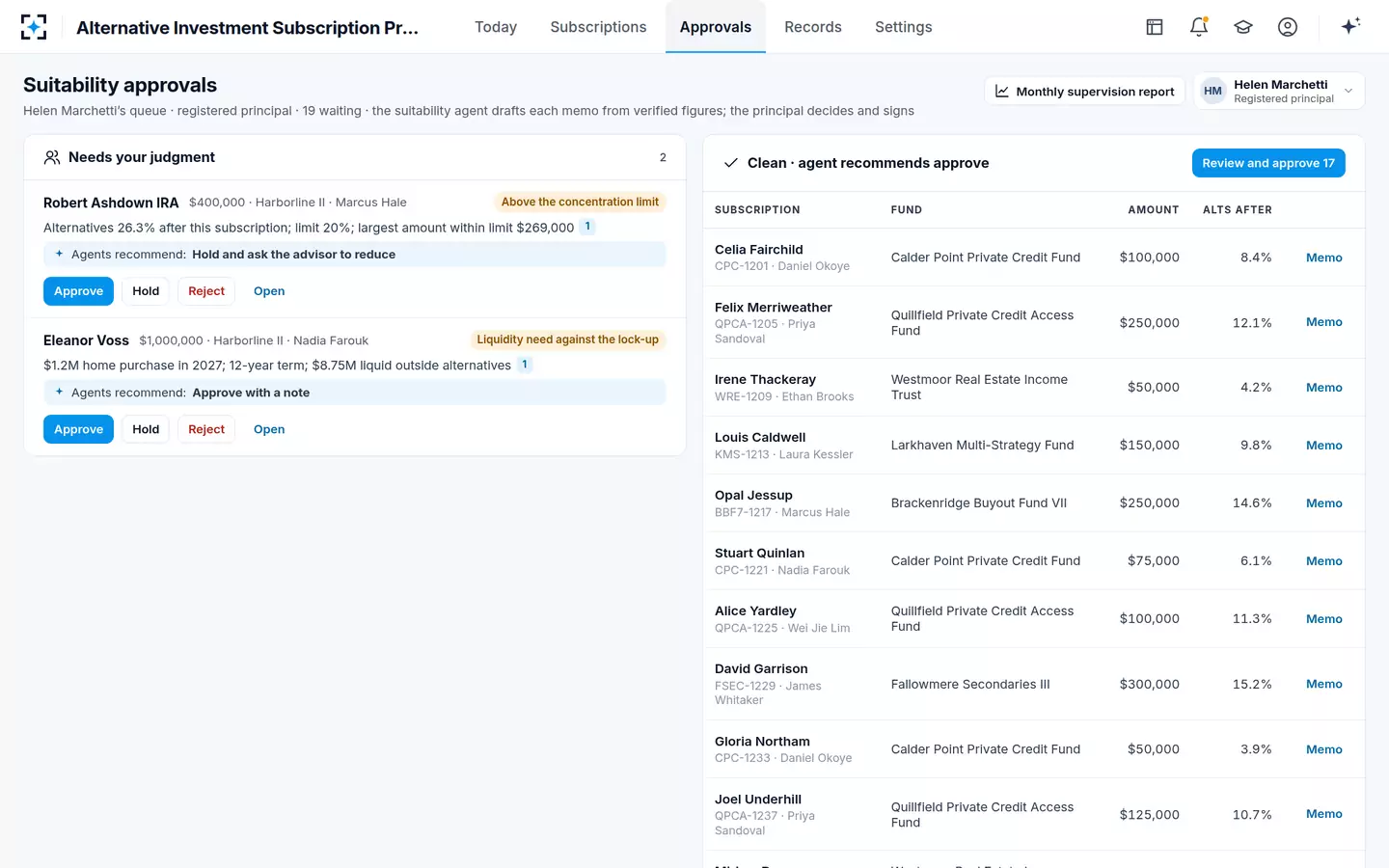
Signatures, authority and screening: the seat that reads the deed
A signature is only good if the signer had authority to sign, and authority lives in documents the booklet does not contain: the trust deed, the LLC's operating agreement, a corporate signatory list. The check is to read who the documents name and how they must act, then compare that with who signed, page by page. Co-investors need their own signatures; a power of attorney needs its own scope.
In the sample close, the Ruiz Ferrer Family Trust's $600,000 subscription was signed by Carmen Ruiz as trustee. The trust deed, in Spanish, names two other people as trustees acting jointly. Nothing in the booklet could have shown that; only the deed could. The fix is a re-signature of one page by both named trustees. Screening runs alongside: names, owners and signatories go through sanctions screening, and a possible match goes to the AML analyst, who alone clears it. For a client the firm rates high risk, the same file may also need evidence of where the wealth came from; source of wealth documents sets out what proves each kind.
Who funds the subscription, and when?
The client funds the subscription, from cash held at the firm, from the sale of other holdings, by wire, or through an IRA custodian's direction, and operations confirms the cash is there by the fund's funding date. Funding is often the last check to close because it depends on events outside the desk. In the sample close, documents were due on Monday, October 26 and cash on Wednesday, October 28, for an October 31 close. One couple's subscription waited on a $310,000 municipal bond sale settling on October 23, with $190,000 of cash already reserved.
The funding seat's rule is simple and hard to automate away: nothing reserves, releases or moves money except a person with the authority to do it. What can be automated is the matching, every subscription's cash sources against its date, so that a shortfall shows a week early instead of on the morning of the wire.
Maker and checker: why the person who prepared a batch cannot send it
The second operations reviewer exists because one person's error should need a second person to reach the fund. A maker builds the batch for the administrator; a different checker confirms it and sends it. In the sample close, batch HIF2-B07 held four subscriptions for $1,600,000, each with the current booklet, questionnaire, tax form, ID, AML certificate, the principal's suitability approval and an eligibility evidence summary. The specialist who prepared it could not check it; the system said so and waited for her colleague.
The same rule produces the file an examiner asks for. Rule 2310's duty to keep "documents disclosing the basis" for each suitability decision, and the SEC's interest in illiquid products, both assume the firm can show who decided what, on which evidence, and when.
A maker prepares the batch; a different checker sends it
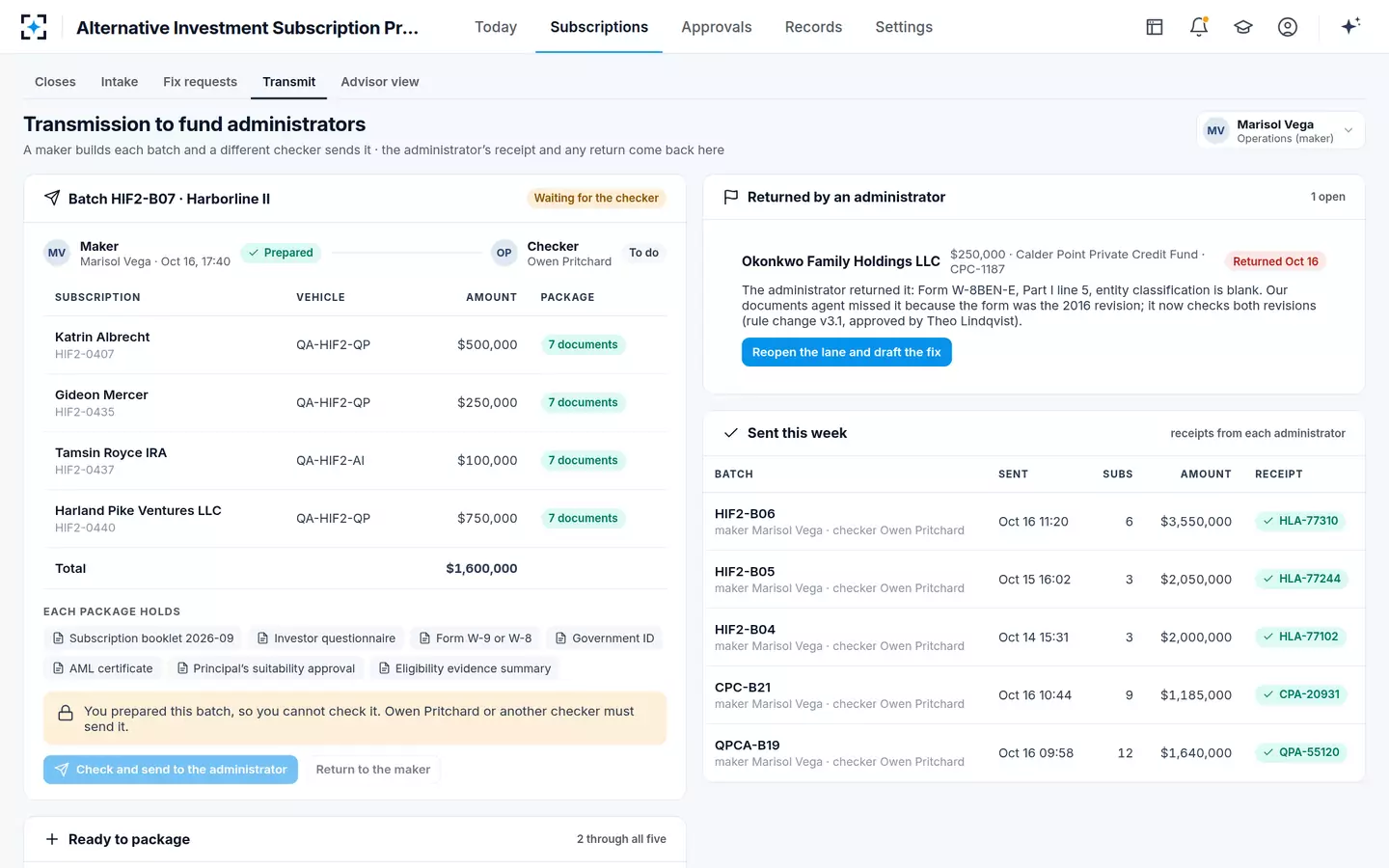
What happens before a fund close? The last two weeks
Before a close, the desk works backward from three dates the fund sets: the documents cutoff, the funding date and the close itself. Packages arrive as clients decide and advisors gather signatures, so the volume builds toward the cutoff. Each one is checked, and each gap goes back to the advisor. The days are lost in that loop: a fix request goes out, the advisor reaches the client, the client signs, the package comes back and is checked again, and sometimes a second gap appears that was there all along.
Botminds' estimate for a typical alternative fund subscription on a wealth platform puts seven business days into a package by hand, three of them in a single round of fixes with the advisor. It is an estimate, not a measurement, and the useful thing about it is its shape: most of the time is waiting, and waiting multiplies when problems are found one at a time.
Most of a subscription's days go to the round trip with the advisor
By hand, about 7 business days
- Log and match · 7%
- Pages, forms, booklet version · 14%
- Eligibility arithmetic · 14%
- Principal review · 14%
- One round of fixes · 44%
- Maker, checker, send · 7%
That is why the sample close runs on a forecast. With seven days to the cutoff, 18 of 46 subscriptions were blocked, worth $10.70 million. At each advisor's usual reply speed, the solution's Close coordinator expected 15 of the 18 to clear and named the three that would not, $2.10 million together, so they went to branch managers a week early instead of on the last afternoon. What it costs when a subscription slips to the next close is worked through in alternative investment platforms and the missed close.
A close is not lost on the last day. It is lost a week earlier, when the third fix request for the same package goes out because nobody read the trust deed the first time.
Where agents fit on the desk, and where they stop
Agents fit where the work is reading and comparing, and stop where the work is deciding. In Alternative Investment Subscription Processing, eight agents read packages, rebuild eligibility from the evidence, test concentration, check pages and signers, match cash and draft one fix request per subscription. In the sample close they read 38 packages overnight, ran 212 checks and drafted 13 fix requests; none was sent until the operations specialist approved it.
The limits are written into the solution, not left to judgment. Agents never send to a fund administrator, approve suitability, release a cash reserve or clear a sanctions match. Eligibility has no override at all: only evidence opens it. And a maker can never check or send her own batch. The design targets are 95% of subscriptions in good order at the administrator on the first pass and every investor's eligibility recomputed from evidence and kept on file; both are targets, to be measured on the firm's own closes. The full set of agents and limits is on the Alternative Investment Subscription Processing page.
Questions people ask
What does an alternative investment operations analyst do?
An analyst on an alternatives operations desk checks subscription packages against the fund's booklet and the firm's rules, follows up gaps with advisors, tracks closes and funding dates, and prepares packages for the fund administrator. At a wealth distributor the role also gathers the eligibility evidence that a principal or compliance relies on. The title varies by firm; the work is the five checks in this guide.
What is a subscription booklet?
A subscription booklet is the set of documents an investor completes to buy into a fund: the subscription agreement, an investor questionnaire with eligibility representations, tax certifications and, for entities, extra pages on ownership and authority. Funds revise booklets, so a package on an old version can be returned even when every field is filled. The sample fund's booklet ran to 24 pages.
Who signs off a subscription before it goes to the fund?
At most wealth firms, three sign-offs: a registered principal on suitability, operations on completeness, and a second operations reviewer who sends the batch. For broker-dealers, FINRA's Regulatory Notice 23-08 confirms that Reg BI applies when private placements are recommended to retail customers, so the suitability sign-off is not optional.
Why does a 3(c)(7) fund care who its investors are?
Because its exclusion from registration depends on them: its outstanding securities must be owned exclusively by people who were qualified purchasers when they bought. A fund relying on section 3(c)(1) instead is limited to not more than one hundred beneficial owners, which is why distributors track seats in those feeders.
Does alternative investment operations verify accredited investors?
Often in practice, though the duty sits with the issuer: in a Rule 506(c) offering, the issuer must take reasonable steps to verify that purchasers are accredited investors (17 CFR 230.506(c)). The rule's non-exclusive methods include tax forms for the last two years for income, statements dated within the prior three months for net worth, or a written confirmation from a CPA, attorney, registered adviser or broker-dealer that verified the investor within the prior three months.
How many people does an alternatives desk need?
No regulator or independent study publishes staffing ratios for alternatives desks, so firms size them by peak close volume. A useful measure is subscriptions per specialist in the final week before a cutoff; in the sample firm one specialist works 60 to 90 subscriptions a day across 14 closes. Measure your own across two closes before deciding.