Source of wealth documents are the papers that prove how a client acquired their wealth: a share purchase agreement for a business sale, a probate record for an inheritance, tax returns for a career, a completion statement for a property, custodian statements for investment growth. Which ones a file needs depends on how the wealth was made, and how much weight each carries depends on who produced it. A client's own spreadsheet is weaker than the client's bank statement, which is weaker than a court's probate record. The work is slow because high-net-worth clients made their money in many places, so the documents arrive in several languages and formats. Botminds' Source of Wealth Verification reads each document in its original language, puts an English reading beside it, and marks which rung of evidence each stream of wealth has reached.
The rule texts below come from the regulators' own pages. Worked examples use the solution's fictional sample client, Mateo Arriaga Lund.
The evidence ladder: for each kind of wealth, three rungs of proof
Sale of a business
Rung 1 · the client saysCompany founded, share sold, price, date
Rung 2 · the client's paperShare purchase agreement; bank advice showing the proceeds arrive
Rung 3 · a third party's recordCorporate registry extract; the buyer's published accounts or filing
Inheritance
Rung 1 · the client saysWho died, when, share of the estate
Rung 2 · the client's paperLawyer's or executor's letter; bank receipt for each distribution
Rung 3 · a third party's recordProbate or court record; notarised will
Salary and bonuses
Rung 1 · the client saysEmployers, roles, years, rough pay
Rung 2 · the client's paperPayslips; employer letter; personal tax returns
Rung 3 · a third party's recordTax authority assessment; letter from the employer's auditor; public pay disclosures
Business income and dividends
Rung 1 · the client saysShareholding, years of distributions
Rung 2 · the client's paperDividend vouchers; management accounts
Rung 3 · a third party's recordAudited financial statements over several years; share register
Property sale
Rung 1 · the client saysAddress, purchase and sale dates and prices
Rung 2 · the client's paperSale contract; completion statement
Rung 3 · a third party's recordLand registry entry; conveyancing file
Gift
Rung 1 · the client saysDonor, relationship, amount, reason
Rung 2 · the client's paperGift letter; donor's bank statement
Rung 3 · a third party's recordIdentity papers proving the relationship; evidence of the donor's own wealth
Investment growth
Rung 1 · the client saysPortfolio size then and now
Rung 2 · the client's paperClient's own statements or spreadsheets
Rung 3 · a third party's recordStatements received direct from the custodian, covering the period
What is a source of wealth document?
A source of wealth document is any record that shows how a particular part of a client's wealth came into being: an agreement, a court record, a tax filing, a statement. It is not the same as a document that shows the wealth exists. A custodian statement showing $29 million proves a balance; it does not show whether the balance came from a business sale or from something else.
The regulators that name source of wealth give lists rather than definitions. MAS's guidelines for banks give, as examples of "appropriate and reasonable means" of establishing source of wealth or funds, "copies of trust deeds, salary details, tax returns, bank statements, audited financial statements of the legal person or legal arrangement owned or controlled by the PEP, site visits, a copy of the will (in cases where the source of wealth or funds is an inheritance), conveyancing documents (in cases where the source of wealth or funds is a sale of property) and credible public information sources" (Guidelines to MAS Notice 626, 8-5-7). The UK regulations point the same way, listing among enhanced measures "seeking additional independent, reliable sources to verify information provided or made available" by the client (MLR 2017, regulation 33(5)(a)).
The evidence ladder: the client's word, the client's paper, a third party's record
The useful question about any document is who made it. A client's own account of their wealth is the first rung, and MAS is explicit that it is not enough on its own: firms are to test whether the story is plausible rather than lean on what the customer says (how to tell whether it holds up; MAS, AML/CFT supervisory expectations, October 2024). The second rung is paper the client supplies but did not write alone: a sale agreement signed by a buyer, a bank's credit advice, payslips. The third rung is a record made and held by someone independent of the client: a registry, a court, a tax authority, an auditor, a custodian sending statements directly.
"For material SOW, FIs should attempt to use more reliable corroborative information, such as audited accounts or documents issued by independent third parties (e.g. tax accountants)."
Monetary Authority of Singapore, Circular AMLD 08/2024, 26 July 2024
The ladder is not a demand that every stream reach the top. MAS's 2024 circular asks firms to focus on "the SOW that are more material or of higher risk", and in May 2026 it went further, telling firms not to try to corroborate every last item (MAS Circular AMLD 05/2026). The ladder tells a reviewer which rung each stream has reached; the firm's policy says which rung it needs, and the bigger and riskier the stream, the higher.
Source of wealth for the sale of a business
A business sale needs three things proved: that the client owned what was sold, that it was sold at the stated price, and that the money arrived. Each has its own document. Ownership comes from a share register, a notarial deed or a registry extract; the price from the sale agreement; receipt from the bank advice for the proceeds. Coutts was fined £8.75 million in 2012 partly for files where the source of funds "was in six cases stated to be the proceeds from the ownership and/or sale of an asset, for example a property or business", but the firm did not establish "the ownership of the asset, the income arising from it or, where appropriate, the subsequent sale of the asset and the proceeds arising from that sale" (FSA Final Notice, Coutts & Company, 23 March 2012).
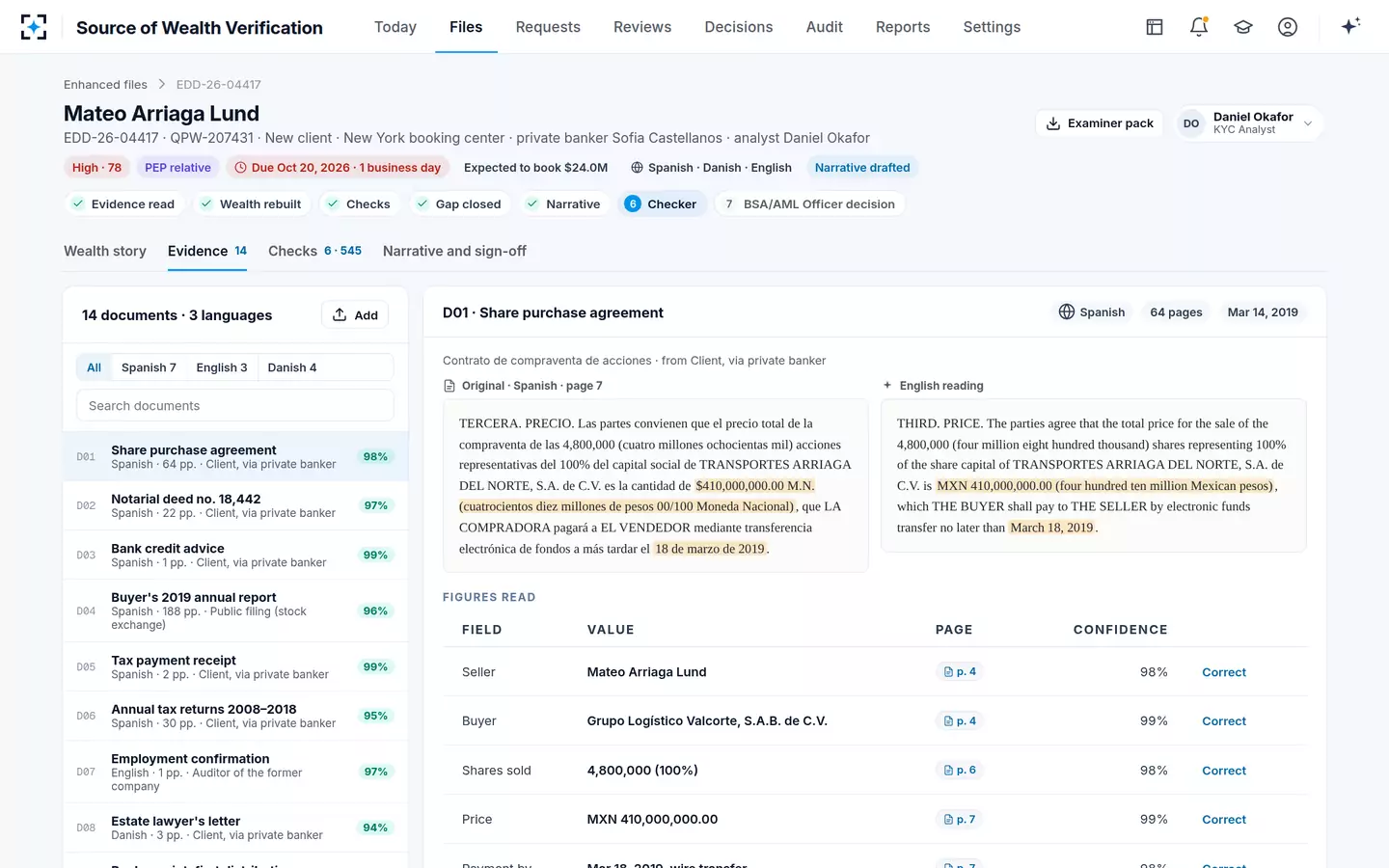
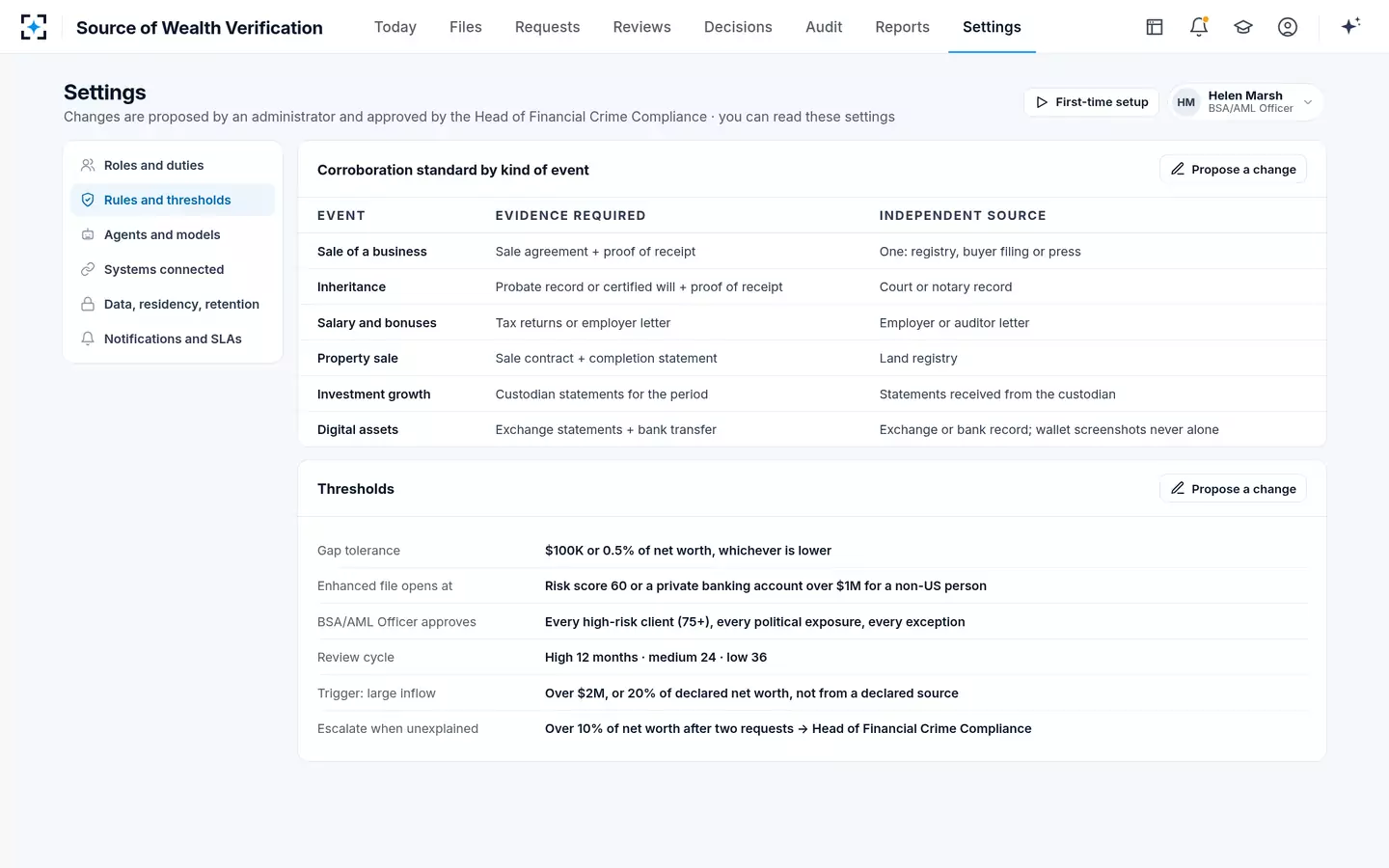
In the sample file, the 2019 sale of the client's Monterrey logistics company is backed by four documents: the Spanish share purchase agreement (clause Tercera states MXN 410,000,000), a notarial deed, the bank credit advice for 18 March 2019, and the buyer's 2019 annual report, a public filing that reports the acquisition. The last is the rung-3 record: the buyer, not the client, published it. The fictional firm's standard for a business sale is agreement plus proof of receipt plus one independent source, and the stream meets it.
Where the business is still owned and the wealth is its profits or dividends, the documents change. MAS says firms "should seek to obtain audited financial statements, if available", that "Unaudited management accounts should only be considered as an alternative", and that for dividend income spanning many years firms should obtain "several years’ worth of financial statements, instead of using a couple of financial statements to extrapolate" (MAS, October 2024).
Source of Wealth Verification: fourteen source of wealth documents in three languages
Source of wealth for an inheritance, and for gifts
An inheritance is proved by the estate's own papers, and the strongest are the court's. The client's word gives who died and what they left; a lawyer's or executor's letter gives the estate's division; the probate record or a certified will is the independent record; and the bank receipt for each distribution proves the money arrived. MAS lists "a copy of the will (in cases where the source of wealth or funds is an inheritance)" among its examples. An estate paid out in stages needs a receipt for each stage, because each is a separate inflow.
That is exactly where the sample file stopped. The client's mother died in Aarhus in February 2021 and the estate was divided between two heirs. The Danish lawyer's letter and a bank receipt proved the first distribution, DKK 15.8 million. The second, DKK 15.1 million or about $2.4 million, had no document, and stayed unexplained until the probate record arrived: net estate DKK 61.8 million, two heirs, second distribution on 9 November 2021, matching a custodian inflow two days later.
A gift needs more, because the wealth behind it belongs to someone else. MAS's guidelines say that where a material source of wealth is a gift, a bank should establish "the relationship between the third party and the customer", verify the transfer against reliable sources such as bank statements, and "assess the plausibility of the third party’s source of wealth as part of the assessment" (8-5-7B). For relatives, the October 2024 paper suggests documents such as a "birth certificate (if available) or address proof", and closer scrutiny "especially if it is from unrelated parties".
Salary, bonuses and a career that ended years ago
Employment income is proved by payslips, employer letters and tax returns, and corroborated by a tax authority or an independent party. In the sample file, the client's 2008–2019 pay as chief executive is backed by Spanish-language tax returns for 2008 to 2018 and an employment confirmation from the auditor of his former company, and tested against a pay range for executives of comparable private firms.
Careers that ended decades ago are the classic gap, and MAS has accepted reasoned estimates in their place. In its 2020 paper on private banking controls, MAS described as good practice a bank whose client's wealth came from senior employment at a global bank in the Middle East from 1985 to 2012, with no old payslips available. The bank "Verified the husband’s previously held position at the global bank through online searches", "Obtained salary benchmarks of finance professionals in the Middle East", and applied "a conservative return on investments (with basis documented)" to arrive at the net worth (MAS, Effective AML/CFT Controls in Private Banking, September 2020). The same paper criticised a bank whose client attributed her wealth to senior management roles, where the bank "did not obtain any salary benchmarks nor supporting documents to corroborate her salary earnings".
Property, investment growth and digital assets
A property sale is proved by the sale contract and completion statement and corroborated by the land registry; MAS names "conveyancing documents (in cases where the source of wealth or funds is a sale of property)". Investment growth is proved by statements over the period, and the strongest come direct from the custodian rather than through the client. In the sample, $11.8 million of growth from 2019 to 2026, about 6.9% a year, is shown in custodian statements and tested against a balanced benchmark.
Digital-asset gains are the newest stream and the easiest to fake on screen. The fictional firm's standard is exchange statements plus the bank transfer of the proceeds, with independent proof from an exchange or bank record, and "wallet screenshots never alone". The second sample client, with $1.1 million of digital-asset gains backed only by screenshots, gets one request for exactly those statements.
A written standard for each kind of wealth, with its independent source
Source of funds documents: proving this transfer
Source of funds documents prove one flow: the statement of the sending account, the bank advice for the transfer, and the document for the activity that filled the account. MAS gives "salary payments or sale proceeds" as examples of appropriate information (8-5-6). Its 2020 paper describes as good practice a bank whose client said US$30 million would come from another bank: "Beyond ascertaining that this was a first party transfer, the bank obtained supporting documents showing that the funds were derived from the sale of his properties." In the same paper, a bank told of a US$80 million transfer "did not obtain additional information to establish the legitimacy of the funds" and was criticised for it.
For the difference between the two questions, and why a sending bank is not an answer, see source of wealth vs source of funds.
What counts as independent corroboration?
Independent corroboration is evidence the client did not create and could not easily alter: a public registry, a court or tax authority record, audited accounts, a statement sent by a custodian, credible public reporting. The independence is in the producer, not the paper. A notarised copy of a client-drafted letter is still the client's letter.
Who produced the document decides how far it carries
| Document | Produced by | Rung it can reach | Common weakness |
|---|---|---|---|
| Client declaration or questionnaire | The client | 1 | Restates the story it is meant to test |
| Client spreadsheet of assets | The client | 1 | Lists what is owned, not how it was acquired |
| Share purchase agreement | Client and buyer | 2 | Proves the price agreed, not that it was paid |
| Bank advice or statement via the client | The bank, passed on by the client | 2 | Easy to edit; missing descriptors are a red flag |
| Unaudited management accounts | The client's company | 2 | MAS: only an alternative, with triangulation |
| Audited financial statements | The company, signed by an auditor | 3 | Check the auditor's sign-off is present |
| Probate or court record | A court | 3 | May arrive late, in another language |
| Registry extract or buyer's published filing | A registry or a listed buyer | 3 | Dates may differ from the client's account |
| Statements received direct from the custodian | The custodian | 3 | Cover only the assets held there |
The FCA saw one firm's training set out this reasoning explicitly. In its 2024 review of politically exposed persons it described, as good practice, guidance on "corroboration strength factors" including "independence of the information" and "reputation of the source(s)". How to turn those factors into measures a reviewer can check is the subject of source of wealth corroboration.
Red flags inside the documents themselves
A document can be on the right rung and still be wrong. MAS does not ask staff to be forensic examiners: "MAS does not expect FIs’ staff to conduct forensic analysis of all documents obtained from customers." It does expect them to notice material red flags, and its October 2024 paper lists the ones its inspections found.
Red flags MAS has seen in source of wealth documents
- The client's account and an independent source disagree
MAS: "Significant discrepancies in customers’ representations against independent sources, such as corporate data reports".
- Financial statements do not fit the profile
"Accounting errors, or anomalies in financial statements that are not in line with the FIs’ understanding of the customer’s profile".
- No official sign-off
"Lack of official sign-offs by relevant certifying parties e.g. auditor, notary public."
- Bank statements that look assembled
"Bank statements with missing descriptors and irregular formatting."
- A sale that did not happen
A web domain "sold" for a large sum remained in use and was marketed for sale at a fraction of the price.
- Dates that do not line up
Differing dates of the customer's shareholding between the client's account and an independent corporate data report.
When the document no longer exists
Some evidence is gone: payslips from 1990, a company dissolved twenty years ago, an estate in a country whose records are not online. Regulators accept this, within limits. MAS's 2024 circular recognises "SOW from many years ago for which documents may no longer be easily available", and asks firms in such cases to focus on the material sources and "assess whether the residual risk of the uncorroborated wealth is acceptable". The 2026 circular tells firms to "Avoid unnecessary or unreasonable information requests (e.g. requesting for long dated financial or employment records)."
What happens when the evidence is not asked for at all
30of 61
high-risk files where Coutts failed to establish, or evidence, the customer's source of wealth
16
files where it failed to establish, or evidence, the source of funds received at the outset
£8.75m
penalty, after a 30% settlement discount
The answer to a missing document is a reasoned substitute, written down: a benchmark, a public record, an estimate with its basis, and the amount it covers. What a regulator will not accept is the gap left blank. In the Coutts files, even where the private banker had noted that source of wealth was "not known", "no steps had been taken to rectify the gap". When the substitute is a request to the client, it should be one request, for one document; how the solution's agents do that is in source of wealth checks.
Reading documents in the language they were written in
High-net-worth clients' documents are often not in English, and the weak point is the translation. In the sample file, seven of the fourteen documents are in Spanish and four in Danish. The solution's Evidence agent reads each in its original language, puts an English reading beside it, and cites each extracted amount, date and party to its page; it "never treats a translation as the original", and below 85% confidence on a field a person decides. MAS made the same point about adverse media: firms should consider "adverse media searches in native languages of countries known to be associated with the customer". The Source of Wealth Verification page shows the full sample file.
Questions people ask
What documents prove source of wealth?
It depends on how the wealth was made: a sale agreement and proceeds advice for a business sale, a probate record or will for an inheritance, tax returns and employer letters for employment, a completion statement for property, custodian statements for investment growth. The strongest are records made by a third party, such as a court, registry, tax authority or auditor.
Is a bank statement enough to prove source of wealth?
Usually not. A bank statement proves money moved and where it sits; it rarely shows the activity that created it. It is good evidence of receipt, for example of sale proceeds, alongside the document that explains the payment.
Can a client's signed declaration count as evidence?
As the first rung only. MAS asks firms to "avoid overreliance on customers’ representations", and for politically exposed persons and private banking clients expects independent corroboration of the material sources. A signed declaration is the client's account, not proof of it.
What if the documents are in another language?
They should be read in the original, with a translation beside them, and any figure taken from the translation checked against the original page. MAS also expects adverse media searches in the native languages of countries associated with the client, so the same rule of working from the original applies to news as to documents.
Do I need documents for every part of a client's wealth?
No. MAS's 2026 circular tells firms not to try to corroborate every item, and to focus on the material or higher-risk sources. What remains uncorroborated should be sized and the residual risk accepted or mitigated by someone with authority.