Private banking software covers a lot of ground, from core banking and portfolio management to client portals and CRM, but for KYC the question a buyer needs answered is narrow: what does one enhanced due diligence file cost today, line by line, and which lines can software remove? That file, proving how a high-risk client built their wealth and where the deposit comes from, is the slowest step in onboarding a private banking client, because the evidence arrives as share purchase agreements, probate records and tax returns in several languages, and an analyst reads, translates, re-keys and writes it up by hand. No regulator or independent study publishes what a file costs, so the business case has to start from your own timesheets. Botminds' Source of Wealth Verification is built for that one file: its agents read the evidence in any language, reconcile it to the declared net worth, test it and draft the request and the narrative, and three people sign. This page shows how to price the file before and after.
The worked estimate uses Botminds' own model for one high-risk client, and the solution's fictional sample firm. Replace both with your figures.
Where an enhanced file's working days go, by hand and with the agents
By hand · 9.5 business days
- Reading and translating · 31.6%
- Searches · 21.1%
- Narrative and rework · 21.1%
- Re-keying · 15.8%
- Request · 10.5%
With the agents · 1.0 business day
- Narrative and rework · 40%
- Reading and translating · 20%
- Searches · 20%
- Re-keying · 10%
- Request · 10%
Private banking software: price the enhanced file before the licence
A licence fee is the easiest number in a software decision and the least informative. The cost that software changes is the analyst time inside each enhanced file, and that is invisible until someone measures it. Pricing one file first does three things: it tells you which line items are large enough to matter, it gives you a baseline to hold a vendor to, and it shows which costs no software touches, such as the days a file waits for the client.
The regulators themselves do not count it. When FinCEN renewed its paperwork estimate for the US private-banking due diligence rule in 2024, it limited the estimate to maintaining and approving each institution's program, two hours a year per institution, and explained why it could go no further.
"Due to the practical challenges of obtaining the total number of correspondent accounts maintained by covered financial institutions … and the number of private banking accounts, the scope of the annual PRA burden is limited to the annual burden of (i) maintaining and updating a due diligence program …"
FinCEN, renewal of the information collection for 31 CFR 1010.610 and 1010.620, 89 FR 49273, 11 June 2024
What does an enhanced due diligence file cost?
The cost of an enhanced file is the analyst, checker and approver hours in it, times a loaded hourly cost, plus external costs such as translation and data, plus the rework when a file is returned. No regulator or independent study publishes a typical figure for source of wealth files, and figures quoted in marketing are vendors' surveys. The only defensible number is one built from your own files.
A worked example shows the method. Take Botminds' estimate of 9.5 business days of analyst work for a high-risk client with evidence in two or three languages, assume an eight-hour working day, and price the hours at the fully loaded composite hourly rate of $106.30 that FinCEN used in the same 2024 notice. That is 76 hours and about $8,080 of analyst time for one file by hand. At the solution's one-day design target it is 8 hours and about $850. The rate is not an analyst's wage: FinCEN built it from May 2022 national wage data for six occupations, chief executives and lawyers among them, scaled by a benefits factor of 1.42 (89 FR 49273). Use your own loaded cost for each role.
One file, priced: a worked estimate to replace with your own
76h
analyst hours for one high-risk file by hand: 9.5 business days at 8 hours, Botminds' estimate
$106.30
FinCEN's fully loaded composite hourly rate in its 2024 burden estimate
not an analyst wage
$8,080
analyst time per file by hand at that rate, before translation, data and the checker
$850
the same arithmetic at the solution's one-day design target
How long does a source of wealth review take?
No regulator publishes source-of-wealth review times, so the honest answer is to measure two different clocks. Working time is the hours someone is actually on the file. Elapsed time is the calendar from opening to decision, most of which is usually waiting: for the client, for a translation, for a checker. A file can take three weeks to close and contain four days of work.
Measure both from your case management or email timestamps on a sample of recent high-risk files: opened, first document received, last document received, submitted to checker, returned, approved. The gaps between timestamps show where the calendar goes; timesheets, or a week of analysts logging each file, show where the work goes. The fictional firm in the solution sets a service level of ten business days for a new-client file and two for the BSA/AML Officer's decision, and flags any file at risk of missing it.
Where do KYC analysts' hours go?
On a manual file, mostly into reading and re-keying rather than judgement. In Botminds' estimate, reading and translating foreign-language evidence takes about a third of the analyst's time, re-keying figures and reconciling them to declared net worth another sixth, and searches a fifth. Writing the narrative and handling the checker's rework take about a fifth, and working out what is missing and writing the request the rest. With agents doing the reading, re-keying and first drafts, the shape inverts: the largest share of a shorter day goes to the narrative and the checker's review, which is where judgement sits.
Source of Wealth Verification: the analyst's day starts with what was read overnight
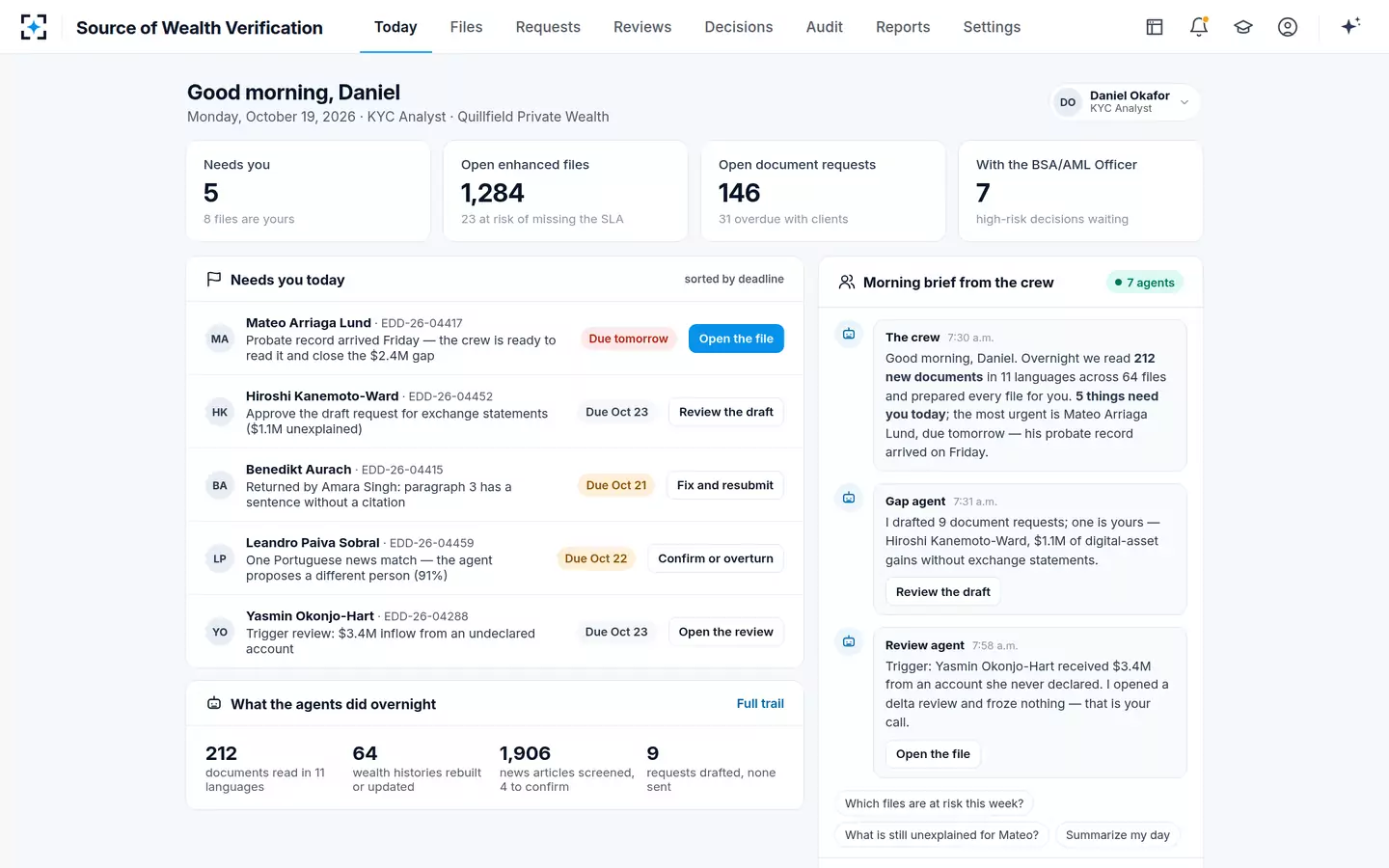
What is the cost of KYC per client? A worksheet for one enhanced file
Cost per client is a blend of cheap standard files and expensive enhanced ones, so price the enhanced file on its own. The worksheet below lists the lines to measure, how to measure each, and Botminds' estimate where one exists. Fill the right-hand column from a sample of your own recent files: twenty is enough to see the shape.
Cost-per-file worksheet for one enhanced source of wealth file
| Line item | How to measure it | Botminds' estimate (days) | Your figure |
|---|---|---|---|
| Reading and translating evidence | Analyst hours on documents; translation invoices per file | 3.0 by hand · 0.2 with agents | hours + $ |
| Re-keying and reconciling to net worth | Hours on the spreadsheet; count of figures keyed | 1.5 · 0.1 | hours |
| Registry, plausibility and adverse media searches | Hours, plus data and registry fees per file | 2.0 · 0.2 | hours + $ |
| Working out what is missing, writing the request | Hours, plus the count of request rounds per file | 1.0 · 0.1 | hours, rounds |
| Narrative and checker rework | Analyst and checker hours; share of files returned | 2.0 · 0.4 | hours, % returned |
| Approval | Officer minutes per decision; files escalated | not estimated | minutes |
| Waiting on the client | Elapsed days between request and reply | not counted | days (no cost line, but it is the calendar) |
How many files can one analyst finish a week?
On Botminds' estimate, about one every two weeks by hand if an analyst did nothing else, and up to about five a week with the agents' reading and drafting done; in practice periodic reviews, trigger reviews and client queries take part of every week, so measure your own throughput rather than adopt either figure. The arithmetic is simply working days available divided by working days per file. What changes the result most is not the reading speed but the rework: a file returned by the checker, or sent back to the client a second time, costs the same hours again.
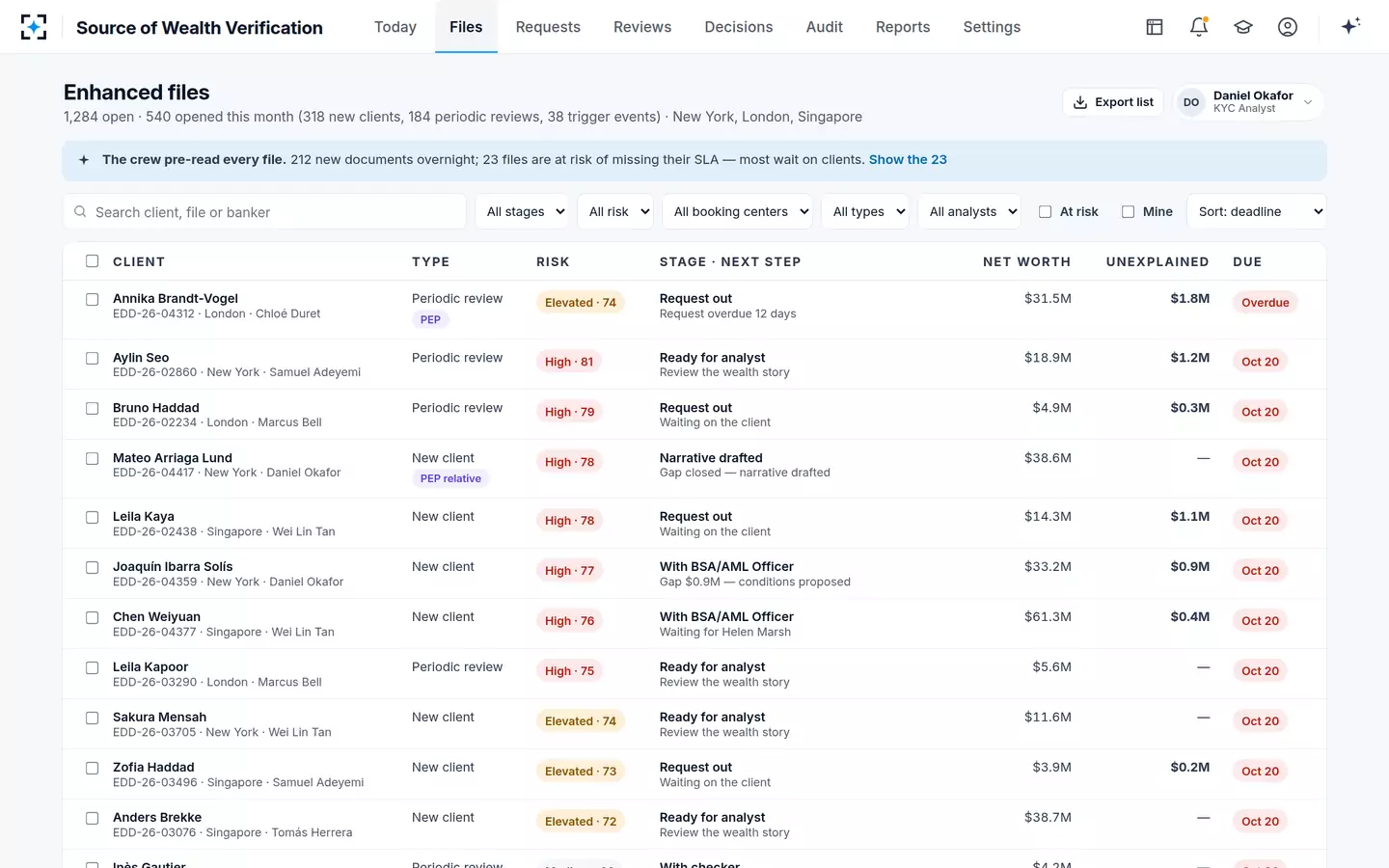
Volume decides whether the line items matter. The solution's fictional firm opened 540 enhanced files in one month, 318 for new clients, 184 periodic reviews and 38 trigger events, across New York, London and Singapore. Periodic reviews are lighter than new-client files, so a firm should price each type separately.
The volume a cost model has to carry: every enhanced file, with its gap and deadline
What software cannot remove: waiting, deciding and bad requests
Three costs survive any tool. The first is the client's time: a request takes as long as the client takes to answer it, which is why the solution's sample firm counts 31 requests overdue with clients and why the estimate above excludes waiting. The second is decision time, which should stay with a person: the BSA/AML Officer's decision, the checker's review, the escalations. The third is rework caused by vague requests, which software only removes if it asks precisely.
The third is where regulators and cost meet. MAS's May 2026 circular tells firms to avoid "multiple rounds of information requests", and says a working group co-led by MAS under the Private Banking Industry Group was "established ... to improve account opening efficiency" (MAS Circular AMLD 05/2026). A file that goes back to the client once instead of three times saves the analyst's hours and the client's patience at the same time. How the agents draft that single request is in source of wealth checks.
What should private banking software do for KYC?
It should make the enhanced file faster without making it thinner. The cost of a thin file is not hypothetical: in 2012 Coutts was fined £8.75 million after the regulator found deficiencies in 73 of 103 high-risk files it reviewed (FSA Final Notice, 23 March 2012), and in August 2026 FinCEN's $125 million penalty against UBS Financial Services warned that risk-based due diligence is not "simply “papering” dispositions of apparent risks" (FinCEN, 3 August 2026). A tool that speeds up papering speeds up the finding.
What to ask private banking software before it touches a source of wealth file
- Show me one of our past files, end to end
Use a closed high-risk file with foreign-language evidence. Time each line of the worksheet against your own record of it.
- Where does each figure come from?
Every amount should open at its document and page, in the original language, with the translation beside it.
- What does it do with a gap?
It should state the unexplained amount in money and name the document that would close it, not mark the file incomplete.
- Who can send a request to the client?
Not an agent, and not the person who approved the request.
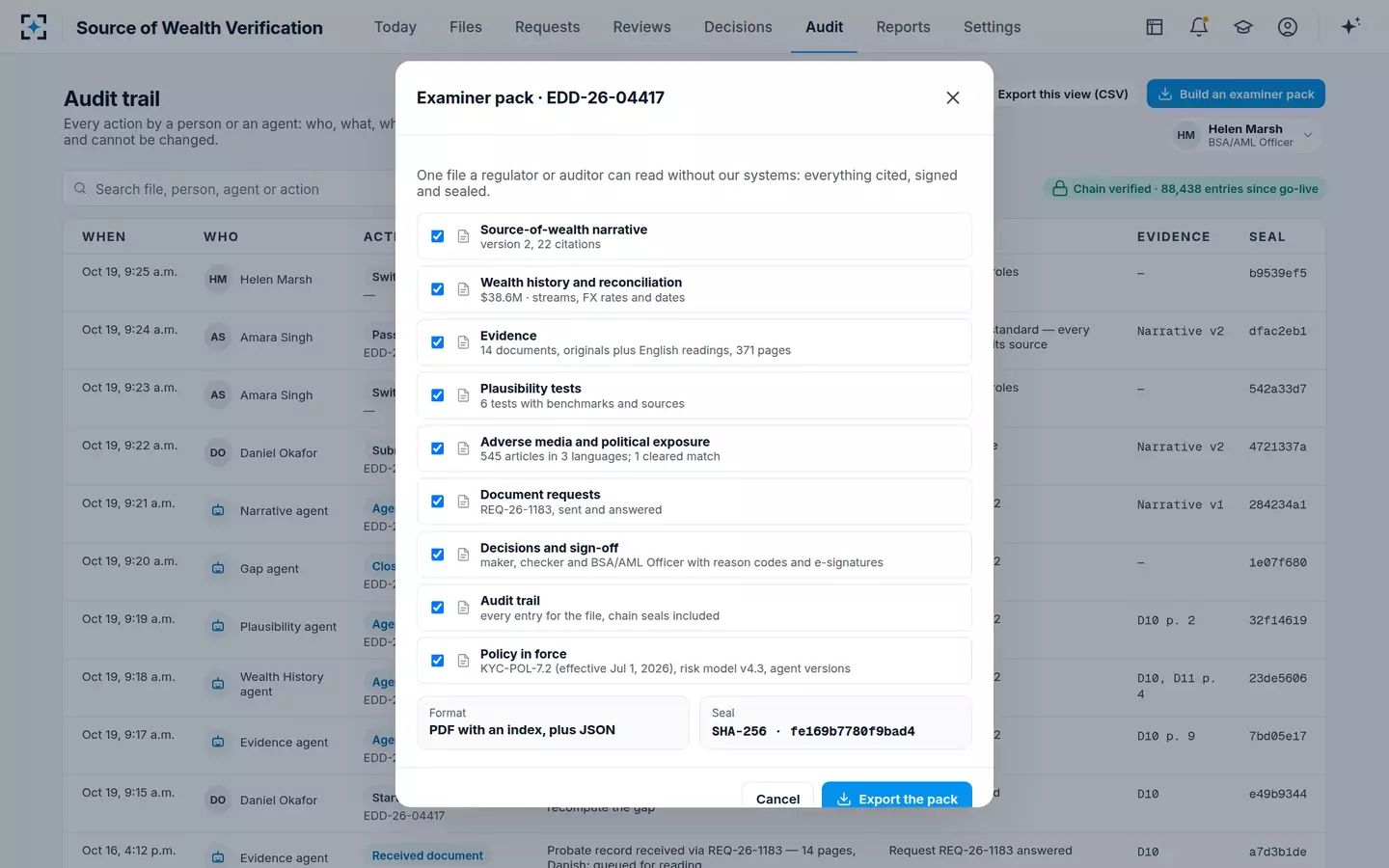
- What will the examiner get?
One export per client: narrative, wealth history, every document with its reading, the tests, the request, the decisions and the policy in force.
- How are thresholds changed?
By a person, with a second approval, re-tested on past decided files before the change goes live.
- Which of our systems does it replace?
For this work, ideally none: it should read from onboarding, screening, CRM and custodian feeds, and write back decisions.
Where Source of Wealth Verification sits in a private banking stack
The solution is one part of the stack, not a replacement for it. It opens enhanced files from the risk model in the client onboarding system and returns decisions and conditions to it; takes sanctions, political-exposure and watchlist results from the screening service; reads news, court and regulatory articles from a multilingual news source and company filings and deal multiples from registry and financial data; sends client requests through the CRM; and reads inflows and holdings from core banking and custodian feeds. Originals are kept in the document archive with their seals and retention holds.
What the cost buys: one export the examiner can read without your systems
It does not hold assets, book trades, run portfolios, screen names, monitor transactions or decide which clients are high risk. If your KYC cost is mostly in standard onboarding of low-risk clients, a client onboarding platform is the better first purchase, and choosing client onboarding software covers that work. If it is in enhanced files with foreign-language evidence, the worksheet above will show it, and the source of wealth checklist sets out what to prepare before go-live. The Source of Wealth Verification page shows the full sample file, and who signs the file covers the three signatures the cost model should never remove.
Questions people ask
What is private banking software?
A broad term for the systems a private bank runs: core banking and custody, portfolio management, client onboarding and KYC, CRM and client portals. For KYC buyers, the useful distinction is between onboarding platforms that collect standard information and tools for the enhanced file that proves source of wealth for high-risk clients.
Is there an industry benchmark for KYC cost per client?
Not from a regulator or an independent study for source of wealth files; FinCEN's own burden estimate for US private-banking due diligence counts program maintenance only, because the number of accounts could not be obtained. Build the figure from a sample of your own files.
Which part of the file costs most by hand?
In Botminds' estimate, reading and translating foreign-language evidence, about three of nine and a half business days, followed by searches and by the narrative with its rework. Your mix will depend on how much of your clients' evidence is in English.
Does faster onboarding mean weaker due diligence?
Not if the time saved is reading and re-keying rather than checking and deciding. MAS's 2024 circular asks firms to minimise "any undue delay to the onboarding of legitimate customers" while corroborating the material sources; the saving should come from the mechanical lines, with the checker and approver steps intact.
How do I build the business case?
Price twenty recent high-risk files with the worksheet, multiply by annual volume per file type, and compare with a vendor's run on a few of the same files. Count the returned files and repeat requests separately; they are often the largest saving.