Source of wealth vs source of funds is the difference between two questions a private bank or wealth manager asks a high-risk client. Source of funds asks where the particular money arriving in this relationship came from: the sale proceeds, the salary, the account it is wired from and the activity that filled that account. Source of wealth asks how the client came to own their entire body of wealth: the business built and sold, the inheritance, the career, the growth. The first is about one flow; the second is about a life. The work is hard because the two answers need different evidence, often in other languages, and because the rules do not ask for them in the same words. Botminds' Source of Wealth Verification exists to put both answers in one file, every amount cited to its page, before the BSA/AML Officer signs.
The rule texts below are quoted from the regulators' own pages. The worked example is a fictional client, Mateo Arriaga Lund, from the solution's sample data.
Source of wealth vs source of funds, row by row
Source of funds: Where did the money for this account, deposit or transfer come from, and what activity generated it?
Source of wealth: How did the client acquire everything they own, from the first capital to today?
Source of funds: One flow, or the flows expected through the relationship.
Source of wealth: The entire body of wealth, including assets held elsewhere.
Source of funds: Statement of the sending account, sale completion statement, payslip credit, the bank advice for the wire.
Source of wealth: Sale agreements, probate records, tax returns, audited accounts, custodian statements over years.
Source of funds: Named: 31 CFR 1010.620(b)(3) for private banking accounts of non-US persons.
Source of wealth: Not named. FinCEN removed "sources of wealth" from the 2002 proposal in its 2006 final rule.
Source of funds: Named for PEPs and other high-risk cases.
Source of wealth: Named beside source of funds in the same sentences.
Source of funds: At onboarding, and again for any large or unusual inflow.
Source of wealth: At onboarding, refreshed at each periodic or trigger review.
Source of funds: The file names the sending bank and stops.
Source of wealth: The file restates the client's own account of their life.
What is source of wealth, and what is source of funds?
Source of wealth is how a client acquired their total wealth; source of funds is the origin of the money in the relationship and the activity that produced it. Those are not our paraphrases. The FCA's 2024 review of how firms treat politically exposed persons defines source of funds as "the origin of the funds in the business relationship or occasional transaction", adding that it "refers to the activity that generated the funds, for example salary payments or sale proceeds, as well as the means through which the customer’s or beneficial owner’s funds were transferred." Source of wealth, in the same glossary, "describes how a customer has acquired their total wealth" (FCA, The treatment of politically exposed persons, July 2024).
The Monetary Authority of Singapore says the same at greater length, and adds two details that matter in practice. Source of wealth "generally refers to the origin of the customer’s and beneficial owner’s entire body of wealth (i.e. total assets), and includes seed money that generated subsequent wealth and gifts or other assets (if any) received", and it "relates to how the customer and beneficial owner have acquired the wealth, which is distinct from identifying the assets that they own" (Guidelines to MAS Notice 626, paragraph 8-5-5). A list of assets is therefore not a source of wealth answer. A schedule showing a house in Monterrey, a flat in London and a portfolio in Copenhagen says what the client owns. It says nothing about how he came to own it.
The same guidelines define source of funds as "the origin of the particular funds or other assets which are the subject of the establishment of business relations", such as the amounts invested, deposited or wired (paragraph 8-5-6). The scope is narrower, but the depth is not: the inquiry is meant to reach the activity behind the money, not stop at the bank it came from.
Why do banks ask for source of funds, and why for source of wealth as well?
Banks ask for source of funds so they can tell whether the money entering an account is the proceeds of crime, and so they have a baseline against which to judge later transactions. The US private-banking rule makes the second purpose explicit: once a firm has found out where the money deposited into a private banking account came from and what the account is for, it must review the account's activity against that information (31 CFR 1010.620(b)(3)–(4)).
Source of wealth answers a question source of funds cannot. A transfer can come from a clean account at a well-regulated bank and still be the end of a long chain that began with a bribe. The money is laundered by the time it moves; the wealth story is where the inconsistency shows. That is why each rule quoted on this page asks for source of wealth in the cases with the most concealment risk: politically exposed persons, clients from high-risk countries, and private banking, where one relationship can hold tens of millions. MAS put the purpose in one line in its 2024 circular to wealth managers: establishing source of wealth helps firms "form a clearer understanding of their customers and the legitimacy of the customers’ assets" and informs ongoing monitoring.
Two questions, and how far the rules reach
$1M
minimum aggregate deposit that makes a US private banking account, for non-US owners
31 CFR 1010.605(m)
2006
the year FinCEN took "sources of wealth" out of the US private-banking rule text
71 FR 496
4
regimes compared here; three of them name source of wealth in their rule text
UK, EU, Singapore
Does US law require source of wealth?
No US regulation requires source of wealth in those words; the private-banking rule requires source of funds, and FinCEN removed source of wealth from the text on purpose. FinCEN's 2002 proposal for the section 312 private-banking rule would have required firms to ascertain the identity of each owner "as well as information on their lines of business and sources of wealth". The final rule of January 2006 dropped the phrase, and the preamble says why, and what it still expects.
"The final rule modifies this provision to more accurately reflect the wording of the statute, which does not refer to lines of business or sources of wealth. However, … part of an institution's due diligence may often include a review of the individual's lines of business and sources of wealth."
FinCEN, final rule on special due diligence programs, 71 FR 496, 4 January 2006
So the US position is narrower in law and similar in practice. The 2016 customer due diligence rule's preamble describes broker-dealers being expected, at account opening, to "inquire about the source of the customer's assets and income so that the firm can determine if the inflow and outflow of money and securities is consistent with the customer's financial status" (FinCEN, 81 FR 29398, May 2016). The 2020 interagency statement on politically exposed persons adds that some wealth management accounts fall outside the rule's definition of a private banking account and can still carry a higher risk of illicit finance (Federal Reserve, FDIC, FinCEN, NCUA and OCC, 21 August 2020). A US firm that asks only for source of funds on a $40 million relationship is within the letter of 1010.620, and short of what FinCEN itself said due diligence "may often include".
The source of wealth requirements in each jurisdiction are set out side by side on a separate page, with dates. The point here is the vocabulary: when a US procedure says "source of funds", read whether it means the deposit or the life. Many mean both.
Where the UK, EU and Singapore name both
Outside the US, the two terms sit in the same sentence of the rule. The UK Money Laundering Regulations 2017 require a firm dealing with a politically exposed person, family member or known close associate to take adequate measures to establish both the source of wealth and the source of funds behind the relationship (regulation 35(5)(b)), and for a person established in a country on the FATF's call-for-action list, enhanced due diligence must cover both for the customer and its beneficial owner (regulation 33(3A)(c)). The rule text for each jurisdiction, side by side, is in source of wealth requirements in the US, UK, EU and Singapore.
Who names source of funds, who names source of wealth
| Rule | Source of funds | Source of wealth | Applies to |
|---|---|---|---|
| US: 31 CFR 1010.620(b)(3) | Required | Not in the text | Private banking accounts of non-US persons, $1M minimum |
| US: CDD rule preamble (2016) | Expected | "source of the customer's assets and income" | Broker-dealers at account opening |
| UK: MLR 2017 reg 35(5)(b) | Required | Required | PEPs, family members, known close associates |
| UK: MLR 2017 reg 33(3A)(c) | Required | Required | Customers established in FATF call-for-action countries |
| EU: AMLR Art 42(1)(b), from 10 July 2027 | Required | Required | Politically exposed persons |
| EU: AMLR Art 34(4)(c), from 10 July 2027 | May be required | May be required | Other higher-risk relationships |
| Singapore: MAS Notice 626, 8.3(b) and 8.7 | Required | Required | PEPs and customers assessed as higher risk |
The EU's new single rulebook, which applies from 10 July 2027, does the same for politically exposed persons, again naming both sources in one duty (Regulation (EU) 2024/1624, Article 42(1)(b)). For other higher-risk cases, Article 34(4)(c) lets enhanced due diligence include gathering more information on both. Singapore's MAS Notice 626 requires banks to establish both, by appropriate and reasonable means, for a politically exposed customer and any beneficial owner, and extends the same measures to any customer it assesses as higher risk (paragraphs 8.3(b) and 8.7).
One client, two answers: the sample file
Take the solution's sample client. Mateo Arriaga Lund, 54, a Mexican and Danish citizen living in Monterrey, plans to book $24.0 million with a New York private bank. His two answers look like this.
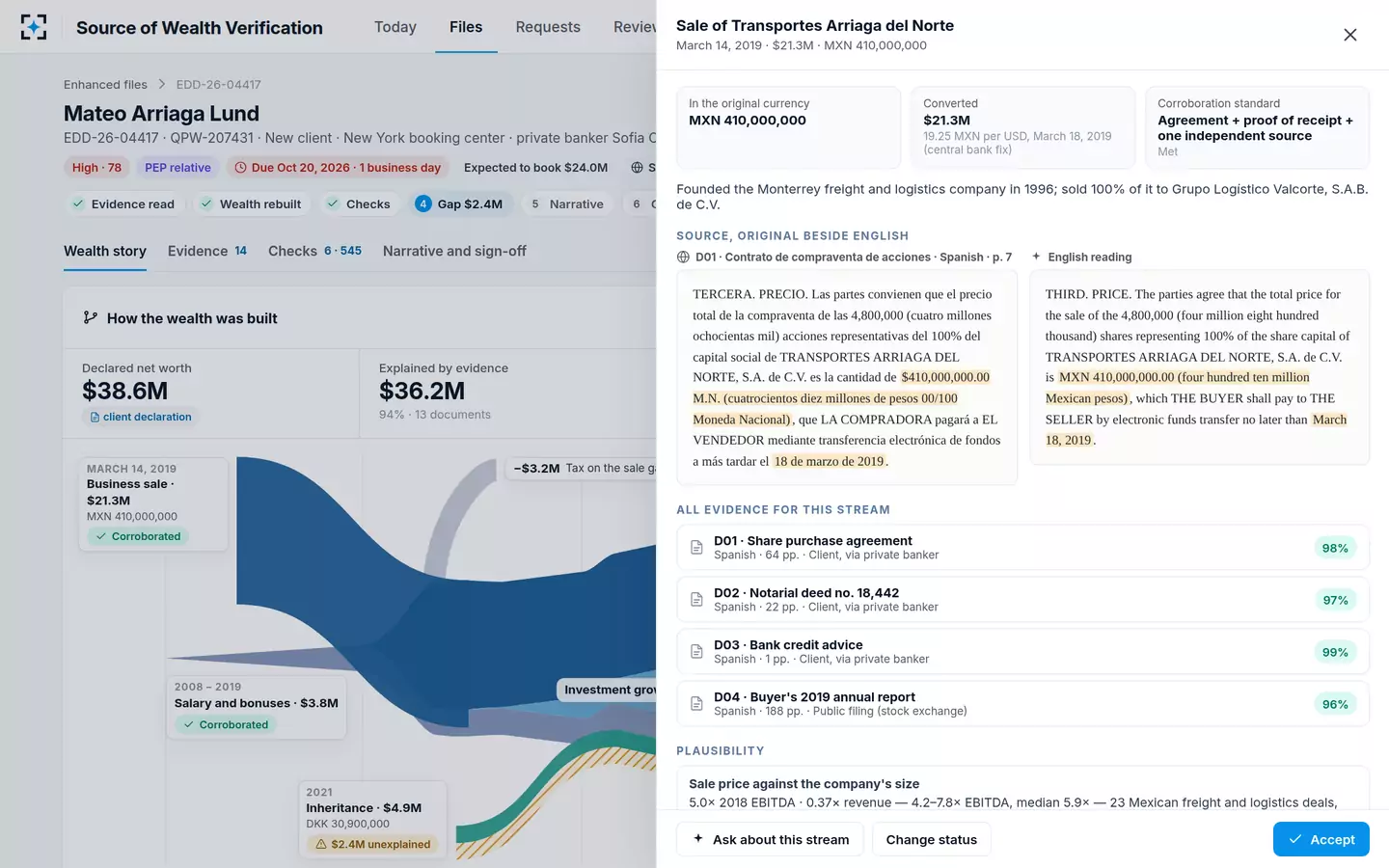
His source of funds is one line of the narrative: the initial $24.0 million will be transferred from his own account at Øresund Privatbank in Copenhagen. His source of wealth is a $38.6 million history in four streams: the 2019 sale of the logistics company he founded in 1996 ($21.3 million, after converting MXN 410,000,000 at the rate on the day the money arrived), salary and bonuses from 2008 to 2019 ($3.8 million), a 2021 inheritance from his mother's estate in Aarhus ($4.9 million), and investment growth since the sale ($11.8 million), less $3.2 million of tax on the sale gain. Each stream has its own documents: a Spanish share purchase agreement, a notarial deed, tax returns, a Danish lawyer's letter and probate record, custodian statements.
Source of Wealth Verification: one narrative, both answers, each sentence cited
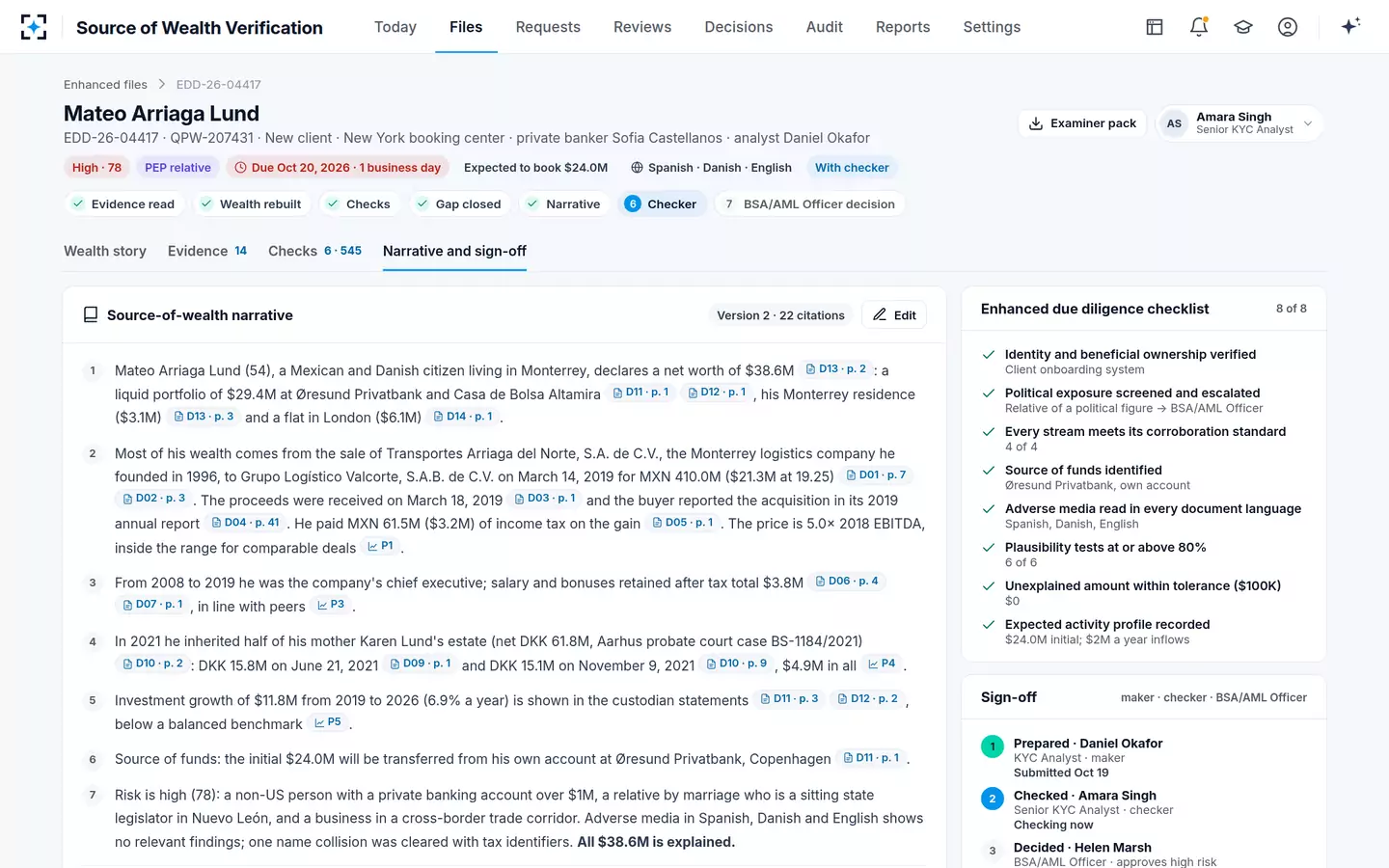
The two answers have to agree. A $24.0 million transfer must fit inside a $29.4 million liquid portfolio, and that portfolio must be explained by the streams. If a client declared $10 million of wealth and wired $24 million, the file would have a source-of-funds answer and a source-of-wealth problem.
"The other bank" is not a source of funds
The most common weak source-of-funds answer names the bank the money comes from and stops. MAS addresses it directly: a bank "should not limit its source of funds inquiry to identifying the other FI from which the funds have been transferred, but more importantly, the activity that generated the funds", and the information obtained "should be substantive" (Guidelines to MAS Notice 626, 8-5-6). A first-party transfer from a regulated bank proves the client controls the sending account. It does not prove what filled it.
The UK guidance is more relaxed for lower-risk relationships, and the difference is worth knowing. In FG25/3 the FCA says adequate measures "will vary according to the risks assessed", and that "for lower risk products or relationships, reliance might be placed on funds coming from credit or financial institution." For higher-risk relationships the same guidance expects firms to "take more intrusive and exhaustive steps". A firm with clients in London and Singapore therefore cannot write one source-of-funds standard; it needs the stricter one wherever the client is high risk, which in private banking is most of the book.
In the sample file, the narrative's source-of-funds line names the Copenhagen account; the activity behind that account is what the rest of the file evidences, from the sale proceeds received on 18 March 2019 to seven years of custodian statements. A reviewer checking the two answers should be able to walk from the wire to the stream that paid for it.
Source of funds traced to the activity: sale proceeds, not just a sending bank
When the two answers must be refreshed
Source of funds is refreshed by events; source of wealth by time and by change. The US rule's ongoing duty is about funds: a deposit that does not fit the client's stated source of funds and expected use should be noticed. FinCEN's 2006 preamble says firms are not expected "to verify the source of every deposit placed into every private banking account", but that "a single, large deposit may warrant additional scrutiny if it is unusual" (71 FR 496). The source-of-wealth answer goes stale differently: a client sells a second business, inherits, moves country, or takes public office.
The EU's new rule puts a ceiling on how stale customer information may get: the gap between updates may never be longer than one year for higher-risk customers under enhanced measures, and five years for all others (AMLR Article 26(2), from July 2027). In the solution, the fictional firm's settings run reviews at 12, 24 and 36 months by risk, and a large inflow, over $2 million or 20% of declared net worth from a source not declared, opens a review of the wealth story without freezing the account.
Questions that separate the two answers in a file
- Does the source-of-funds line name an activity, not only an account?
Sale proceeds, salary, a dividend, a loan drawdown. "Transferred from his account at another bank" names a route.
- Does the transfer fit inside the explained wealth?
The amount wired should be smaller than the liquid wealth the source-of-wealth history accounts for.
- Does the source-of-wealth answer cover the whole body of wealth?
Including assets held elsewhere, which MAS says the firm should seek to understand even though it does not hold them.
- Is each stream dated and in its original currency?
A sale in pesos and an estate in kroner convert at the rate on the day the money moved.
- Is any unexplained part stated in money?
An approver can weigh "$2.4 million of an inheritance not yet evidenced". "Further documents requested" says nothing.
- Which rule does the file answer to?
US private banking needs funds; UK, EU and Singapore politically exposed persons need both. A cross-border client usually needs both.
How Source of Wealth Verification keeps both answers in one file
The solution treats the two answers as linked parts of one file rather than two forms. Its Wealth History agent rebuilds the client's wealth as dated streams, converts each at the rate on its date, and reconciles the total to the declared net worth; a declared amount without a document stays unexplained. Its Narrative agent writes both the source-of-wealth and the source-of-funds paragraphs, and may not state a figure without a source. An analyst prepares, a different senior analyst checks, and the BSA/AML Officer decides; the agents never submit or decide.
What it does not do is decide which rule applies to which client. That is the firm's policy, set as settings a second person approves. How the evidence behind each stream is graded is covered in source of wealth documents, and the file's starting point, the client's own account, in the source of wealth declaration template. For a different reader, the written narrative itself, Enhanced Due Diligence Review's guide on how to write a source of wealth narrative goes paragraph by paragraph. The solution page is Source of Wealth Verification.
Questions people ask
What is source of wealth in KYC?
In KYC, source of wealth is the explanation, with evidence, of how a customer acquired their total wealth: business ownership, employment, inheritance, investments, gifts. MAS defines it as the origin of the customer's "entire body of wealth (i.e. total assets)", including seed money. It is part of enhanced due diligence, not standard onboarding, in every regime compared here.
Is source of funds the same as proof of funds?
No. Proof of funds shows that money exists, such as a bank letter confirming a balance. Source of funds shows where that money came from and what activity produced it, which is why MAS says the inquiry should not stop at the bank that sent it.
Does every client need a source of wealth check?
No. The rules ask for it in higher-risk cases: politically exposed persons and their families and associates, clients linked to high-risk countries, private banking, and other relationships a firm rates high risk. The UK's FG25/3 says that even for lower-risk politically exposed persons a firm still has to ask about source of wealth, using information it already holds where it can.
Which comes first, source of funds or source of wealth?
Most firms collect the source-of-wealth declaration first, because it frames what the incoming funds should look like. The source-of-funds evidence then has to fit inside it: the transfer should come from wealth the history already explains.
What does the FCA say source of funds means?
In its July 2024 review of politically exposed persons, the FCA defined source of funds as the origin of the funds in the relationship, the activity that generated them, "for example salary payments or sale proceeds", and the means by which they were transferred. Source of wealth, in the same glossary, is how a customer acquired their total wealth.
Do US broker-dealers have to ask about source of wealth?
No rule names it, but FinCEN's 2016 customer due diligence rule describes broker-dealers being expected to inquire about "the source of the customer's assets and income" at account opening. In August 2026 FinCEN's $125 million penalty against a broker-dealer serving wealthy clients cited, among other failures, risks tied to customers' source of wealth that the firm had not appropriately considered.