A source of wealth narrative is the paragraph of an enhanced due diligence file that explains how a customer built the wealth or the business behind its account, and it works only if it is written as an argument. It makes a claim (the wealth came from twenty-two years running a freight company, sold in 2023), cites the evidence for each part of the claim (the sale agreement, the tax returns, the closing statement), and tests plausibility (is that much wealth consistent with the customer’s age, career and the activity the bank sees). Source of funds is the narrower question of where the money in this account came from. Most weak narratives fail because they describe the customer instead of proving anything. Botminds’ Enhanced Due Diligence (EDD) Review drafts the narrative as part of a memo in which every sentence carries the document it came from, and the analyst decides what it proves.
Anatomy of a narrative that holds: claim, evidence, plausibility, gap closed
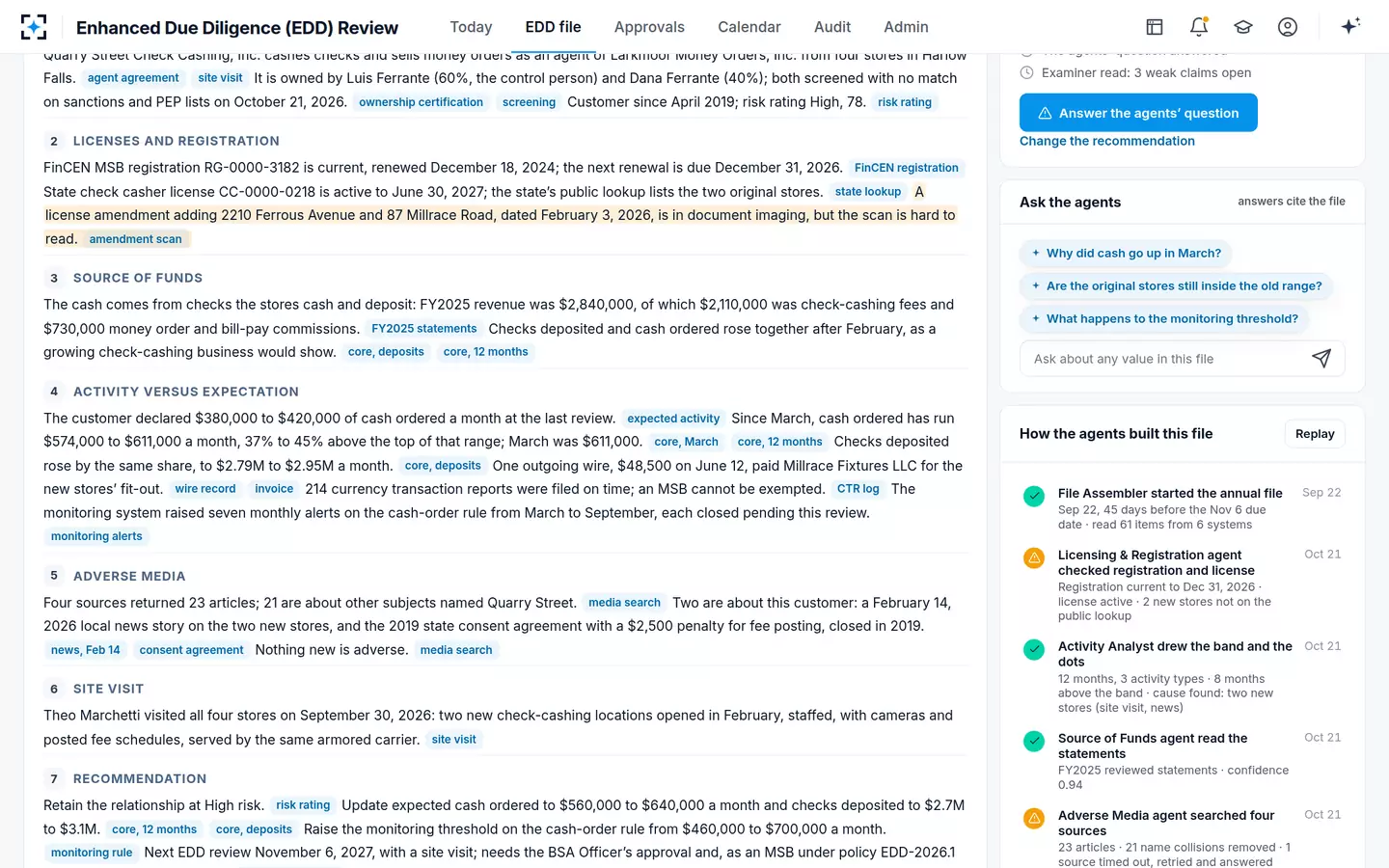
“The cash comes from checks the stores cash and deposit.”
One sentence that says where the money comes from, in terms that can be proved or disproved.
“FY2025 revenue was $2,840,000, of which $2,110,000 was check-cashing fees and $730,000 money order and bill-pay commissions.” FY2025 statements
Numbers from a named document, broken down so the claim’s mechanism is visible: fees and commissions, not just revenue.
“Checks deposited and cash ordered rose together after February, as a growing check-cashing business would show.” core, deposits core, 12 months
A test against the bank’s own data: if the business story is true, these two series should move together. They do.
“Interim statements to June 30, 2026 show six-month revenue of $1,720,000, up 21% on the same half of 2025, in line with the new stores.” interim statements
The year-end statements predate the expansion they are meant to explain. Newer evidence closes the gap the reviewer named.
What is a source of wealth narrative?
It is the written explanation, in an EDD file, of the origin of a customer’s entire body of wealth. FATF’s guidance on politically exposed persons draws the line that the rest of the industry uses: “The source of wealth refers to the origin of the PEP’s entire body of wealth (i.e., total assets). This information will usually give an indication as to the volume of wealth the customer would be expected to have, and a picture of how the PEP acquired such wealth” (FATF Guidance on Politically Exposed Persons, 2013).
Two words in that definition matter for writing. “Volume” means the narrative has a number in it: wealth of about a certain size, from which the bank can judge whether the account’s activity fits. “Picture” means it has a sequence: how the wealth was acquired, in an order a reader can follow. A narrative with neither is a label.
In the US the requirement is narrower than the practice. The only regulation that names source of funds is the private banking rule, which requires reasonable steps to find out where the funds deposited into a private banking account come from, and the account’s purpose and expected use (31 CFR 1010.620(b)(3)). The FFIEC lists “the source of the client’s wealth and estimated net worth” among the information a bank’s risk-based private banking procedures may consider (FFIEC BSA/AML Manual, private banking). For other high-risk customers, the bank’s EDD policy decides when a narrative is needed.
Source of funds vs source of wealth: what is the difference?
Source of funds is where the money in this relationship came from; source of wealth is how the customer came to have everything it owns. FATF’s guidance is explicit that “‘Wealth’ and ‘funds’ are two different concepts”, and describes source of funds as “the origin of the particular funds or other assets which are the subject of the business relationship”, such as the amounts deposited, invested or wired. It adds that this information “should not simply be limited to knowing from which financial institution it may have been transferred. The information obtained should be substantive.”
Source of funds vs source of wealth, with examples
Source of funds: Where did the money coming into this account come from?
Source of wealth: How did the customer come to have the wealth it holds?
Source of funds: This deposit, this wire, this year’s inflows.
Source of wealth: The customer’s total assets, built over years.
Source of funds: $1.2 million wired in from the customer’s brokerage account, which received it from the sale of a company.
Source of wealth: Twenty-two years building a freight company, sold in 2023; a salary before that; a house bought in 1998.
Source of funds: Check-cashing fees and money order commissions deposited by four stores.
Source of wealth: A business opened in 2019 and grown to four stores, funded by the owners’ capital and retained earnings.
Source of funds: Bank or brokerage statements showing the incoming funds and their immediate origin; invoices; a sale settlement.
Source of wealth: Tax returns, financial statements, sale agreements, probate papers, property closing statements, employment history.
Source of funds: That the money traces to a substantive origin, not just another account.
Source of wealth: That the amount is plausible for the customer’s age, work and history.
The difference decides which documents prove the claim. A brokerage statement can prove source of funds for a wire and still say nothing about how the customer came to own the brokerage account. Narratives that confuse the two tend to stop one step too early: “funds transferred from the customer’s account at another bank” is a source of funds statement without a source.
How to write it: three parts an examiner can follow
Write the claim first, in one sentence that could be wrong. Then give each part of the claim its evidence, with the document named and the number quoted. Then test plausibility against something the bank knows independently: age, career length, business size, the customer’s own activity. The figure at the top of this page shows the order on a real-shaped paragraph.
The claim must be specific enough to fail. “The customer is a successful businessman” cannot fail; “the customer’s wealth comes mainly from the 2023 sale of his 70% stake in a freight company, for about $9.5 million after tax” can, and that is what makes it useful. A reviewer can check the sale agreement, the tax return for 2023 and the date the proceeds arrived.
The evidence must be attached, not mentioned. Every number in the narrative should point to a page. In the solution each sentence of the memo ends with labels for its sources, and clicking a label opens the passage it came from; that is the standard to aim for even in a hand-written file. Where a document could not be read with confidence, the narrative should say so rather than assert around it.
A source of funds paragraph where every sentence carries its document
How to verify source of wealth
Verify the events that created most of the wealth, with documents produced by someone other than the customer. A customer’s own declaration is a starting point, not evidence. FATF accepts that a bank may lack documents for assets it does not hold, and notes it “may be possible to gather general information from commercial databases or other open sources”; the narrative should say which source supports which part.
Source of wealth documents, by how the wealth was made
| Origin of wealth | Documents that prove it | What to check |
|---|---|---|
| Employment income | Tax returns, wage statements, an employment contract | Years worked and pay level make the total plausible after living costs |
| Sale of a business | Sale and purchase agreement, closing statement, tax return for the year of sale | The customer owned the stake sold; the proceeds match what arrived |
| Business ownership | Audited or reviewed financial statements, business tax returns, dividend records | Profits and distributions over the period support the wealth claimed |
| Inheritance or gift | Probate or estate papers, a will, a gift letter with the donor’s own evidence | The estate’s size and the customer’s share; the donor’s source in turn |
| Property sale | Settlement or closing statement, title records | Purchase price, sale price and timing |
| Investments | Brokerage statements over several years, tax forms showing gains | Growth is consistent with the market and the starting capital |
How to verify source of funds, and how far back to go
Verify source of funds by tracing the money that funds or flows through the account back to a substantive origin: a sale, a salary, a business’s receipts. For a single large deposit that usually means the statement that shows the funds leaving the previous account, plus the document that explains how they got there. For a business, it means tying the account’s inflows to the business’s revenue, as the check casher’s narrative above does with its fees and commissions.
No US rule sets a look-back period for source of funds. The private banking rule asks the bank to ascertain the source of funds deposited, and FATF asks for “reasonable measures”; the EU’s AML Regulation, from July 2027, asks for “adequate measures” to establish source of wealth and funds for politically exposed persons (Regulation (EU) 2024/1624). A defensible rule of thumb is to go back as far as it takes to reach an origin that does not raise the same question again. A transfer from the customer’s own savings account is not an origin; the salary or sale that filled it is.
For a business customer with steady activity, the look-back is set by the expectation the bank is testing. One bank told GAO it asks for three months of some high-risk businesses’ prior statements to establish their typical cash and wire volume (GAO-18-263). For the annual review of an existing customer, the bank’s own twelve months of activity is usually the better evidence, because it cannot be curated by the customer.
Plausibility: the test most narratives skip
Plausibility compares the narrative with what the bank can see for itself. Does the wealth fit the customer’s age and career? Does the business’s revenue fit its size and staff? Does the account’s activity fit the wealth and the business? A narrative that passes the first two and fails the third is not finished; it has found the question the file exists to answer.
Enforcement orders show what failing that test looks like. FinCEN’s October 2026 order against Bank of America describes a small-to-medium commercial customer that expected $1 million to $4 million a year in sales and then received wires from high-risk jurisdictions many orders of magnitude larger (FinCEN consent order 2026-03; expected account activity reads the case). The expectation was in the file. Nobody tested it against the wires.
The UBS order of August 2026 shows the same failure at the source of wealth end: a customer’s income had a nexus to Russian sources that the firm did not evaluate, so the customer was rated low risk and never reached EDD (FinCEN consent order 2026-02). The question “where does this customer’s money really come from” was never asked, and FinCEN spelled out what asking it would have found.
Such enhanced due diligence could have identified that Customer 1 earned consulting income from his work for a project associated with a Russian oligarch through at least 2017, years after this oligarch was designated by the U.S. Office of Foreign Assets Control (OFAC).
FinCEN, Consent Order No. 2026-02 with UBS Financial Services, August 2026
Source of wealth narrative examples
Two short examples show the structure. The first is hypothetical; the second is the fictional check casher from the solution’s sample data.
A private banking client (hypothetical). “The client, 61, is a non-US national whose wealth comes mainly from the 2023 sale of his 70% stake in a regional freight company, which he founded in 2001. The sale agreement dated March 14, 2023 shows a price of $12.4 million for his stake; his 2023 tax return shows a gain of $11.8 million and tax paid of $2.9 million. The $8.6 million wired to open the account on April 2 left the escrow account named in the closing statement. Before 2001 he was a salaried manager for 14 years; that period explains the house he bought in 1998 but not the current wealth. Net worth of about $10 million is consistent with the sale, the tax paid and his age. No adverse media.” Every sentence names its document, the numbers reconcile, and the paragraph says what the earlier career does and does not explain.
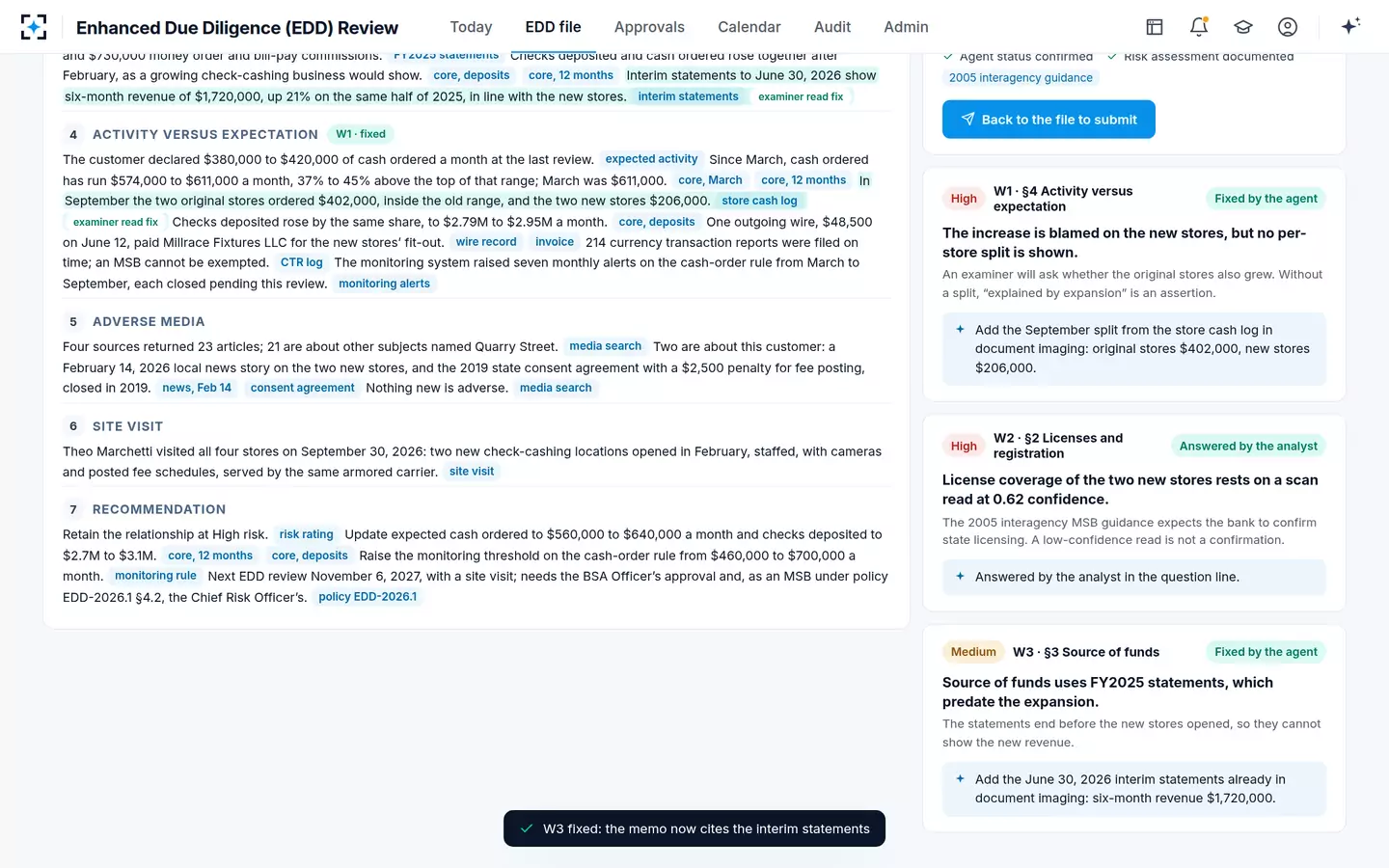
A money services business (fictional sample data). The Quarry Street paragraph in the figure above makes the business version of the same argument, and its weak point is instructive. A second read by the solution’s Examiner Reader flagged that the FY2025 statements ended before the two new stores opened, so they could not show the new revenue. The fix was not a better sentence but newer evidence: the interim statements to June 30, 2026 already in document imaging.
A weak claim in the source of funds paragraph, closed with newer evidence
The weaknesses reviewers find most often
Most weak narratives fail in one of a few predictable ways, and each has a fix that can be checked before the file goes to approval. The list below works as a self-review for analysts and as a test sheet for quality assurance, and measuring whether two reviewers agree on a file is the way to find out whether it is applied consistently.
Seven checks before a source of wealth narrative goes to approval
- Is there a claim that could be wrong?
“Successful entrepreneur” is a description. Name the event, the year and the amount.
- Does each number cite a document?
A figure without its page will be re-checked by the approver, or by the examiner.
- Is the evidence independent of the customer?
Tax returns, statements and public filings, not a self-declaration form alone. Paxos let customers pass EDD with “unverified photographs”.
- Does the evidence cover the period it explains?
Year-end statements cannot explain a change that happened after the year ended.
- Is source of funds traced past the last bank account?
A transfer from the customer’s own account is not an origin.
- Has plausibility been tested against the bank’s own data?
Wealth against age and career; revenue against size; activity against both.
- Does it say what it could not establish?
An honest gap, flagged, is better than a confident sentence that an examiner can break.
Who should write the narrative, and who should check it?
The analyst owns it, because the judgment in the plausibility test cannot be delegated. The gathering behind it can. Most of the hours in a source of wealth narrative go on finding the documents and pulling the numbers out of them, not on deciding what they prove, which is why the solution’s agents assemble the evidence and draft the paragraph, and the analyst reads, corrects and signs. The memo then goes to a checker, usually the BSA Officer, and for relationships with foreign politically exposed persons international standards expect senior management approval (FATF Recommendation 12).
How the narrative fits into the review cycle, and why “consistent with the business” is not a conclusion, is the subject of EDD reviews for high risk clients. What the US requires for politically exposed persons specifically is in PEP enhanced due diligence in the US.
Questions people ask
What is an example of a source of wealth?
The sale of a business, years of employment income, an inheritance, a property sale or long-term investment gains. The narrative names the event that created most of the wealth, with its year and amount, and the document that proves it, such as a sale agreement or tax return.
What documents prove source of wealth?
Documents produced by someone other than the customer: tax returns, financial statements, sale agreements and closing statements, probate papers, brokerage statements over several years. A self-declaration starts the process but does not finish it.
Is source of wealth required under US law?
Not by name for most customers. 31 CFR 1010.620 requires a bank to ascertain the source of funds for private banking accounts of $1 million or more held for non-US persons; beyond that, the bank’s risk-based EDD policy decides when to establish source of wealth. FATF requires both for foreign politically exposed persons.
What is an EDD questionnaire source of wealth narrative?
It is the customer’s own account of how it built its wealth, collected on the bank’s EDD questionnaire. It is useful as the claim to be tested, not as the narrative itself: the bank’s narrative must verify it with independent documents and say where it could not.
How detailed should a source of wealth narrative be?
Detailed enough that a reader who has never met the customer can follow from the evidence to the conclusion: a specific claim, a cited document for each number, and a plausibility check. For most files that is one or two paragraphs, not pages.
Can a bank rely on a customer’s accountant letter?
As one piece of evidence, with care. A third-party letter is only as good as what it attests to and who wrote it; FinCEN’s 2023 action against Bancrédito described ownership accepted on a law-firm letter for a company formed when its supposed owner was a minor.