Expected account activity is the customer's own account, given at onboarding, of how it will use the bank: how much will be deposited, how many wires it will send or receive and to where, what ACH volume it will originate, whether it will use cash. A bank records it as part of understanding the nature and purpose of the relationship, and it becomes the baseline that transaction monitoring compares real activity with. That makes it the onboarding number examiners hold a bank to: when activity later runs far beyond it and nobody noticed, the enforcement order quotes both figures. Botminds' Corporate KYC drafts expected activity product by product from the client's statements and answers, cites the source of every figure, and checks it against the rest of the corporate file.
The sample figures on this page come from a fictional bank and client, Corvane National Bank and Brightwater Cold Chain Holdings, as their file runs through the solution. The cases and rules are real, and linked.
One customer onboarded as a "small-medium" commercial customer with expected annual sales of $1 to $4 million yet which received wires from high-risk jurisdictions amounting to multiple orders of magnitude greater than this expected level of activity.
FinCEN, Consent Order No. 2026-03 with Bank of America, October 13, 2026
What is expected account activity? The meaning in a bank's file
Expected account activity, also called anticipated account activity, means the transactions a bank expects a customer to conduct, described by product, volume, value, frequency and counterparties. FinCEN describes its purpose plainly: the information gathered at account opening "should be used to develop a baseline against which customer activity, such as the customer's expected use of wires or typical number of deposits in a month, can be assessed for possible suspicious activity reporting" (FinCEN CDD FAQs, F.2).
The phrase does not appear in the regulation itself. The AML program rule requires banks to understand "the nature and purpose of customer relationships for the purpose of developing a customer risk profile" and to monitor (31 CFR 1020.210). Expected activity is how most banks make nature and purpose measurable. The one place a regulation names it directly is correspondent banking: the due diligence program for foreign correspondent accounts must assess "the type, purpose, and anticipated activity of such correspondent account" (31 CFR 1010.610).
Is expected activity required for every customer?
No. FinCEN's answer to exactly that question is that the CDD rule "does not categorically require" collecting any particular information beyond what the risk profile, monitoring and beneficial ownership need, and it lists expected activity "on all customers at account opening" among the things not categorically required (FAQ F.4). Understanding nature and purpose, by contrast, "is required for all customers and accounts," and for lower-risk customers it may rest on "inherent or self-evident information, such as the type of customer or type of account."
For a commercial client using wires, ACH origination and a card programme, self-evident information rarely carries the profile. The FFIEC manual says the bank "should gather sufficient information about the customer to form an understanding of the nature and purpose of customer relationships at the time of account opening," and that higher-risk customers warrant more (FFIEC BSA/AML Manual, CDD overview). In practice, expected activity is optional for a small business with a checking account and close to indispensable for a corporate treasury relationship.
Two enforcement orders, one lesson about the onboarding number
$1–4M
expected annual sales recorded for a Bank of America customer that received wires orders of magnitude larger
$1.2B
FinCEN civil money penalty against Bank of America, October 2026, for CDD and monitoring failures
90days
of actual activity Shinhan Bank America used as its monitoring baseline instead of the onboarding answers
$15M
FinCEN civil money penalty against Shinhan Bank America, September 2023
What happens when actual activity exceeds expected: the Bank of America order
When actual activity exceeds expected and the bank does not react, the gap becomes the finding. In its October 2026 order, FinCEN found that Bank of America "failed to develop customer risk profiles that adequately reflected the nature and purpose of its relationships with certain higher risk customers," and that it failed "to timely identify and respond to material deviations between customers' expected activity and their actual transactional activity" (FinCEN, Consent Order No. 2026-03).
The order's detail is instructive. The customer in the quotation above was a vehicle export business classified as "small-medium," and it received "hundreds of millions of dollars in cross-border wires from Eastern Europe." The bank ran quarterly reviews of its elevated- and high-risk customers to check whether activity "remained consistent with their expected activity," yet in some instances staff simply carried the same observations from one quarter into the next, and its limited periodic reviews failed "to capture any information about geographic trends." The expected-activity figure existed; nothing compared it with what the account was doing.
The order also names what the profile left out: the customers' "heavy reliance on third-party payments," which "limited the Bank's visibility into the true source of funds," and their exposure to high-risk jurisdictions, "including indirect exposure through affiliated entities." Both are things an expected-activity section can capture at onboarding: who pays the client, and where its affiliates are.
Collected, then ignored: Shinhan's 90-day baselines
Collecting expected activity is not enough if monitoring never uses it. Shinhan Bank America's policies "required first-line employees to collect information on anticipated account activity from each customer at account opening. However, at times, this information was not validated or transferred over to the TM system." Instead, "TM baselines were established using 90 days of actual activity" (FinCEN, Consent Order No. 2023-03).
The consequence is subtle and important. A baseline built from a customer's own first three months treats whatever the customer did in those months as normal, including activity that was never normal for the business it described. FinCEN put it in one sentence: the bank "measured whether its customers' activity was unusual solely against a benchmark that was set based on the customers' prior account activity, and not based on relevant information obtained at account opening." The onboarding answers are the only benchmark that comes from outside the account.
How to set expected activity for a business, product by product
Set expected activity product by product, in units a monitoring system can compare, with a source for every figure. A single line such as "operating account, $1 to $4 million in sales" cannot be tested against wires. A table by product can.
How to write expected activity a monitoring system can use
Operating accounts
What to stateDeposits a month, by value; main payer types
Where the figure comes fromAudited statements: revenue and receivables; the client’s answer
What monitoring does with itFlags deposits well above the stated level, or from payers the business does not describe
ACH origination
What to stateValue a month and the daily exposure limit; payroll versus vendor credits
Where the figure comes fromPayroll and payables in the statements; the requested limit
What monitoring does with itFlags volume above the limit, or debits where only credits were expected
Domestic wires
What to stateNumber and value a month; main counterparties
Where the figure comes fromStatements and the client’s answer
What monitoring does with itFlags new counterparties and volume spikes
International wires
What to stateNumber and value a month, by country and by named counterparty, including the client’s own affiliates
Where the figure comes fromThe structure chart, the client’s answer, the latest statements
What monitoring does with itFlags any country not on the list, which is how geographic drift is caught
Commercial card
What to stateCards issued and spend a month
Where the figure comes fromThe programme request
What monitoring does with itFlags spend far above the programme
Cash
What to stateExpected cash in and out, or none
Where the figure comes fromThe business model; for cash-intensive trades, prior statements
What monitoring does with itSeparates a business that never uses cash from one that always does
Three choices make the table useful. State a number and a value for each product, not a range copied from the application. Name the countries and, where the client has affiliates abroad, name the affiliates, because flows to a client's own subsidiary are both common and exactly where indirect exposure hides. And cite the document each figure came from, so a reviewer can see whether it rests on last year's statements or this year's.
Anticipated account activity and estimated monthly activity: units that monitoring can test
Anticipated account activity and estimated monthly account activity are the same idea in different forms; the monthly form is usually the useful one. Monitoring scenarios run on daily, weekly and monthly windows, and an annual sales figure has to be divided, guessed and translated before it can be compared with anything. A monthly figure per product can be compared directly.
Expected activity that cannot be tested, and the same client written so it can
Vague: Operating account for general business purposes.
Testable: Consolidating three banks into one treasury relationship for refrigerated warehousing and transport serving food and pharma customers.
Vague: Varies with the season.
Testable: About $39.5M a month, from food and pharmaceutical customers, per FY2025 audited statements.
Vague: Payroll.
Testable: About $23.8M a month of payroll and vendor credits; daily limit $4.2M.
Vague: Domestic and international as needed.
Testable: 64 domestic wires a month, about $15.2M; 22 wires a month to Mexico, about $6.5M, to the client’s Nuevo León subsidiary.
Vague: Relationship manager’s notes.
Testable: FY2025 audited statements and the client’s signed five-question form, each figure cited.
The sample file: expected activity written on last year's statements
On the sample file, the first draft of expected activity was accurate and out of date. The Writer agent drafted it from the FY2024 audited statements, which described a company with no operations outside the United States: deposits of $34.0 million a month, ACH of $21.4 million, 58 domestic wires a month for $14.0 million, and no international wires. The Checker agent, running on a different model, disputed the chapter under the bank's standard requiring the most recent statements, because chapter 1 showed a Mexican subsidiary opened in 2025 and chapter 4 had no Mexico wires.
Expected activity by product, every figure cited, and the checker's dispute
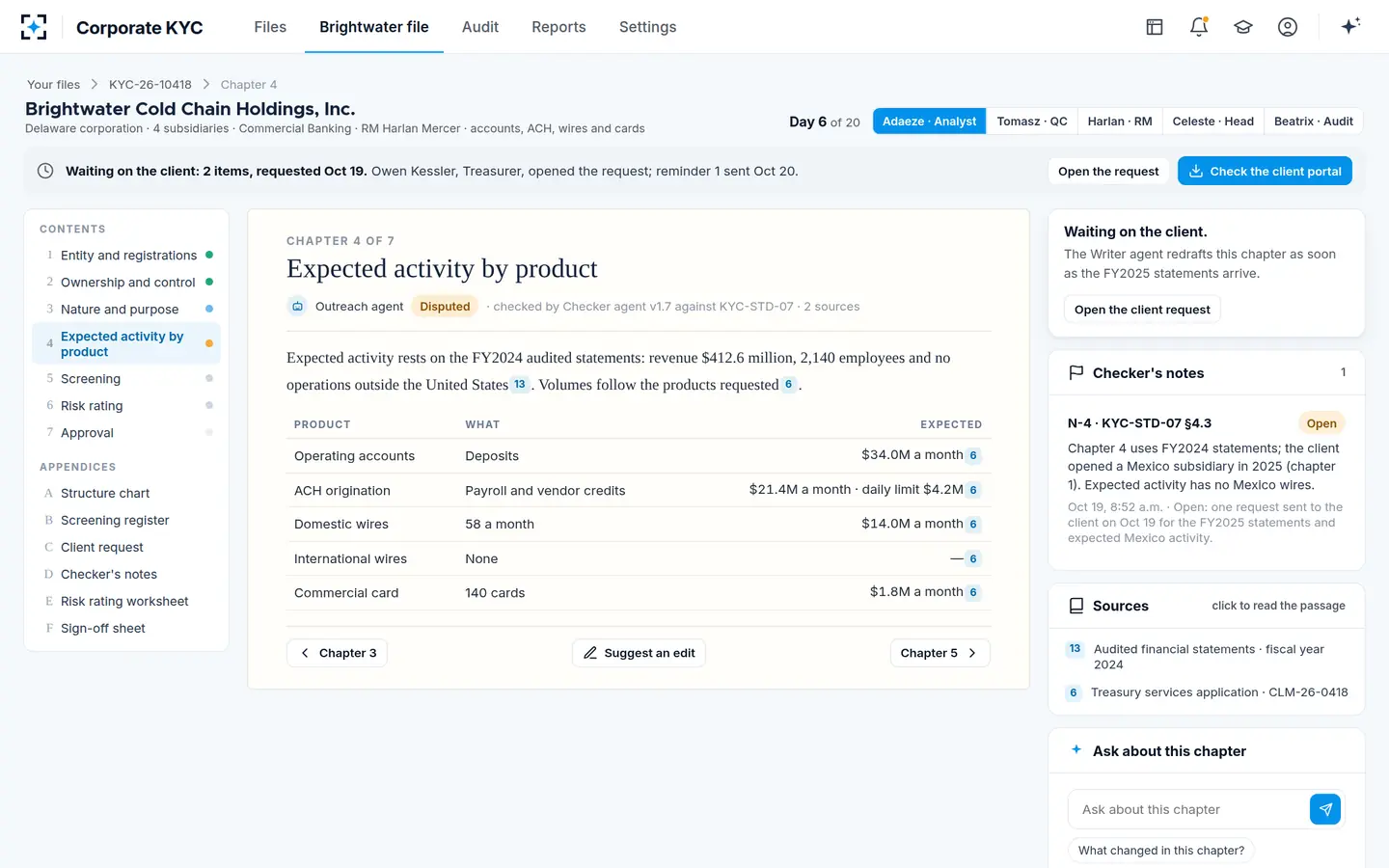
One request went to the client's treasurer for the FY2025 statements and a five-question form on Mexico activity. When they arrived, the chapter was redrafted on the new figures, and the comparison below is the difference between the two versions. The largest change is the one that matters most: a corridor of 22 wires a month to Mexico, about $6.5 million, that the first version did not have at all.
Declared on FY2024 statements, and declared again on FY2025: a monthly corridor appears
The redraft did not stop at chapter 4. The new corridor meant the Mexican subsidiary would receive wires, and it had never been screened, so the Checker agent disputed the screening chapter too. Had the file been approved on the first draft, monitoring would have seen $6.5 million a month to Mexico from a client whose profile said it had no international activity. The file would have recreated, on day one, the gap the Bank of America order describes.
When the business changes: updating expected activity
Update expected activity when monitoring shows the business has changed, not only on a review date. FinCEN's FAQ F.2 says that "if account activity changes, particularly with regard to what should be anticipated based on the original nature and purpose of the account, risk-based monitoring may identify a need to update customer information, including, as appropriate, beneficial ownership." FAQ F.6 adds that there is "no categorical requirement" to update on "a continuous or periodic schedule"; updates are risk based and happen "as a result of normal monitoring."
Regulators have ordered banks to build exactly those triggers. The OCC's 2022 order against USAA Federal Savings Bank required CDD collection at opening, periodically on risk, and whenever an event showed information missing or incomplete, a profile out of date, or activity that did not fit the profile (OCC, EA 2022-008; the full set is in the trigger events regulators have named). A file kept as one record of the client across all its accounts makes those triggers easier to act on, because the expected activity and the structure chart live in the same place.
Expected account activity that will hold up later
- Stated by product, monthly, in number and value
So a monitoring scenario can compare it without translation.
- Countries named, and the client’s own affiliates named
Indirect exposure through affiliates is what the Bank of America order says the profiles missed.
- Third-party payers described
Who pays the client, and whether payments arrive from parties it has no relationship with.
- Every figure cited to a dated document
The latest statements, not the ones that happened to be on file.
- Read against the structure chart
A subsidiary abroad with no matching flow, or a flow with no matching subsidiary, is a question to ask.
- Loaded into monitoring as the baseline
Not replaced by the first 90 days of actual activity, the gap in the Shinhan order.
- Re-opened when activity departs from it
FinCEN FAQ F.2 and F.6: updates follow monitoring, not only the calendar.
Where expected activity feeds the corporate KYC risk rating
Expected activity is an input to the customer risk rating, not the rating itself. The bank's model decides the weights; what the corporate KYC file has to do is make each factor traceable to the activity the client declared. On the sample file the redraft moved the rating from Low, 28 to Moderate, 46 on the bank's model, and two of the factors came straight from the new expected activity: 12 points for international wires to Mexico and 6 for the foreign subsidiary.
The risk rating worksheet, with expected activity as cited factors
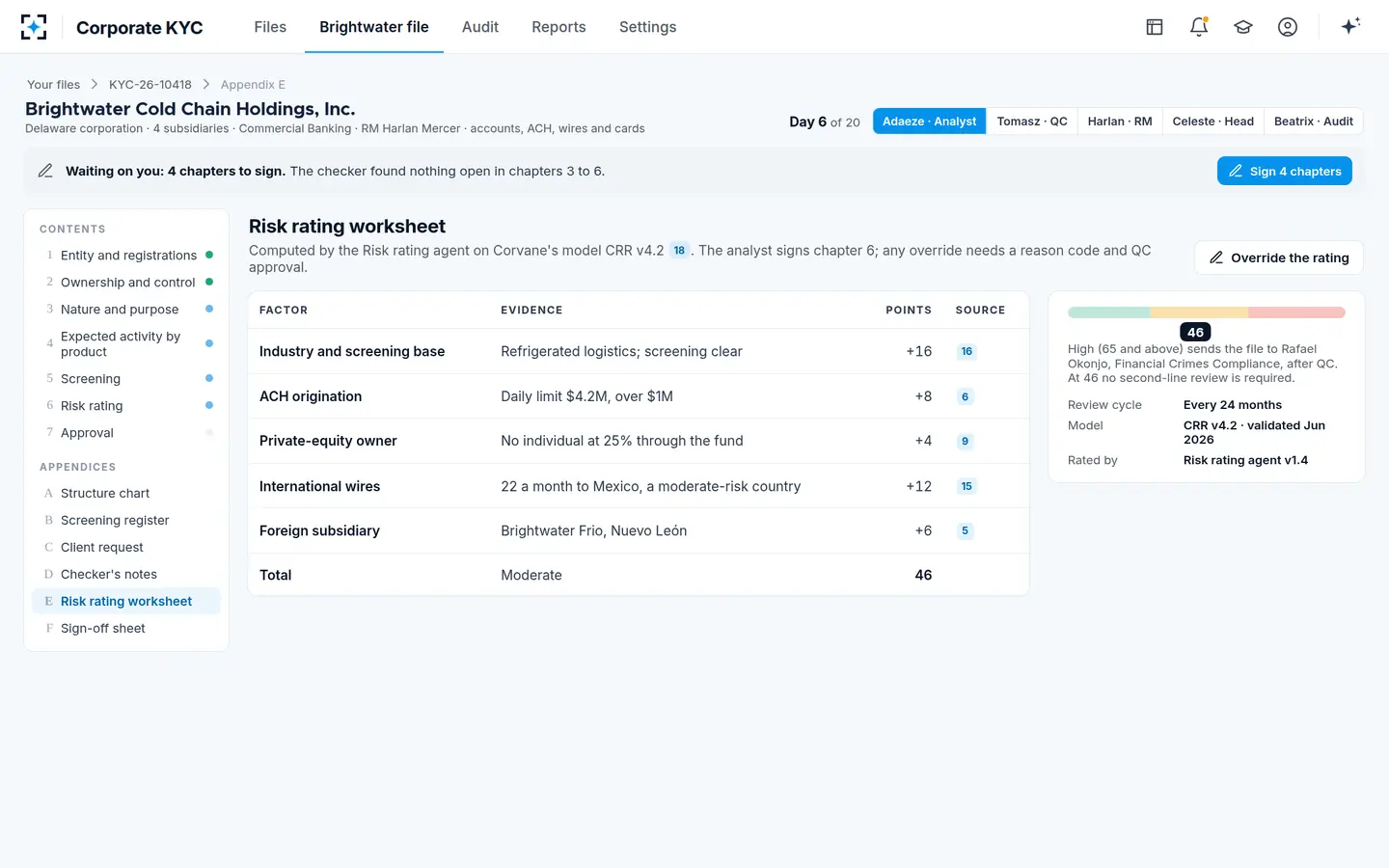
The 24-month review cycle shown is Corvane's policy for a moderate rating, not a regulatory requirement. What the expected-activity figures add is a second, earlier trigger: if the Mexico corridor doubles next quarter, monitoring has a number to compare it with. To see how the file assembles the figures, the statements and the structure together, start from Corporate KYC; the documents behind each figure are mapped separately.
Questions people ask
What does anticipated account activity mean?
It means the transactions a customer tells the bank it expects to conduct: what kinds, how many, how much and with whom. Anticipated and expected account activity are used interchangeably; the correspondent banking rule, 31 CFR 1010.610, uses "anticipated activity" for foreign correspondent accounts.
What is estimated monthly account activity on a bank form?
It is the customer's estimate of how much money will move through the account each month, often split by deposits, withdrawals, cash, wires and ACH. Banks ask for monthly figures because monitoring compares activity over monthly windows; an honest estimate protects the customer from avoidable alerts later.
What does expected annual activity mean on an account application?
It is the yearly version of the same estimate, usually total deposits or sales. It is less useful to the bank than a monthly figure by product: the customer in the Bank of America order was recorded with $1 to $4 million of expected annual sales, which said nothing about wires from abroad.
Will a bank close an account if activity exceeds what was expected?
Not automatically. Activity above the expected level usually prompts an alert, a review and often a question to the customer; if the change is explained, the bank updates the profile and perhaps the rating. Closing the account or filing a report follows only when the activity cannot be explained or looks suspicious.
How often should expected activity be updated for a business?
FinCEN sets no fixed schedule: updates are risk based and should follow monitoring, especially when activity departs from what the original nature and purpose would predict. Banks also review on a cycle by risk tier; that cycle is policy, and a material change in the business should not wait for it.