A KYC analyst checks that a bank knows who its customer is: the identity of the person or company, who owns and controls it, what the relationship is for, and how much risk it carries, and then documents that conclusion so an examiner can test it. On a corporate client the job is mostly assembly and reconciliation. A commercial customer arrives with a parent, subsidiaries in several states or countries, owners behind funds and trusts, signers and a list of products, and the analyst has to pull each piece from a different source, make them agree, and only then judge. Botminds' Corporate KYC is built around that split: agents assemble and cross-check one cited file per client, and the analyst keeps the judgement and the signature.
The examples below follow a fictional bank, Corvane National Bank, and its sample client, Brightwater Cold Chain Holdings, as the file runs through the solution. The people and companies are invented. The rules, research and labour figures come from regulators and official statistics, linked where they appear.
Four seats carry a corporate file; the KYC analyst sits in the middle
Today
Pulls registry extracts state by state, draws the ownership chart by hand, writes expected activity from old statements and chases the client by email.
With agents
Reads chapters already drafted with a source on every sentence, settles each checker dispute with a reason, and signs as maker.
Still theirs: The judgement on each chapter and the signature
Today
Collects the application and the client’s answers, then phones the analyst to learn where the file stands.
With agents
Sees progress without risk details and is told when the client request changes.
Still theirs: The client relationship; never the approval
Today
Reads the whole file at the end, finds what is missing and returns it, and the cycle repeats.
With agents
Gets files with every chapter signed and every party screened, and approves or returns them with a reason code.
Still theirs: The checker’s approval of the file
Today
Sees high-risk files late, often after the relationship manager has promised a date.
With agents
Receives files above the bank’s risk line with the rating worksheet and its sources attached.
Still theirs: Approval of high-risk relationships and of every setting
What does a KYC analyst do? The corporate version of the job
The short answer: a KYC analyst gathers the customer's identifying information, verifies it, identifies the beneficial owners of a business customer, documents the nature and purpose of the relationship, screens every party, proposes a risk rating and writes the file up for approval. Retail analysts do this on individuals in minutes. A corporate KYC analyst does it on a group of legal entities, and the time grows with every entity, owner and product.
The best public measure of that time comes from the Government Accountability Office. Studying 11 banks' 2018 costs, it estimated that staff spent about half an hour, on average, collecting and reviewing customer information for a new personal account, and more than an hour for a new business account, which usually also meant identifying the owners (GAO-20-574). Several banks told GAO the work included collecting state documents such as certificates of good standing. That is the floor for a single business account. A holding company with four subsidiaries and a fund among its owners multiplies it.
GAO also described who does what. Front-line staff collect the information when the account is opened; "another individual, often the BSA/AML officer, reviews the information collected to confirm its completeness and identify potential concerns"; then staff assign a risk rating, "often with the assistance of automated software at larger banks." In larger commercial banks the reviewing individual has become a team of KYC analysts, with QC reviewers behind them and a second line above.
The four questions every corporate KYC file has to answer
Every corporate file answers four questions, and each comes from a rule rather than a bank's preference. Knowing which rule sits behind each part of the file is what separates an analyst who fills in a template from one who can defend it.
Who is the customer? The bank's Customer Identification Program must let it reasonably believe it knows who each customer really is, and for a company that means the legal name, a principal place of business and a taxpayer identification number, obtained before the account opens and verified within a reasonable time after (31 CFR 1020.220). Who owns and controls it? The beneficial ownership rule asks for each individual who owns 25 percent or more, directly or indirectly, and one person with significant responsibility for controlling, managing or directing the company, certified by the person opening the account and verified by the bank (31 CFR 1010.230).
What is the relationship for? The bank must understand the nature and purpose of the relationship well enough to build a customer risk profile from it (31 CFR 1020.210; expected account activity is where that understanding becomes numbers). How risky is it, and does that stay true? The same rule requires ongoing monitoring and, "on a risk basis," keeping customer information up to date, including the beneficial owners. The difference between the KYC an individual gets and the KYB a company gets is mostly the second question, and it is where a corporate analyst spends the most care.
Hour by hour: one corporate KYC file on the day it was approved
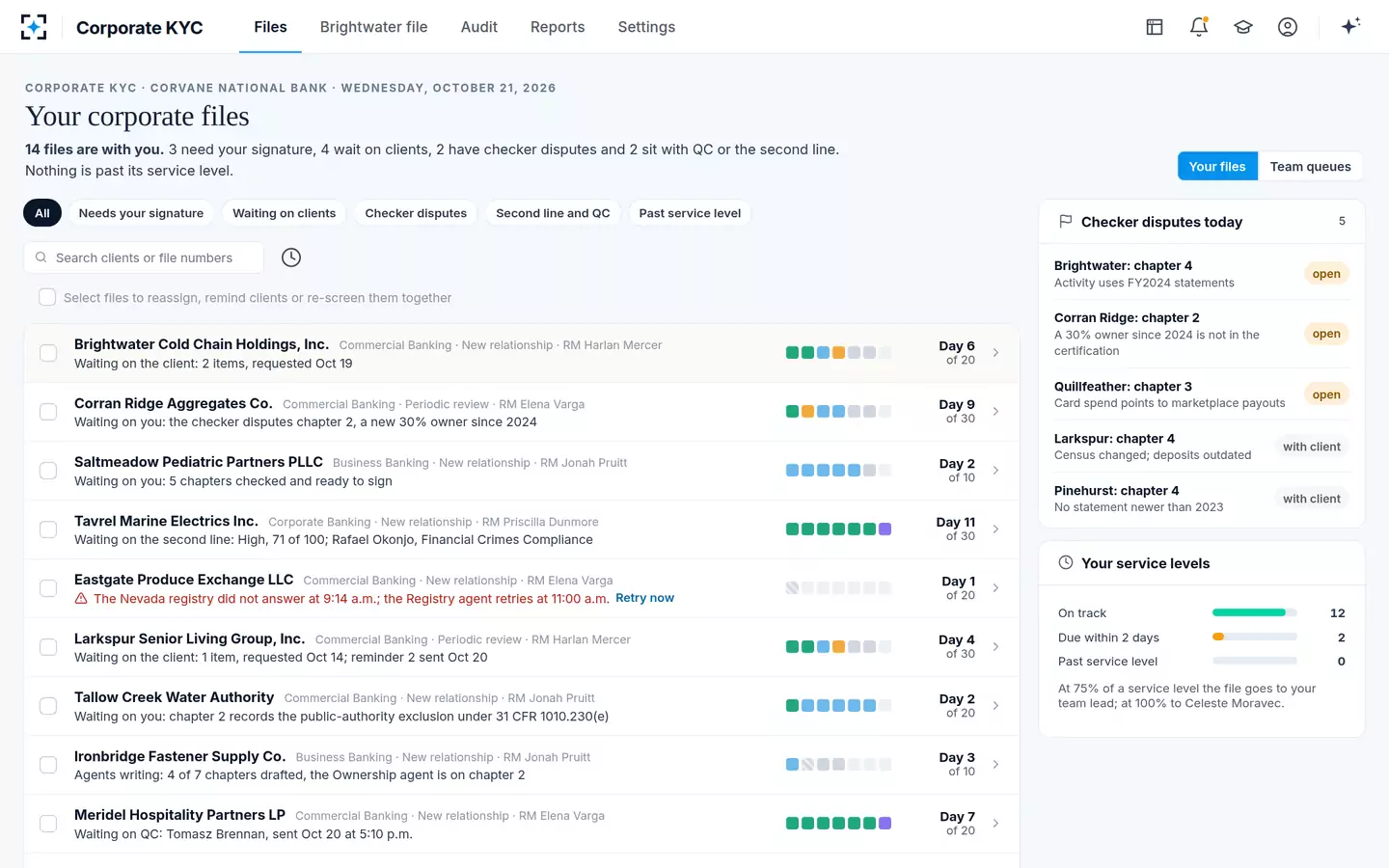
The clearest way to see the job is to watch one file move. On the sample file, Corvane's analyst Adaeze Whitfield has 14 files on her list that morning: 3 need her signature, 4 wait on clients, 2 have checker disputes and 2 sit with QC or the second line. Brightwater's file is on day 6 of a 20-day service level, waiting on two items from the client's treasurer.
Wednesday, October 21: Brightwater's file from the client's reply to approval
10:42
Client
The treasurer uploads the FY2025 audited statements and the five-question Mexico activity form.
10:44
Writer agent
Redrafts expected activity: 22 wires a month to Mexico, about $6.5M, plus higher ACH and domestic wire volumes.
10:45
Checker agent
Disputes the screening chapter: the Mexican subsidiary will receive those wires but was never screened.
11:02
Screening agent
Screens the subsidiary and its general manager; one possible match at a 71% name score, proposed as not the same entity.
11:04
KYC analyst
Confirms the clearance on country, registration number and formation date, with a reason code.
11:05
Risk rating agent
Re-rates the relationship from Low, 28 to Moderate, 46, every factor cited.
11:05–3:51
KYC analyst
Reads chapters 3 to 6 and their sources between her other files.
3:51
KYC analyst
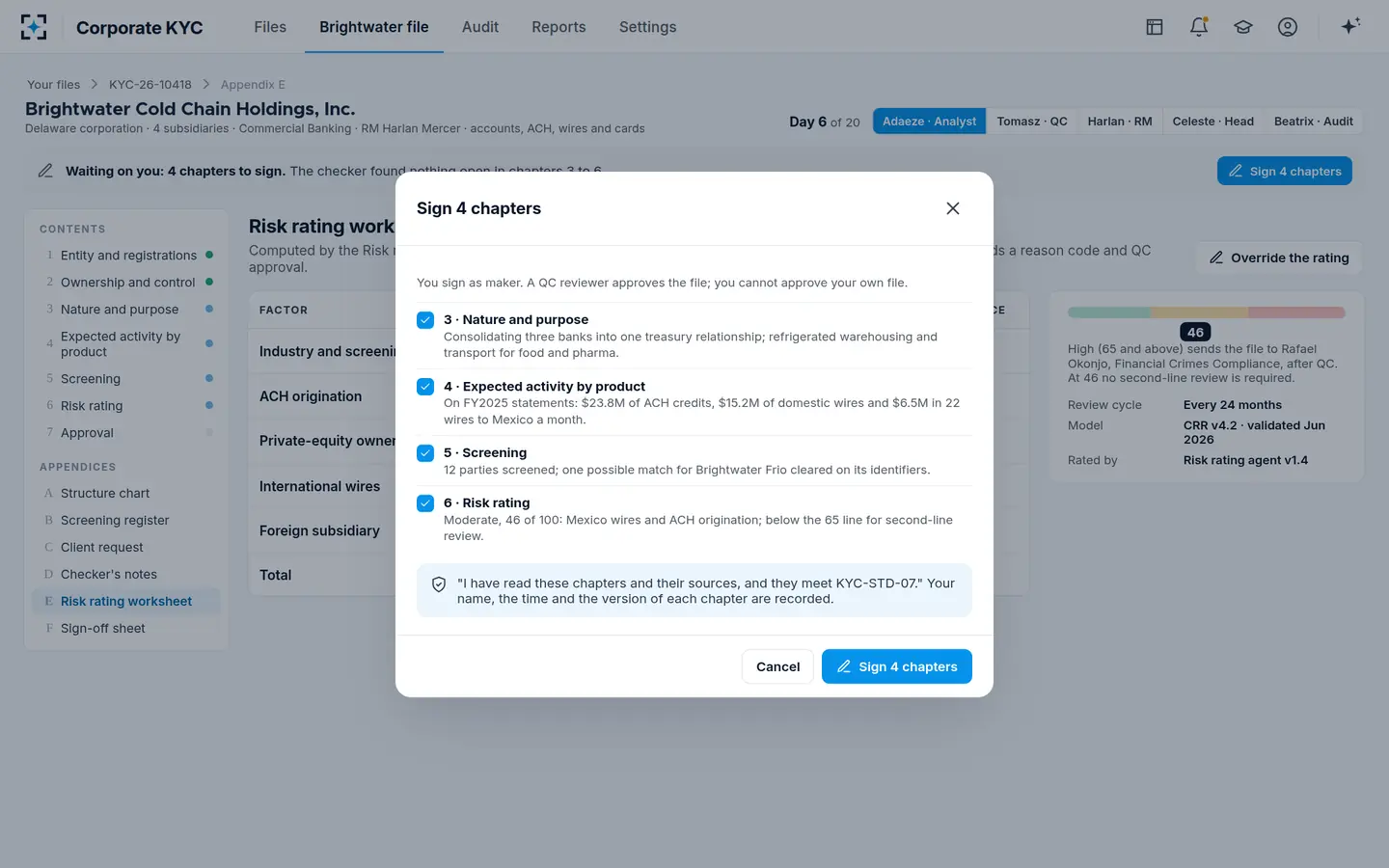
Signs four chapters as maker with one attestation; at 3:52 sends the file to QC.
4:12
QC reviewer
Works through the QC checklist and approves the file; the products open a minute later.
Read the rows by who acts. Between 10:42 and 11:05 the agents redraft one chapter, find a gap in another, screen two new parties and re-rate the file; the analyst makes one decision, the clearance of a look-alike name. Then the afternoon is hers: reading four chapters against their sources before she signs them. That reading is the job. Every sentence she signs has a numbered source, and her attestation says she has "read these chapters and their sources."
The gap the checker found is the kind analysts are paid to catch. Brightwater opened a Mexican subsidiary in 2025, its expected activity now includes $6.5 million a month of wires to Mexico, and the subsidiary that will receive them had never been screened. On a manual file the expected-activity chapter and the screening chapter are often written days apart from different documents, and nothing forces them to be read against each other until QC. Why the expected-activity figure matters so much later is a story of its own.
Which KYC analyst tasks take the time, and which are judgement
Most of a corporate analyst's hours go to tasks that have a right answer: fetching a registry extract, tying a stock register to a certification, copying volumes from an audited statement into a product table, re-screening a name. The judgement tasks, deciding whether an ownership explanation is credible, whether activity fits the business and what the risk rating should be, are a much smaller share of the clock and almost all of the accountability.
Where a corporate KYC analyst's time goes, by hand and with agents assembling
By hand
- Chasing documents · 25%
- Registries and ownership · 25%
- Writing up · 20%
- Screening hits · 15%
- Judgement · 15%
With agents assembling
- Reading cited chapters · 40%
- Settling disputes · 20%
- Client and RM · 10%
- Judgement · 30%
The estimate is ours, and it is labelled so for a reason: no regulator or independent study measures how long analysts spend on each task. What the official figures do pin down is the beneficial ownership step. When FinCEN finalised the ownership rule in 2016 it priced the extra onboarding time at 20 to 40 minutes per legal-entity account, raised from 15 to 30 after commenters objected, and banks told it each additional owner took another 10 to 15 minutes (FinCEN, 81 FR 29398). On a holding company with a fund, a family trust and a long tail of management shareholders, that step alone can fill a morning.
The analyst's corporate files, ordered by what needs her
KYC analyst skills that the job actually tests
Job descriptions list "attention to detail" and "knowledge of AML regulations." The skills that separate a good corporate analyst are narrower and more concrete. Each one below maps to a place where files fail review.
Eight skills a corporate KYC analyst uses on every file
- Reading an ownership structure through funds and trusts
Knowing that a trust’s 25% stake makes the trustee the owner under 31 CFR 1010.230(d)(3), and that a fund may hold 34% with no individual reaching 25% through it.
- Telling a legal entity customer from an excluded one
The rule excludes 16 kinds of entity, from SEC-registered issuers to state-regulated insurers, and covers nonprofits under the control prong only.
- Choosing the one control person
The rule asks for a single individual with significant responsibility, such as a CEO, CFO, managing member or general partner; FinCEN expects a high-level official.
- Turning statements into expected activity
Volumes by product, in numbers and values a monitoring system can compare with what the account actually does.
- Clearing a screening hit on identifiers, not names
Country, registration number, date of formation or birth, and recording why the match is not the customer.
- Reading documents against each other
The subsidiary in chapter 1 that receives wires in chapter 4 must appear in the screening register in chapter 5.
- Writing a reason an examiner can test
A file shows the source for each line and the reason for each judgement; “consistent with the business” is not a reason.
- Asking the client once, and well
One request for what is missing, nothing already on file, with no hint of ratings or screening results.
Three of the eight are reading skills, not data-entry skills. That matters for career planning, because they are the part of the job least exposed to automation and the part examiners look at. When an examiner tests customer due diligence, the question is whether the bank collected enough to understand the nature and purpose of the relationship and built it into the risk profile, not whether every field was filled. The analyst who can show the reasoning is the one whose files hold up in an audit of the file.
Who a corporate KYC analyst works with, and where the handoffs bite
A KYC analyst sits between people who want the account open and people who must be able to defend it. The relationship manager owns the client and the promised date. The client's treasurer or controller owns most of the documents. QC owns the approval. The BSA officer, or a second-line financial crimes team, owns the high-risk files and every threshold the analyst works to.
The handoffs are where corporate files lose time. A document request goes out by email, comes back incomplete, and goes out again; the relationship manager asks for status by phone; QC returns a file for a gap the analyst could have seen on day one if the chapters had been read together. In the sample file the client is asked once, for the two items actually missing, and the request lists what is already on file so nothing is asked twice. The relationship manager sees progress in his CRM but never ratings, screening results or checker notes, and never approves.
Is KYC analyst a good career? What the labour data says
There is no official statistic for "KYC analyst." The Bureau of Labor Statistics classifies the work inside broader occupations, most often compliance officers, and its projections for that group point to steady demand rather than decline. The clerical roles that used to collect account-opening information are the ones shrinking.
Compliance roles grow while account-opening clerks shrink
436,400
compliance officers employed in the US in 2025, all industries
+3.8%
projected growth to 2035, with about 32,700 openings a year
$80,730
median annual pay for compliance officers
−6.5%
projected change for new accounts clerks, 37,900 jobs in 2025
The pattern matches what is happening inside banks. Collection is moving to systems, portals and, increasingly, agents. Review, judgement and the ability to explain a file to an examiner are not. An analyst who can read a structure chart, challenge a client's expected activity and write a defensible rationale is building the skills that the growing occupation, not the shrinking one, is paid for.
Corporate KYC interview questions worth preparing for
Interviewers for corporate KYC roles tend to test the same handful of judgements, because they are the ones that go wrong in files. A candidate who answers from the rule text, not from a training slide, stands out.
Expect to be asked who must be identified when a fund owns 34% and no individual reaches 25% through it (no one for that stake, though the bank may look further on risk), who the owner is when a trust holds 30% (the trustee), whether a publicly traded company needs a beneficial ownership certification (no: companies listed on the major exchanges, and their majority-owned US subsidiaries, are outside the definition), and what to do when a client's activity outgrows what it declared at onboarding (update the profile and, where the facts call for it, the rating). A strong candidate also knows that since February 13, 2026 a bank may stop re-collecting ownership at every new account for an existing client, under FinCEN's relief order FIN-2026-R001, and can say what it must still record when it relies on a client's confirmation.
What changes for the KYC analyst when agents do the assembly
When agents pull the registries, build the ownership chart, draft the chapters and screen every party, the analyst's day moves toward reading and deciding. In Corporate KYC the analyst still signs every chapter as maker, cannot approve her own file, and settles every dispute the Checker agent raises by fixing it, overriding with a reason code or asking the client. The agents may not sign, approve, send anything to the client without her approval, clear a screening match or override the risk model.
The analyst signs four checked chapters with one attestation
What the analyst gains is the part of the job that was always squeezed. The solution’s design target is 30 to 50% fewer analyst hours per corporate file; it is a target, not a measured result. The hours that remain are the reading hours, and they are spent on files that arrive complete. How the work divides between agents and people, task by task, and what regulators say about it, is set out separately. To see the whole file from the analyst's chair, start from Corporate KYC.
Questions people ask
What does a KYC AML analyst do?
A KYC AML analyst verifies customers' identities, identifies the beneficial owners of business customers, documents what each relationship is for, screens customers against sanctions lists and proposes a risk rating. In some banks the same analysts also review alerts, but most separate onboarding KYC from transaction monitoring and suspicious activity investigation.
What is a client onboarding analyst?
A client onboarding analyst moves a new client from application to an open account: collecting documents, coordinating with the relationship manager and operations, and making sure KYC is complete before products are set up. In many commercial banks the onboarding analyst and the KYC analyst are the same seat; in others onboarding handles logistics and passes the due diligence to a KYC team.
What does a KYC onboarding analyst job description usually include?
Typical duties are collecting and verifying identity documents, identifying beneficial owners at the 25% threshold and one control person, screening against OFAC and other lists, documenting nature and purpose and expected activity, escalating high-risk clients and meeting service levels. Good descriptions also name the bank's CDD standard and the approval chain, because those decide what the analyst actually signs.
What is the difference between a corporate KYC analyst and a retail one?
A retail analyst verifies an individual; a corporate analyst verifies a company, its owners, its control person, often its subsidiaries and signers. GAO measured about 30 minutes of staff time for a consumer account against over an hour for a business account in 2018, and complex groups take far longer than a single business.
How do you become a KYC analyst?
Most analysts enter from operations, banking or a compliance graduate programme, and many hold or study for an AML certification. What hiring managers test is practical: reading an ownership chart, applying the 25% rule through intermediate entities, clearing a screening hit on identifiers and writing a rationale an examiner could follow.