KYC automation for banks is worth buying when it lowers the cost of a file without lowering what the file proves, and the only honest way to judge that is to start from what one file costs today. The best public measure comes from GAO: in 2018 the banks it studied spent between $5 and $44 per new account on customer due diligence, $15 on average, and the bank opening the most complex accounts paid the most. A corporate file sits at the expensive end, because every entity, owner and product adds work. Botminds' Corporate KYC is built to take the assembly cost out of that file, while the analyst's review and QC's approval stay where they are; this guide shows how to price that against your own numbers.
Figures from the solution come from a fictional bank, Corvane National Bank, and its sample client, Brightwater Cold Chain Holdings, or are design targets, and are named as such. Cost figures for the industry come from GAO, FinCEN and the Conference of State Bank Supervisors.
What customer due diligence costs US banks, per account and in total
$5–44
CDD cost per new account across the banks GAO studied, 2018
$15
average CDD cost per new account
29%
of direct BSA/AML compliance cost spent on customer due diligence, the largest single area
$3.7M
one-time cost to one very large bank of adding beneficial ownership in 2016–2018
What does KYC cost per customer? GAO's $5 to $44
KYC costs a US bank roughly $5 to $44 per new account in staff time for customer due diligence, according to the only public study that measured it bank by bank. GAO estimated that "the selected banks spent an estimated average of $15 per new account to comply with the customer due diligence requirements in 2018, and per-account costs ranged from $5 to $44" (GAO-20-574). The cost covers personnel time to collect and review identifying information for customers and beneficial owners and the information needed to understand the account and rate it.
Two limits matter when using the figure. GAO's sample of 11 institutions is, in its own word, nongeneralizable. And the figure excludes the costliest parts of a high-risk corporate relationship: enhanced due diligence and ongoing monitoring. A bank's own corporate files will cost more than $44 each; the GAO figure is a floor and a sense of proportion, not a price.
CDD cost per new account at nine of the banks GAO studied
Why the most expensive bank paid three times the average
The per-account cost tracks the kind of account more than the size of the bank. GAO said the range "was due, in part, to differences in the types of accounts banks opened and the time they required to collect and review customer information," and it timed the difference: roughly half an hour on average for a personal account against more than an hour for a business account, where owners usually had to be identified too (GAO-20-574; how long it takes to open a business bank account follows the hour step by step).
The chart shows it. The two largest banks sit at opposite ends: one opening more than half a million accounts a year spent $6 each, the other, opening fewer, spent $44. Volume dilutes the cost of simple accounts; it does nothing for complex ones. A bank whose growth is in commercial and corporate clients should expect its average per-file cost to rise even as its systems improve, unless the work inside each corporate file changes.
Size cuts the other way on the total. GAO found direct BSA compliance cost was about 2% of operating expenses at the three smallest banks it reviewed against about 0.6% at the three largest. The Conference of State Bank Supervisors, looking at ten years of survey data, found the smallest banks spend roughly 11% to 15.5% of payroll on compliance tasks against 6% to 10% at the largest, and community bankers say BSA/AML is 25% of their compliance burden (CSBS, Too Small to Scale, 2025; CSBS, BSA modernization).
Where the BSA budget goes: customer due diligence is the largest line
Customer due diligence is the single largest share of what banks spend on BSA compliance. GAO found CDD and reporting "generally were the most costly regulatory areas—representing, on average, about 29 and 28 percent of total BSA/AML compliance costs, respectively," and that CDD was the costliest area at five of the 11 banks, "including the four largest." Across banks it ranged from about 15% to about 59% of direct BSA cost.
Where a bank's direct BSA/AML compliance cost goes, on average
Average of 11 banks, 2018
- Customer due diligence · 29%
- SAR and CTR reporting · 28%
- Program requirements · 18%
- Software and vendors · 17%
- Other · 8%
Two things follow for anyone pricing KYC automation. Software is already a sixth of the budget at the average bank, so a new tool has to replace work, not add a layer. And because customer due diligence is the biggest line, it is where a given percentage saving is worth most.
The cost of a rule change: $3.7 million and 4,000 people trained
The largest KYC costs often arrive as one-off changes, and they are paid in people. When the beneficial ownership rule came in, GAO reported, one very large bank "which opened over 36,000 legal entity accounts in 2018, spent an estimated $3.7 million," assigned "two senior compliance personnel to the implementation project over a 2-year period, updated hardware and software systems, and trained approximately 4,000 bank personnel on the new requirement." A small credit union that opened one legal entity account spent under $100.
FinCEN priced the same rule nationally. It assumed 8 million new legal-entity accounts a year, each needing 20 to 40 extra minutes at opening, and banks told it each beneficial owner added 10 to 15 minutes (FinCEN, 81 FR 29398). Our arithmetic on those figures: 2.7 million to 5.3 million staff hours a year, or about $61 million to $122 million at the median wage of a new accounts clerk (BLS), before overheads. Since February 2026 the bill should fall, because FinCEN's relief lets banks stop repeating the ownership work at each new account for an existing client (FIN-2026-R001). Automation that keeps one file per client is how a bank actually collects that saving.
What KYC automation can take out of a corporate file's cost
KYC automation can take out the assembly cost of a file, not its review cost. In a corporate file the assembly is most of the hours: pulling registry records entity by entity, reconciling the certification with the stock register, chasing the client, writing up expected activity from statements, re-screening and re-rating when something changes. The review, reading the chapters, settling disputes and approving, is a smaller share of the hours and all of the accountability, and the rules require a person for it.
That is where Corporate KYC aims. Its design target is 30 to 50% fewer analyst hours per corporate file; it is a target, not a measured customer result, and a bank should test it on its own files. On the fictional sample file the shape of the saving is visible: the client was asked once, for the two items actually missing, and when the reply arrived the expected-activity chapter was redrafted, a screening gap found and the rating updated within about twenty minutes, without a return from QC.
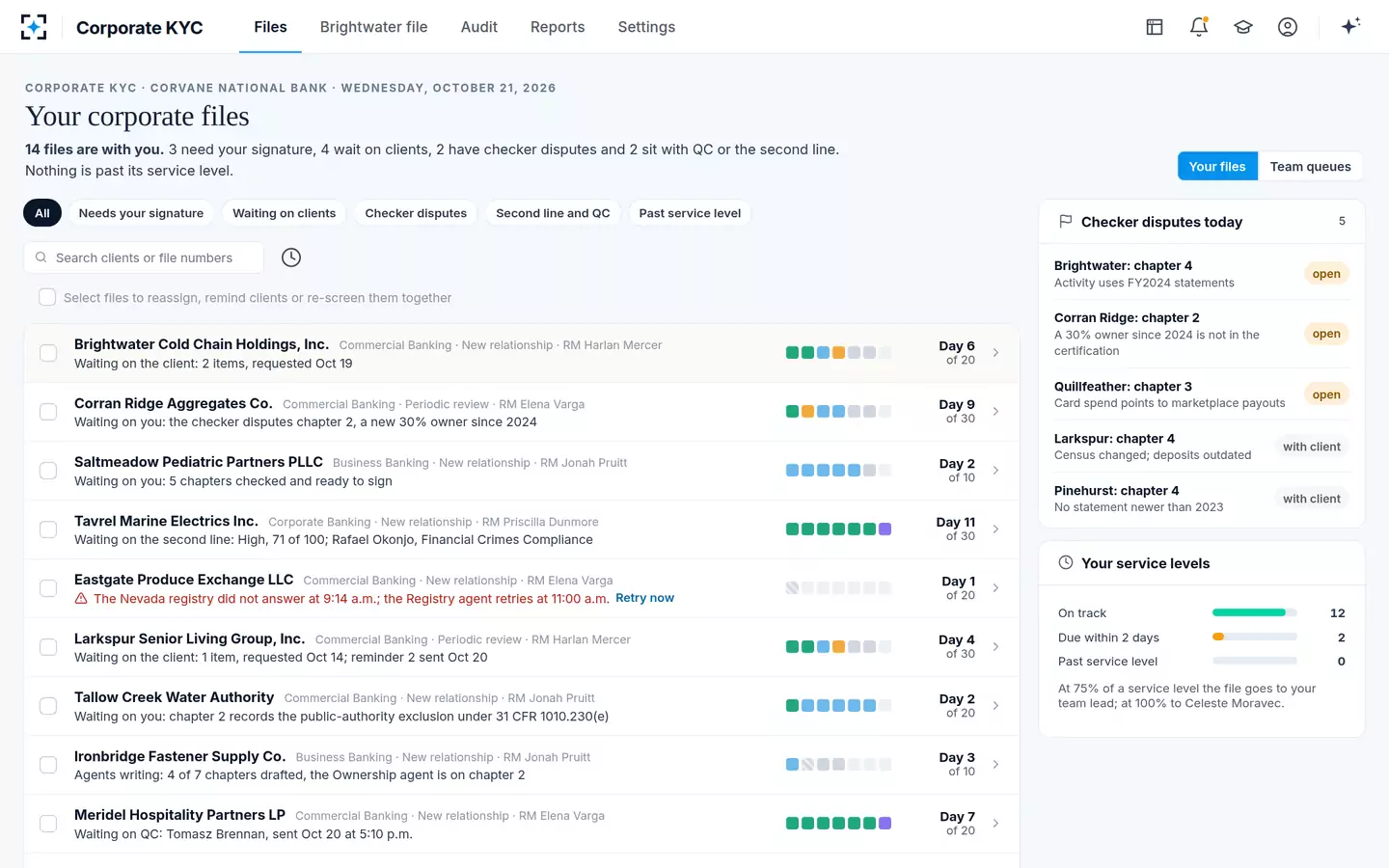
An analyst's queue of corporate files, ordered by what needs her
How to measure what one corporate file costs your bank
Measure the cost of a corporate file with a short time study on recent files, because no public source gives a reliable per-file figure for corporate KYC. GAO's $44 is per account across all the account types one bank opened, and the figures that circulate for corporate reviews come from industry surveys, which we do not rely on. A bank's own files are the only sound basis for a business case.
Four weeks is usually enough. Pick 30 to 50 corporate files closed in the last year, spread across segments and risk ratings, and for each one reconstruct three things from the file and the people who worked it: analyst hours by task (registries, ownership, client contact, writing, screening, rating, rework), QC hours and the number of returns, and elapsed days by who held the file. Add the variable data costs, registry extracts, identity checks and screening, which are often charged per entity and per party and so rise with the size of the group.
Two cautions keep the study honest. Count the hours spent on files that were returned by QC, because rework is where manual corporate KYC loses most time and it rarely appears in a process map. And separate the client's waiting time from the bank's working time: a file that took 40 days may hold 8 hours of work, and automation changes the two very differently. The first shrinks; the second shrinks only if the client is asked once and well.
The result is a per-file cost, a split by task and a list of where files waited. The split tells a buyer which part of the file automation could remove; the waits tell it whether faster assembly would matter at all. If most days are spent waiting for clients who were asked three times, the gain comes from asking once; if most hours are spent reconciling ownership documents, it comes from the look-through.
ROI of KYC automation: a model to fill with your own numbers
The return on KYC automation is the hours it saves on files you would have done anyway, plus the rework it avoids, minus everything it costs to run and govern. Every term below can be measured on a bank's own files in a pilot; none should be taken from a vendor's slide, including ours.
The return on KYC automation, term by term
Analyst hours saved
Corporate files a year × analyst hours per file × share saved × loaded hourly cost
Hours per file from your own time study; share saved from a pilot on closed files
KYC operations
Rework avoided
Files returned by QC × hours per return × loaded cost
Returns caused by gaps a checker would have caught before QC
QC lead
Run cost
Licence + compute + integration upkeep
Client lifecycle system, core banking, registries, screening, document imaging
Technology
Governance cost
Testing changes on a golden set + approvals + examiner preparation
SR 26-2 leaves generative and agentic AI to the bank’s own governance
BSA officer
Two numbers decide most cases. The first is analyst hours per corporate file today, which few banks measure; a week of time-coding on a sample of files is enough. The second is the share of those hours the software actually removes on your files, which only a pilot shows. If a bank cannot fill in those two terms, it is not ready to judge the ROI, whatever the price.
KYC automation software: what to price besides the licence
The licence is rarely the largest cost of KYC automation over its life; integration and governance often are. The table lists what a bank should price, and what Corporate KYC does about each.
Costs of KYC automation software beyond the licence
| Cost line | Why it exists | In Corporate KYC |
|---|---|---|
| Integration | The file must read from registries, imaging and screening, and write back to the client lifecycle system and core | Works alongside the client lifecycle system, core banking, registry data service, document imaging, screening service, secure portal and CRM |
| Configuration | Your CDD standard, risk model, chapter templates, reason codes and service levels | All are versioned settings that take effect only on the BSA officer’s approval |
| Testing changes | A new prompt, model or threshold can change outcomes | Each change runs on a golden set of 240 past files before approval |
| Governance | SR 26-2 puts generative and agentic AI outside model risk guidance; the bank must govern them itself | Agents are versioned and bounded; they may not sign, approve, clear a match or override the model |
| Examination | Examiners will ask how the tool works and see its outputs | Examiner, internal audit and BSA officer packs with every chapter version and source |
| People | Analysts move from assembling to reviewing; QC changes what it checks | Analysts sign chapters as maker; QC approves; relationship managers see progress only |
A KYC automation platform or point tools? Where Corporate KYC fits
Banks automating KYC usually choose between point tools, one for registries, one for screening, one for document reading, stitched together by analysts, and a platform that builds the file end to end. Point tools lower the cost of individual steps but leave the reconciliation between them, the expensive part of a corporate file, with the analyst. An end-to-end file lowers the reconciliation cost but has to work with the tools a bank already owns.
Corporate KYC is the second kind for one job: the KYC file for commercial and corporate clients. It does not monitor transactions, triage alerts or decide on suspicious activity reports, and it does not replace the bank's screening service or client lifecycle platform; it uses them. It applies the bank's CDD standard and risk model rather than its own. A bank whose cost problem is retail account opening, or alert volumes, should look elsewhere first. A bank whose problem is corporate files that take weeks and bounce at QC is the case it was built for, and a pilot on closed files is the cheapest way to find out.
One corporate file, seven chapters, each with its sources and its author
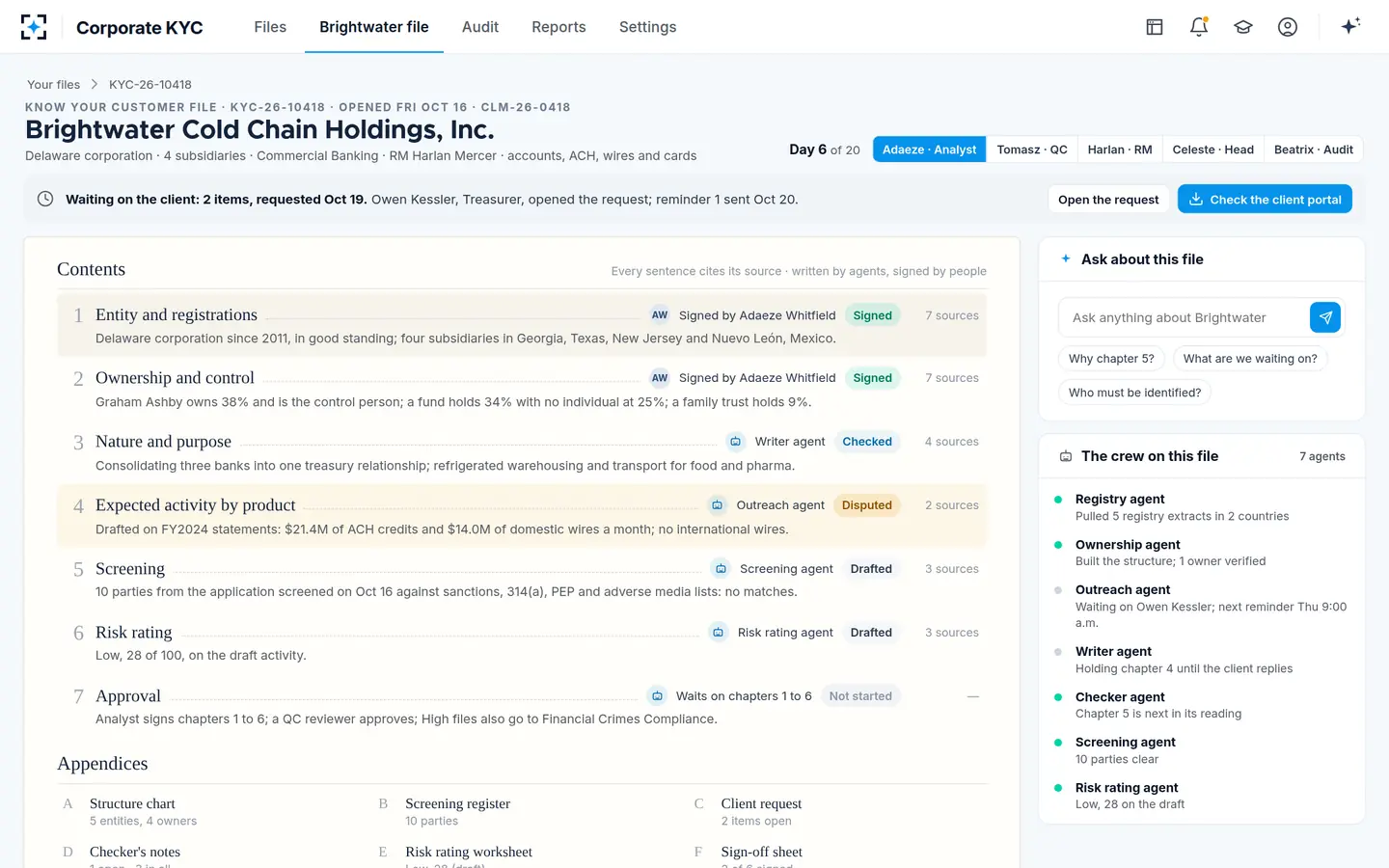
The work inside the file is divided task by task in agentic AI for KYC. To see the whole file, start from Corporate KYC.
Questions people ask
What is KYC automation?
KYC automation is the use of software to perform parts of know-your-customer work: collecting and verifying identity information, reading documents, screening names, scoring risk and assembling the file. Older tools automate single steps; newer agent-based tools assemble and check the whole file, with people reviewing and approving.
What is KYC process automation in a bank?
It is automation applied to the workflow rather than to one check: routing a file from intake to approval, chasing missing documents, triggering re-screening when something changes and keeping service levels. In corporate KYC, the biggest gain usually comes from removing the second and third client requests and the QC returns, not from speeding up any one step.
Can a community bank justify KYC automation?
Sometimes. Compliance weighs more on small banks: GAO found direct BSA cost near 2% of operating expenses at the smallest banks it studied against 0.6% at the largest. But a bank opening few corporate accounts may not save enough hours to cover the run and governance cost; the ROI model above, filled with its own volumes, will say.
Does KYC automation lower examination risk?
It can, if the files it produces show their sources and reasoning more consistently than manual files; it raises risk if it closes, clears or approves without a person. The OCC's 2026 order against Community Federal Savings Bank, where automated triage auto-closed alerts it should have escalated, shows the second case.
How long does KYC automation take to pay back?
There is no reliable public benchmark; it depends on how many corporate files a bank handles, how many analyst hours each takes today and what share the software actually removes. A pilot on 30 to 50 closed files gives the last two numbers, and the ROI model above turns them into a payback period for that bank.