How long it takes to open a business bank account depends on which clock you read. On the bank's clock it is a little over an hour of staff time to collect and review the information, by GAO's estimate across 11 banks. On the owner's clock it runs from the first conversation to an account that can take a deposit, and that can be the same day for a complete packet or weeks for one with a missing owner, an expired certificate or a name that does not match the state's filing. Almost all of the difference is waiting between touches, not work. Botminds' Business Account Opening (KYB) is a solution for community and regional banks that attacks that waiting: it finds every gap in the first minutes and asks the owner once.
The worked example on this page is a fictional sample bank, Tessaly Community Bank, opening an account for a fictional customer, Halvorsen Marine Supply LLC, in the solution. The research figures come from GAO, FinCEN, the FFIEC and the Census Bureau.
The bank's clock is short; the volume behind it is not
30 min
average staff time to collect and review due diligence on a new personal account
1 hr+
on a new business account, which often needs beneficial ownership and state documents
5.67M
business applications filed in the US in 2025
How long does it take to open a business bank account?
A complete packet for a simple business, such as a small LLC whose owners are in the branch, can open the same day. A packet with a gap takes as long as the gap takes to close, and the bank rarely controls that. Two numbers bracket the bank's part. GAO, studying 11 banks, wrote: "we estimated that bank personnel required about 30 minutes, on average, to collect and review customer information when opening new consumer (or personal) accounts, compared to over 1 hour for new commercial (or business) accounts, which often required the collection of beneficial ownership information." It added that "Several banks told us this process involved collecting and reviewing documentation from state agencies to verify this information, such as certificates of good standing" (GAO-20-574, page 43).
FinCEN's own estimate of the beneficial ownership step alone is 20 to 40 additional minutes per legal entity account, which it raised from 15 to 30 minutes after commenters objected that the lower figures were too low (81 FR 29398). Neither number includes the time a file spends in a queue, waiting for a reply or waiting for someone to approve it. Those are the hours the owner experiences.
The bank's clock: GAO's hour of staff time
The bank's clock counts touches. Collecting the application and documents, checking the state's business filing, entering owners and signers into identity and list-screening tools, reading the operating agreement against the certification, assigning a risk rating and boarding the account in the core system: each takes minutes, and together they make GAO's hour. At a large bank those minutes are spread over three or four people; at a community bank they are often one business banker's, as what banks need to open a business account describes.
The touches multiply when something is missing. Each gap adds a call or an email, a second look at the file when the answer comes back, and often a second rekeying. That is why the same business can cost a bank half an hour one week and half a day the next: the work is driven by the number of exceptions, not by the size of the business.
The owner's clock: days of waiting between touches
The owner's clock starts with the first contact and stops when the account can take money. In between it runs through every queue the file sits in. The sample case shows the shape in miniature: the packet arrived by email at 11:35 AM and the account was open at 2:47 PM, 3 hours 12 minutes later. Of those 192 minutes, 134 were spent waiting for one owner to answer a request, and 32 waiting for a deposit operations specialist to pick up the file and approve it.
One sample packet, two clocks: 192 minutes elapsed, 58 of them the bank's
- Agents read and check; banker sends one request
- Waiting for the third owner to answer134 min
- Verify, confirm, submit
- Waiting for the checker32 min
- Approve and board
- Read and request
- Verify and submit
- Checker queue and boarding38 min
The two lanes are the argument of this page. The bank's clock, 58 minutes, includes half an hour in the checker's queue; the people at the bank touched the file for less than half of it. The owner's clock is more than three times as long, and the extra time is one person's afternoon. On a weekday when the owner is on a boat, or a week when the certificate of good standing has to be ordered from the state, the owner's clock runs to days while the bank's barely moves.
Why does it take so long to open a business bank account?
It takes long because a business account depends on documents and people outside the bank, and each gap is found late. In a branch or email process, nobody checks that a packet is complete when it arrives; the banker finds the expired certificate on Tuesday, the missing owner on Wednesday and the trade name mismatch on Thursday, and asks about each in turn. Each question restarts the owner's clock.
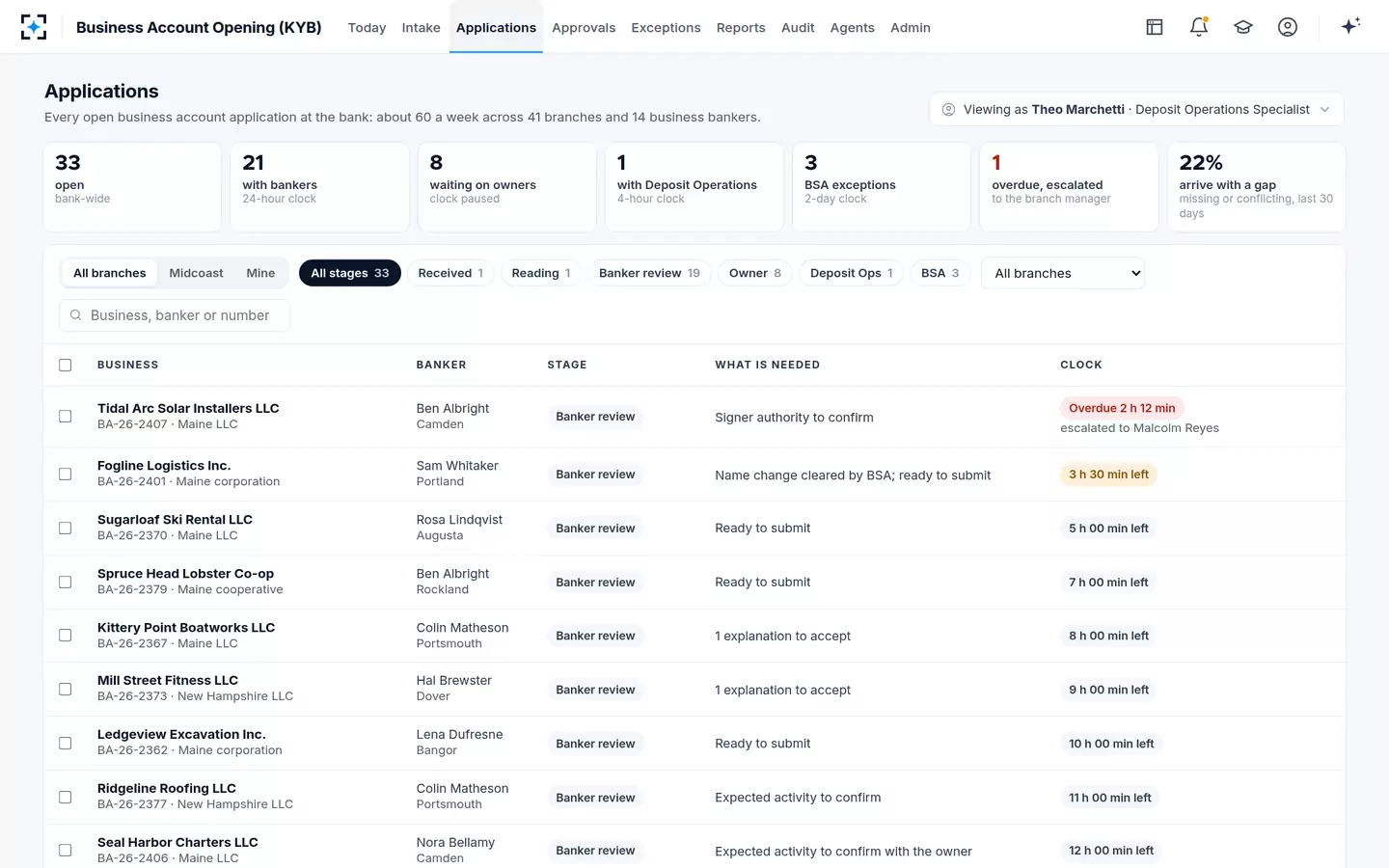
At the sample bank, open applications sit in five places at any moment. Most are with bankers, a quarter are waiting on owners, and a few wait on deposit operations or the BSA officer. The sample bank's own figure is that 22% of packets arrived with a gap over the last 30 days; that is fictional sample data, not an industry rate, but the mechanism is general.
Where 33 open applications sit in Business Account Opening (KYB) at the sample bank
The order of discovery is the lever. A gap found in the first five minutes costs one request; the same gap found on day three costs a request plus three days. The KYB process flow that shortens the owner's clock therefore starts with a complete reading of the packet before anyone calls the customer, and KYB automation that asks the owner once follows that design from the bank's side.
How long does a bank have to verify identity after opening?
A "reasonable time", which the rule does not define in days. The CIP rule requires the identifying information before the account opens, but verification may follow: the program must include procedures for verifying the customer's identity within a reasonable time once the account is open (31 CFR 1020.220(a)(2)(ii)). The rule adds that the bank's procedures should describe what a customer may do with the account while verification is still under way, and when the bank should close it if verification fails (CIP exceptions works through those terms).
That flexibility is why some banks open first and verify after, with limits on the account in between, and others verify everything before opening. The beneficial ownership rule allows the same order for owners. Neither approach is required; what is required is a written procedure and a file that shows it was followed.
Online or in person: does the channel change the clock?
The channel changes how identity is verified, not what must be collected. The CIP rule names opening an account without ever visiting the bank as one of the situations in which the bank's procedures must address non-documentary verification. Online applications therefore lean on database checks, photographed IDs and secure upload links, and the rules about the business, its owners and its purpose are identical.
Internationally, the standard-setter has moved in the same direction. In February 2025 the Financial Action Task Force amended its standards so that non-face-to-face relationships count as potentially higher risk only when suitable measures to mitigate that risk are missing (FATF; what the change means for banks is in digital account opening after the FATF change). An online business application can be as fast as an in-person one, or faster, when the verification steps are built for it. It is slow when an online form simply produces a PDF that a banker re-reads by hand.
What examiners sample when an account opens before verification ends
Examiners look for exactly the accounts a fast process creates. The FFIEC's CIP examination procedures tell examiners to sample new accounts opened since the last examination and, on a risk basis, to include any new accounts that opened while verification information was still incomplete, along with accounts opened under the exception for customers that have applied for a tax number (FFIEC BSA/AML Manual, CIP examination procedures). For each, they check that the information was obtained before opening (what examiners sample in CIP testing has the full list), that verification happened within a reasonable time, and that discrepancies were resolved.
Speed, then, is defensible only if the file shows its own timeline. A business account that opened at 2:47 PM with every owner verified by 2:00 PM, each step with a time and a person against it, answers the examiner's question before it is asked. One that opened on a promise to send the missing owner's details later answers it only if someone wrote down when they arrived.
The clocks a bank can set, and who each one protects
| Clock | Sample bank setting | What it protects |
|---|---|---|
| Banker, from a complete packet | 24 hours; branch manager warned at 20, escalation at 24, regional manager at 48 | The owner: a file cannot sit unread |
| Owner reminders | At 24 and 48 hours; a call task at 72 hours | The application: quiet owners are noticed before they give up |
| Deposit operations approval | 4 hours | Same-day opening once the banker submits |
| BSA officer exception | 2 business days | Trusts, marijuana-related businesses and possible list matches get a decision, not a pile |
| Identity verification after opening | The bank's written CIP procedure | The rule: a reasonable time after opening, not defined in days |
One sample packet, 3 hours 12 minutes, step by step
The sample case is worth walking through as a KYB process flow, because the order of steps is what made it short. At 11:35 AM the business banker dropped the six files the owner had emailed, 23 pages in all. Within a minute the Packet Reader had split and typed them; within five, the Registry, Ownership and Screening agents had checked the state's filing, recomputed ownership from the operating agreement and screened the entity and three people, and a Second Read agent had re-read all fourteen lines. Eleven were confirmed, two differed with a filed explanation each, and one was missing: a 25% owner left off the certification.
At 11:44 the banker read and sent one request to two owners, listing three items. The missing owner answered from her phone at 1:58 PM and her co-owner e-signed the updated certification at 2:01. At 2:09 the banker submitted the file; at 2:41 a deposit operations specialist approved every field that would be written; and between 2:44 and 2:47 the account, the signature card and the documents were written to the core, imaging and the CRM.
Opened the same day: boarding after approval in Business Account Opening (KYB)
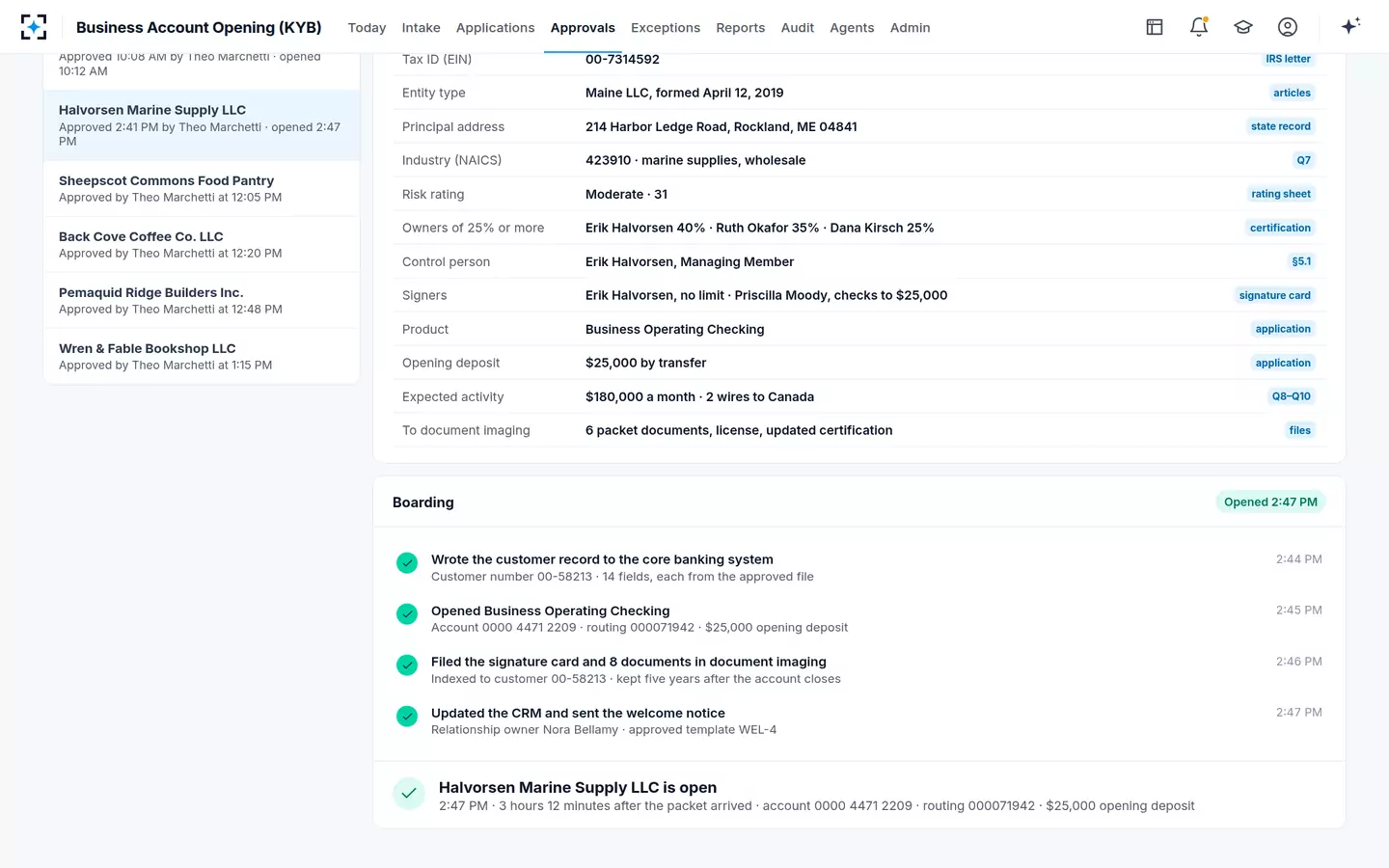
Two things in that sequence did the work. The gap was found in five minutes, not on day three. And the owner was asked once, for exactly what was missing, through a link she could answer from her phone. Neither depends on the agents being fast; both depend on reading everything before asking anything. What the packet should contain in the first place is in documents needed to open a business bank account.
The queue that keeps the bank's clock honest
Questions people ask
Can I open a business bank account the same day?
Often, if the packet is complete and the bank verifies identity during the visit or the online session. The CIP rule allows verification within a reasonable time after opening, so some banks open first with limits; others verify everything first. A missing owner or an out-of-date certificate is the usual reason it does not happen.
How long does it take to open a business bank account online?
The requirements are the same as in a branch, so the time depends on how quickly the bank verifies the documents and owners it receives. An online application that is read and checked as it arrives can open within hours; one that becomes a PDF for a banker to re-read later takes as long as the queue.
What slows down business account opening the most?
Gaps found late: an owner left off the beneficial ownership certification, a certificate of good standing older than the bank's limit, a trade name or registered agent that differs from the state's filing, or an EIN letter in a slightly different name. Each adds a request to the owner and restarts the wait.
Why does a business account take longer than a personal account?
Because a business account verifies an entity and the people behind it. GAO estimated about 30 minutes of staff time for a personal account and over an hour for a business account, mainly because of beneficial ownership information and state documents such as certificates of good standing.
Does the bank's clock stop while it waits for me?
That depends on the bank's own service standard. In the sample bank's settings, the banker's 24-hour clock pauses while a request is with the owner, and the owner gets reminders at 24 and 48 hours and a call at 72. A bank that does not pause the clock usually reports its time per file, not per wait.
How many business accounts are opened each year?
No federal series counts business account openings directly. FinCEN's 2016 analysis assumed about 8 million new legal entity accounts a year across covered institutions, and the Census Bureau counted about 5.67 million new business applications in 2025, each a likely future account holder.