Yes, beneficial ownership is still required at the bank. Two separate rules used to ask businesses for their owners. The Corporate Transparency Act's reporting rule required companies to report beneficial ownership information to FinCEN; since March 26, 2025 US companies are exempt, and a final rule made that permanent on August 14, 2026. The bank's customer due diligence rule, 31 CFR 1010.230, requires the bank itself to identify and verify every individual owning 25% or more of a business customer and one person who controls it, and that rule is unchanged. What did change, in February 2026, is how often the bank must do it: once at the first account, then again only when something calls the information into question or its own risk procedures require. Botminds' Business Account Opening (KYB) is built around that first certification, recomputing it from the operating agreement before the bank relies on it.
The rules on this page are quoted from FinCEN, the Federal Register and the OCC. The worked example is a fictional sample business at a fictional community bank, as it appears in the solution.
Two rules, two very different years
Exempt
US companies from FinCEN beneficial ownership reporting, since March 26, 2025; final rule August 14, 2026
Unchanged
the bank's duty under 31 CFR 1010.230 to identify and verify 25% owners and one controller
3
situations in which a bank must re-verify owners after the first account, under FIN-2026-R001
Is beneficial ownership still required? At the bank, yes
At a US bank or credit union, beneficial ownership is still required for every legal entity customer at its first account. The regulation still requires the bank to identify who owns and controls each legal entity customer when it opens a new account, using a certification signed by the person opening it (31 CFR 1010.230(b)(1); the form itself is in beneficial ownership certification). The OCC told its banks the same in its Spring 2025 risk perspective: "OCC-supervised banks must continue to comply with the existing FinCEN 2016 Customer Due Diligence rule and other existing BSA requirements" (OCC Semiannual Risk Perspective, Spring 2025).
So a business owner opening an account in 2026 will still be asked for the names, dates of birth, addresses and identification numbers of each person who owns 25% or more, and of one person who controls the company. The form is the bank's, the duty is the bank's, and an owner who declines to complete it gives the bank grounds not to open the account.
What changed in 2025 and 2026, in order
Four dates tell the story, and they are often run together. Two concern the FinCEN registry, one concerns the bank's form, and one concerns FinCEN's own guidance.
Beneficial ownership after the BOI rule: four dates, two rules
| Date | What happened | Effect on the company | Effect on the bank |
|---|---|---|---|
| March 2 and 26, 2025 | Treasury suspends enforcement against US companies; an interim final rule exempts them from BOI reporting | No BOI report to FinCEN, no updates | None to its CDD rule |
| February 13, 2026 | FinCEN order FIN-2026-R001: beneficial ownership at the first account, then on triggers | Fewer certifications for a second or third account | May stop re-identifying owners at every new account |
| May 6, 2026 | FinCEN re-issues its consolidated CDD FAQs to match the order | None | Updated answers on new accounts and updates |
| August 14, 2026 | Final rule makes the US-company exemption permanent | Permanent exemption; FinCEN deleting US-person data | The bank's certification becomes the only US owner list it can use |
Is beneficial ownership reporting still required to FinCEN?
Not for US companies. The interim final rule of March 26, 2025 said that entities "previously defined as 'domestic reporting companies' are exempted from the reporting requirements and do not have to report BOI to FinCEN, or update or correct BOI previously reported to FinCEN" (90 FR 13688). FinCEN's own page now reads: "U.S. companies are exempt from the Beneficial Ownership Information (BOI) reporting requirements and therefore, are no longer required to file BOI reports" (FinCEN, BOI).
Foreign companies registered to do business in a US state still report, but not the US persons who own them. And FinCEN is removing what it already holds: its final-rule guidance says it is setting up a process to delete what it holds on any individual it reasonably believes a US person supplied (FinCEN, BOI final rule Q&A). The 2026 answer to "boi reporting requirements" is therefore short for a US LLC: there are none.
Why the bank's form survived the end of BOI reporting
Because the two rules were never the same rule. FinCEN said so in the August 2026 final rule: the reporting rule and the CDD rule have different purposes and rest on different legal authority. It also said it still has a legal duty to revise the CDD rule to fit the reporting rule, and that with the reporting changes finished it can now turn to that revision (91 FR 52508; the bank-side consequences are in beneficial ownership information at banks). No proposal to change the CDD rule had been published by October 2026, so the bank's duty stands as written.
FinCEN BOI reporting and the bank's beneficial ownership rule, side by side
FinCEN BOI reporting (Corporate Transparency Act): The company, by filing with FinCEN
The bank's beneficial ownership rule (31 CFR 1010.230): The bank, at account opening
FinCEN BOI reporting (Corporate Transparency Act): Exempt since March 26, 2025; permanent from August 14, 2026
The bank's beneficial ownership rule (31 CFR 1010.230): In force, text unchanged since 2016
FinCEN BOI reporting (Corporate Transparency Act): 25% or more, plus anyone with substantial control (no limit on number)
The bank's beneficial ownership rule (31 CFR 1010.230): 25% or more (up to four), plus a single control person
FinCEN BOI reporting (Corporate Transparency Act): At formation, and on every change (before the exemption)
The bank's beneficial ownership rule (31 CFR 1010.230): At the first account; then when facts cast doubt or risk procedures require
FinCEN BOI reporting (Corporate Transparency Act): FinCEN; a bank only with the company's consent
The bank's beneficial ownership rule (31 CFR 1010.230): The bank, its examiners and law enforcement through legal process
FinCEN BOI reporting (Corporate Transparency Act): Self-reported
The bank's beneficial ownership rule (31 CFR 1010.230): The bank verifies each person's identity
The comparison explains why the bank's list was never a copy of FinCEN's. The registry was self-reported, could name many control persons and, under the statute, open to a bank only if the company agreed (31 U.S.C. 5336(c)(2)(B)(iii)). The bank's list names one controller and every person on it is verified by the bank.
What the FinCEN CDD relief order changed
The order changed how often, not whether. Before February 2026 the rule applied to each new account, so a business opening a savings account beside its checking account certified its owners again. FIN-2026-R001 lets a bank stop doing that. Instead of identifying and verifying the owners at every account, it may confine that work to three moments: the customer's first account at the institution; any later time when the bank knows of facts that could reasonably make it doubt the ownership information it already holds; and whenever its own risk-based procedures for ongoing due diligence call for it (FinCEN, FIN-2026-R001; the order is read clause by clause in FinCEN's 2026 CDD rule relief).
The relief is optional: the order leaves it to each institution to decide whether, and how far, to use it. The NCUA relayed it to credit unions on February 17, 2026 as removing the requirement "to identify and verify information for business customers each time the business customer opens a new account" (NCUA). FinCEN's 2016 analysis had put the customers' own cost of certifying at every account between $475 million and $955 million in present value over ten years (81 FR 29398), so the change is not trivial for repeat business customers.
Do banks still ask for beneficial ownership on a second account?
Some will and some will not, because the relief is the bank's choice. A bank that uses it can rely on the owners it verified at the first account. FinCEN's re-issued FAQ D.3 describes how: the earlier information satisfies the requirement for each later account as long as the customer confirms, in writing or by telephone or in person, that it is still current and accurate when that account opens, and the bank keeps a record of every confirmation, spoken ones included (CDD Rule FAQs, D.3).
A second account for an existing business customer, after FIN-2026-R001
- Find the first certification
The owners and controller verified at the first account, with their verification records.
- Ask the customer to confirm it
A verbal or written confirmation that the information is still up to date and accurate, written down either way.
- Check what the bank knows
Anything since the first account that calls the owners into question: a new member on a filing, a changed control person, monitoring alerts.
- Apply the bank's own risk triggers
A higher-risk customer may be re-verified under the bank's ongoing due diligence procedures even if nothing has visibly changed.
- Re-verify when the customer cannot confirm
If the customer cannot or will not confirm, identify and verify the owners as at a first account.
- Re-certify on an ownership change
A new owner must be collected, certified and verified; a changed address of an existing owner can usually be confirmed.
The design consequence is sharp. When the first certification is relied on for every later account, an owner missing from it is missing from all of them. The relief raised the stakes of the first file and lowered the stakes of the rest.
Is beneficial ownership required for guarantors, single-member LLCs and sole proprietors?
The rule asks about the customer's owners and controller, not about the roles people play in a loan. A guarantor is named on the certification only if they also own 25% or more or are the chosen control person; otherwise the bank verifies the guarantor under its credit policy. A single-member LLC always names its member, because it is a legal entity customer created by a state filing and the member owns 100%. A sole proprietorship names nobody, because it is not a legal entity customer at all. The full sorting, including nonprofits and trusts, is in LLC bank account requirements.
The bank's file is now the only US owner record
For most US businesses, the bank's own certification is now the only beneficial ownership list anyone verified. That is our inference from three developments: US companies no longer report to FinCEN; FinCEN is deleting US-person information it already held; and a bank could only ever see a company's FinCEN filing with the company's consent. FinCEN itself lists as an open question "the expectations on financial institutions with respect to reconciling disparities between BOI obtained under the CTA and information collected by the financial institution itself", which assumes the bank's information is the one that persists.
That shifts the weight onto the first account. A certification that omits a 25% owner, accepted without reading the operating agreement, is relied on at the second account and the third, and nobody else holds a list to compare it with. The documents that make the first certification checkable are covered in documents needed to open a business bank account.
The first certification, checked against the agreement in Business Account Opening (KYB)
What Business Account Opening (KYB) does with the first-account rule
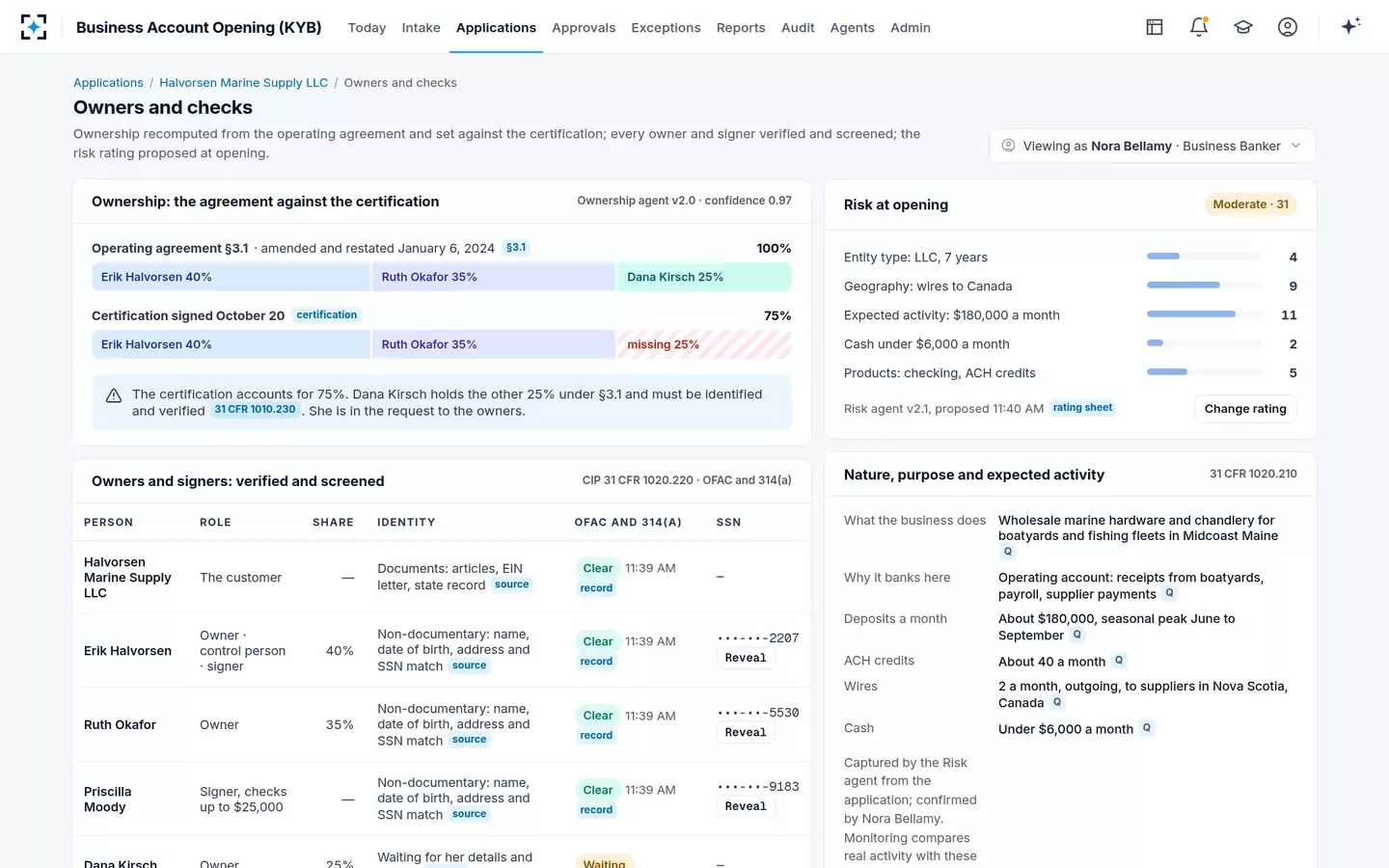
Business Account Opening (KYB) treats the first certification as the one that must be right. Its Ownership agent recomputes ownership from the operating agreement or other governing documents and lays it over the certification. In the sample case the agreement's section 3.1, amended and restated on January 6, 2024, adds up to 100% and the certification to 75%, so the third member, at exactly 25%, is marked missing with the section that proves it. The agent never removes a person from the owners, and an ownership doubt goes to the BSA officer.
The fix is a single request. The Outreach agent drafts one message asking for the missing owner's details on a secure form, a photo of her licence and the managing member's signature on an updated certification; the banker reads it and sends it. The design target is that every 25% owner is verified before anything is written to the core banking system, and every step, including the owner's upload and the e-signature, is kept with its time and the person who did it.
The missing owner answers from her phone
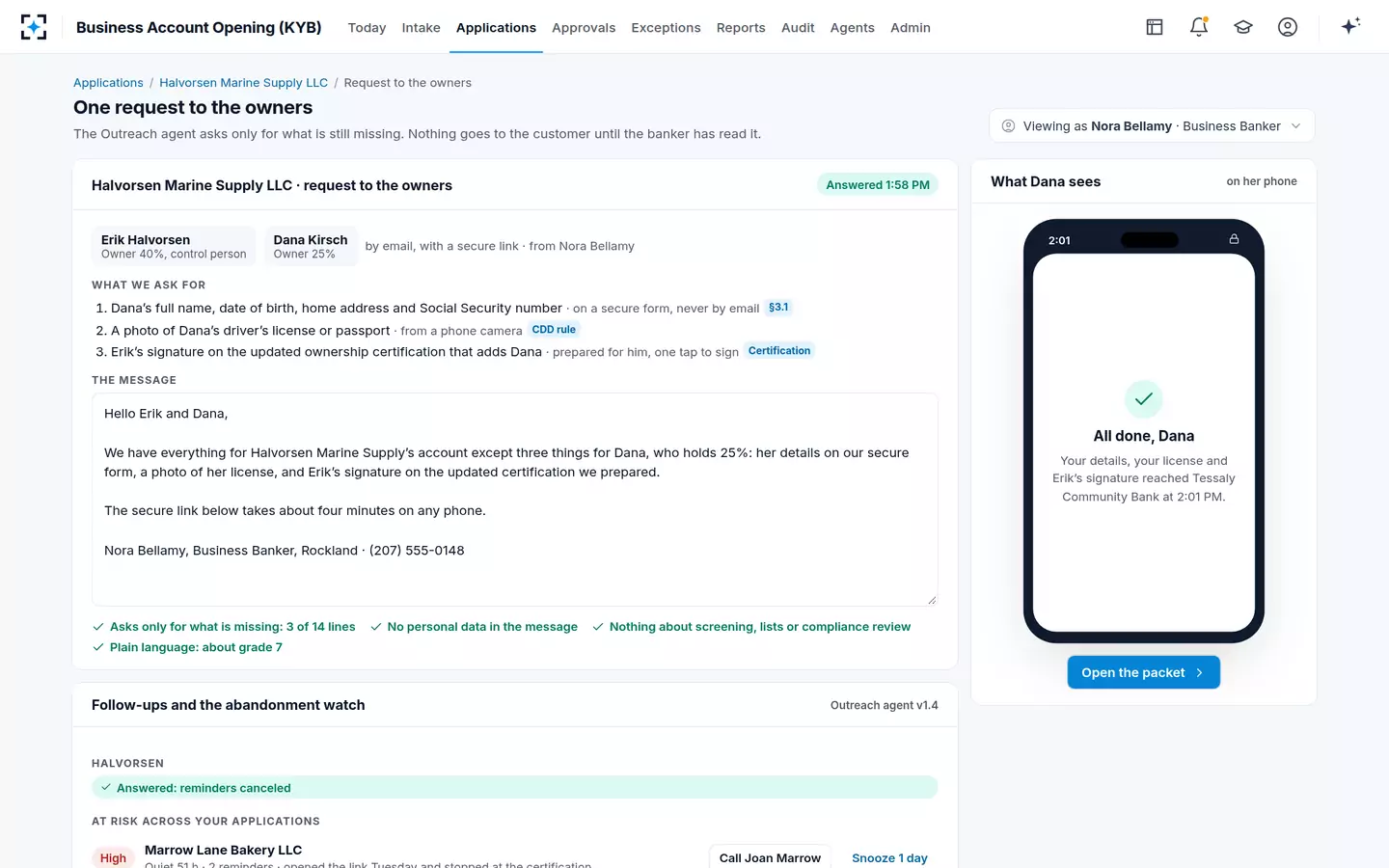
For later accounts the solution's role is narrower, and it depends on how the bank chooses to use the relief. A second account can rest on the first certification and a recorded confirmation, which is the kind of request the agents draft and the banker sends. Why one request beats several is the subject of KYB automation that asks the owner once.
Questions people ask
Is beneficial ownership information still required for my LLC in 2026?
Not by FinCEN, if the LLC is a US company: it is exempt from BOI reporting under the March 2025 interim final rule, made final on August 14, 2026. Your bank will still ask for the owners of 25% or more and one controller when you open your first account, because its own customer due diligence rule is unchanged.
Do banks still ask for beneficial ownership for existing customers?
Only on triggers, if the bank uses FIN-2026-R001. It must re-verify when it learns facts that call the earlier information into question, or when its risk-based procedures require; otherwise it may rely on the first certification with a recorded confirmation from the customer.
What is the FinCEN CDD relief order?
FIN-2026-R001 is an exceptive relief order issued by FinCEN on February 13, 2026. It lets banks and other covered institutions identify and verify a business customer's owners at its first account and then only in three situations, instead of at every new account. Using it is optional.
Can a bank get my company's owners from FinCEN instead of asking me?
Not in practice for a US company. The statute only ever allowed bank access with the company's consent, US companies no longer file, and FinCEN is deleting US-person information it received. The bank's certification is the source.
Has the FFIEC updated its exam procedures for the relief order?
Not in the version we could find. The beneficial ownership examination procedures captured in April 2026 still sample new legal entity accounts opened since May 11, 2018, and we found no update reflecting FIN-2026-R001 by October 2026; banks should check the current manual.
Does the beneficial ownership rule apply to accounts opened before 2018?
No. FinCEN's FAQ C.3 says the rule does not cover accounts opened before its applicability date of May 11, 2018. A bank may still update those customers' owners under its risk-based ongoing due diligence.