To open a business account, a US bank needs four things before the account can be used: the business's identity (legal name, address and taxpayer identification number), the identity of the people who own and run it, a signed certification naming each owner of 25% or more and one person who controls it, and enough about the business to understand what the account is for. The first comes from the Customer Identification Program rule, the second and third from the beneficial ownership rule, the fourth from the customer due diligence rule. At a community bank one business banker usually collects all of it, checks it and keys it into the bank's systems, which is why an incomplete packet stalls at one desk. Botminds' Business Account Opening (KYB) is built for that desk: agents read the whole packet, check it against the state's business filing and the owners' documents, and leave the banker with the decisions.
The worked examples on this page use a fictional sample bank, Tessaly Community Bank, and a fictional customer, Halvorsen Marine Supply LLC, as they run through the solution. The research figures come from regulators and federal agencies, linked where they appear.
One business account, one desk, more than an hour
1 hr+
of staff time to collect and review the due diligence on a new business account, against about 30 minutes for a personal one
25%
the ownership line: every person at or above it is named, plus one person who controls the business
37,900
new accounts clerks in the US in 2025, projected to fall 6.5% by 2035
What do banks need to open a business account? Four things, not one list
Banks need the same four things for every business account, though the papers that supply them vary by entity type. Each answers a separate federal rule, and knowing which rule a request comes from tells a banker what can wait and what cannot.
The first is the entity's identity. Under the Customer Identification Program rule, 31 CFR 1020.220, the bank must have the business's name, a street address (where it mainly does business, a local office or another physical site) and its taxpayer identification number before it opens the account. It then verifies them, from documents that show the entity exists, from public sources, or both.
The second and third are the people. The beneficial ownership rule, 31 CFR 1010.230, requires the bank to identify and verify each individual who owns 25% or more of a legal entity customer, up to four of them, and one individual who has significant responsibility for running it. The person opening the account certifies that list. The people who will sign on the account are a separate question: the bank's own signature card and resolution decide who may move money.
The fourth is purpose. The customer due diligence rule, 31 CFR 1020.210, requires the bank to understand the nature and purpose of each customer relationship well enough to build a risk profile for it (expected account activity shows what that looks like in a file). In practice that means a few answers at opening: what the business does, why it banks here, roughly what it will deposit and send, and whether it uses cash or wires abroad. Those answers become the baseline that monitoring compares real activity against.
What a banker has to be able to say before a business account opens
- Who the business is
Legal name, physical address and taxpayer identification number on file before opening; verified from documents showing the entity exists or from independent sources.
- Who owns 25% or more of it
Each such individual named on the certification and verified, unless the entity is excluded or covered by the control prong only.
- Who controls it
Exactly one person with significant responsibility for running the business, such as a managing member or chief executive.
- Who may sign
Signers and their limits, from the operating agreement, bylaws or a resolution, matched to the signature card.
- What the account is for
Nature of the business, purpose of the account and the activity expected, enough to build a risk profile.
- That nobody is on a list
The entity and its people compared against the government lists the bank must check, and possible matches sent to the BSA officer.
One change in 2026 matters for repeat customers. Under FinCEN's exceptive relief order FIN-2026-R001 of February 13, 2026, a bank may identify and verify a business's owners at its first account and then rely on them for later accounts, unless something calls them into question. So the full list above is what a new business customer meets; an existing one opening a second account may face a much shorter one.
Who checks a business account application at a community bank?
At most banks the person who collects the information is not the only one who looks at it. GAO's review of 11 banks found the same pattern across sizes: front-line staff such as personal bankers gather the due diligence information while they set up the account, and a second person, frequently the BSA/AML officer, then reviews it for completeness and for warning signs, such as gaps or high-risk indicators, that could call for more due diligence (GAO-20-574, page 42; the reviewer's side of that split is in what a KYC analyst does).
GAO describes the roles, not the hours. At a large bank the collector, the reviewer and the operations team that boards the account are three departments with their own queues. At a community bank with a handful of branches they are often one business banker, a deposit operations specialist who boards accounts for the whole bank, and a BSA officer who is also the compliance department. The business banker carries everything until the file is complete, and every gap, every call to the owner and every question from operations comes back to that one person.
The occupational data shows the same desk getting thinner. The Bureau of Labor Statistics counted 37,900 new accounts clerks in 2025 and projects 35,500 by 2035, a fall of 6.5%, at a median wage of $47,670 (BLS Employment Projections). O*NET's task list for the role begins with interviewing customers for the information needed to open accounts or rent safe-deposit boxes (O*NET 43-4141). In smaller banks that interview has moved to the business banker, who also sells the relationship.
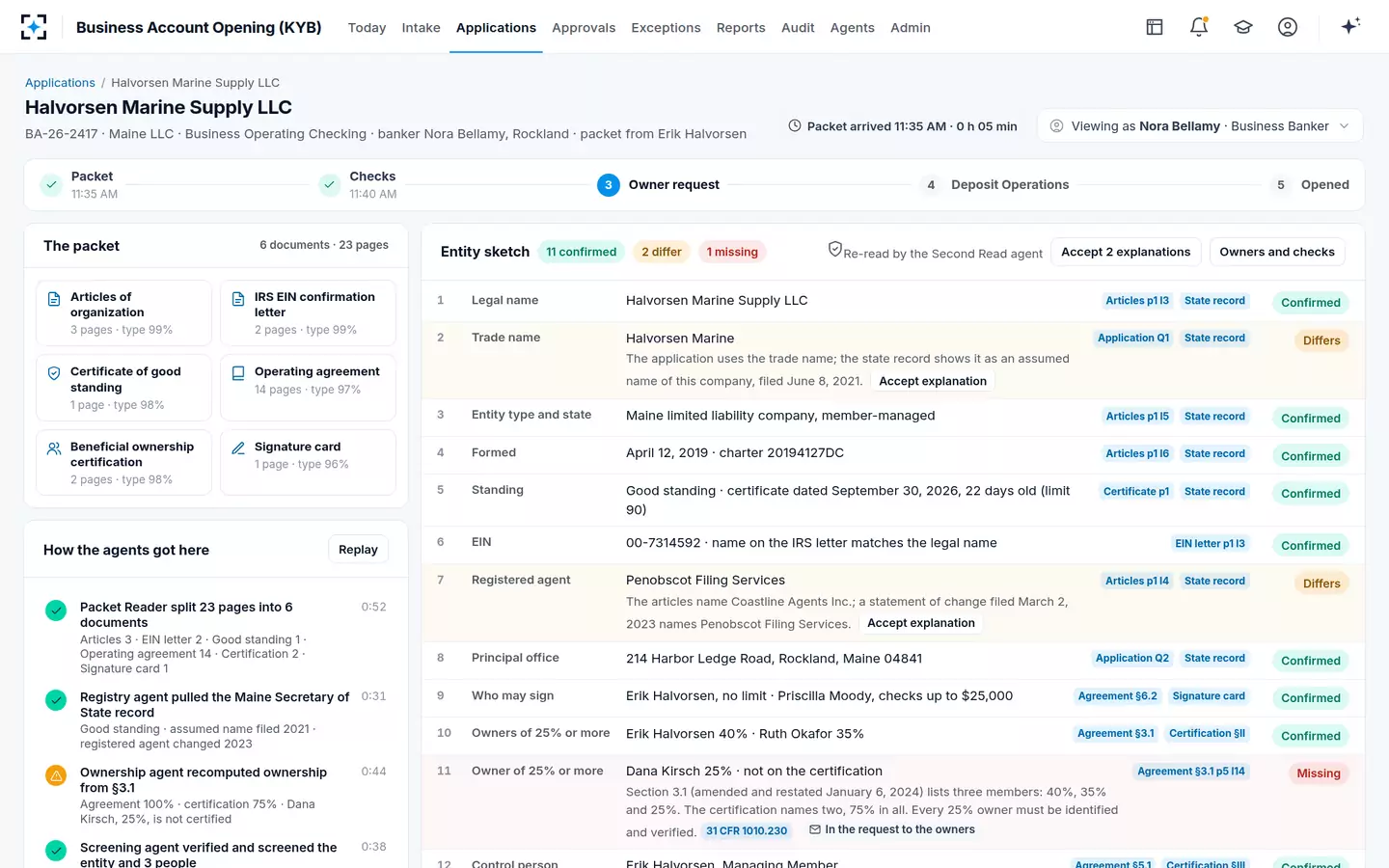
The business banker's one page: the entity sketch in Business Account Opening (KYB)
Can a bank refuse to open a business account for you?
Yes. A bank can decline a business account, and its identification program must say when it will. The CIP rule requires procedures that say in which cases the bank will decline to open an account because it cannot form a reasonable belief that it knows the customer's true identity (31 CFR 1020.220(a)(2)(iii)). An owner who will not complete the beneficial ownership certification, or a business whose name, address and tax number cannot be verified, can be refused on that ground.
What has changed is how a refusal must be reasoned. Executive Order 14331, signed August 7, 2025, requires banking decisions to rest on an objective, risk-based assessment of the individual customer (90 FR 38925; can a bank refuse to open an account sets out the limits). The banking agencies had already said in 2022 that they do not tell banks which accounts to open, close or keep (joint statement on the risk-based approach). And the OCC and FDIC rule that took effect on June 9, 2026 bars those agencies from pushing banks to close accounts for reputation risk alone (91 FR 18279).
For the banker the practical consequence is documentation. A decline should rest on something in the file: an identity that could not be verified, an owner who would not be named, an activity the bank's risk policy does not accept. Business Account Opening (KYB) routes declines to the branch manager for countersignature with a reason code, so the reason is written down by two people before the customer hears it.
Where the business banker's hours go on one packet
GAO put the average at a little over an hour of staff time per business account. A packet with a gap takes much longer, because the time is spent finding the gap and asking about it, not reading what is there. The split below is the product team's estimate for one small-business packet that arrives with something missing, worked by hand.
A packet with a gap, by hand: most of the time is finding and chasing
About 5.5 staff hours across the banker and deposit operations
- Sorting the packet, checking it is complete · 14%
- State filing against the articles · 9%
- Operating agreement against the certification · 18%
- Keying owners into identity and list checks · 14%
- Calls and emails, one per gap · 27%
- Re-checking and rekeying into the core · 18%
Two segments carry the risk as well as the hours. Reading the operating agreement against the certification is where a missing 25% owner is found or missed: the customer fills in the form, and nothing in the rule makes the bank re-read the agreement, so a file can go through on the form alone. Re-checking and rekeying is where a typed tax number or a transposed address becomes the core's version of the truth. The calls are the largest share, and how long it takes to open a business bank account follows them from the bank's clock to the owner's.
What the banker checks before anything reaches the core
Before a business account is submitted, a careful banker reconciles four sources that rarely agree on the first pass: the application, the documents in the packet, the state's business filing and the owners' identity documents. Most differences are innocent. A trade name filed as an assumed name, a registered agent changed by a statement of change, an address that is the registered agent's and not the business's: each needs a sentence of explanation, not a call.
The differences that are not innocent look the same at first glance. Take the sample customer. Its operating agreement, amended and restated on January 6, 2024, lists three members at 40%, 35% and 25%; the certification its managing member signed names the first two, 75% in all. The third member must be identified and verified before the bank can rely on the file. Nothing on the certification itself reveals the gap; only reading section 3.1 of the agreement does. The documents a packet should contain, and the rule each one answers, are set out in documents needed to open a business bank account.
Who signs what on one business account at a community bank
| Decision | Who makes it | Who checks it | Where the rule comes from |
|---|---|---|---|
| The application is complete and every difference explained | Business banker | Deposit operations, before boarding | Bank procedure; CIP verification, 31 CFR 1020.220 |
| Owners of 25% or more and one controller are named and verified | Business banker, from the customer's certification | Deposit operations; BSA officer on any doubt | 31 CFR 1010.230 |
| The risk rating at opening | Business banker, from a proposed rating | BSA officer sets the policy and reviews exceptions | 31 CFR 1020.210 and the bank's risk model |
| A possible sanctions or 314(a) match | BSA officer only | Independent testing | OFAC rules; 31 CFR 1010.520 |
| Decline, or an unusually large opening deposit | Business banker proposes | Branch manager countersigns | Bank policy |
| Writing the account to the core banking system | Deposit operations approves | A different person from the maker | Bank control (maker and checker) |
The people around the banker: maker, checker, BSA officer, branch manager
The business banker is the maker; three other roles touch every business account, and each has a different view of the same file. What changes when agents do the reading is not who decides but what each of them looks at.
Four seats around one business account, before and with Business Account Opening (KYB)
Today
Takes the packet in the branch or by email, keys the entity and every owner into three or four systems, reads the operating agreement if there is time, and calls the owner once for each gap.
With agents
Reads one page in which each line names its source and says confirmed, differs or missing, accepts or questions each line, and sends one request to the owner that she has read first.
Still theirs: The relationship, the nature and purpose of the account, and the decision to submit.
Today
Re-checks the file against the packet, rekeys it into the core banking system and sends it back when a page is missing.
With agents
Sees every field that will be written to the core with its source, and approves or returns it with a reason code.
Still theirs: The second pair of eyes. Nobody approves a file they submitted.
Today
Receives trusts, marijuana-related businesses and possible list matches whenever the banker gets to them, with no clock and little context.
With agents
Receives each exception with why it stopped, what was found and what is proposed, on a two-business-day clock.
Still theirs: Every potential list match, every ownership doubt and the risk rating policy.
Today
Hears about a stuck file when the customer complains.
With agents
Sees every open application on a clock and is warned before it runs out.
Still theirs: Countersigning declines and large opening deposits.
The checker's change is the one auditors notice. A deposit operations specialist who rekeys a file is checking the banker's typing. One who sees every field that will be written, each with the page it came from, is checking the banker's judgement, and can return the file with a reason code instead of a sticky note.
Why the one-person desk is shrinking and the work is not
New business formation is running high. The Census Bureau's Business Formation Statistics count more than 5.6 million business applications in 2025, the highest annual total since at least 2019, when there were about 3.5 million (our sum of the monthly, not seasonally adjusted series; an application is not an account, but most businesses that operate need one). Every new LLC that opens an account brings a beneficial ownership certification, a state filing to check and owners to verify.
Meanwhile the work is spread across fewer people at small banks. GAO found that total direct BSA compliance cost was about 2% of operating expense at the three smallest banks it studied, more than three times the share at the three largest, and KYB software and bank size works through what that means per business account. The rules did not get lighter for small banks; the 25% threshold and the single control person apply at a bank with one branch exactly as at a bank with a thousand.
The classification question is where a thinly staffed desk most often goes wrong. A sole proprietorship needs no beneficial ownership certification; a nonprofit corporation needs only its controller; a company 25% owned by a trust names the trustee. LLC bank account requirements sets out which duties apply to which entity, and the order in which to work them out.
Where Business Account Opening (KYB) takes the mechanical part off the desk
Business Account Opening (KYB) gives the banker one page per application instead of six documents and four systems. The banker drops the whole packet; a Packet Reader splits and types it, a Registry agent compares the articles with the state's business filing, an Ownership agent recomputes ownership from the operating agreement and sets it against the certification, and a Screening agent verifies and screens every owner and signer. A Second Read agent re-reads every line before the banker sees it.
In the sample case the packet, six files and 23 pages, arrived by email at 11:35 AM. The entity sketch was ready five minutes later with 11 lines confirmed, two that differed with an explanation each, and one missing owner. One request went to the owners at 11:44, the missing owner answered from her phone at 1:58 PM, and the account was open at 2:47 PM, after a deposit operations specialist had approved every field. The account was opened 3 hours 12 minutes after the packet arrived, on fictional sample data.
Every open application at the sample bank on one clock
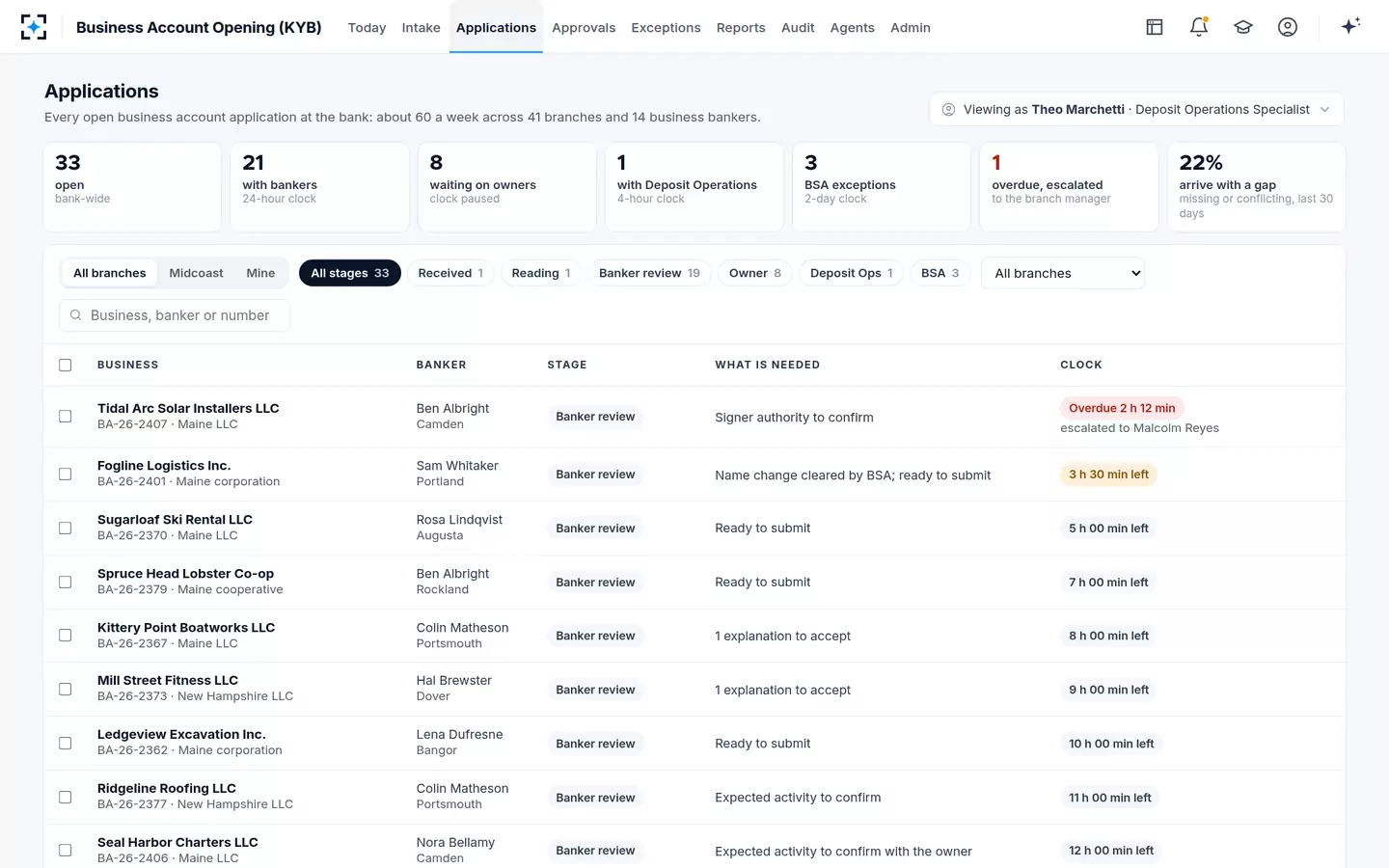
What the agents do not do matters as much. They do not decide the risk rating; they propose it with its factors, and the banker owns it. They do not send anything to a customer that the banker has not read. They do not clear a possible list match. And nothing is written to the core banking system until a different person has approved it.
Questions people ask
What do I need to open a business bank account for a sole proprietorship?
A sole proprietor usually needs personal identification, the business name and address, and a taxpayer identification number, which can be the owner's Social Security number if the business has no employees. A sole proprietorship is not a legal entity customer under 31 CFR 1010.230, so no beneficial ownership certification is required. A bank may still ask for a trade name filing if the business operates under a name other than the owner's.
Who verifies a business at a bank?
The banker or a new-accounts employee collects the information, and verification is done against documents that show the entity exists, such as certified articles, and against public sources such as the state's business filing. A second person, often the BSA officer, reviews the file at many banks, according to GAO's review of 11 banks. Possible sanctions matches go to the BSA officer.
How long does it take to open a business bank account in person?
The staff time averages a little over an hour per business account, by GAO's estimate, but the elapsed time depends on whether the packet is complete. A complete packet can open the same day; one with a missing owner or a document that disagrees with the state filing waits for the owner's answer. The sample case on this page took 3 hours 12 minutes, most of it waiting for one owner's reply.
Does the bank need my operating agreement?
Federal rules do not require a bank to collect an operating agreement, but most banks ask for it because it shows who owns the LLC and who may sign. It is also the document that reveals an owner missing from the beneficial ownership certification. Some banks accept a resolution or a certificate of incumbency for signer authority instead.
What is a certificate of good standing used for at a bank?
It shows that the business is registered with the state and authorized to do business there, which helps the bank verify that the entity exists. GAO found banks collecting certificates of good standing from state agencies as part of business account due diligence. A bank may also set its own freshness limit; the sample bank accepts a certificate up to 90 days old.
What do banks check before opening a business account?
They check the entity's identity against documents and the state's filing, verify each 25% owner and the control person, compare the entity and its people against the government lists, and record the nature and purpose of the account. Larger banks often use automated software to help assign the risk rating, GAO found. A bank may also pull a business credit or deposit history report under its own policy.