Can a bank refuse to open an account? Yes. No federal law obliges a bank to open a deposit account for everyone who applies, and the identity rule actually requires a bank to have procedures for when it "should not open an account" (31 CFR 1020.220). But the grounds have narrowed. Executive Order 14331, signed on August 7, 2025, states that "banking decisions must instead be made on the basis of individualized, objective, and risk-based analyses", and the OCC, FDIC and NCUA have since removed reputation risk from their supervision. So both common beliefs are wrong: a bank need not open an account for anyone, and it may not refuse for any reason it likes. Botminds' Deposit Account Opening runs the checks behind that decision once, applies limits the bank sets, and sends every refusal to a person with one written reason, which is what an individual, objective analysis looks like on file.
The rules are quoted from the Federal Register, the eCFR and the agencies' own statements, linked where they appear. The sample screens come from a fictional bank, Corvane National Bank.
Five beliefs about refused bank accounts, and what the rules actually say
The belief: A bank has to open an account for anyone who applies.
What the rules say: No federal rule says so. The CIP rule requires procedures for when a bank should not open an account it cannot verify, and the agencies "do not direct banks to open, close, or maintain specific accounts."
The belief: A bank can refuse for any reason it likes.
What the rules say: EO 14331: decisions "must instead be made on the basis of individualized, objective, and risk-based analyses," not political or religious beliefs or lawful business disfavored for political reasons.
The belief: A bank can turn you away because you would look bad for it.
What the rules say: OCC, FDIC and NCUA rules effective June and July 2026 bar examiners from criticising a bank on reputation risk or pressing it to refuse lawful customers on that basis.
The belief: A bank never has to tell you why.
What the rules say: If a consumer report played any part, the FCRA requires a notice naming the reporting company and your rights to a free copy and to dispute.
The belief: Some kinds of customer are high risk by definition.
What the rules say: The 2022 joint statement: risk varies within every customer type, so no type is uniformly risky. Each file is assessed on its own facts.
Can a bank refuse to open an account for you? The short answer
A bank can refuse to open an account for you when it has a risk-based reason it can explain: it could not verify who you are, your checking or credit history falls outside its policy, the application shows signs of fraud, or the account would breach its anti-money-laundering obligations. Those are the reasons the rules expect a bank to weigh, and a bank that applies them consistently is acting within its discretion.
What it cannot do, under the policy the executive order set out, is refuse "on the basis of the customer's or potential customer's political or religious beliefs, or on the basis of the customer's or potential customer's lawful business activities that the financial service provider disagrees with or disfavors for political reasons" (EO 14331, sec. 3). The order calls that "politicized or unlawful debanking", and it covers potential customers, so it reaches the refusal to open as well as the closure of an existing account.
For applicants with a past banking problem, the useful question is not whether the bank may refuse, but whether it offers anything else. Why a bank account application is denied sets out the reasons from the applicant's side, including second-chance accounts.
What is debanking, and what changed in 2025 and 2026?
Debanking is a bank refusing, closing or restricting someone's accounts. The term now has a legal edge: EO 14331 defines "politicized or unlawful debanking" as restricting access to, or adversely modifying the conditions of, accounts and other products "of any customer or potential customer" because of political or religious beliefs or politically disfavored lawful business. Four dated steps followed, and they are worth knowing precisely, because they are not all in force everywhere.
From the fair banking order to the reputation-risk rules, month by month
- EO 14331 signed Aug 7, published Aug 12Aug
- NCUA stops examining for reputation risk, Sep 25Sep
- Agencies draft rulesOct–Jan
- Fed proposes its rule, Feb 26Feb
- OCC/FDIC final rule and FinCEN program proposal, Apr 10Apr
- OCC/FDIC rule effective Jun 9Jun
- NCUA rule effective Jul 27Jul
The 2026 rules bind the regulators, not the banks directly. The OCC and FDIC rule "prohibits the agencies from requiring, instructing, or encouraging an institution to close an account, to refrain from providing an account, product, or service" on the basis of political, social, cultural or religious views, protected speech, or "solely on the basis of politically disfavored but lawful business activities perceived to present reputation risk" (91 FR 18279). It also defines reputation risk broadly, "regardless of how the risk is labeled", so a relabelled concern does not escape it.
The Federal Reserve is the gap. Its rule is still a proposal, so a state member bank's examiners operate under the order and the Board's own guidance rather than a final rule. A bank's policy, in any case, should not depend on which regulator examines it: the order's standard of individualized, objective, risk-based analysis is the one an applicant, a journalist or a court will apply.
"Banking decisions must instead be made on the basis of individualized, objective, and risk-based analyses."
Executive Order 14331, Guaranteeing Fair Banking for All Americans, sec. 2 (August 7, 2025)
Why would a bank refuse to open an account? The lawful reasons
A bank refuses to open an account lawfully when the refusal follows from a risk it can name and document. The reasons fall into four groups, each tied to a rule or to the bank's own written policy, and each leaves a different trace in the file an examiner or a court would read.
Grounds for refusing an account: what they rest on, and what the file should show
| Ground | What it rests on | What the file should show |
|---|---|---|
| Identity not verified | CIP rule: procedures for "when the bank should not open an account" after verification fails | Which data could not be verified, the sources tried, and how any discrepancy was resolved |
| Checking or credit history | The bank’s written policy, applied to a consumer report | The entry relied on, the policy line it failed, and the FCRA notice sent |
| Fraud signals | The bank’s fraud and funding controls | The signal, its evidence, and the person who decided |
| Sanctions or AML risk | OFAC obligations and the bank’s AML program | The match or risk factor, reviewed by a person, kept to those who need it |
| Political or religious belief, or lawful business disfavored for political reasons | Not a lawful ground under the policy of EO 14331 | Nothing: it should never be the reason |
The examiners' own manual makes the same point from the other side. A bank that has a working process for customer risk decisions, and has followed its own policies and procedures, should not be faulted for an individual decision unless it affects the program as a whole or shows bad faith (FFIEC BSA/AML Manual, CDD). The protection runs to the process, not the outcome: a bank that can show its reasoning is defending a decision; one that cannot is defending a guess.
Can a bank decline to open an account without telling you why?
Partly. No general rule requires a bank to give its full reasoning for refusing a deposit account. But if the refusal was based "in whole or in part on any information contained in a consumer report", the Fair Credit Reporting Act requires a notice naming the reporting company, stating that it did not make the decision, and telling the applicant of the right to a free copy within 60 days and to dispute it (15 U.S.C. 1681m(a)).
Two things are deliberately kept out of any letter. A match against FinCEN's 314(a) list is confidential by rule, and a bank may not disclose that FinCEN requested information. Suspicious activity reports are confidential too. So an honest refusal letter can be specific about the report, and silent about some other reasons, without either being a failure.
Myth: banks refuse accounts mainly because of crime risk
The evidence points elsewhere. Treasury's 2023 review of de-risking, written under the Anti-Money Laundering Act, "identifies profitability as the primary factor in financial institutions' de-risking decisions" (Treasury, 2023). An account that is expensive to verify and monitor, and earns little, is easy to refuse and hard to defend.
International standard setters say the same. FATF's 2021 stocktake found that de-risking and financial exclusion "remain challenges for many sectors and run contrary to the RBA", the risk-based approach FATF promotes (FATF, 2021). FinCEN's April 2026 proposal for AML programs says it aims to lower the risk that institutions are improperly pushed into closing customers' accounts, and ties itself to EO 14331 (91 FR 18704).
Who ends up outside the banking system
6%
of US adults were unbanked in 2025, steady since 2021
21%
of adults with income below $25,000 were unbanked, against 1% at $100,000 or more
1.7B
adults worldwide without a basic transaction account, in FATF’s 2021 estimate
That is why the cost of checking matters to fair access. When verifying a thin-file applicant takes a specialist half an hour, the cheapest answer is no. When the checks run once and a referral arrives already explained, the bank can afford to say yes to more applicants inside the same risk appetite, including second-chance customers it would otherwise turn away. Digital account opening after FATF's 2025 change makes the same argument for remote applicants.
Debanking and de-risking: two words for different refusals
Debanking, in the executive order's sense, is a refusal or restriction aimed at a person's beliefs or politically disfavored lawful business. De-risking is broader and older: Treasury's 2023 strategy uses it for institutions ending or restricting relationships with whole categories of customers to avoid risk rather than manage it (Treasury, 2023). The two overlap, but a consumer refused a checking account usually meets neither; they meet a policy line applied to their own file.
Treasury named the groups most affected by de-risking: smaller money services businesses, non-profits working in high-risk jurisdictions abroad, and foreign financial institutions with low correspondent volumes. Those are business relationships, outside this guide's consumer focus, but the remedy Treasury and the agencies point to is the same at any scale: assess the customer in front of you, on the risks that customer actually presents, and keep the reasoning.
Can a bank deny you an account because of your industry?
A bank can deny an account because of the specific risks a business presents, but not because of its category alone. The agencies' July 2022 joint statement says no type of customer carries one uniform level of risk or one fixed profile (CDD vs EDD shows what that means for reviews), and "the Agencies do not direct banks to open, close, or maintain specific accounts" (joint statement, 2022). The order adds that lawful business activity disfavored "for political reasons" is not a ground at all.
In practice that means the file has to carry the reasoning. A refused money transmitter, cannabis-adjacent business or charity should have a record of what was assessed: ownership, expected activity, controls, and why the bank's program could or could not manage them. A one-line "outside appetite" no longer reads as an individualized analysis. This guide is about consumer deposit accounts; business accounts carry the same principle with more questions.
How a bank shows its refusals are individual and objective
A refusal is individual and objective when the same facts produce the same answer, the answer cites the rule or policy line it rests on, and a second person has checked it. Each part can be built into the process rather than left to whoever happens to read the file.
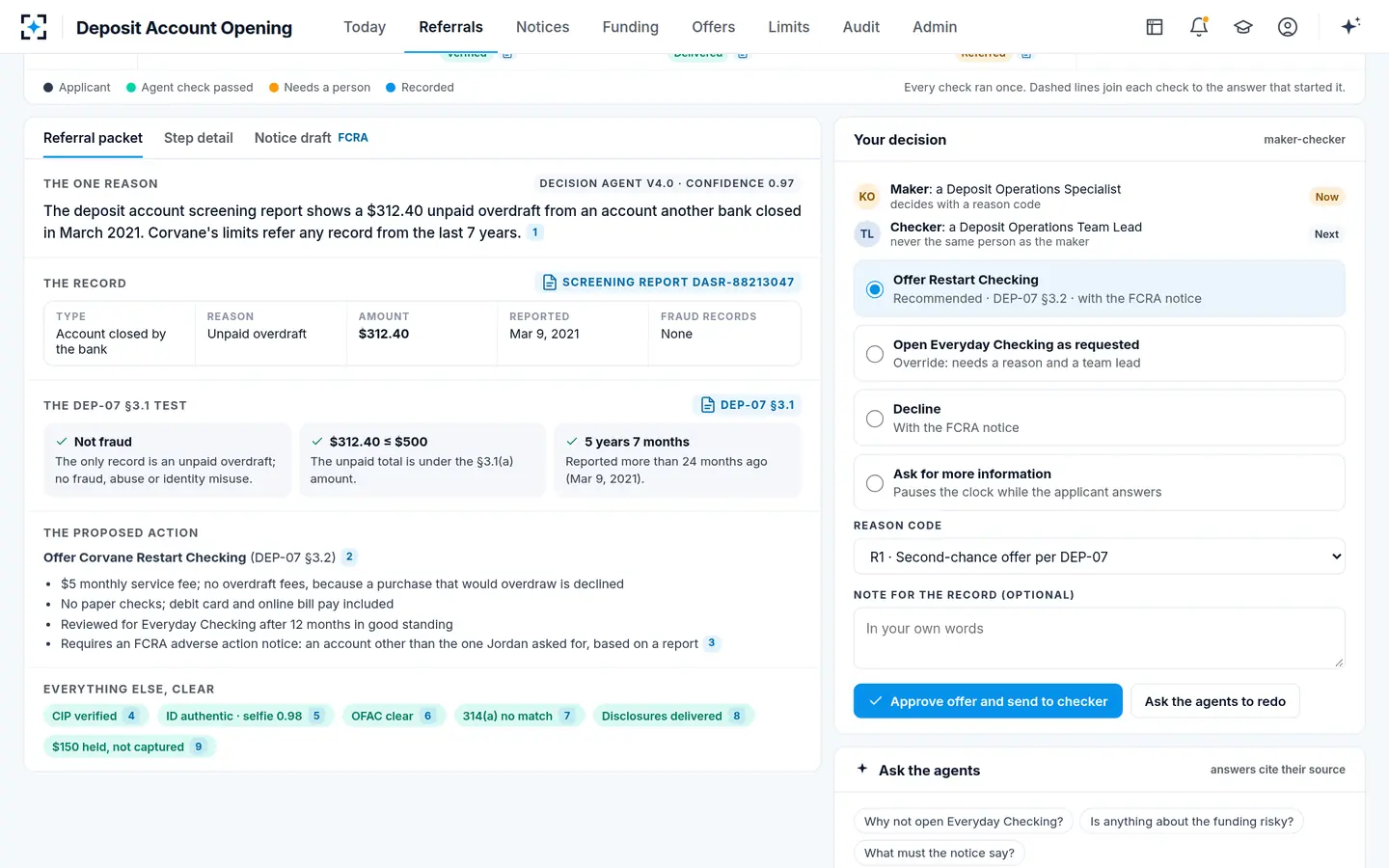
In Deposit Account Opening the agents may open an application on their own only inside written limits the bank sets, and they never decline. Everything outside the limits goes to a specialist as a referral packet: one reason, the record behind it, the policy test applied line by line, and the action the policy allows. The specialist decides with a reason code and a team lead checks; overriding the proposal needs a reason and a note.
The limits the agents work inside, and yesterday's referrals by rule
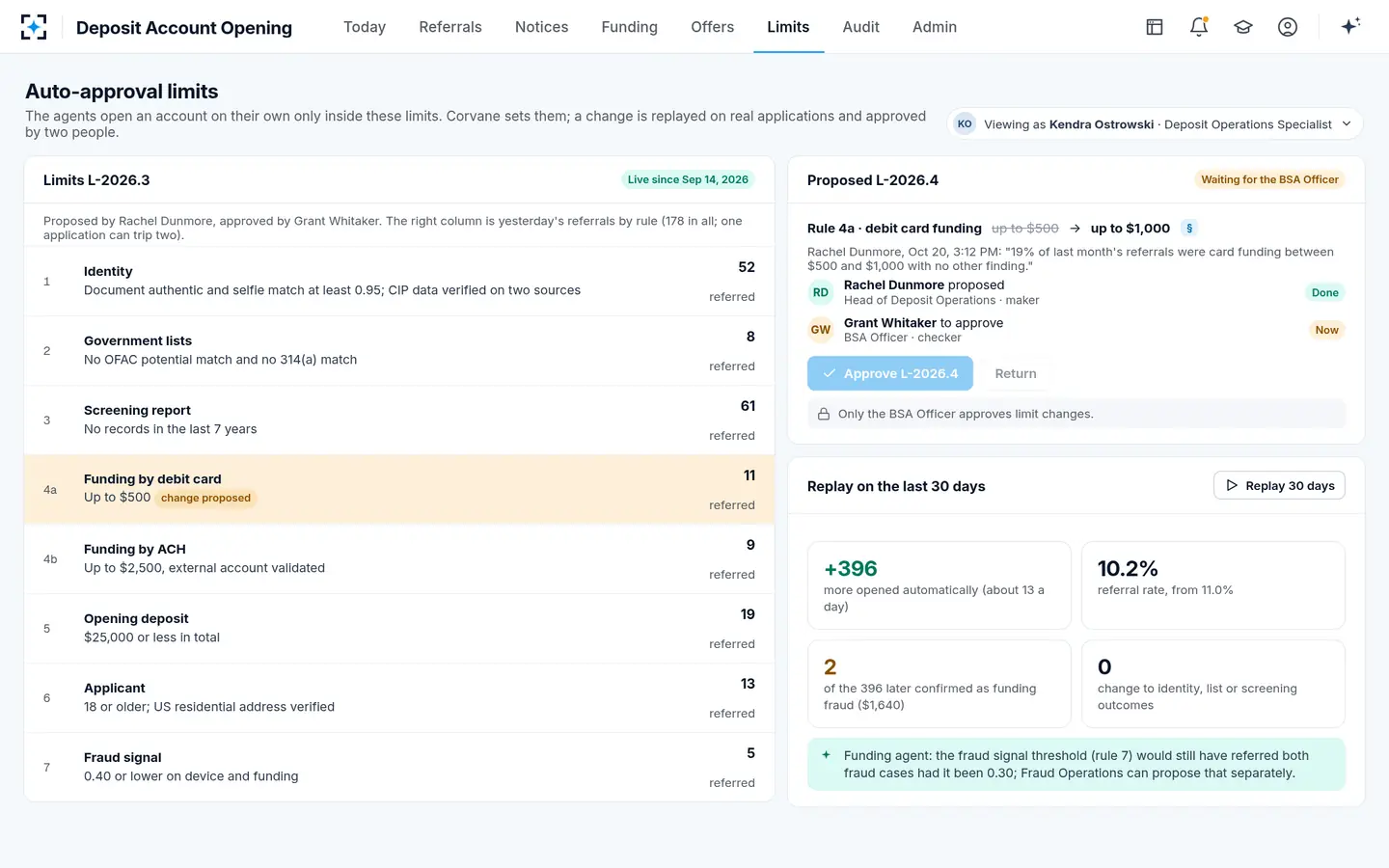
Consistency is the part examiners and applicants notice. Take a sample referral: Jordan Ellery, a fictional applicant, had one entry on his checking account report, an unpaid overdraft of $312.40 from March 2021, with no fraud record. The sample bank's policy allows a second-chance account in exactly that case, so the agents proposed one, and every applicant with the same facts gets the same proposal. Whether Jordan got an account no longer depended on who read the report.
A referral that carries its own reasoning
To see how a refusal, an offer and its notice are decided and recorded, start from Deposit Account Opening.
Questions people ask
Is there a law that says a bank must open an account for me?
No federal law requires a bank to open a deposit account for every applicant. The interagency statement of 2022 says the agencies do not direct banks to open or close specific accounts. What has changed is the basis: under EO 14331 decisions are to rest on individualized, objective, risk-based analysis, not beliefs or politically disfavored lawful business.
What is the fair banking executive order?
Executive Order 14331, "Guaranteeing Fair Banking for All Americans", was signed on August 7, 2025 and published on August 12, 2025. It directed the federal banking regulators to remove reputation risk from their guidance and examinations within 180 days, and defined politicized or unlawful debanking. The OCC, FDIC and NCUA have since adopted final rules; the Federal Reserve has proposed one.
Can a bank close my account without notice?
This guide is about refusals to open, but the order's definition of debanking covers existing customers too, and the same standard of individualized, objective analysis applies. Account agreements usually set the notice terms for closure. Where a closure or refusal relied on a consumer report, the FCRA notice still applies.
Can a bank refuse me because of a ChexSystems report?
Yes, a checking account report is an objective, individual input, and banks may use it under their own policies. The bank must send an adverse action notice naming the reporting company if the report played any part, and some banks offer second-chance accounts for applicants with older or smaller entries.
Who do I complain to if I think I was debanked unfairly?
The bank's regulator is the usual route: the OCC for national banks, the FDIC for state non-member banks, the Federal Reserve for state member banks and the NCUA for federal credit unions, and the CFPB takes consumer complaints about banks and credit unions. Keep the refusal letter and any notice, because the reason the bank gave is the first thing a regulator will ask about.