Account opening software pricing is usually argued from the back-office minutes a system saves, and the better test is the applicants it keeps. The software for banks is the system that takes a consumer or business from application to an open, funded deposit account: the form, identity verification, sanctions and screening checks, disclosures, funding and the decision. The minutes are real: the GAO found banks spent an average of $15 per new account on customer due diligence, from $5 to $44 (GAO-20-574). But the larger value sits with the applicant: whether they finish in one session, whether a genuine customer is wrongly refused, and whether someone with an old overdraft is offered an account at all. Those decide how many deposits the bank actually opens. Botminds' Deposit Account Opening works across the systems a bank already has, runs every check once while the applicant types, opens clean applicants inside the bank's limits and writes every referral with one reason; this guide shows how to value that from the applicant's side as well as the bank's.
The research figures come from the FDIC, the Federal Reserve, the GAO and FinCEN, linked where they appear. The sample figures come from a fictional bank, Corvane National Bank, as its applications run through the solution; where we do arithmetic on them, we say so.
The two sides of the business case
$15
average customer due diligence cost per new account in 2018, from $5 to $44 by bank
30min
of staff time to collect and review a new consumer account’s information
54.3M
new account relationships a year that FinCEN counts for its identity-rule burden estimate
70.5%
of banked households now reach their bank mainly through mobile, online or phone
What account opening software does, and what it should be judged on
An account opening system collects the application, calls the identity, sanctions and screening services, presents the disclosures, takes the opening deposit, and either opens the account in the core or routes the application to a person. The question a buyer should ask is not which features it lists but what happens to three applicants: the clean one, the one with a discrepancy, and the one with a past problem.
The clean applicant should open in one sitting. The one with a discrepancy, a birth year that differs between the ID and the bureau, a mailbox address, a selfie that did not match well, should be asked one precise question rather than dropped or sent to a queue as a code. The one with a past problem should be measured against the bank's written policy, offered what the policy allows, and sent the notice the law requires. Software that handles the first well and the other two badly saves staff time and loses customers.
Who is not opening accounts, and why
The FDIC's survey of households without a bank account is the closest thing to a map of the applicants account opening software either serves or loses. In 2023, 4.2% of US households, about 5.6 million, had no bank account, and 29.1% of them said they were very or somewhat interested in having one (FDIC, 2023).
Why interested unbanked households say they have no account
Two of those three reasons sit squarely inside the account opening process. Lacking the required ID is partly a question of which documents and numbers a bank accepts and whether it can verify them remotely; a non-citizen may legally use a passport or other government photo ID number, and a bank's software either supports that or does not. Past banking problems are a question of how the bank reads a checking account report: the CFPB points applicants with accurate negative entries to the lower-risk accounts that a number of banks and credit unions offer, accounts that do not let the customer overdraw (CFPB, 2016).
The Federal Reserve's household survey adds the income picture: 6% of adults were unbanked in 2025, and 21% of adults with income below $25,000, against 1% at $100,000 or more (Federal Reserve, 2026). FATF's 2021 stocktake estimated 1.7 billion adults worldwide without a basic transaction account and counted de-risking among the unintended consequences of its own standards (FATF, 2021). An account opening process that cannot afford to look at an unusual applicant refuses them.
Where referred applicants come from
A bank's own referrals show where its applicants are won or lost, and they are the first numbers to collect before buying anything. At the fictional sample bank, 178 completed applications were referred to a person on one day, out of roughly 1,600 opening deposits verified. More than six in ten were about the checking account report or identity.
What one day's 178 referrals were about, at the sample bank
Referrals by the rule that stopped them
- Checking account report · 34%
- Identity · 29%
- Funding and deposit limits · 22%
- Applicant age or address · 7%
- Lists or fraud signal · 8%
Each slice has a different value per applicant. An identity referral answered with one precise request, a second ID or a new selfie, becomes a customer the same day; one left as a code becomes an abandoned application. A screening referral measured against a written second-chance policy becomes either a standard account, a second-chance account or a documented refusal; one left to whoever reads it becomes a coin toss. The funding referrals are where the fraud is, and the value there is the money that never moves.
Account opening software pricing: what to compare
Account opening software is priced in several ways, per application, per account opened, by subscription, or as part of a wider digital banking contract, and we know of no independent public benchmark of those prices. A bank comparing offers should therefore convert each into the same unit, cost per completed application, and set it against the value per completed application, which it can estimate from its own data.
The value of account opening software, per completed application
Applicants who finish
extra completed applications × share that open × value of a new account
From the bank’s own funnel; the applicant who abandons at the identity step never reaches the referral queue.
Digital product
Referrals that become customers
referrals resolved the same day × share opened × value of a new account
A precise question instead of a code; a second-chance offer instead of a refusal.
Deposit operations
Staff minutes on referrals
referrals × minutes saved × loaded cost per minute
On our estimate, about 43 minutes saved on each referred application.
Operations finance
Software and integration
licence + integration + running cost, per completed application
Including the systems it must connect to, which a bank already pays for.
Technology
The staff term is the easiest to estimate. On our estimate a referred application worked by hand takes about 50 minutes of a specialist's and a team lead's time and about 7 when the checks have already run and the referral arrives written. At the sample bank's 178 referrals a day, that is roughly 128 staff hours a day saved, our arithmetic on fictional data. A bank should replace both numbers with its own before trusting the result.
The second-chance account as a measure of value
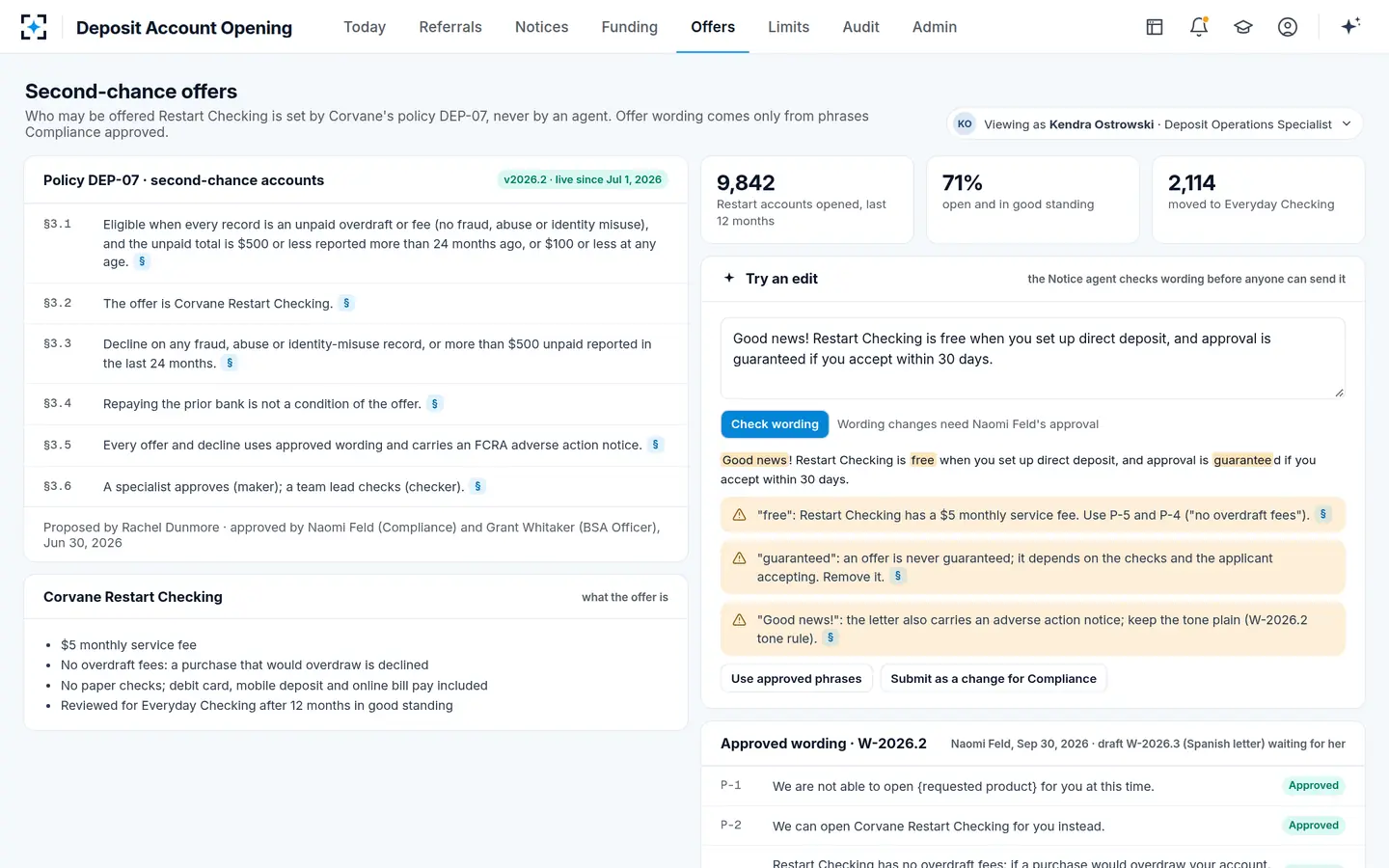
Second-chance accounts show the applicant side of the case most clearly, because they are accounts the bank would otherwise refuse. In the CFPB's description they are lower-risk products that do not allow overdrafts and may limit services such as paper checks. They work only if the policy deciding who qualifies is written down and applied the same way to every applicant.
At the fictional sample bank, the second-chance policy offers Restart Checking, with a $5 monthly fee, no overdraft fees and a review after twelve months, to applicants whose only entries are unpaid overdrafts or fees of $500 or less reported more than 24 months ago, or $100 or less at any age. Over twelve months it opened 9,842 Restart accounts; 71% were open and in good standing, and 2,114 had moved to the standard account. Those are applicants a policy left to whoever reads the file might well have refused, and the figures are sample data, shown to illustrate what a bank should measure.
A second-chance policy, its outcomes, and the wording it may use
Account opening software comparison: questions that reveal applicant value
Feature lists converge; what separates account opening systems is how they handle the applications that do not go straight through. The table sets out what to compare, why it matters to the applicant, and what to ask a vendor to show on your own data.
Comparing account opening software by what happens to the applicant
| Compare | Why it matters to the applicant | Ask to see |
|---|---|---|
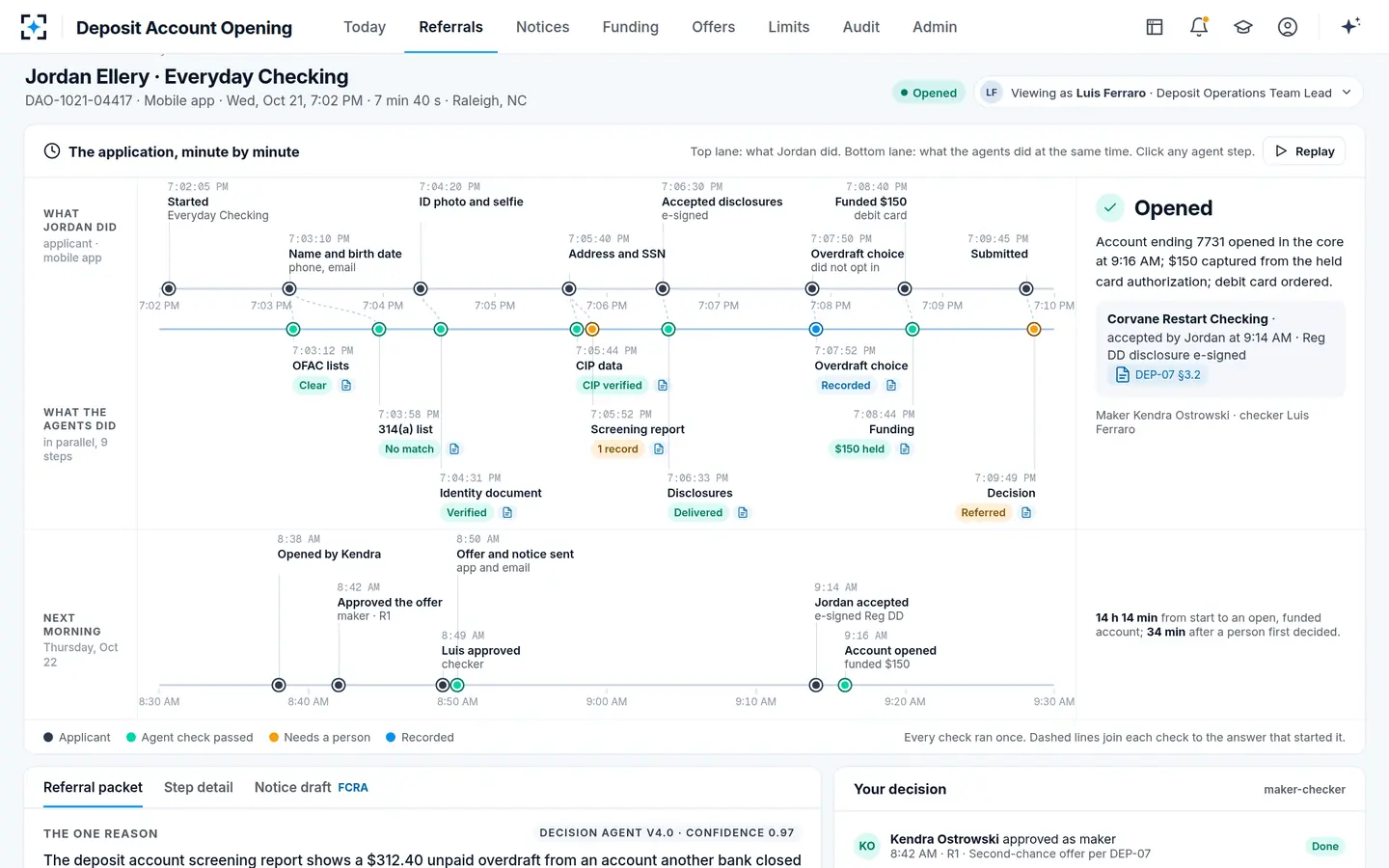
| When each check runs | Checks that start as data arrives finish before submit; the applicant gets an answer while still in the session | A timeline of one application, check by check |
| What a referral looks like | A referral with one reason becomes one precise question to the applicant, not silence | Ten of your own past referrals, as the system would write them |
| Documents and numbers accepted | Non-citizens may use a passport or other ID number; ITIN holders may need their letter | How a passport-only or ITIN application is verified and referred |
| How the checking account report is read | The same history should get the same answer, including a second-chance offer | The policy test applied line by line to one record |
| Who can refuse, and with what notice | A refusal based on a report owes a notice naming the company and the 60-day right | A drafted notice, and who approves it before it is sent |
| Funding before approval | A refused applicant’s money should not have moved | Whether deposits are held or captured, and who releases a hold |
| Limits and changes | More applicants open only if the limits allow it, safely | A limit change replayed on 30 days of your applications |
Ask for evidence in the bank's own terms. A vendor demonstration on its own sample applicants shows the happy path; the bank's last month of referrals shows the rest. Digital account opening after FATF's 2025 change covers the controls a remote channel must show, and why an application is denied shows the letter from the applicant's side.
Online account opening software for banks: build, buy or add a layer
A bank choosing online account opening software has three broad options: build its own flow, buy a digital account opening platform, or keep the platform and systems it has and add a layer that runs the checks across them. Each has a place, and the right one depends on what the bank already owns and where its applicants are lost.
Building gives control and takes the longest. Replacing the platform suits a bank whose current one cannot support remote identity proofing or modern disclosures at all. Adding a layer suits a bank whose platform, identity service, screening service and core all work, but which loses applicants and staff time in the gaps between them; that is the case Deposit Account Opening is built for. Digital account opening software that works with the core sets out what that integration involves.
One applicant's whole path, from the first tap to a funded account
Which banks Deposit Account Opening suits, and which it does not
Deposit Account Opening fits a bank or credit union that already has a digital account opening platform and a core, and wants three things from them: every check run once while the applicant types, clean applicants opened inside limits it sets, and every other applicant referred with one reason and the action its policy allows. The design targets are that 89% of completed applications open inside the bank's limits and every referral is decided the same day.
It is not a replacement for the platform's front end, the core, or the identity and screening vendors, which it uses; it does not set the bank's appetite or its second-chance policy, which the bank writes; and it is not a lending product. Community banks, where compliance takes 11% to 15.5% of payroll at the smallest institutions against 6% to 10% at the largest, according to a 2025 CSBS analysis, are the ones for whom staff minutes per referral weigh most (CSBS, 2025). To run the case on your own past applications, start from Deposit Account Opening.
Questions people ask
What is an account opening system in a bank?
It is the software that runs a new deposit account from application to opening: the form, identity verification, sanctions and screening checks, disclosures, funding and the decision, connected to the core where the account is booked. A bank often uses a digital account opening platform for the front end and separate services for identity and screening.
How much does account opening software cost?
Vendors price per application, per account opened, by subscription or within a broader digital banking contract, and we know of no independent public price benchmark. Compare offers as a cost per completed application, and set that against your own value per application; GAO's $15 average due diligence cost per account is a floor for the staff side alone.
Who are the main account opening software providers?
The market includes core banking providers, digital banking platform vendors, specialist account opening platforms and identity verification companies, and banks often combine several. We do not rank vendors here; the comparison table on this page is a way to test any of them, including Botminds, on your own applications.
What features should account opening software have?
At minimum: CIP collection and verification, sanctions screening, checking account report decisioning, electronic disclosures and consent, overdraft opt-in, funding verification, and a decision with an audit trail. What separates systems is how referrals are handled: whether each arrives with a reason, whether a second-chance policy is applied consistently, and whether notices are drafted and approved by two people.
Does account opening software help unbanked customers?
It can, when it supports the documents non-citizens may legally use, refers identity discrepancies as precise questions, and applies a written second-chance policy. The FDIC found 16.4% of interested unbanked households lack the required ID and 13.2% cite past banking problems, both reasons a better process can address.