Digital account opening software is the layer that lets a customer apply for and open a deposit account online, and in most banks it is not one system but several: a digital account opening platform for the application, an identity verification service, a checking account screening service such as ChexSystems or Early Warning Services, sanctions and 314(a) screening, the card processor and ACH rails for the opening deposit, document imaging, and the core where the account is booked. Replacing all of that to fix account opening is slow and risky, and usually unnecessary: what fails is the gaps between the systems, where an application stops with a code and a specialist re-runs the checks to learn why. Botminds' Deposit Account Opening is built for those gaps. It connects to the systems a bank already has, runs every check once while the applicant types, opens clean applications in the core inside the bank's limits, and writes every other one up for a person; this guide shows how that integration works and how long it takes.
The rules are quoted from the eCFR and the agencies, linked where they appear. The sample screens and figures come from a fictional bank, Corvane National Bank.
The integration sequence: read first, run beside the team, then open inside limits
Agent
Read what existsConnect read-only to the platform, the identity and screening services and the core; replay the last 30 days of applications.
A person decides
Compare with your decisionsDeposit operations and compliance compare each replayed referral and opening with what the bank actually did, and set the limits.
Agent
Run beside the teamLive applications are checked in parallel and referrals written, while people still decide everything as today.
Never: opens or refuses anything in this phase.
A person decides
Approve the go-liveThe BSA officer approves the limits; compliance approves notice wording; a team lead checks the first referrals.
Agent
Open inside the limitsClean applications open in the core within the approved limits; every other one reaches a person with one reason.
What digital account opening platforms already connect to
A digital account opening platform already connects to several other systems, and each of them carries a rule. The core books the account and its disclosures; the identity service supports the CIP verification the bank must perform; the screening service supplies the checking account report a refusal may be based on; the sanctions service and FinCEN's 314(a) list carry their own confidentiality; the card and ACH rails carry the opening deposit and its hold. The table maps each system to what an agent layer reads from it, what it writes back, and the rule that shapes both.
The systems one deposit account opening touches, and what an agent layer does with each
| System | What the agents read | What they write back | Rule that shapes it |
|---|---|---|---|
| Digital account opening platform and branch desk | The application as it is typed, the documents and the disclosures shown | Requests for one missing item; the status the applicant sees | CIP notice before opening; Regulation DD disclosures before an online account opens |
| Identity verification service | Document authenticity, selfie match and liveness, data matches from independent sources | Nothing; results are kept with their source | CIP verification and the record of how each discrepancy was resolved |
| Checking account screening service | The report and each entry on it | Nothing; the entry is cited in the referral and the notice | FCRA adverse action notice if the report leads to a refusal |
| OFAC screening and the 314(a) list | Potential matches at the moment the name is entered | Referrals to the sanctions team; 314(a) matches to the BSA officer only | 314(a) requests may not be disclosed |
| Card processor and payments hub | Card authorization, name and address match; ACH account validation; device and velocity | A hold, and a capture only when the account opens | New-account rules on funds availability for the first 30 days |
| Core banking system | Existing relationships, for customers who already bank there | The new account, the customer record and the captured deposit | An existing customer the bank already knows may not be a new CIP customer |
| Document imaging | Prior documents on file | IDs, letters and notices as sent | CIP records kept five years; the bank may keep longer by policy |
Does digital account opening replace the core?
No. Digital account opening software sits in front of the core and calls it to book the account; it does not replace it. The core remains the system of record for the account, the customer and the balance, and the opening process writes to it once the decision is made. A project that bundles a new core with new account opening is two projects, and the second is the one that fixes applicants' experience.
The same is true one layer up. An agent layer such as Deposit Account Opening does not replace the digital account opening platform either: the platform still presents the form, captures the documents and shows the disclosures, and the agents read what it collects as it is collected. What changes is the order and the hand-off. Checks that the platform used to run after submit, one by one, run as the data arrives, and an application that cannot open arrives in the back office as a sentence rather than a code.
Replace the stack, or integrate across it
Replace the platform and the services: A full selection, contract and migration before the first application benefits.
Integrate an agent layer across them: A replay on past applications in weeks, then live checks beside the team before anything is automated.
Replace the platform and the services: Identity, screening and core interfaces all change at once, with new vendors in each.
Integrate an agent layer across them: Existing vendors and contracts stay; the layer reads them first and writes only to the core and the queue.
Replace the platform and the services: New procedures, new evidence formats and a migration to explain.
Integrate an agent layer across them: The same CIP procedures, with each check’s result and source now on one audit trail.
Replace the platform and the services: An outdated front end, if that is the problem.
Integrate an agent layer across them: The gaps between systems, where applicants are lost and checks are repeated.
Replace the platform and the services: When the current platform cannot support remote identity proofing or electronic disclosures at all.
Integrate an agent layer across them: When the systems work but the applications that do not go straight through are slow, inconsistent or lost.
Account opening software for KYC compliance: what the integration must preserve
Account opening software helps with KYC compliance only if the integration keeps the evidence the rules require, in a form an examiner can sample. For the CIP rule, that means the identifying information, a description of the methods and results of verification, and how each substantive discrepancy was resolved, kept five years after the account closes for the identifying information and five years after they are made for the verification records (31 CFR 1020.220).
Three integration points carry particular rules. FinCEN's 314(a) information may be used only for reporting, for "determining whether to establish or maintain an account", or for BSA compliance, and the bank "shall not disclose" that FinCEN requested it (31 CFR 1010.520), so a match must never reach a customer letter or a queue that customer-facing staff see. The opening deposit sits under Regulation CC's new-account rules, which treat an account as new "during the first 30 calendar days after the account is established" (12 CFR 229.13). And Regulation DD requires the account disclosures before an online account opens (12 CFR 1030.4), so the integration must prove what was delivered, which version, and when.
One audit trail across the systems, and an examiner pack built from it
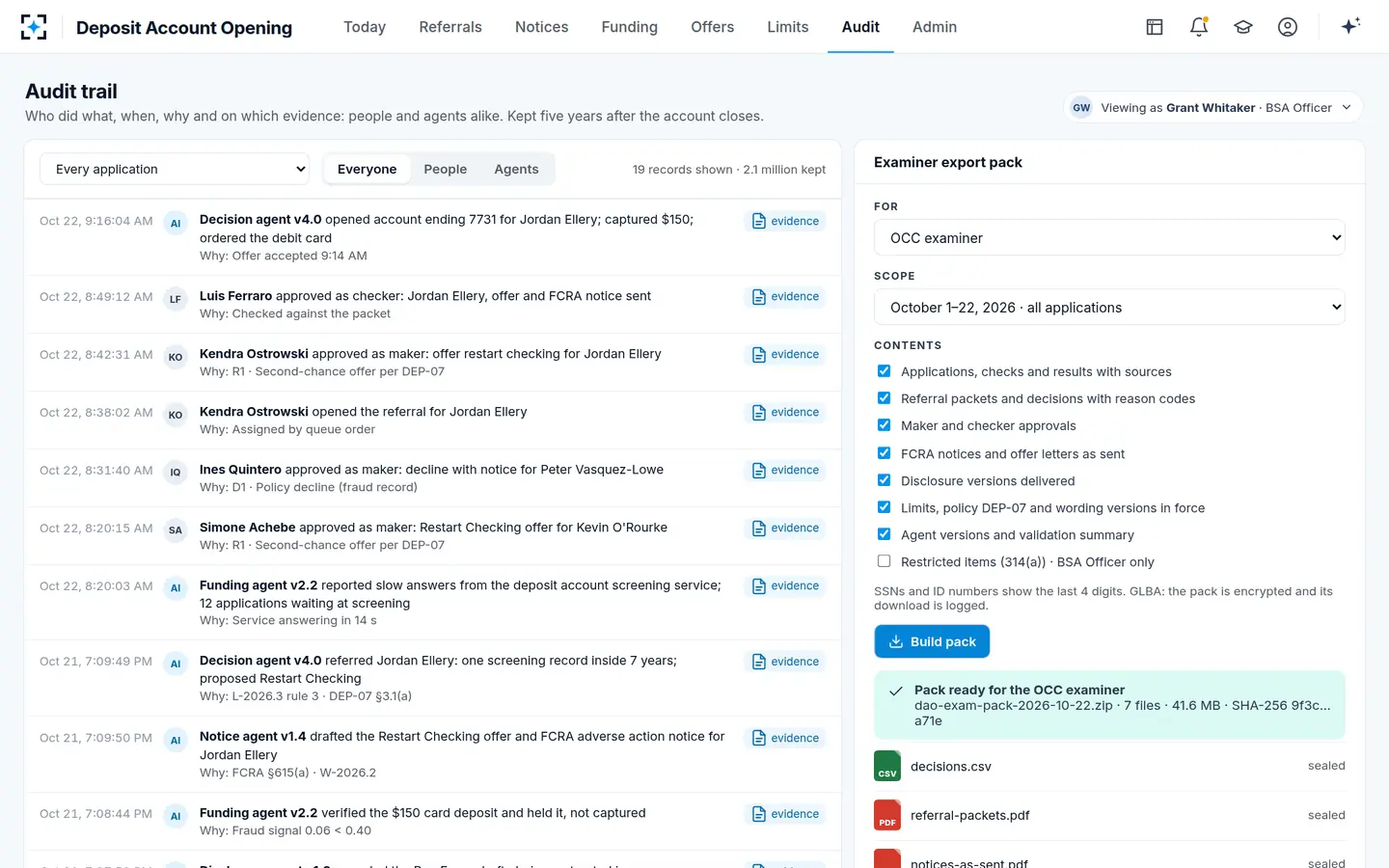
Integration also exposes the systems themselves. In the sample above, the Funding agent logged that the screening service was answering slowly, with 12 applications waiting on it, which is the kind of dependency a bank rarely sees until applicants complain. A single trail makes the vendors' performance visible alongside the bank's own.
How long does it take to implement digital account opening?
Integrating an agent layer is measured in weeks, because nothing is migrated: the work is connecting to systems that already exist, replaying past applications, and agreeing the limits. The shape below is how Deposit Account Opening is brought in; the length of each phase depends on the bank's systems and how quickly its people approve limits and wording, so read it as a shape, not a promise.
A go-live shape: replay, run beside the team, then open inside limits
- Read-only connections to platform, services and core~2 wk
- Replay 30 days of past applications; compare with decisions taken~2 wk
- Live checks and written referrals; people decide everything2–4 wk
- Limits approved by the BSA officer; wording by complianceapprove
- Clean applications open; every referral to a personlive
The replay is the step that earns the rest. Running the agents on the bank's last 30 days of applications shows, before anything is live, how many would have opened inside the proposed limits, how many of those later proved to be funding fraud, and how each referral would have been written. In the sample bank's replay of one limit change, 396 more applications would have opened over 30 days and 2 of them later proved to be funding fraud, $1,640 in all, a trade its BSA officer could weigh before approving.
Regulators have long said that trying such technology carefully is not itself a supervisory concern: the agencies' 2018 joint statement said failed pilots should not by themselves draw criticism (joint statement, 2018), and FinCEN's April 2026 proposal for AML programs, not yet final, would go further for innovation pursued responsibly (91 FR 18704). A replay on past data, followed by a period beside the team, is that care in practice.
Digital account opening system: the funding rails, where fraud shows up
The funding integration deserves its own design, because the opening deposit is where new-account fraud often becomes visible: a card in someone else's name, several applications from one device, a large amount split across cards. If the deposit is captured before the checks finish, the money has moved by the time anyone looks.
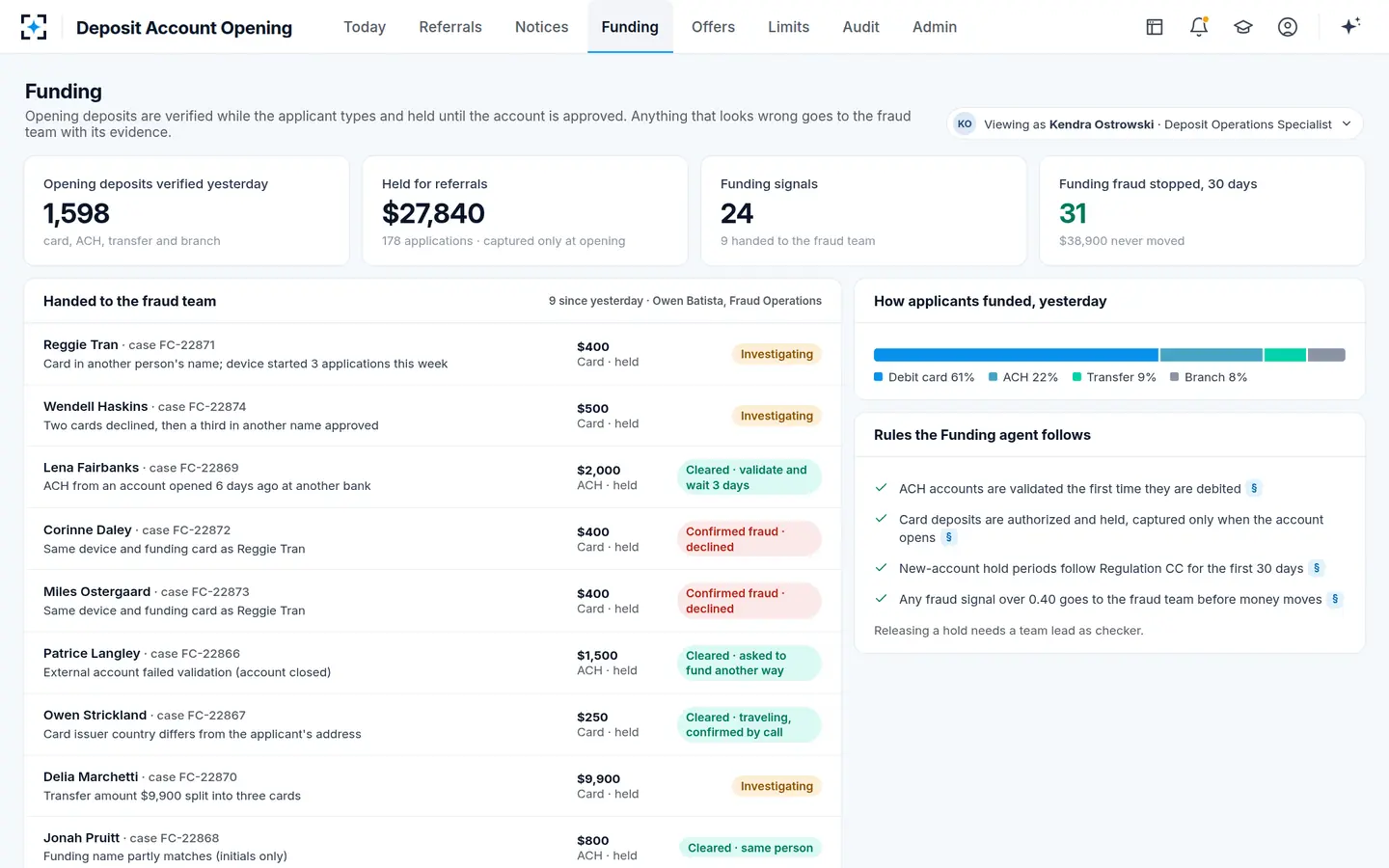
Deposit Account Opening's Funding agent verifies the card's name, address and authorization and validates an ACH account the first time it is debited, checks device and velocity while the applicant types, holds the deposit, and captures it only when the account opens. Signals over the bank's threshold go to its fraud team with the evidence, and a hold is released only with a second person. On one sample day, 1,598 opening deposits were verified, $27,840 was held for 178 referrals, and 9 of 24 funding signals went to the fraud team.
Funding verified and held, with signals handed to the fraud team before money moves
Digital account opening platforms: what to check before connecting anything
Before a bank connects an agent layer to its digital account opening platform, five properties of the existing systems decide how much of the parallel design it can use. None needs a new vendor; each is a question for the vendor the bank already has.
Does the platform expose data as it is entered, or only at submit? Checks can start at the name only if the name is available then. Do the identity and screening services return the evidence, not just a pass or fail: the document result, the match scores, the report entries? A referral can cite only what it receives. Can the card processor authorize and hold an opening deposit without capturing it, and release it on instruction? Does the core accept an account-opening call with the customer record, the product and the disclosures delivered, so nothing is re-keyed? And can restricted items be kept apart, so a 314(a) match reaches the BSA officer and nobody else?
Where an answer is no, the integration still works, with less overlap: a platform that releases data only at submit means the checks run in the seconds after submit rather than during the form. The replay on past applications shows the bank what each gap costs before it decides whether to close it.
What you bring to an integration
An integration goes as fast as the bank's own documents and access allow. Most of what is needed already exists in a bank that opens accounts today; the work is gathering it and deciding who approves what.
What a bank brings to a Deposit Account Opening integration
- Read access to the platform, identity and screening services, and the core
Through the interfaces they already offer; nothing is written until the go-live is approved.
- Thirty days or more of past applications and their outcomes
Including referrals, decisions, refusals and any later funding fraud, for the replay.
- The CIP procedures and the discrepancy rules
What counts as verified, which sources, and how each kind of mismatch is resolved.
- The screening and second-chance policy
Which entries refer, which qualify for a second-chance account, and which decline.
- Adverse action and offer wording approved by compliance
The sentences notices may use; the agents draft only from them.
- Funding limits and hold rules
Card and ACH limits, the fraud threshold, and who may release a hold.
- Named approvers
Who decides referrals, who checks, who approves limit and wording changes, and who alone sees restricted matches.
Where Deposit Account Opening fits in the stack, and where it does not
Deposit Account Opening is the layer between the systems a bank already runs for account opening: it reads the platform, the identity and screening services, the sanctions lists and the payment rails as an application arrives, applies the bank's limits, opens clean applications in the core and writes every other one up for a person. The design targets are that 89% of completed applications open inside the bank's limits and that every referral is decided the same day. The GAO found automated software already helping larger banks assign risk ratings at opening (GAO-20-574); this goes further, to the checks and the referral themselves.
It is not a core, a front-end platform, an identity or screening vendor, a sanctions system or a fraud case manager, and it does not replace any of them. A bank whose platform cannot do remote identity proofing at all may need a new platform first; one whose systems work but whose referrals are slow and inconsistent is the case it is built for. The account opening process run in parallel shows the checks in sequence, the limits matrix shows what each agent may do, and the business case by applicant value shows how to price it. To run the replay on your own applications, start from Deposit Account Opening.
Questions people ask
What is digital account opening software?
It is the software that lets customers apply for and open a deposit account online or in an app: the application, remote identity proofing, screening, electronic disclosures and consent, funding and the decision, connected to the bank's core. In practice it is usually a platform plus several services, and the quality of the connections between them decides how many applicants get through.
What is the difference between a digital account opening platform and a core banking system?
The platform runs the application and the customer's experience of it; the core is the system of record that books the account and holds the balance. The platform calls the core to open the account once a decision is made. Changing one does not require changing the other.
Can digital account opening software work with our existing identity vendor?
It should. Deposit Account Opening reads the results of the identity, screening and sanctions services a bank already uses and keeps each result with its source; it does not require new vendors. The bank's own thresholds, such as the selfie match below which an application refers, are applied to those results.
Is a digital account opening application safe for the bank's data?
The integration should give each system only the access it needs, keep restricted items such as 314(a) matches to the BSA officer, and mask identification numbers in exports. In Deposit Account Opening, examiner packs show Social Security numbers to the last four digits and are encrypted, with each download logged.
Do we need to change our CIP procedures to integrate agents?
Not the substance. The procedures still say what is collected, how it is verified and how discrepancies are resolved; the integration applies them as the data arrives and records the evidence. The bank should, however, document which steps run without a person and who decides the rest, which is good practice under its own governance now that agentic AI falls outside the agencies' 2026 model risk guidance.