If you are asking why your bank account application was denied, the answer is almost always one of three things: the bank could not verify your identity under its Customer Identification Program, a checking account report from a company such as ChexSystems or Early Warning Services showed an unpaid balance or a closed account, or the bank's own risk policy did not accept what the report showed. Each leaves a different trace, and each has a different fix. If the report played any part, federal law requires the bank to send you a notice naming the company that supplied it and telling you how to get a free copy. Botminds builds Deposit Account Opening, the software banks use to run those checks once while you apply and to write each decision, and the notice, in plain words; this guide is written for the applicant on the other side of it.
The rules quoted here come from the Fair Credit Reporting Act, the federal identity rule and the CFPB's guidance for people denied checking accounts, linked where they appear. The sample letters and screens come from a fictional bank, Corvane National Bank.
Four reasons for a denial, how to tell which one, and what to do
Your identity could not be verified
How you can tellThe bank asks for a second ID, proof of address or your SSN card, or the letter says it could not verify who you are. No reporting company is named.
What to doSend what is asked for, or apply in a branch with an unexpired photo ID. Check that your name, birth date and address match across your ID and your credit file.
Your checking account report
How you can tellThe letter names a reporting company, such as ChexSystems or Early Warning Services, and says it did not make the decision.
What to doGet the free report within 60 days, dispute anything wrong with the company and the bank that reported it, and pay or settle what is right.
The bank’s own risk policy
How you can tellThe record is accurate, but the bank’s policy refers or declines it: an unpaid balance, a recent closure, too many applications in a short time.
What to doAsk whether the bank offers a lower-risk or second-chance account, or apply where the policy fits your history.
A possible list match or a funding problem
How you can tellA hold or a request to wait, with little explanation; the funding card or account may be in another name or not verifiable.
What to doFund from an account or card in your own name. A name that resembles a sanctions listing is reviewed by a person, which takes time.
Why would a bank deny you a checking account?
A bank denies a checking account when it cannot confirm who you are, when your history suggests the account could cost it money, or when something about the application looks like fraud. The first is a legal requirement: the identity rule tells every bank to write procedures for when it will not open an account because it cannot verify the customer's identity (31 CFR 1020.220). The second and third are judgements, made under policies each bank writes for itself.
Those judgements lean heavily on one document. "Banks and credit unions typically get these reports from one of two checking account reporting companies—ChexSystems or Early Warning Services," the CFPB explains, and the reports play the role for checking accounts that the big credit bureaus play for loans (CFPB, 2016). A report can list past accounts, any negative closing balance, whether it is still unpaid, a reason code for the closure, recent inquiries from other banks, and public records.
The CFPB groups the negative entries into two kinds. Account abuse means the bank believes you did not keep to the account's terms, such as unpaid overdrafts or fees. Suspected fraud means the bank says it was intentional, such as check fraud. A denial can also follow a joint account with someone else who had either problem, which surprises applicants who never overdrew anything themselves.
Past banking problems keep people out, but they are not the main reason
13.2%
of unbanked households interested in an account cite problems with past banking or credit history
16.4%
of the same households say they lack the ID required to open an account
42.3%
of unbanked households cite not having enough money for minimum balances, the most cited reason
6%
of US adults had no checking, savings or money market account in 2025
Bank account application denied for identity: the CIP reasons
An identity denial happens when the bank cannot satisfy itself that it knows who the applicant really is, the standard the CIP rule sets. Before opening any account a bank must collect your name, date of birth, address and an identification number, and then verify them, either from documents such as a driver's license or passport, or by comparing what you gave with a consumer reporting agency, a public database or another source.
Online applications are prone to stopping at this step for a simple reason: nobody is there to ask a follow-up question. If the birth year on your license differs from the one in a credit file, or your address is a mailbox service rather than a street address, the bank's system stops and someone in its back office has to decide. The rule requires a residential or business street address for an individual, so a commercial mail-receiving address alone will not do.
The fix is usually documents, not time. Send a second ID if asked, show proof of address, or open the account in a branch with an unexpired government photo ID. If you have no Social Security number, the rules are different again: opening a bank account without a Social Security number explains which numbers and documents a bank may accept instead.
ChexSystems denial reasons, and what the report can hold
A ChexSystems or Early Warning denial means the bank read your checking account report and its policy did not accept what it found. The usual entries are an account another bank closed with money owed, often from overdrafts or fees, an account closed for suspected fraud, and a run of recent applications at other banks.
Age matters. A consumer report may not include most adverse items that are more than seven years old (15 U.S.C. 1681c(a)(5)), and the CFPB notes that some checking account reporting companies disregard information once it is five years old. Within that window, each bank draws its own lines. One may refer any entry; another may accept an old, small balance and decline only fraud.
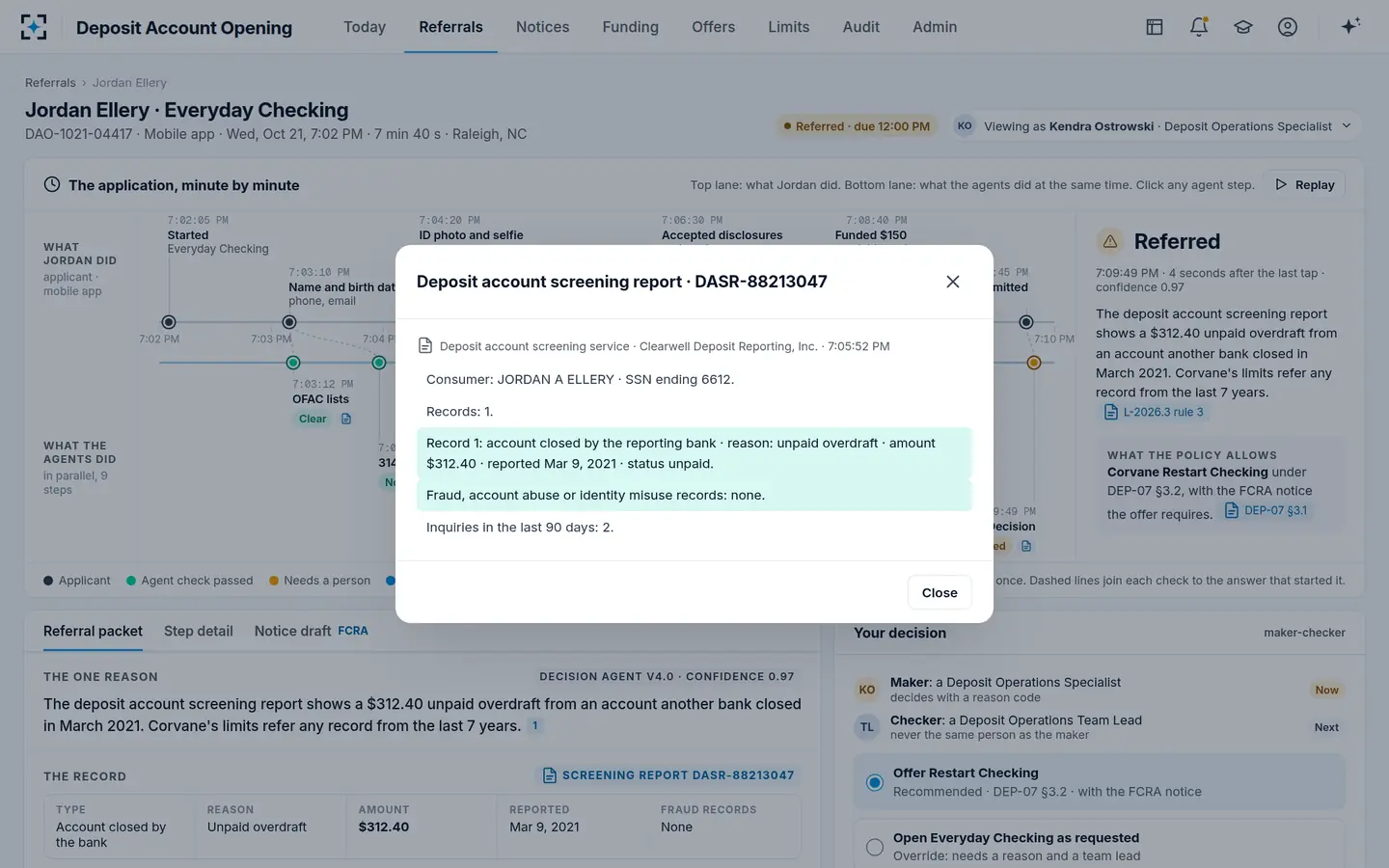
Take a sample case. Jordan Ellery, a fictional applicant, applied for Everyday Checking at the fictional Corvane National Bank on a Wednesday evening. His report showed one entry: an account another bank closed for an unpaid overdraft of $312.40, reported in March 2021, still unpaid, with no fraud or account abuse record. The bank's limits referred any entry from the last seven years, so the application went to a person, with the record attached.
What a checking account report entry looks like to the bank
What a ChexSystems denial letter must tell you
If a bank denies you an account "based in whole or in part" on information in a consumer report, the Fair Credit Reporting Act requires it to tell you so and to give you four things (15 U.S.C. 1681m(a)). The CFPB puts it in plain terms: "If a consumer is denied an account based in any part on information from a checking account reporting company, the bank or credit union must give the consumer a notice that includes the name of the reporting company."
The adverse action notice: what it must say, and what it need not
The notice must give you: The name, address and telephone number of the reporting company, with a toll-free number if it keeps files nationwide.
What it does not have to give you: The name of anyone at the bank who decided, or the internal code its system used.
The notice must give you: A statement that the reporting company did not make the decision and cannot tell you why it was made.
What it does not have to give you: A full explanation of the bank’s policy or its thresholds.
The notice must give you: Your right to a free copy of the report from that company, and the 60-day period to ask for it.
What it does not have to give you: The report itself; you request it from the company.
The notice must give you: Your right to dispute the accuracy or completeness of anything in the report with that company.
What it does not have to give you: Any promise that the bank will reconsider after a dispute.
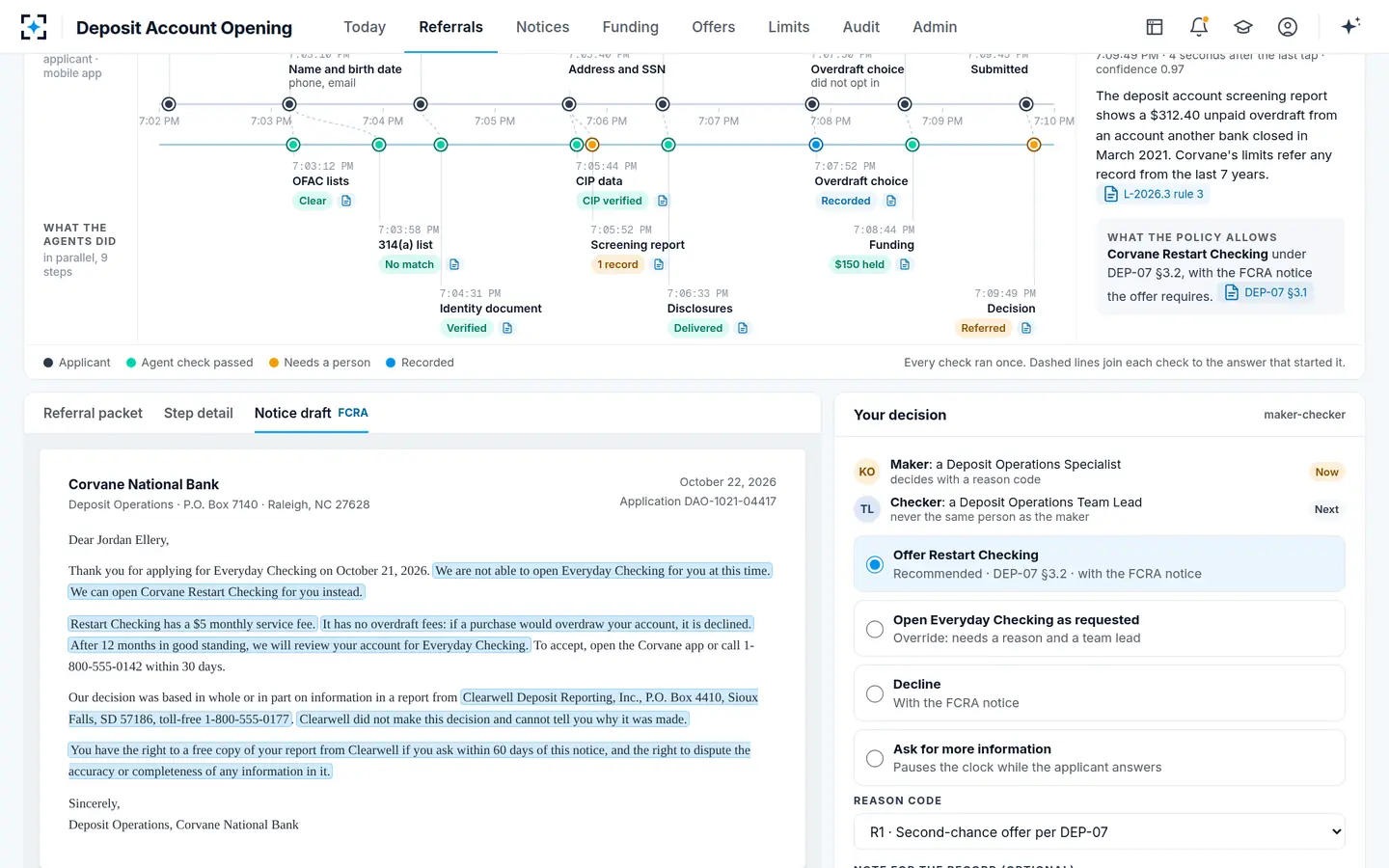
A denial is not the only adverse action. The Act's definition reaches any action "made in connection with an application" that is "adverse to the interests of the consumer" (15 U.S.C. 1681a(k)). If you applied for one account and were offered a lesser one because of your report, a careful bank treats that offer as adverse action too, and sends the same notice with it.
A second-chance offer and its notice, in the same letter
How to dispute ChexSystems, and the clock that runs
To dispute a ChexSystems or Early Warning entry, ask the reporting company for your free report, then dispute anything inaccurate or incomplete with the company in writing, and with the bank that reported it. The CFPB recommends both, and offers a sample dispute letter. If identity theft is involved, the company may ask for an identity theft report or affidavit.
The company must then reinvestigate, free of charge, and record the current status of the item or delete it, "before the end of the 30-day period" after it receives your dispute (15 U.S.C. 1681i). The period can be extended by up to 15 days if you send more information during it. You are also entitled to one free report a year from each company that keeps check-writing histories nationwide, whether or not you were denied (15 U.S.C. 1681j).
From the denial letter to a corrected report: the days the law sets
- Read the notice; note the company namedday 0
- Request your free report from that companyby day 60
- Reinvestigate the disputed item, free of charge30 days
- Extension if you send more information+15 days
An accurate entry is a different matter. A dispute removes what is wrong, not what is true. If the balance was really owed, paying or settling it changes its status from unpaid to paid, which a bank's policy may weigh differently, and the entry ages out of most reports after seven years.
Second chance banking: what it is and how it works
Second chance banking means accounts offered to people whose checking account report would otherwise lead to a denial. The CFPB describes them as "lower risk account options", typically "checking accounts and prepaid cards that are designed not to allow overdrafts", and some limit services such as paper checks (CFPB, 2016). After a period of good standing, some banks move the customer to a standard account.
Who qualifies is the bank's policy, and good policies are specific. At the fictional sample bank, an applicant qualifies when every entry is an unpaid overdraft or fee with no fraud, abuse or identity-misuse record, and the unpaid total is $500 or less reported more than 24 months ago, or $100 or less at any age. Repaying the prior bank is not a condition. Jordan's $312.40 from 2021 met that test, so he was offered Restart Checking: a $5 monthly fee, no overdraft fees because a purchase that would overdraw is declined, no paper checks, and a review for Everyday Checking after 12 months.
Who qualifies for a second-chance account is written down, and so is the wording
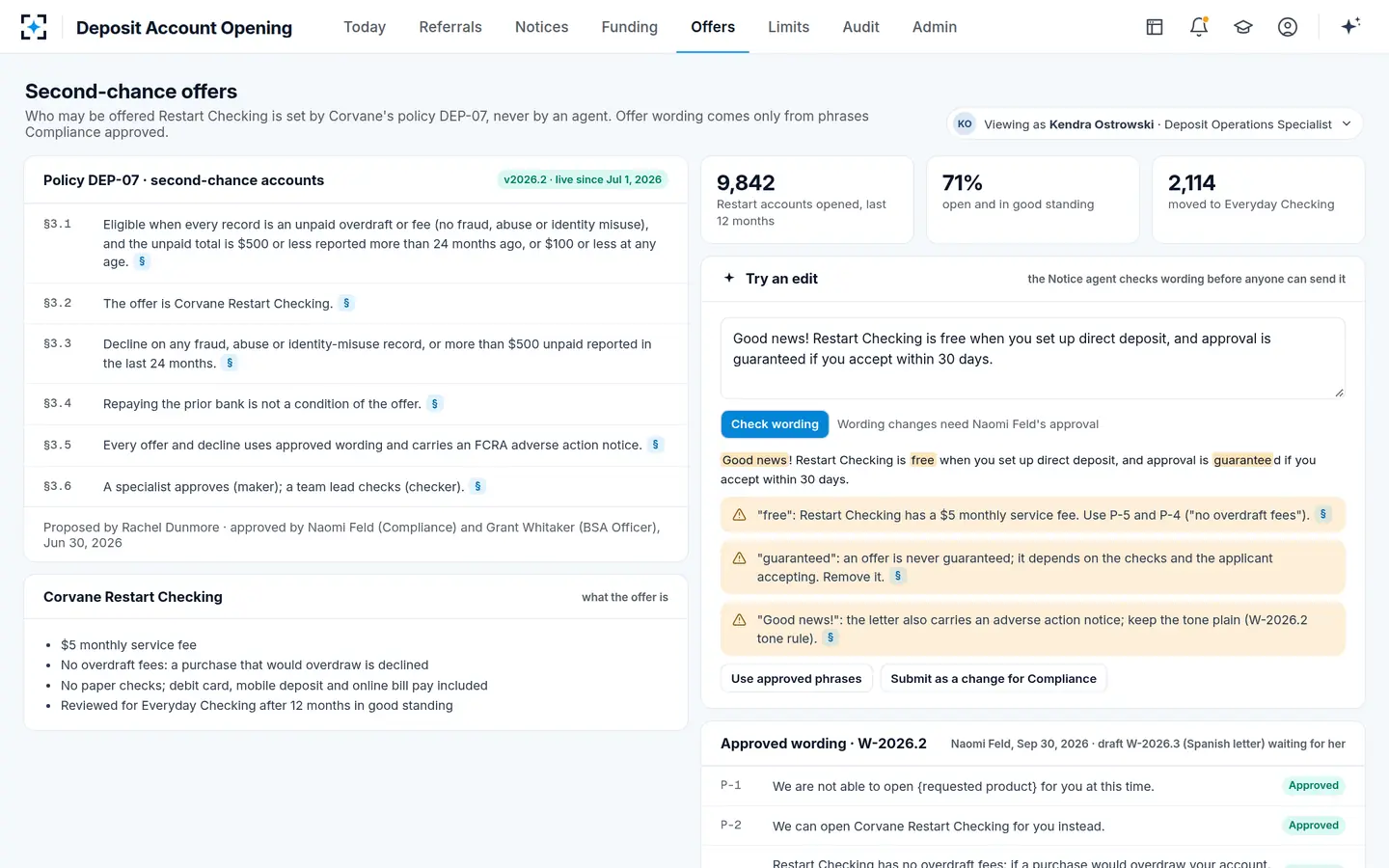
Whether the same applicant is offered a second chance should not depend on which employee happens to read the report. When it does, two applicants with the same history get different answers, which is a fair-treatment problem for the bank as well as a lost customer. Whether a bank can refuse to open an account sets out the limits on that discretion as they stand after the 2025 executive order and the 2026 rules.
What to do this week if you were denied
Start with the letter, because it tells you which of the reasons applies. A letter that names a reporting company points to the report; a request for documents points to identity; a letter that names neither may point to the bank's own policy or to a hold on the funding, and you can ask the bank which.
Five steps after a denied bank account application
- Find the notice, or ask for it
If the report played any part, the bank owes you one naming the company. It may arrive by email, in the app or by post.
- Request the free report within 60 days
From the company named, by phone, online or by post. You can also request one free report a year from each nationwide check-reporting company.
- Dispute what is wrong, in writing
With the reporting company and the bank that supplied the entry. Keep copies and note the date the company received your dispute.
- Settle what is right, if you can
A bank’s policy may weigh a paid balance differently from an unpaid one, even before it ages off the report.
- Ask about a second-chance or lower-risk account
At the same bank or another one. Check the monthly fee and whether it moves you to a standard account after a period of good standing.
Why your letter can say so little, and how banks are changing that
A denial letter can say little when the bank's systems never turned the reason into a sentence. A digital application that stops sends a refer code to a back office, and the person who reads it often has to re-run the checks to find out why. A letter written from a code rather than a reason tends to be generic, which leaves the applicant guessing which of the reasons above applies.
In Deposit Account Opening, the agents read the report against the bank's own policy while the applicant is still filling in the form, and the decision arrives with one reason. In the sample case, Jordan submitted at 7:09:45 PM, the referral was written four seconds later, and a deposit operations specialist opened it at 8:38 the next morning, read the entry itself, approved the second-chance offer with a reason code, and a team lead checked it before 8:50 AM. The notice went out with the offer, naming the reporting company and the 60-day right. Jordan accepted at 9:14 AM and the account was open and funded at 9:16 AM. The limits on what such agents may decide alone are set out separately; none of them may decline an applicant.
To see how a bank runs these decisions, start from Deposit Account Opening.
Questions people ask
Can a bank deny you an account because of ChexSystems?
Yes. Banks may use a checking account report to decide whether to open an account, and many do. If the report played any part in a denial, the Fair Credit Reporting Act requires the bank to send a notice naming the company, and you can then get a free copy within 60 days and dispute anything inaccurate.
How long does a ChexSystems record stay on your report?
Most adverse information may not be reported once it is more than seven years old, under 15 U.S.C. 1681c. The CFPB notes that some checking account reporting companies disregard information after five years. A paid balance can still appear inside that window, but marked as paid.
Why was my checking account application denied when I have good credit?
A credit score and a checking account report are different files. A bank can deny a checking account because of an unpaid overdraft or a closed account in your checking history even with a strong credit score, or because it could not verify your identity, for example when the birth date or address you gave does not match its sources.
Can I get a bank account if I owe another bank money?
Often, yes. Many banks and credit unions offer second-chance or lower-risk accounts, which the CFPB describes as accounts designed not to allow overdrafts. Some banks require the old balance to be paid first and some do not; at the fictional bank in this guide, repaying the prior bank is not a condition of the offer.
Does applying for several bank accounts hurt my chances?
It can. Checking account reports include inquiries from other banks where you applied, and a bank's policy may treat several applications in a short time as a fraud signal. If you were denied once, find out why before applying elsewhere, so the next application addresses the reason.
Is a second chance checking account the same as a prepaid card?
No, though both appear among the lower-risk options the CFPB describes. A second-chance checking account is a deposit account at a bank, usually with debit card access, no overdrafts and a monthly fee, and often a path to a standard account. A prepaid card holds money you load onto it and does not build a checking history in the same way.