A new accounts clerk job description, in the Labor Department's own words, starts with "interview customers to obtain information needed for opening accounts" and "compile information about new accounts, enter account information into computers, and file related forms" (O*NET 43-4141). The clerk, often called a new accounts representative or personal banker, is the first of four seats a checking account passes through: behind the desk sit a deposit operations specialist who works the exceptions, a team lead who checks them, and a BSA officer who owns the identity program. The hard part is not the interview but what happens after it, when an application stops for a reason nobody at the desk can see. Botminds' Deposit Account Opening runs the identity, list, screening, disclosure and funding checks once while the applicant answers, opens clean applicants inside the bank's limits, and sends every other application to a person with one reason and the action the bank's policy allows.
The pay, employment and task figures below are federal data, linked where they appear. The examples of the work behind the desk come from a fictional sample bank, Corvane National Bank, as its applications run through the solution.
A small, specialised job that is shrinking
37,900
new accounts clerks employed in the US in 2025, 97% of them in finance and insurance
−6.5%
projected change in those jobs from 2025 to 2035, to 35,500
$47,670
median annual pay in 2025, or $22.92 an hour
2,300
openings a year projected, almost all from people leaving the job
What does a new accounts clerk do?
A new accounts clerk opens deposit accounts and the services attached to them: the interview, the paperwork, the first deposit, and the explanation of what the customer is signing up for. O*NET lists fifteen tasks for the occupation. The core ones, ranked by importance, are teller duties as required, compiling and keying new account information, collecting deposits and fees, explaining how to apply for services such as debit cards and direct deposit, answering questions about deposit accounts, and interviewing customers for the information an account needs.
Read against the rules a bank works under, most of those tasks map to a specific obligation. The interview is how the bank collects the four pieces of identifying information the CIP rule requires before an account is opened. The explanation of services is where the account disclosures change hands. Even the supplemental task "obtain credit records from reporting agencies" is, in a deposit setting, the checking account report a bank reads before it decides.
The clerk's tasks, and the rule each one quietly serves
| O*NET task | What it is in a checking account opening | Rule behind it |
|---|---|---|
| Interview customers to obtain information needed for opening accounts | Name, date of birth, address and identification number, before the account opens | CIP rule, 31 CFR 1020.220(a)(2) |
| Compile information about new accounts, enter it into computers, file forms | The application, the ID images and the verification results kept on file | CIP recordkeeping, 1020.220(a)(3) |
| Inform customers of procedures for applying for services | The notice that the bank will ask for identifying information, and the account terms | CIP notice, 1020.220(a)(5); Regulation DD |
| Answer questions and explain available services | Fees, minimum balance, overdraft coverage and how to opt in or not | Regulations DD and E (overdraft opt-in) |
| Obtain credit records from reporting agencies (supplemental) | The checking account report from a company such as ChexSystems or Early Warning Services | Fair Credit Reporting Act, if it leads to a denial |
| Refer customers to appropriate bank personnel | The referral to deposit operations when anything stops the application | The bank’s own procedures |
New accounts clerk salary and outlook: the numbers
The median new accounts clerk earned $47,670 in 2025, a little above the median teller at $43,030 and well below a compliance officer at $80,730, according to the Bureau of Labor Statistics. The job usually needs a high school diploma and moderate-term on-the-job training. Employment is small, 37,900 people nationwide, and almost entirely inside banks, credit unions and other financial firms.
The outlook is a decline, but a gentle one compared with the teller line next to it. BLS projects new accounts clerks to fall 6.5% by 2035 and tellers 13.2%, a loss of 44,700 teller jobs, while compliance officers grow 3.8% and financial examiners 9.3%. The pattern is the argument of this page in miniature: the counter shrinks, and the work of checking what was collected at the counter grows.
Around the desk, the counter jobs shrink and the checking jobs grow
Why the counter shrinks is no mystery. In the FDIC's 2023 household survey, 70.5% of banked households used mobile, online or telephone banking as their main way of reaching the bank, against 28.9% who mainly used a teller or an ATM (FDIC 2023). An application typed on a phone has no clerk to interview the applicant, so the interview is now a form, and the questions the clerk used to settle face to face arrive in a back office as exceptions.
The rules the new accounts desk carries
Four federal rules shape every checking account a clerk opens, and the clerk is the person most applicants meet when each one applies. The CIP rule says the bank "must obtain, at a minimum," the name, date of birth, address and identification number before an account is opened, and must verify identity within a reasonable time, by documents, by other means, or both (31 CFR 1020.220). The same rule requires a notice to the customer before the account opens that the bank will ask for that information.
Regulation DD requires the account disclosures before an account is opened, and Regulation E bars an overdraft fee on ATM and one-time debit card transactions unless the customer has opted in after a segregated notice. The Fair Credit Reporting Act applies the moment the bank acts against an applicant because of a consumer report: the notice must name the reporting company, say that it did not make the decision, and tell the applicant of the right to a free copy of the report within 60 days and to dispute it (15 U.S.C. 1681m(a)).
None of these rules says who in the bank must do the work. That is why the seats around the desk differ from one bank to another, and why an examiner testing a bank's identity program reads the account file, not the org chart. The FFIEC's CIP procedures tell examiners to sample new accounts and, on a risk basis, to include accounts opened before verification was complete (FFIEC BSA/AML Manual).
Who reviews what the clerk collected?
In most banks a second person reviews what the front line collected, and that person is often the BSA officer. The GAO, studying eleven banks and credit unions, described the common sequence: customer service staff "such as member service representatives or personal bankers, collect required customer due diligence information", and a second person, often the BSA/AML officer, then checks it is complete and looks for warning signs (GAO-20-574; what a KYC analyst does describes that reviewer's day).
The same study put a price on it. Collecting and reviewing customer information took about 30 minutes per new consumer account, and the banks spent an average of $15 per new account on customer due diligence in 2018, from $5 to $44 depending on the bank. FinCEN's own paperwork estimate for the identity rule is two minutes per account (FinCEN, 2024). The gap between two minutes and thirty is the exceptions, the discrepancies and the second look, and it is where the other seats earn their keep.
Four seats on one checking account, before and with the agents
Today
Interviews the applicant, keys the application, explains the products and hands over the disclosures. When the platform says refer, the application leaves the desk with a code and the customer leaves with a promise.
With agents
Still meets the customer at the branch desk, where the same checks run as the applicant answers. A refer now arrives with one sentence the banker can say out loud.
Still theirs: The conversation, the product choice and the judgement about what the customer needs.
Today
Opens each referral, re-runs identity and screening in other systems to learn why it stopped, then writes the letter and the adverse action notice by hand.
With agents
Opens a referral that already states the one reason, the record behind it and the action the bank’s policy allows, and decides with a reason code.
Still theirs: Every decision on an application the bank’s limits did not clear.
Today
Checks offers and notices assembled from several screens, and watches the queue against a same-day promise.
With agents
Approves or returns what a specialist decided, with the packet and the notice side by side; the system will not let anyone check their own item.
Still theirs: The second signature, and the hold releases.
Today
Owns the CIP program, OFAC and the 314(a) searches, and assembles an examiner request from the platform, the core and the screening service by hand.
With agents
Approves limit changes after they are replayed on 30 days of applications, sees restricted matches alone, and exports an examiner pack from one audit trail.
Still theirs: The program, the limits and anything restricted.
The seat that inherits the exceptions: deposit operations
When the digital platform or the branch system cannot open an application, it sends it to deposit operations, usually as a code rather than a sentence. A specialist then re-runs the identity check, the list check and the screening report in their own systems to find out what stopped it, reads the report against the bank's second-chance policy, checks the opening deposit, and writes the letter and the adverse action notice by hand. Our estimate, for a referred application worked that way, is about fifty minutes across the specialist and the team lead.
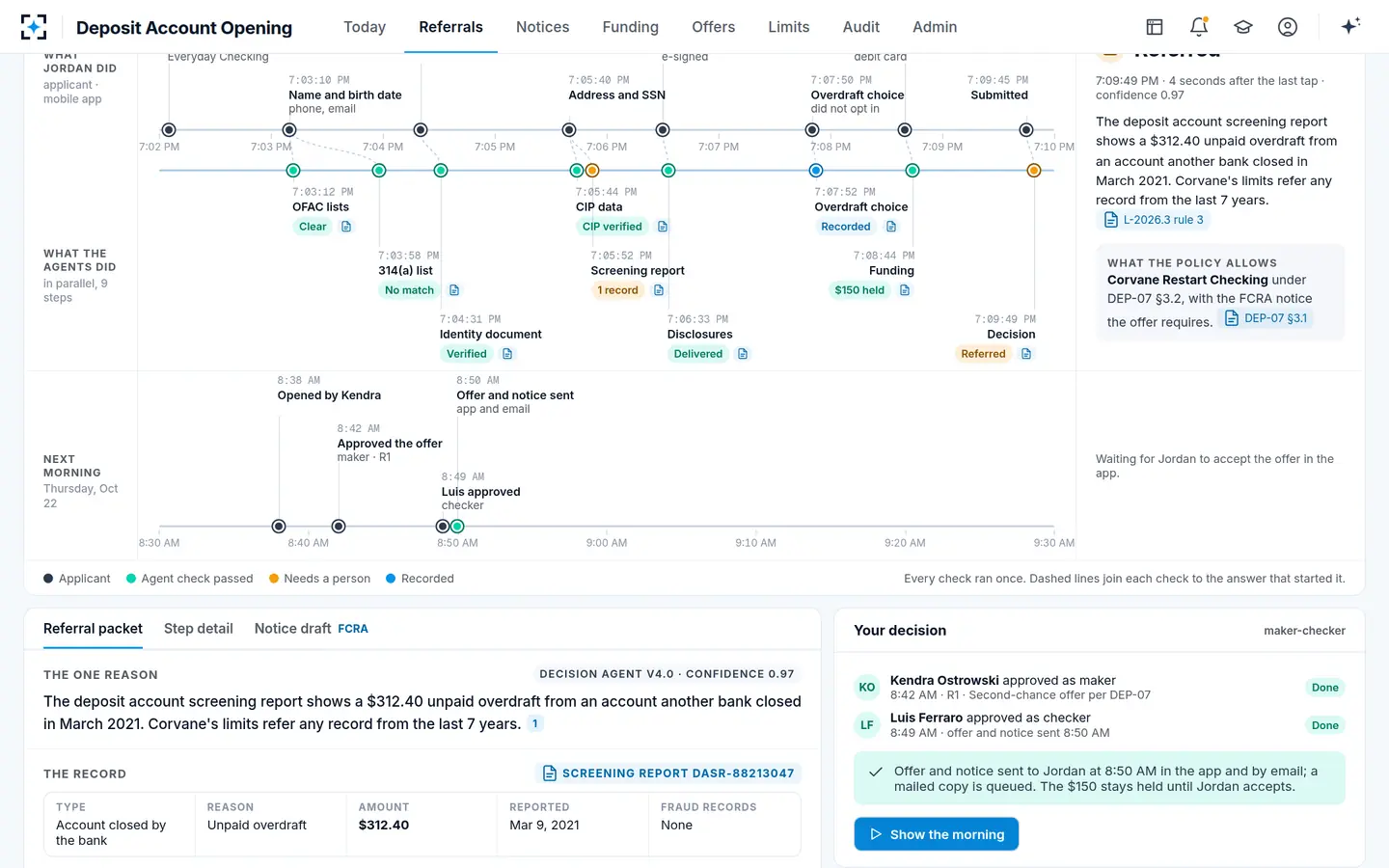
Take a sample referral as it runs through the solution. Jordan Ellery, a fictional applicant, applied for Everyday Checking on a phone at 7:02 PM and submitted at 7:09:45 PM. Four seconds later the application was referred, because his checking account report showed a $312.40 unpaid overdraft at another bank from March 2021, and the sample bank's limits refer any record from the last seven years. Kendra Ostrowski, a deposit operations specialist, opened it at 8:38 the next morning and found the reason, the record and the account the policy allows already written out.
The specialist's queue, written as sentences rather than codes
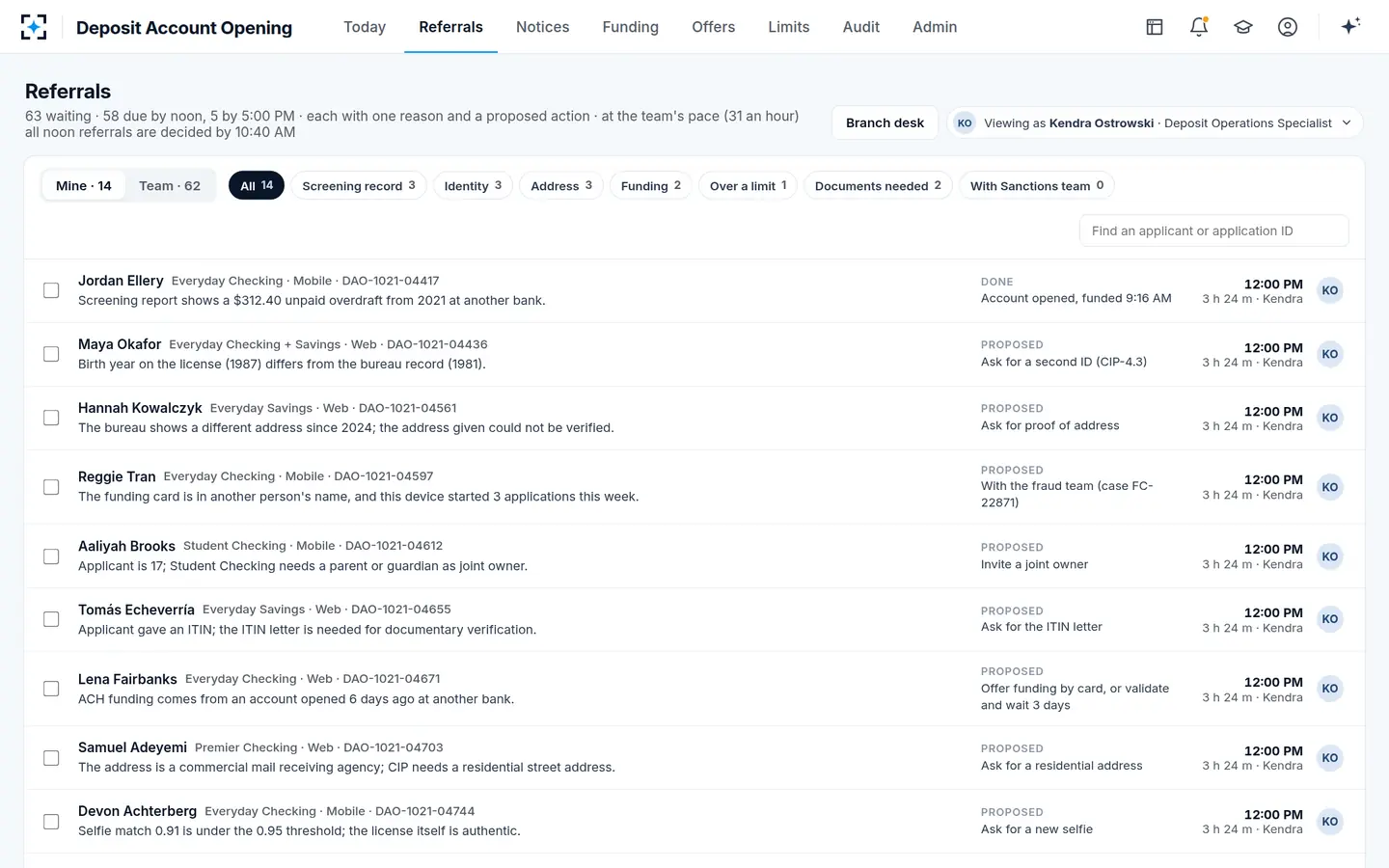
The queue is where the clerk's interview and the back office meet. Several of those rows are questions a clerk at a desk would have settled in a minute: a birth year that differs between the license and the bureau, an address that turns out to be a mail-receiving agency, a 17-year-old who needs a parent as joint owner. Online, no one asked, so the specialist does, and the speed of the whole operation depends on how quickly that seat learns why. The account opening process in banks, step by step shows which of those checks can run while the applicant is still typing.
When the account is refused: compliance's seat
A refusal is the moment the consumer compliance officer's seat matters most. If the bank declines, or offers a lesser account, based in any part on the checking account report, the Fair Credit Reporting Act requires a notice, and the CFPB's guidance for consumers tells them to ask for exactly that notice when they are turned down (CFPB, 2016). The words in that letter, and in any second-chance offer that goes with it, are the compliance officer's responsibility, whoever types them.
Two people sign every one of those letters in the solution. The specialist decides as maker with a reason code, and a team lead checks the decision and the notice side by side; the system blocks the same person from both roles. In the sample, Kendra approved a second-chance offer at 8:42 AM, Luis Ferraro checked it at 8:49 AM, and the offer and notice reached the applicant at 8:50 AM. Why a bank account application is denied, written for the applicant, shows the same letter from the other side.
A maker decides and a different checker approves the offer and the notice
Is new accounts clerk a declining job?
Yes, slowly: BLS projects a 6.5% fall in new accounts clerk jobs between 2025 and 2035, against a 13.2% fall for tellers. With 37,900 people in the occupation, that is about 2,500 fewer jobs over ten years, and most of the 2,300 openings a year will come from people retiring or moving on. The decline follows the channel: when seven in ten households bank mainly off-site, fewer applications start with an interview.
What the numbers do not show is where the work goes. The identity, screening and notice duties do not shrink when the interview moves to a form; they move to the back office, into the deposit operations specialist's queue, the team lead's checks and the BSA officer's exam file. The occupations that grow, compliance officers and financial examiners, are the ones that check that work. For someone in the job today, the durable skills are the ones that travel with it: reading a checking account report, resolving an identity discrepancy, and explaining a decision to a customer in plain words.
One checking application, from the desk to an open account
A person decides
New accounts clerk or the applicant onlineCollects name, date of birth, address and identification number before the account is opened, as the CIP rule requires, and records the product the customer wants.
Agent
Identity and list checksVerify the ID and the data on two sources, and check the name against OFAC and the 314(a) list as soon as it is typed.
Never: resolves a mismatch or clears a potential match alone.
Agent
Screening and fundingRead the checking account report against the bank’s second-chance policy and hold the opening deposit until the account is approved.
Never: declines; fraud-type records always go to a person.
A person decides
Deposit operations specialistDecides each referral with a reason code: open, offer a different account, decline, or ask the applicant for more.
A person decides
Team lead, BSA officer and complianceThe team lead checks each decision and notice before it reaches the customer; the BSA officer and compliance own the limits, the policy and the wording.
What changes at each seat when agents run the checks
When the checks run once, in parallel, while the applicant answers, the desk stops being the place where information is collected and checked by hand, and the back office stops being the place where it is checked again. In Deposit Account Opening the agents verify the ID and the data on two sources, check OFAC and the 314(a) list at the name, read the checking account report against the bank's policy, deliver the disclosures and hold the opening deposit. The bank's target is that 89% of completed applications open inside limits it sets, and that every referral is decided the same day.
The specialist's minutes move from finding out to deciding. On our estimate, the fifty minutes a referred application takes by hand fall to about seven, most of them spent reading the record and choosing. In the sample queue, 63 referrals were waiting at the start of the morning, 58 due by noon, and at the team's pace of 31 an hour every noon referral was decided by 10:40 AM.
What does not change is who decides. The agents never resolve an identity mismatch on their own, never clear a potential sanctions match, never decline, and never open a referred application without a person's approval. Account opening automation, agent by agent sets out those limits in full, and the roles screen below shows how the bank assigns them.
Who may decide, check, release a hold or change a limit
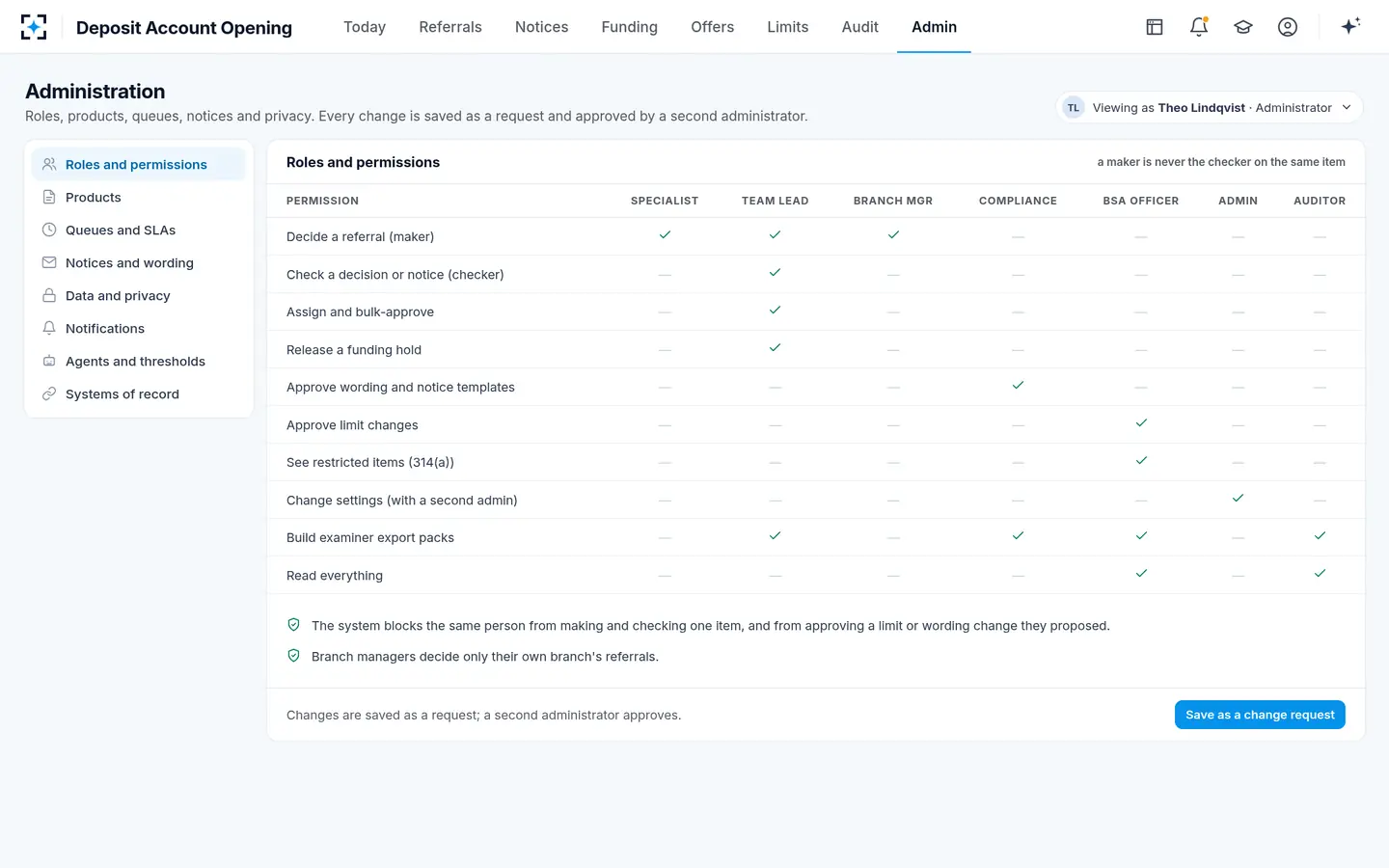
For the branch, the change is mostly felt at the desk. A personal banker opening an account face to face sees the same checks as the online applicant, in the same order, and a referral comes back as a sentence the banker can say to the customer: the bureau has a different birth year, so we need a second ID. To see the whole process on one application, start from Deposit Account Opening.
Questions people ask
What is a new accounts clerk?
A new accounts clerk is the bank or credit union employee who opens deposit accounts: interviewing the customer, collecting identifying information, keying the account and explaining its terms. BLS classifies the job as occupation 43-4141, with 37,900 people employed in 2025. Banks often use other titles for the same seat, such as new accounts representative, personal banker or member service representative.
What is the difference between a new accounts clerk and a teller?
A teller handles transactions on existing accounts, cashing checks and taking deposits, and verifies the customer's identity before each one. A new accounts clerk opens the account in the first place, and O*NET lists "perform teller duties as required" as one of the clerk's tasks, so the two often share a counter. Tellers are the larger group, 339,200 jobs in 2025, and the faster-shrinking one.
How much does a new accounts representative make?
The BLS median for new accounts clerks was $47,670 a year in 2025, or $22.92 an hour. Pay varies by state and employer, and personal banker roles that add sales goals or lending often pay differently from the clerk occupation. The figures cover all industries, though 97% of the jobs are in finance and insurance.
What skills does a new accounts clerk need?
The core skills are interviewing, accurate data entry and explaining products plainly, and BLS lists a high school diploma with moderate-term on-the-job training as the usual entry path. Increasingly the valuable skills are the ones the back office uses: reading a checking account report, spotting a discrepancy between an ID and the bureau's data, and knowing which disclosures go out before the account opens.
Who reviews a new account after the clerk opens it?
Usually a second person, often the BSA officer at smaller banks, reviews the information for completeness and risk, as the GAO found across eleven institutions. Larger banks add a deposit operations team that works exceptions, and examiners later sample new accounts, including ones opened with incomplete verification. In Deposit Account Opening every referral has a maker and a different checker.
Do new accounts clerks check ChexSystems?
The clerk or the account opening system usually pulls a checking account report from ChexSystems or Early Warning Services, the two companies the CFPB names. What happens next is set by the bank's policy, not by the clerk alone. If the report leads to a denial or a lesser account, the bank owes the applicant an adverse action notice naming the company.